
How to Choose a UAV Propeller for Heavy Lift: Thrust, Efficiency, and Load Factors
Publication Date
author
How to Choose a UAV Propeller for Heavy Lift: Thrust, Efficiency, and Load Factors
Selecting the right uav propeller for heavy lift is not a matter of bigger diameter alone. For technical evaluators, the real decision depends on thrust margin, efficiency under sustained load, motor-matching behavior, and structural reliability across demanding flight profiles. This guide examines the engineering trade-offs that determine whether a propeller can deliver stable payload performance, lower energy loss, and predictable safety margins in commercial heavy-lift UAV operations.
The first mistake in heavy-lift propeller selection is to treat the propeller as an isolated component. In practice, the propeller only makes sense inside a propulsion system: motor KV, voltage, ESC current headroom, airframe geometry, payload profile, and flight duty cycle all shape whether a given rotor is appropriate. A propeller that produces impressive static thrust on a bench may still be a poor choice if it drives the motor into an inefficient operating region, creates poor control authority at partial throttle, or imposes unacceptable mechanical loads during repeated takeoff and descent cycles.
That is why experienced teams rarely ask, “Which propeller gives the highest thrust?” The better question is, “Which propeller gives enough thrust, at acceptable electrical and structural cost, across the full mission envelope?” For agricultural spray drones, cargo multirotors, tethered inspection platforms, and industrial logistics UAVs, the answer is rarely the same.
What Heavy Lift Really Changes
A heavy-lift platform operates closer to the limits of its propulsion system for longer periods. That sounds obvious, but it changes the selection logic. On a light multirotor, the propeller may spend much of its time in a comfortable mid-throttle region with short bursts of demand. On a heavy-lift UAV, climb-out, hover with payload, crosswind station-keeping, and low-altitude maneuvering can all keep the propeller under sustained aerodynamic and torsional loading. The consequence is that efficiency, blade stiffness, thermal behavior, and vibration control matter more than peak thrust numbers on a datasheet.
Thrust margin is the starting point. A propulsion system should not be selected around a barely sufficient hover condition. If the aircraft only hovers near the upper end of throttle under nominal payload, it leaves little reserve for gust response, battery voltage sag, altitude effects, or minor weight growth during program evolution. Technical evaluators usually look for a comfortable gap between required hover thrust and maximum available thrust, but the exact margin depends on mission criticality, control architecture, and operating environment. There is no universal ratio that fits every platform, and that is precisely why simplistic buying guides tend to mislead.
Diameter Helps, but It Is Not the Whole Story
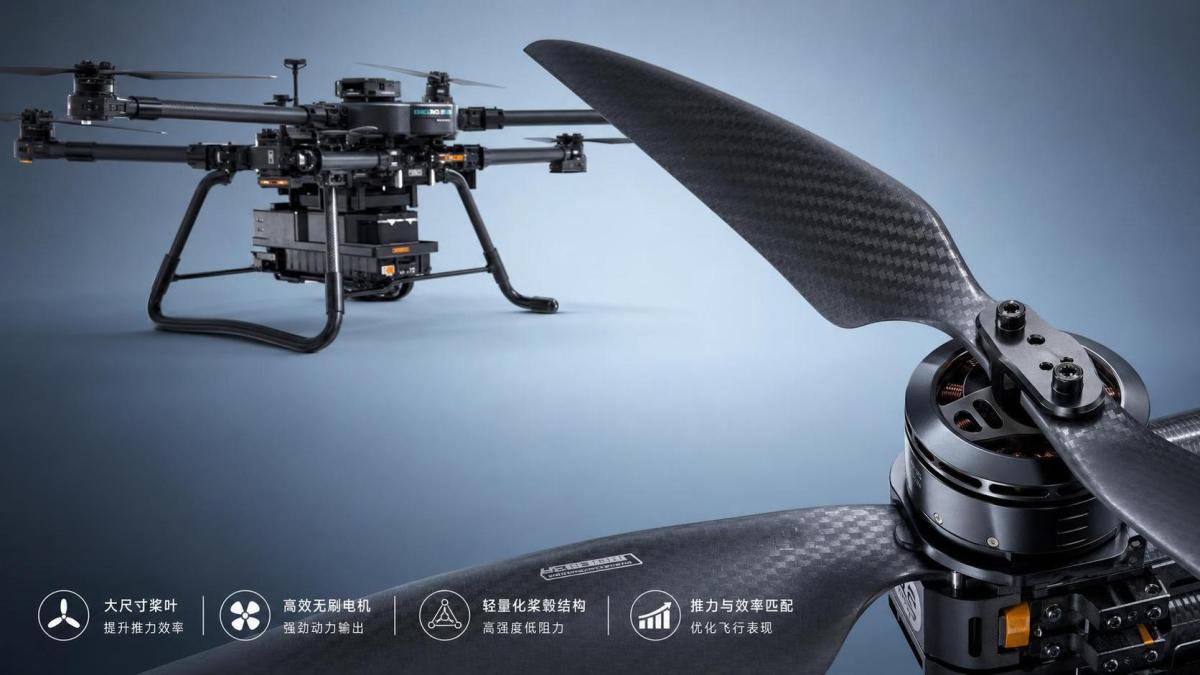
Larger diameter propellers generally improve thrust production efficiency because they accelerate a larger mass of air with less induced loss. For heavy-lift missions, this is often directionally correct: lower disc loading usually means better hover efficiency and lower power required per unit of lift. But a larger propeller also raises integration constraints. Arm length, ground clearance, transport envelope, blade tip speed, and inter-rotor aerodynamic interference become more demanding as diameter grows.
Pitch complicates the picture further. Higher pitch can increase forward-flight performance and alter the motor load curve, but it also raises torque demand and may reduce low-speed efficiency if the system is not matched carefully. In heavy-lift multirotors that spend substantial time hovering or flying slow mission segments, chasing aggressive pitch values can be counterproductive. The better propeller is often the one that keeps the motor in a more efficient current band while preserving stable control response, not the one with the most aggressive geometric specification.
Blade count deserves the same caution. More blades can be useful where diameter is constrained and additional disc area must be approximated within packaging limits. They can also change acoustic signature and loading characteristics. But additional blades usually increase profile drag and may reduce efficiency compared with a well-sized two-blade solution, assuming space allows it. For heavy-lift airframes with tight mechanical layouts, the decision often becomes a system compromise rather than a purely aerodynamic preference.
Why Static Thrust Data Is Necessary but Incomplete
Static thrust testing is useful because it provides a comparable baseline, especially during early screening. It can reveal whether a propeller-motor pair is even in the right class for the intended payload. Yet static data alone should never close the selection. Heavy-lift UAVs do not operate only in ideal, sea-level, zero-wind, fresh-battery hover. They operate with battery sag, repeated thermal cycling, sometimes at altitude, often with payloads that alter center of gravity and control behavior.
A propeller that tests well in static conditions may create excessive current draw during transient throttle changes, or may lose efficiency once motor temperature rises and electrical losses accumulate. This is where bench testing should expand beyond thrust and current to include vibration trends, thermal stability, throttle linearity, and repeatability across multiple samples. For procurement and qualification work, repeatability is not a side note. It is a direct indicator of manufacturing consistency.
Load Factors Are Not Just About Weight
In heavy-lift UAV discussions, “load” is often used as shorthand for payload mass. That is too narrow. The propeller sees a combination of aerodynamic, inertial, and structural loads. Rapid throttle transitions, hard braking in descent, gust rejection, rotor wake interaction, and even folding-blade hinge behavior can all influence stress on the blade root and hub interface. A propeller that appears acceptable in nominal hover may reveal weakness during repeated mission cycles, especially where operational tempo is high.
Material choice matters here, but not in a simplistic “carbon fiber is always better” sense. Carbon fiber propellers are often preferred for heavy-lift platforms because higher stiffness can preserve blade geometry under load and reduce aerodynamic inconsistency. That can support more predictable thrust and lower deformation at high torque. At the same time, stiffness changes the vibration and impact behavior of the assembly. The right question is whether the blade construction, hub design, and manufacturing quality are appropriate for the mission profile, maintenance practice, and expected service life.
Where vendors provide fatigue, balance, or material data, evaluators should examine test conditions closely. Terms such as “high strength” or “industrial grade” are not engineering evidence. What matters is whether the available information helps estimate durability under actual rotational speed, temperature variation, and load cycling. In the absence of transparent data, incoming inspection and controlled endurance testing become much more important.
Motor Matching Is Where Good Selections Often Fail
Many poor propulsion choices come from evaluating the propeller and motor separately. A heavy-lift propeller with too much inertia can degrade response even if it produces adequate thrust. A motor with insufficient torque reserve may spin the propeller, but only at the cost of high current, elevated temperatures, and weak transient control. For aircraft carrying expensive sensors, liquid payloads, or variable cargo, that mismatch becomes an operational risk rather than a lab inconvenience.
This is why advanced teams look at more than maximum thrust. They map the expected hover throttle, climb power, burst current, and thermal ceiling together. They also ask whether the ESC and power distribution architecture can tolerate the real current profile, not just the nominal one. Heavy-lift propulsion systems tend to punish optimistic assumptions quickly.
Common Misreadings in Supplier Comparisons
One common misunderstanding is to compare propellers only by published diameter and pitch. Those values do not capture airfoil design, blade planform, root stiffness, manufacturing tolerance, or balance quality. Two propellers with similar nominal dimensions can behave very differently in current draw, vibration, and sustained thrust consistency.
Another mistake is to assume that the highest efficiency point on a test sheet matches the intended mission. It may not. A delivery drone carrying a near-constant payload in hover-centric operation has a different optimization target than a mapping UAV with longer forward-flight legs. The right propeller is the one that performs well where the aircraft actually spends time, not where the chart looks most attractive.
There is also a procurement-side blind spot: replacement consistency. For heavy-lift fleets, the issue is not just whether one sample performs well, but whether replacement blades from the same supplier behave consistently enough to preserve tuning, vibration limits, and maintenance intervals. In data-driven sourcing, this is often where apparently similar vendors separate.
A Practical Selection Path
A disciplined evaluation process usually starts with the mission, not the catalog. Define takeoff mass range, payload variation, hover percentage, climb requirement, ambient temperature range, and expected operating altitude. From there, narrow the propeller class that can support adequate thrust margin with reasonable disc loading. Only then does it make sense to compare pitch, blade count, materials, and supplier data.
Shortlisted candidates should then be tested as system combinations. At minimum, that means measuring thrust, power draw, response, vibration, and thermal behavior under representative voltage and loading conditions. For platforms intended for repetitive commercial use, endurance exposure and maintenance inspection criteria should be part of qualification, because field reliability often turns on small structural or manufacturing details that static performance tables do not reveal.
For organizations building supplier benchmarks or drafting technical specifications, the useful mindset is simple: do not buy a claim, buy a verified operating envelope. That approach is consistent with the broader hard-tech sourcing discipline now shaping aerospace and UAV procurement. Parameters matter, but only when they are tied to real operating conditions, measurement methods, and repeatable results.
In the end, choosing a uav propeller for heavy lift is less about finding the “largest” or “strongest” blade and more about identifying the most defensible engineering match. A propeller is acceptable when it can carry the required mass with measurable thrust reserve, predictable electrical demand, manageable thermal behavior, and structural confidence over time. Anything less may still fly. It just may not fly in a way a serious technical evaluator can trust.
Search News
Hot Articles
- Carbon Fiber StructuresHow to Specify Aerospace Carbon Fiber Assemblies for Lightweight, Load-Bearing PartsJul 11, 2026
- Machine VisionXiaomi, Alibaba DAMO Academy Drive Open-Source Robotics Model Ecosystem, Lowering Algorithm Development Barriers for Overseas SMEs Adopting Chinese Robotics SolutionsMar 30, 2026
- Cobots & ArmsShanxi 'AI+' Conference Showcases Embodied Intelligence with Multinational Buyer Engagement: Key Industry ImplicationsMar 30, 2026
Popular Tags
Recommended News
 Jul 11, 2026How to Specify Aerospace Carbon Fiber Assemblies for Lightweight, Load-Bearing PartsAerospace carbon fiber assemblies: learn how to specify laminate design, load data, joining methods, and inspection controls for lighter, reliable load-bearing aerospace parts.Elena Rostova (UAV Systems Researcher)
 Mar 30, 2026Xiaomi, Alibaba DAMO Academy Drive Open-Source Robotics Model Ecosystem, Lowering Algorithm Development Barriers for Overseas SMEs Adopting Chinese Robotics SolutionsXiaomi & Alibaba DAMO Academy's open-source robotics models lower algorithm barriers for global SMEs. Boost efficiency in manufacturing, logistics & smart retail with ROS 2 compatible solutions.TSV Data Lab
 Mar 30, 2026Shanxi 'AI+' Conference Showcases Embodied Intelligence with Multinational Buyer Engagement: Key Industry ImplicationsShanxi 'AI+' Conference highlights embodied intelligence with Tesla, Ubtech & Jiantao showcasing multimodal robotics. 40+ global buyers validated tech on-site, creating new B2B channels for industrial automation & AI solutions.Chen Wei (Automation Lead Engineer)
 Mar 30, 2026Zhongguancun Unveils 6G Integrated Sensing-Computing-Intelligence Platform to Empower Embodied Robots for Global Industrial ApplicationsZhongguancun's new 6G platform revolutionizes industrial robotics with <10ms latency, empowering global automotive, logistics & port automation. Discover how this tech boosts China's smart manufacturing exports.TSV Data Lab
 Mar 30, 2026Mech-Mind Tianjin Embodied Intelligence R&D and Production Base Goes Live, Cutting Delivery Time by 20%–30% for Global Customized AMR+Vision SolutionsMech-Mind's Tianjin AMR+Vision production base cuts delivery time by 20%-30% for欧美 & Latin American markets. Discover how this PLd-certified facility accelerates customized robotics solutions for smart manufacturing and logistics.Chen Wei (Automation Lead Engineer)
 Mar 30, 2026Boao Forum Reveals 'Co-evolution of Big and Small Brains' Trend in Humanoid Robots, China's Embodied Intelligence Accelerates Adaptation to Overseas Manufacturing Service ScenariosDiscover how China's humanoid robots, featuring 'Co-evolution of Big and Small Brains,' are revolutionizing global manufacturing. Learn about Embodied Tian Gong 3.0's ISO compliance and overseas deployment at Boao Forum 2026.Chen Wei (Automation Lead Engineer)
 Mar 30, 2026China Railway Industrial Secures Patent for Embodied Robotics in Material Handling, Boosting High-Precision Delivery Capabilities for Overseas Infrastructure and Manufacturing ProjectsChina Railway Industrial's new patent for embodied robotics in material handling boosts high-precision delivery for global infrastructure & manufacturing. Discover how this innovation enhances logistics accuracy in automotive, rail transit & EPC projects.Chen Wei (Automation Lead Engineer)
 Oct 26, 2026AMAXiMAL Releases Open-Source TopMod 3D v3 With Claude AIExplore AMAXiMAL’s free, open-source TopMod 3D v3 with Claude AI assistance, topology-based modeling and plywood fabrication tools that connect complex designs to physical builds.Dr. Marcus Vance
 Oct 26, 2026Choosing a SCADA System Integrator Company: PLC Compatibility and Long-Term SupportChoose a scada system integrator company with proven PLC compatibility and reliable long-term support. Discover what to test, compare, and require before investing.Victor Lin (Chief Software Architect)
 Oct 25, 2026Hesai Leads Global ADAS Main Lidar Shipments in Yole’s 2026 ReportHesai led global ADAS main lidar shipments with a 43% share in 2025, according to Yole’s 2026 report. Explore what this ranking reveals about its automotive market position.TSV Data Lab
 Oct 25, 2026Choosing an Aerospace Materials Manufacturer: Quality and Traceability ChecksChoosing an aerospace materials manufacturer? Learn how to verify certifications, test reports, and lot traceability to qualify suppliers confidently and reduce costly sourcing risks.Dr. Marcus Vance
 Oct 24, 2026Guotai Haitong: Global Entry-Level 3D Printer Shipments Rose 39% in Q1 2026Entry-level 3D printer shipments rose 39% in Q1 2026, Guotai Haitong reports. Explore how AI, multicolor printing and print farms are shaping market growth.Dr. Marcus Vance
 Oct 24, 2026Choosing an Industrial Vision Inspection Supplier: Acceptance Tests That MatterChoose an industrial vision inspection supplier with confidence. Discover acceptance tests for defect detection, false rejects, production speed, and reliable part rejection before you buy.TSV Data Lab
 Oct 23, 2026US Navy Raises Gecko Robotics Contract Ceiling to $300M for Robotic Fleet MaintenanceUS Navy raises Gecko Robotics’ contract ceiling to $300M for Pacific Fleet robotic inspections. Explore potential opportunities for maintenance suppliers and key procurement considerations.Chen Wei (Automation Lead Engineer)
 Oct 23, 2026Choosing Industrial Sensing Systems for Global Plants: Protocol CompatibilityCompare industrial sensing systems international buyers can trust. Explore protocol compatibility, reduce integration risks, and select proven configurations for reliable global plant deployments.TSV Data Lab
 Oct 22, 2026KUKA Showcases Physical AI and iiQKA.AI Vision at NVIDIA GTC BerlinExplore KUKA’s Physical AI showcase at NVIDIA GTC Berlin and discover how iiQKA.AI Vision aims to simplify robotic vision integration and improve 2D and 3D scene recognition.TSV Data Lab
 Oct 22, 2026Robotic Machining of Advanced Composites: What Tolerances Are Achievable?Explore advanced materials machining robotics: discover what drives achievable composite tolerances and how to validate accuracy before investing in your next machining system.Dr. Marcus Vance
 Oct 21, 2026China’s Industrial Robot Exports Near RMB 10 Billion in First Nine Months of 2026China’s industrial robot exports neared RMB 10 billion in January–September 2026, with value rising faster than volume. Explore the data and what it could mean for suppliers.Chen Wei (Automation Lead Engineer)
 Oct 21, 2026Low-Latency Industrial Data Processing: Pricing and Key Cost DriversExplore industrial data latency price drivers, from edge hardware to integration and support. Learn how to compare quotes, verify performance, and avoid unnecessary costs.TSV Data Lab
 Oct 20, 2026KUKA Launches iiQKA.AI Vision to Simplify Industrial Image ProcessingKUKA iiQKA.AI Vision simplifies industrial image processing with controller-based 2D and 3D vision. Explore drag-and-drop setup for vision-guided automation.TSV Data Lab
 Oct 20, 2026Smart Industrial Edge Devices: Key Criteria for Legacy PLC IntegrationChoose smart industrial edge devices for legacy PLC integration. Discover key criteria for compatibility, data quality, security, and reliable collection without disrupting control.TSV Data Lab
 Oct 19, 2026Choosing a Radar Sensor by Application: Range, Resolution, and Field of ViewSimplify radar sensor application based product selection. Compare range, resolution, and field of view to avoid blind spots and choose with confidence. Explore the guide.TSV Data Lab
 Oct 18, 2026Comparing Material Options for Procurement: Specs, Costs, and Supply RisksExplore procurement oriented technical content on material options, specs, costs, and supply risks. Compare alternatives to cut hidden expenses and make confident sourcing decisions.Dr. Marcus Vance
 Oct 17, 20265-Axis CNC Positioning Accuracy: How to Interpret ISO 230-2 Test ResultsAssess 5 axis CNC machining positioning accuracy with ISO 230-2. Learn to interpret repeatability, reversal error, and test conditions to compare suppliers and make confident acceptance decisions.Dr. Marcus Vance























