How to Choose Smart Hotel Room Controls for Energy Savings and Guest Comfort
Publication Date
author
Smart hotel room controls sit at the intersection of building automation, guest experience, and operating margin. For hospitality assets under pressure to reduce energy intensity, they are no longer decorative technology. They are a practical control layer that links occupancy, HVAC, lighting, shading, and room status into one measurable system.
That shift matters because energy prices remain volatile, sustainability reporting is stricter, and guest expectations are less forgiving. A room that feels intuitive, quiet, and comfortable can support brand value. A room that overheats, misreads occupancy, or forces manual overrides can erase the promised savings.
In that context, choosing smart hotel room controls should be treated as an engineering decision, not a showroom decision. The strongest evaluations rely on verifiable specifications, integration logic, sensing accuracy, and lifecycle data. That approach aligns closely with the TSV principle that parameters matter more than promotional language.
What smart hotel room controls actually include
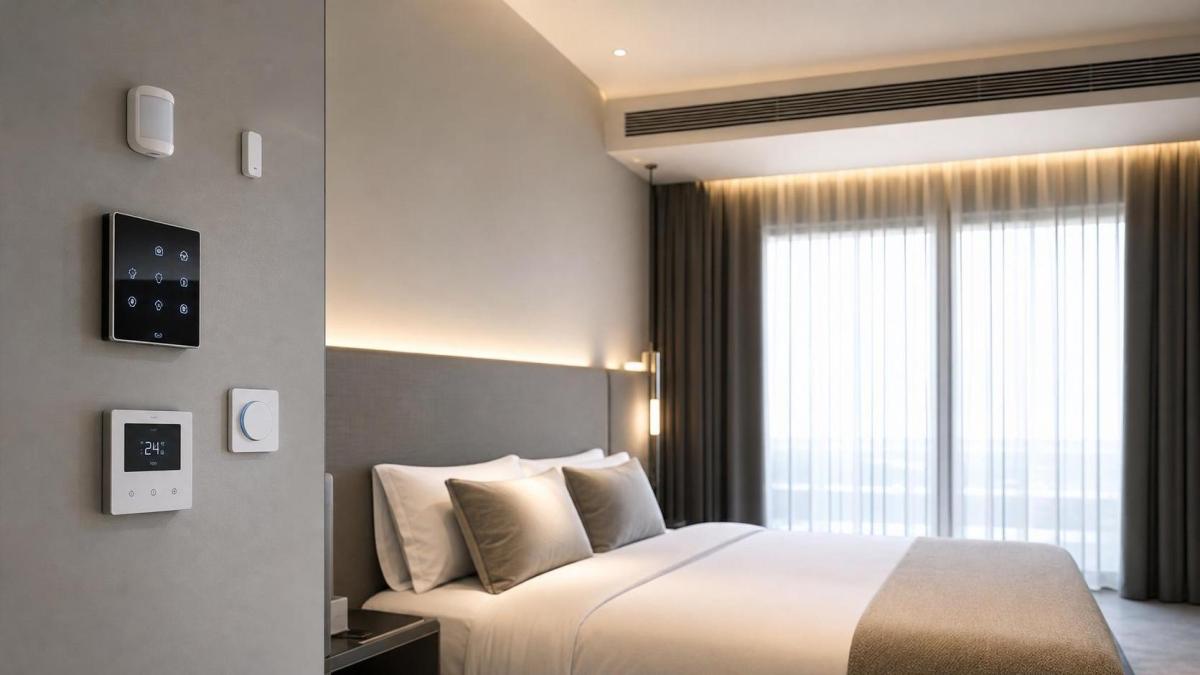
The visual focus is the guest room, but the system reaches much further.
Most smart hotel room controls combine several functions. They usually connect thermostats, occupancy sensors, door contacts, lighting scenes, blackout curtains, bedside panels, and a gateway to the property management or building management platform.
Simple versions only automate lights and temperature setbacks. More advanced versions coordinate room status, housekeeping logic, demand-based ventilation, and remote diagnostics. The difference between those tiers has a direct effect on savings, maintenance workload, and guest comfort.
A useful way to view smart hotel room controls is as a room-level decision engine. It senses conditions, applies programmed rules, and sends commands to equipment. The value comes from how reliably those decisions match real occupancy and real comfort needs.
Why the market now pays closer attention
The hospitality sector has moved beyond basic energy conservation messaging. Owners and operators want proof that room automation reduces kilowatt-hours without generating complaints, truck rolls, or integration disputes.
This is where information noise becomes a problem. Many vendors highlight app interfaces or design finishes, yet understate sensor blind spots, protocol limitations, commissioning complexity, or failure rates under heavy occupancy cycles.
A data-first view is more useful. Borrowing from TSV’s broader philosophy, the relevant questions are specific. How quickly does the occupancy logic respond. What setback range is allowed. Which BACnet, KNX, Modbus, or Zigbee profiles are supported. How much local control remains when the network is down.
Hotels are also under pressure to modernize older buildings. In retrofits, smart hotel room controls must work around legacy fan coil units, mixed wiring conditions, and inconsistent insulation levels. In new builds, the challenge is different: avoiding overengineered systems that add cost but not measurable performance.
The core decision is not interface design but control quality
A polished wall panel does not guarantee a strong control strategy. The deeper issue is whether the platform makes room conditions more predictable.
Occupancy detection must be credible
False vacancy is one of the fastest ways to damage guest experience. If the room reduces cooling while someone is sleeping or working quietly, the automation becomes a liability.
For that reason, smart hotel room controls should be assessed on sensor type, placement logic, timeout settings, and the ability to fuse multiple signals. Door events, motion, thermostat interaction, and curtain use often create a more accurate picture than one passive sensor alone.
HVAC optimization should be transparent
Energy savings usually come from temperature setbacks, staged conditioning before check-in, and reduced runtime during vacancy. Those strategies work only when the recovery time is short and the comfort band is realistic for the property type.
Luxury hotels, airport hotels, resorts, and limited-service brands do not share the same tolerance for room recovery delays. A useful vendor proposal should model that difference rather than promise a generic savings percentage.
Interoperability reduces long-term risk
The best smart hotel room controls do not trap a property inside one closed ecosystem. They integrate with PMS, BMS, access control, and sometimes demand response programs without expensive custom middleware.
Open and well-documented integration pathways matter because hotels renovate in phases. The room control strategy chosen today may need to coexist later with new chillers, lighting upgrades, or ESG reporting tools.
How to compare solutions with less guesswork
A structured comparison helps separate operational value from marketing claims. The table below highlights practical evaluation dimensions.
This type of matrix is useful because it converts a subjective buying process into a specification-driven one. That is especially important when several vendors appear similar on the surface.
Typical deployment scenarios change the right answer
Not every property needs the same architecture for smart hotel room controls. The right fit depends on building age, room count, staffing model, and positioning.
- A new urban hotel may prioritize deep PMS integration, centralized analytics, and scene-based lighting control.
- A retrofit project may value wireless deployment, minimal wall damage, and compatibility with existing HVAC terminals.
- A resort may focus on balcony door logic, humidity management, and occupancy-linked ventilation.
- An extended-stay property may need comfort rules that tolerate longer in-room periods without aggressive setbacks.
In practical terms, the same smart hotel room controls platform can perform very differently depending on how its logic is tuned. Procurement decisions should therefore examine both hardware capability and commissioning methodology.
The hidden costs that weaken ROI
The headline promise is lower utility spend, yet several hidden factors determine whether that promise survives deployment.
One is installation complexity. If a room must be taken offline for too long, the revenue impact can offset part of the energy gain. Another is calibration drift. Sensors and thermostatic logic that are not validated over time may quietly reduce system performance.
Cybersecurity also deserves attention. Smart hotel room controls increasingly connect through gateways, cloud dashboards, and mobile tools. Hotels should ask about firmware updates, credential policies, encrypted communications, and network segmentation.
Then there is supplier transparency. TSV’s broader hard-tech perspective is relevant here: claims should be tied to test conditions. Savings percentages without occupancy assumptions, climate context, or baseline methodology are not strong evidence.
What a stronger evaluation process looks like
A disciplined selection process usually starts with room-level realities, not vendor brochures. Map the room types, HVAC equipment, control pain points, and expected guest profile. Then define success metrics before reviewing proposals.
Useful metrics often include energy reduction by occupied and vacant room state, average comfort recovery time, override frequency, maintenance incidents, and integration uptime. These measurements make smart hotel room controls easier to compare over a pilot period.
It also helps to request a sample control sequence. That document reveals how the system behaves when a guest enters, sleeps, opens a balcony door, checks out, or loses connectivity. Behavior under edge cases often tells more than a polished demo.
Reference checks should go beyond asking whether the client is satisfied. Ask how long commissioning took, how many comfort complaints emerged in the first months, and whether actual savings matched modeled expectations.
A practical next step for better decisions
The best path forward is to create a short technical scorecard before any shortlist is finalized. Include occupancy sensing logic, HVAC integration depth, interoperability, offline resilience, reporting quality, and serviceability. That will keep smart hotel room controls aligned with operating outcomes rather than visual appeal.
For organizations following a data-led sourcing model, the aim is not simply to buy automation. It is to establish a control standard that improves comfort while reducing waste under real conditions. In that sense, the most valuable system is the one that can be measured, verified, and trusted long after installation.
When the next comparison begins, start with the parameters that shape room behavior. The right decision usually becomes clearer once the conversation moves from features to evidence.
Search News
Hot Articles
- Carbon Fiber StructuresHow to Specify Aerospace Carbon Fiber Assemblies for Lightweight, Load-Bearing PartsJul 11, 2026
- Machine VisionXiaomi, Alibaba DAMO Academy Drive Open-Source Robotics Model Ecosystem, Lowering Algorithm Development Barriers for Overseas SMEs Adopting Chinese Robotics SolutionsMar 30, 2026
- Cobots & ArmsShanxi 'AI+' Conference Showcases Embodied Intelligence with Multinational Buyer Engagement: Key Industry ImplicationsMar 30, 2026
Popular Tags
Recommended News
 Jul 11, 2026How to Specify Aerospace Carbon Fiber Assemblies for Lightweight, Load-Bearing PartsAerospace carbon fiber assemblies: learn how to specify laminate design, load data, joining methods, and inspection controls for lighter, reliable load-bearing aerospace parts.Elena Rostova (UAV Systems Researcher)
 Mar 30, 2026Xiaomi, Alibaba DAMO Academy Drive Open-Source Robotics Model Ecosystem, Lowering Algorithm Development Barriers for Overseas SMEs Adopting Chinese Robotics SolutionsXiaomi & Alibaba DAMO Academy's open-source robotics models lower algorithm barriers for global SMEs. Boost efficiency in manufacturing, logistics & smart retail with ROS 2 compatible solutions.TSV Data Lab
 Mar 30, 2026Shanxi 'AI+' Conference Showcases Embodied Intelligence with Multinational Buyer Engagement: Key Industry ImplicationsShanxi 'AI+' Conference highlights embodied intelligence with Tesla, Ubtech & Jiantao showcasing multimodal robotics. 40+ global buyers validated tech on-site, creating new B2B channels for industrial automation & AI solutions.Chen Wei (Automation Lead Engineer)
 Mar 30, 2026Zhongguancun Unveils 6G Integrated Sensing-Computing-Intelligence Platform to Empower Embodied Robots for Global Industrial ApplicationsZhongguancun's new 6G platform revolutionizes industrial robotics with <10ms latency, empowering global automotive, logistics & port automation. Discover how this tech boosts China's smart manufacturing exports.TSV Data Lab
 Mar 30, 2026Mech-Mind Tianjin Embodied Intelligence R&D and Production Base Goes Live, Cutting Delivery Time by 20%–30% for Global Customized AMR+Vision SolutionsMech-Mind's Tianjin AMR+Vision production base cuts delivery time by 20%-30% for欧美 & Latin American markets. Discover how this PLd-certified facility accelerates customized robotics solutions for smart manufacturing and logistics.Chen Wei (Automation Lead Engineer)
 Mar 30, 2026Boao Forum Reveals 'Co-evolution of Big and Small Brains' Trend in Humanoid Robots, China's Embodied Intelligence Accelerates Adaptation to Overseas Manufacturing Service ScenariosDiscover how China's humanoid robots, featuring 'Co-evolution of Big and Small Brains,' are revolutionizing global manufacturing. Learn about Embodied Tian Gong 3.0's ISO compliance and overseas deployment at Boao Forum 2026.Chen Wei (Automation Lead Engineer)
 Mar 30, 2026China Railway Industrial Secures Patent for Embodied Robotics in Material Handling, Boosting High-Precision Delivery Capabilities for Overseas Infrastructure and Manufacturing ProjectsChina Railway Industrial's new patent for embodied robotics in material handling boosts high-precision delivery for global infrastructure & manufacturing. Discover how this innovation enhances logistics accuracy in automotive, rail transit & EPC projects.Chen Wei (Automation Lead Engineer)
 Sep 19, 2026How to Scope Automation Integration Services for Multi-System Factory ProjectsAutomation integration services: learn how to scope multi-system factory projects with clear workflows, interface contracts, safety boundaries, and acceptance criteria.Victor Lin (Chief Software Architect)
 Sep 18, 2026Selecting UAV Aerospace Structural Parts for Strength, Weight, and Fatigue LifeUAV aerospace structural parts guide: compare strength, weight, stiffness, fatigue life, joints, and traceability to select reliable flight-ready components.Elena Rostova (UAV Systems Researcher)
 Sep 17, 2026Selecting Commercial Drone Payloads for European Inspection ProjectsCommercial drone payloads Europe: learn how to select RGB, thermal and LiDAR systems for compliant, reliable inspection data and better project outcomes.Elena Rostova (UAV Systems Researcher)
 Sep 16, 2026Machining Tolerance Validation: How to Verify Critical Dimensions Before Production ReleaseMachining tolerance analysis validation: verify critical dimensions, measurement systems, process capability, and tolerance stacks before production release.Dr. Marcus Vance
 Sep 15, 2026AGV Tape Guidance vs Laser Navigation: Which Fits Your Warehouse Layout?AGV tape guidance comparison: discover how tape and laser navigation fit changing warehouse layouts, docking needs, floor conditions, maintenance, and route flexibility.Chen Wei (Automation Lead Engineer)
 Sep 14, 2026How Point Cloud Analytics Improves Asset Inspection Workflows Across GCC ProjectsPoint cloud analytics GCC helps project leaders improve asset inspections with accurate change detection, safer workflows, and faster maintenance decisions.TSV Data Lab
 Sep 13, 2026How Aerospace Manufacturers Can Build a Digital Thread From Design to Certified ProductionDigital manufacturing for aerospace: learn how to build a traceable digital thread from design through certified production, supplier control, and audit-ready compliance.Victor Lin (Chief Software Architect)
 Sep 12, 2026How to Select a Thermal Sensor for Mapping Drones in Surveying ProjectsMapping drone thermal sensor selection made simple: compare GSD, radiometric data, NETD, calibration, and workflow fit for accurate, survey-ready thermal maps.Elena Rostova (UAV Systems Researcher)
 Sep 11, 2026Integrating Photogrammetry Workflows into Digital Twin Projects Without Data BottlenecksPhotogrammetry workflow integration for digital twins: learn how to streamline capture, validation, versioning, and delivery to prevent data bottlenecks.Victor Lin (Chief Software Architect)
 Sep 10, 2026Hard-Tech Supply Chain Procurement: Qualifying Suppliers to Cut Lead-Time RiskHard-tech supply chain procurement guide: qualify suppliers with proven process, traceability, capacity, and change control to reduce lead-time risk.Chen Wei (Automation Lead Engineer)
 Sep 09, 2026Industrial Application Notes: Cost Factors That Shape Automation Project BudgetsIndustrial application notes cost factors explained: uncover the engineering, safety, integration, and commissioning variables that shape accurate automation budgets.Victor Lin (Chief Software Architect)
 Sep 08, 2026Supplier Discovery for Sourcing: How Buyers Can Verify Capability and Supply RiskSupplier discovery for sourcing: learn how to verify supplier capability, traceability, quote assumptions, and supply risk before placing production orders.TSV Data Lab
 Sep 07, 2026What Determines Process Control Systems Pricing? A Buyer’s Cost GuideProcess control systems pricing explained: compare hardware, engineering, integration, cybersecurity, validation, and lifecycle costs to choose the right-value solution.Victor Lin (Chief Software Architect)
 Sep 07, 2026AMR Robots in ASEAN: Which Industries Are Adopting Them—and Why?AMR robots ASEAN adoption is accelerating in electronics, automotive, warehousing, healthcare, and cold chain. Explore use cases, risks, and deployment insights.Chen Wei (Automation Lead Engineer)
 Sep 05, 2026How to Evaluate Supplier Qualification Support Tools for Industrial Procurement TeamsSupplier qualification support tools help industrial procurement teams verify technical evidence, manage risk, and make defensible supplier approvals. Learn what to evaluate.Victor Lin (Chief Software Architect)
 Sep 04, 2026Grinding Tolerance Analysis: How to Set Realistic Limits for Precision PartsGrinding tolerance analysis explains how to set realistic limits for precision parts, balance fit, geometry, process capability, and inspection for reliable performance.Dr. Marcus Vance
 Sep 03, 2026Warehouse Automation Strategies to Increase Storage Capacity Without ExpansionWarehouse automation space saving strategies help unlock vertical capacity, optimize slotting, and improve storage density without costly building expansion.Victor Lin (Chief Software Architect)