
Drone Propeller Manufacturer: Common Buying Mistakes
Publication Date
author
Choosing the right drone propeller manufacturer is not just about price—it affects flight efficiency, durability, and operational safety. Buyers comparing custom aerospace structural parts, carbon fiber tube for aerospace, or a fixed wing uav supplier often overlook critical factors such as material consistency, balance tolerance, and test data. This guide highlights the most common buying mistakes to help procurement teams, operators, and decision-makers source with greater confidence.
In commercial UAV programs, the propeller is often treated as a replaceable accessory rather than a flight-critical component. That is a costly assumption. A propeller mismatch can reduce endurance by 5%–15%, increase motor load, amplify vibration, and shorten bearing life long before the aircraft reaches its published service interval.
For B2B buyers, the challenge is not simply finding a drone propeller manufacturer with a competitive quotation. The real challenge is filtering technical noise and identifying suppliers that can support repeatable production, traceable materials, stable tolerances, and application-specific engineering support across mapping, inspection, agriculture, logistics, and fixed-wing platforms.
At TechStat Vanguard, the emphasis is always on measurable engineering truth. When evaluating propeller sourcing, that means focusing on dimensional repeatability, dynamic balance, fatigue resistance, process control, and qualification data instead of vague claims about “premium quality” or “high performance.”
Why Buyers Misjudge Drone Propeller Manufacturers
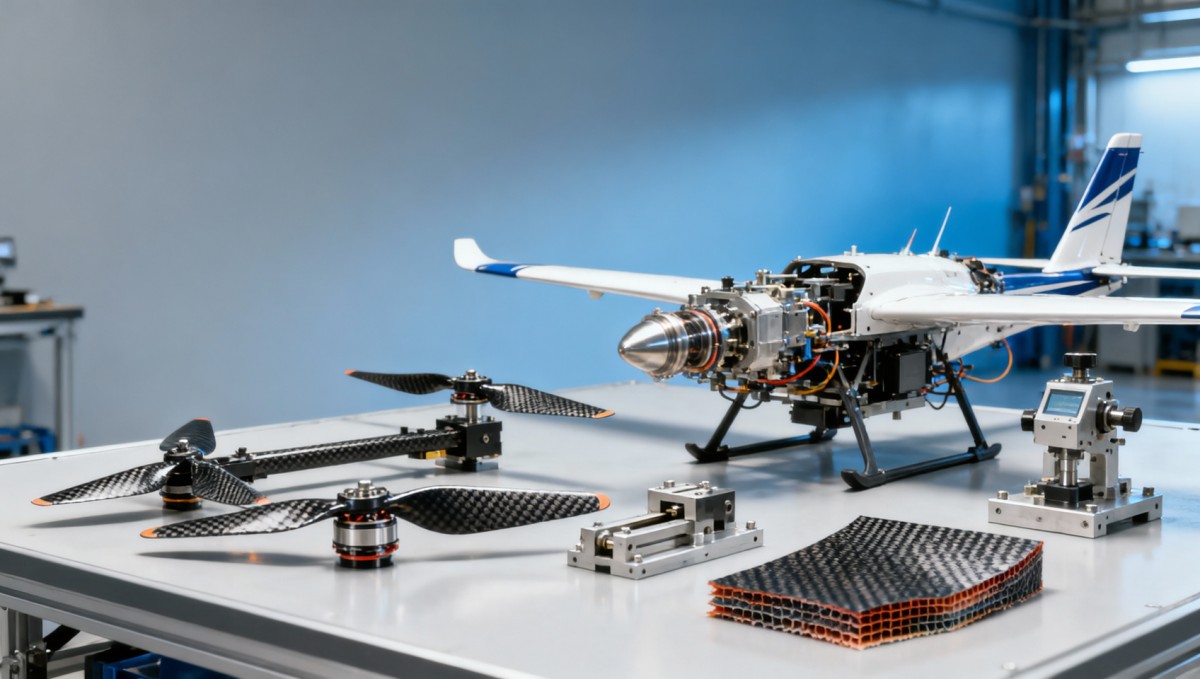
Many sourcing teams enter the market with a basic checklist: diameter, pitch, unit price, and lead time. While those factors matter, they rarely capture the engineering variables that determine whether a propeller will perform consistently over 100, 300, or 500 flight hours. In UAV operations, small deviations can create disproportionate downstream costs.
A common error is assuming all carbon fiber or composite propellers in the same size range behave similarly. In reality, two 28-inch propellers with identical catalog dimensions may differ in stiffness, root strength, resin content, laminate orientation, and mass distribution. Those differences affect thrust curve stability, current draw, and vibration signatures under varying RPM ranges.
Another issue is role confusion inside the buying process. Operators often care most about field reliability and replacement frequency. Procurement focuses on landed cost and supply continuity. Engineering teams care about test data and integration fit. If these three groups do not align, manufacturers with polished brochures can win over suppliers with stronger technical control.
This is especially relevant when the buyer is also sourcing related aerospace components such as carbon fiber tube for aerospace assemblies or custom aerospace structural parts. A weak propeller supplier can disrupt the performance of an otherwise capable airframe, particularly in multi-rotor heavy-lift or fixed wing uav supplier ecosystems where aerodynamic efficiency must remain predictable across batches.
The gap between catalog claims and field reality
Catalog sheets usually summarize nominal dimensions, recommended motor range, and material type. What they often omit is far more important: allowable mass deviation per blade, balance threshold, maximum continuous RPM, fatigue test cycle count, and environmental limits such as -10°C to 50°C or high-humidity operation. Without these, buyers compare appearances instead of engineering performance.
A reliable drone propeller manufacturer should be able to explain not just what the product is, but how it behaves under load. That includes data from static thrust tests, vibration screening, hub integrity evaluation, and consistency checks across multiple production lots rather than a single showcase sample.
Common organizational blind spots
- Selecting by MOQ alone, without asking how tolerances are held from the first 50 units to the next 5,000 units.
- Approving prototypes after limited bench testing, then assuming mass production quality will match sample quality.
- Ignoring integration data with ESC, motor KV, payload mass, and operating altitude.
- Accepting “balanced before shipment” as a claim without defining acceptable imbalance thresholds.
The Most Common Buying Mistakes and Their Operational Cost
The biggest purchasing mistakes usually start with incomplete evaluation criteria. A lower-cost propeller that fails after 80 cycles, requires frequent field balancing, or causes unstable motor behavior can quickly erase any initial savings. In fleet operations, replacement labor, downtime, and mission interruption often cost more than the component itself.
Mistake one is over-prioritizing price per pair instead of cost per flight hour. If one propeller set costs 18% less but lasts 40% fewer cycles, the cheaper option is not actually cheaper. This matters for agricultural UAVs with high daily utilization and for inspection fleets where mission delays can impact service contracts.
Mistake two is failing to verify material consistency. When a manufacturer cannot provide clear information about fiber type, layup process, resin system, or dimensional control, buyers take on unnecessary risk. Even within composite categories, void content, cure stability, and blade root reinforcement can vary significantly between factories.
Mistake three is neglecting tolerance and balance data. Propeller imbalance can lead to elevated vibration, which affects flight controller stability, camera payload image quality, connector fatigue, and motor lifespan. For mapping and ISR platforms, even small vibration increases can degrade data collection quality over long missions.
A practical comparison of high-risk buying errors
The table below shows how common sourcing mistakes translate into engineering and operational consequences. The exact numbers vary by platform, but these ranges are useful for procurement screening and supplier qualification.
The key takeaway is simple: the wrong drone propeller manufacturer does not just create a parts problem. It creates an airframe, powertrain, maintenance, and mission-reliability problem that compounds across the full program lifecycle.
Mistakes buyers should flag early
- No defined acceptance criteria for blade weight matching, runout, or hub concentricity.
- No environmental test discussion for rain exposure, UV exposure, or thermal cycling.
- No spare-part continuity plan for 12–24 months after initial procurement.
- No process for failure analysis if cracks, delamination, or root wear are found in service.
What Technical Data a Serious Manufacturer Should Provide
A dependable drone propeller manufacturer should support procurement with more than a drawing and a quotation. Buyers should expect measurable documentation that helps engineering, QA, and operations teams verify whether the part is suitable for the intended mission envelope.
At minimum, request dimensional tolerance ranges, weight tolerance, material declaration, recommended operating RPM, and balancing method. For demanding UAV programs, especially heavy-lift, BVLOS, mapping, or long-endurance fixed-wing systems, buyers should also ask for fatigue testing logic, traceability of production lots, and process control records.
This level of rigor aligns with how advanced buyers evaluate other airframe elements such as carbon fiber tube for aerospace structures or custom aerospace structural parts. A propeller should not be exempt from the same data discipline, because aerodynamic components directly affect safety, efficiency, and mission predictability.
If a supplier cannot explain how a 1 mm geometry variation or a 2 g mass deviation may influence vibration and thrust consistency, the buyer should treat that as a warning sign. Strong suppliers understand the connection between process capability and aircraft-level performance.
Core data points to request during qualification
The following table can be used as a practical qualification checklist. It helps cross-functional teams compare manufacturers using measurable criteria rather than presentation quality or sales responsiveness alone.
When suppliers can provide these data points clearly, qualification becomes faster and less subjective. It also shortens the supplier screening cycle, often from several rounds of follow-up questions to one structured technical review with engineering and procurement stakeholders present.
Useful thresholds to discuss during review
- Prototype lead time: often 2–4 weeks depending on tooling and surface finish.
- Production lead time: commonly 4–8 weeks for repeat orders, subject to material availability.
- Sampling quantity: 5–20 sets is typical for cross-checking lot consistency before scale-up.
- Validation scope: include bench thrust tests, flight tests, and post-flight inspection over at least 20–50 cycles.
How to Evaluate a Manufacturer Beyond the Quotation Sheet
The strongest buying decisions combine technical validation with supply chain discipline. A quotation may look attractive, but buyers should also evaluate production maturity, communication quality, documentation responsiveness, and the supplier’s ability to support engineering changes without disrupting delivery.
This matters even more when the same sourcing program includes a fixed wing uav supplier, structural composites, propulsion hardware, and integration parts. A propeller manufacturer must fit into a wider system-level procurement model where tolerances, revisions, shipping windows, and replacement planning are aligned across vendors.
For procurement teams, the right approach is to build a weighted scorecard. Price may account for 20%–30% of the decision, but repeatability, documentation, field support, and quality controls should often carry greater combined weight. For mission-critical fleets, risk-adjusted value matters more than nominal cost.
For operators and technical teams, field feedback should be formalized. Issues such as vibration at specific throttle bands, edge chipping after transport, or root stress marks after high-temperature operations should feed back into supplier evaluation rather than remain anecdotal comments in maintenance logs.
A practical 5-step selection workflow
- Define the mission profile: payload, flight time target, altitude, cruise RPM, and environmental range.
- Request technical documents: drawings, tolerance notes, material declaration, and test summaries.
- Conduct sample validation: compare at least 2–3 suppliers under the same bench and flight conditions.
- Audit production readiness: confirm lot traceability, inspection steps, and change-control process.
- Approve a controlled first batch: monitor early field performance before full-scale procurement.
Signs of a mature supplier relationship
A credible drone propeller manufacturer usually responds with clarifying questions rather than immediate blanket assurances. They ask about thrust targets, air density conditions, blade-folding requirements, operating RPM band, and the expected service environment. That behavior indicates engineering engagement, not just transactional selling.
Mature suppliers also define how nonconforming parts are handled, how revision updates are communicated, and how replacement timelines work if field defects appear. These practical details are often more valuable than promotional claims, especially for enterprise users running repeat procurement cycles every quarter or every season.
FAQ for Procurement Teams, Operators, and Decision-Makers
The final stage of supplier comparison often comes down to a few recurring questions. The answers below reflect common decision points in UAV sourcing programs and can help teams reduce ambiguity before issuing RFQs or approving pilot orders.
How many samples should a buyer test before approving a supplier?
For early qualification, 5–10 sets may be enough for basic fit and performance checks. For serious fleet deployment, 10–20 sets across one or two production lots is more informative. The goal is not only to verify one good sample, but to understand whether the manufacturer can hold consistency from unit to unit and batch to batch.
What matters more: carbon fiber material or balancing quality?
Both matter, and separating them is a mistake. Strong material properties without stable balancing can still produce vibration and bearing wear. Good balancing with poor laminate quality can still lead to premature fatigue damage. Buyers should assess material traceability, structural quality, and balance control as a combined package rather than isolated talking points.
What is a reasonable lead time expectation?
For standard items, 2–4 weeks may be achievable. For custom geometry, special hubs, or integrated development with custom aerospace structural parts, 4–8 weeks is a more realistic planning range. If tooling changes, special coatings, or new validation are required, buyers should allow additional time for approval and inspection.
Should one supplier handle propellers and other aerospace composite parts?
Not always, but there are advantages if the supplier has proven competency across related components such as carbon fiber tube for aerospace assemblies. Shared process discipline, traceability logic, and composite manufacturing knowledge can improve coordination. However, buyers should still qualify each product family independently, because airframe tubes and propellers face very different load patterns and performance requirements.
Final procurement checklist
- Confirm technical fit with the real mission profile, not just nominal motor compatibility.
- Require measurable tolerance, balance, and durability data.
- Validate more than one lot before long-term commitment.
- Assess supplier responsiveness to engineering questions and field issues.
- Review total cost of ownership across 12 months, not just initial PO price.
Choosing a drone propeller manufacturer is a technical procurement decision with direct consequences for endurance, stability, maintenance cost, and operational safety. The best outcomes come from disciplined evaluation: measurable tolerances, credible test data, batch consistency, and a supplier that understands how the propeller performs inside the full UAV system.
If your team is comparing drone propulsion components, fixed-wing UAV supply options, or related aerospace composite sourcing, a data-driven qualification framework will reduce trial-and-error costs and shorten supplier approval cycles. Contact us to discuss your sourcing criteria, request a more structured evaluation checklist, or explore a tailored benchmark approach for your next UAV procurement program.
Search News
Hot Articles
- Carbon Fiber StructuresHow to Specify Aerospace Carbon Fiber Assemblies for Lightweight, Load-Bearing PartsJul 11, 2026
- Machine VisionXiaomi, Alibaba DAMO Academy Drive Open-Source Robotics Model Ecosystem, Lowering Algorithm Development Barriers for Overseas SMEs Adopting Chinese Robotics SolutionsMar 30, 2026
- Cobots & ArmsShanxi 'AI+' Conference Showcases Embodied Intelligence with Multinational Buyer Engagement: Key Industry ImplicationsMar 30, 2026
Popular Tags
Recommended News
 Jul 11, 2026How to Specify Aerospace Carbon Fiber Assemblies for Lightweight, Load-Bearing PartsAerospace carbon fiber assemblies: learn how to specify laminate design, load data, joining methods, and inspection controls for lighter, reliable load-bearing aerospace parts.Elena Rostova (UAV Systems Researcher)
 Mar 30, 2026Xiaomi, Alibaba DAMO Academy Drive Open-Source Robotics Model Ecosystem, Lowering Algorithm Development Barriers for Overseas SMEs Adopting Chinese Robotics SolutionsXiaomi & Alibaba DAMO Academy's open-source robotics models lower algorithm barriers for global SMEs. Boost efficiency in manufacturing, logistics & smart retail with ROS 2 compatible solutions.TSV Data Lab
 Mar 30, 2026Shanxi 'AI+' Conference Showcases Embodied Intelligence with Multinational Buyer Engagement: Key Industry ImplicationsShanxi 'AI+' Conference highlights embodied intelligence with Tesla, Ubtech & Jiantao showcasing multimodal robotics. 40+ global buyers validated tech on-site, creating new B2B channels for industrial automation & AI solutions.Chen Wei (Automation Lead Engineer)
 Mar 30, 2026Zhongguancun Unveils 6G Integrated Sensing-Computing-Intelligence Platform to Empower Embodied Robots for Global Industrial ApplicationsZhongguancun's new 6G platform revolutionizes industrial robotics with <10ms latency, empowering global automotive, logistics & port automation. Discover how this tech boosts China's smart manufacturing exports.TSV Data Lab
 Mar 30, 2026Mech-Mind Tianjin Embodied Intelligence R&D and Production Base Goes Live, Cutting Delivery Time by 20%–30% for Global Customized AMR+Vision SolutionsMech-Mind's Tianjin AMR+Vision production base cuts delivery time by 20%-30% for欧美 & Latin American markets. Discover how this PLd-certified facility accelerates customized robotics solutions for smart manufacturing and logistics.Chen Wei (Automation Lead Engineer)
 Mar 30, 2026Boao Forum Reveals 'Co-evolution of Big and Small Brains' Trend in Humanoid Robots, China's Embodied Intelligence Accelerates Adaptation to Overseas Manufacturing Service ScenariosDiscover how China's humanoid robots, featuring 'Co-evolution of Big and Small Brains,' are revolutionizing global manufacturing. Learn about Embodied Tian Gong 3.0's ISO compliance and overseas deployment at Boao Forum 2026.Chen Wei (Automation Lead Engineer)
 Mar 30, 2026China Railway Industrial Secures Patent for Embodied Robotics in Material Handling, Boosting High-Precision Delivery Capabilities for Overseas Infrastructure and Manufacturing ProjectsChina Railway Industrial's new patent for embodied robotics in material handling boosts high-precision delivery for global infrastructure & manufacturing. Discover how this innovation enhances logistics accuracy in automotive, rail transit & EPC projects.Chen Wei (Automation Lead Engineer)
 Oct 16, 2026Choosing a Rugged Edge AI Box Supplier: Thermal Tests and Lifecycle SupportChoose a rugged edge AI box supplier with proven thermal performance and reliable lifecycle support. Discover the tests and commitments to verify before you buy.TSV Data Lab
 Oct 15, 2026R&D Cost Reduction Services: How to Evaluate Fees, Savings, and ROIEvaluate R&D cost reduction services with confidence. Compare fees, verify savings, and calculate ROI without compromising performance. Discover how to choose a provider that delivers real value.Chen Wei (Automation Lead Engineer)
 Oct 16, 2026How Can You Fairly Compare MTBF Across Industrial Servo Motors?Make a fair industrial servo motor MTBF comparison with matched operating profiles, failure criteria, and confidence bounds. Discover how to assess reliability beyond advertised numbers.Chen Wei (Automation Lead Engineer)
 Oct 15, 2026How Should You Compare TechStat Vanguard 5-Axis CNC Tolerances?TechStat Vanguard 5-axis CNC tolerance comparison: learn how to verify part accuracy, assess inspection evidence, and choose suppliers that reliably meet your drawing requirements.Dr. Marcus Vance
 Oct 14, 2026Drone Frame Composites: Carbon Fiber vs. Fiberglass for Weight and StiffnessExplore drone structural materials composites: compare carbon fiber and fiberglass for weight, stiffness, cost, and antenna compatibility. Find the right material for your drone frame.Elena Rostova (UAV Systems Researcher)
 Oct 13, 2026Smart Cameras vs. PC-Based Machine Vision: Which Fits High-Speed Inspection?This industrial product comparison for machine vision weighs smart cameras vs. PC-based systems on latency, throughput, and cost. Discover your best fit for high-speed inspection.TSV Data Lab
 Oct 12, 2026How to Verify RoHS Compliance in Industrial Sensing Systems Before DeploymentRoHS compliant sensing systems: learn how to verify materials, supplier declarations, testing, and configuration controls before industrial deployment.TSV Data Lab
 Oct 11, 2026How Procurement-Oriented Content Taxonomy Improves B2B Buying JourneysProcurement-oriented content taxonomy streamlines B2B buying journeys with clearer evidence, supplier comparisons, risk visibility, and faster approvals.TSV Data Lab
 Oct 10, 2026How to Select a Machine Performance Monitoring Platform for OEE and Downtime ReductionMachine performance monitoring platform selection guide: validate machine states, OEE data, downtime reasons, integrations, and scalability to reduce losses with confidence.TSV Data Lab
 Oct 08, 2026How to Machine Inconel 625 Blades Without Heat Cracks or Edge ChippingInconel 625 blade machining guide: prevent heat cracks, edge chipping, chatter, and work hardening with proven tooling, cooling, fixturing, and inspection strategies.Dr. Marcus Vance
 Oct 07, 2026How to Evaluate an HMI Panel Distributor for Industrial Automation ProjectsHMI panel distributor evaluation guide: verify technical compatibility, traceability, supply reliability, lifecycle support, and total cost for automation projects.Victor Lin (Chief Software Architect)
 Oct 06, 2026Navigation Fault Tolerance Standards for AMRs: What Safety Teams Must VerifyNavigation fault tolerance standards: learn what AMR safety teams must verify, from localization loss and sensor faults to stopping distance, safe restart, and site-specific validation.Chen Wei (Automation Lead Engineer)
 Oct 05, 2026Calculating Edge Computing Total Cost of Ownership Across Distributed SitesEdge computing ownership cost explained: calculate deployment, energy, connectivity, security, remote support, and refresh costs across distributed sites.TSV Data Lab
 Oct 04, 2026CAD/CAM Benchmarking in the GCC: What Manufacturers Should Ask a ConsultantCAD CAM benchmark consultant GCC guide: learn the key questions manufacturers should ask to validate post-processors, workflows, machine performance, and production risk.Victor Lin (Chief Software Architect)
 Oct 03, 2026Selecting Automotive Radar Sensor Modules for ADAS Range, Resolution, and IntegrationAutomotive radar sensor module selection guide for ADAS: compare range, resolution, field of view, latency, and integration to build safer, reliable vehicle systems.TSV Data Lab
 Oct 02, 2026How to Qualify Machined Parts Suppliers for Hard Tech ProgramsHard tech supply chain machined parts demand rigorous supplier qualification. Learn how to assess capability, traceability, quality controls, and delivery resilience.Dr. Marcus Vance
 Oct 01, 2026How to Select an Outdoor Security Radar Sensor for Perimeter Detection?Outdoor security radar sensor selection guide: compare range, accuracy, false-alarm control, integration, and field testing for reliable perimeter detection.TSV Data Lab























