Choosing an AGV LiDAR Sensor Supplier for Mixed Indoor Routes
Publication Date
author
Selecting the right agv lidar sensor supplier for mixed indoor routes is no longer a narrow component decision. It now affects route continuity across warehouses, production aisles, staging zones, elevators, and semi-structured transfer corridors where lighting, floor reflectivity, congestion, and map variability can change within a single shift. As AGV programs expand from fixed loops to hybrid indoor missions, the gap between marketing language and measurable sensor performance becomes more costly. A capable agv lidar sensor supplier should be judged by engineering evidence: point cloud stability, detection consistency, interference resistance, safety integration, lifecycle support, and long-term calibration behavior under real operating conditions.
Mixed indoor routes are changing what an agv lidar sensor supplier must prove
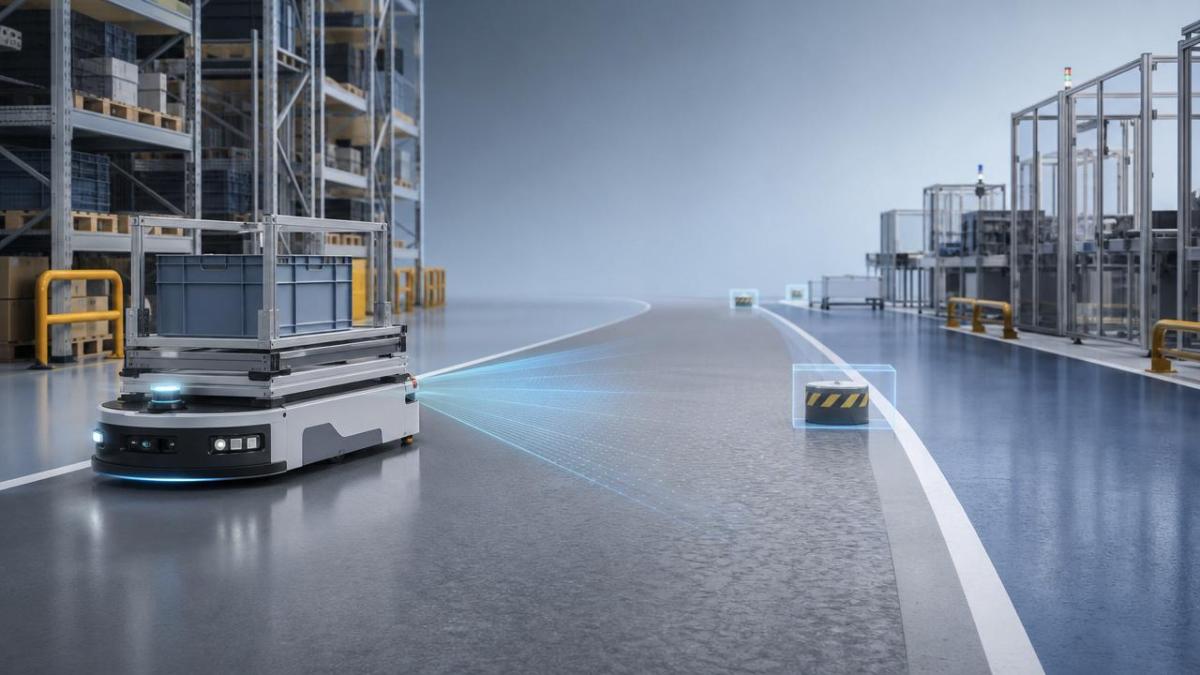
Indoor AGV navigation used to be evaluated in relatively controlled environments: predictable rack layouts, repeatable traffic, and limited dynamic obstacles. That assumption is fading. Today’s facilities often combine narrow warehouse lanes, open kitting areas, reflective packaging stations, temporary pallets, crossing pedestrians, and docking zones with uneven visual references. In this context, an agv lidar sensor supplier is not only supplying a sensor head. The supplier is effectively shaping how reliably the vehicle perceives edges, voids, forks, carts, low-profile obstacles, and route disruptions across multiple operating modes.
This shift is also redefining supplier qualification. A strong agv lidar sensor supplier must demonstrate repeatable performance not just in ideal scans, but in transitions: matte-to-gloss floors, static-to-dynamic traffic, bright loading bays to dim corridors, and clean maps to partially occluded paths. The decision increasingly depends on whether the supplier can provide transparent performance boundaries rather than broad claims of “high precision” or “industrial grade.”
The strongest demand signals come from route complexity, uptime pressure, and safer autonomy
The market is not merely asking for more LiDAR units; it is asking for more reliable perception under mixed operating realities. A qualified agv lidar sensor supplier is increasingly evaluated through the following demand shifts.
These signals explain why supplier selection is becoming more technical and less price-led. In mixed indoor settings, a low-cost sensor that performs inconsistently can raise total ownership cost through slower speeds, larger safety buffers, manual intervention, and route redesign.
The key drivers behind supplier differentiation are now measurable, not narrative
When comparing any agv lidar sensor supplier, the most important question is not “Who has the strongest brochure?” but “Who can quantify operational limits clearly?” Several technical drivers now separate dependable suppliers from generic ones.
- Angular resolution and point density: These define how well the sensor can distinguish slim obstacles, pallet edges, and cluttered route boundaries.
- Range consistency at short and mid distances: Mixed indoor routes often require both near-field protection and mid-range route planning without instability.
- Reflectivity handling: Shiny wrapping, stainless surfaces, glass partitions, and polished floors can distort returns and challenge localization.
- Multi-sensor interference resistance: Dense AGV fleets and nearby scanning devices increase the risk of signal cross-talk.
- Latency and data interface maturity: Stable timing and integration with controllers, safety PLCs, and edge compute units are essential for responsive navigation.
- Environmental robustness: Dust, vibration, wheel shock, and partial lens contamination should not cause unacceptable performance collapse.
- Software toolkit quality: Configuration utility, API support, map tuning, log analysis, and firmware traceability often determine deployment speed.
A reliable agv lidar sensor supplier should be willing to discuss threshold values, failure modes, and edge cases. That transparency aligns well with TSV’s data-first perspective: parameters, tolerances, and test methods are more valuable than generalized positioning statements.
The impact extends beyond navigation to safety envelopes, fleet economics, and integration risk
The choice of agv lidar sensor supplier influences far more than obstacle detection. It alters vehicle behavior policies, route design assumptions, and site-level economics. In mixed indoor routes, perception quality often sets the practical speed limit. If the sensor struggles with clutter, low obstacles, or dynamic scenes, integrators compensate by reducing travel speed, increasing stop distance, or simplifying missions. That can preserve safety, but it reduces throughput.
There is also a direct impact on engineering workload. A mature agv lidar sensor supplier can shorten development by providing tested SDKs, application notes, EMC guidance, safety references, and reproducible log data. A weak supplier often shifts hidden cost into retesting, field debugging, custom filtering, and repeated map adjustments. In other words, sensor sourcing affects qualification cycle time as much as hardware performance.
For facilities with multiple route types, this becomes especially important. One indoor environment may tolerate occasional false positives; another may not. One route may prioritize precise pallet approach; another may prioritize safe coexistence with pedestrians. The best agv lidar sensor supplier is usually the one that can support these scenario differences without forcing a fragmented sensor strategy across the fleet.
What deserves the closest attention during technical evaluation
A practical evaluation framework helps filter out weak candidates early. The following points deserve close review when screening an agv lidar sensor supplier for mixed indoor routes.
- Application-fit test data: Ask for benchmark results in narrow aisles, reflective zones, dynamic crossings, and low-obstacle detection scenarios similar to the target site.
- Localization stability: Review how the sensor performs when environmental features are sparse, temporarily blocked, or frequently moved.
- False stop behavior: Quantify nuisance detection frequency and the conditions that trigger it.
- Safety documentation: Verify support for relevant safety architecture, diagnostic coverage, and validation workflow if the device is used in safety-related functions.
- Firmware governance: Confirm version traceability, rollback options, bug-fix cycle time, and release note quality.
- Supply continuity: Check lifecycle commitment, component change notification policy, and global service capability.
- Integration evidence: Favor any agv lidar sensor supplier that can show successful use with common AGV controllers, navigation stacks, and middleware frameworks.
A useful comparison lens: initial unit price versus operational tolerance
A lower sensor price can look attractive during sourcing, but mixed indoor routes expose the penalty of narrow operational tolerance. If a cheaper unit requires route simplification, extra shielding, slower speeds, or higher manual supervision, its true cost rises quickly. The more valuable agv lidar sensor supplier is often the one that preserves deployment flexibility and reduces exception handling over time.
A stronger next-step approach is to validate suppliers through staged route realism
The most reliable way to evaluate an agv lidar sensor supplier is through staged validation instead of single-demo impressions. Begin with a specification review focused on measurable thresholds: field of view, angular resolution, detection repeatability, ingress protection, latency, shock resistance, and interface compatibility. Then move to controlled route testing with representative obstacles and reflective materials. Finally, validate performance in live mixed indoor traffic with logging enabled.
This staged approach creates a clearer basis for comparison and reduces the risk of selecting an agv lidar sensor supplier whose strengths appear only in narrow test conditions. It also supports a more defensible internal decision because engineering evidence, not presentation quality, becomes the selection standard.
For the next step, build a supplier scorecard around mixed-route performance, safety integration, software maturity, and lifecycle support. Use it to compare each agv lidar sensor supplier against real site conditions, not idealized lab assumptions. In a market where AGV routes are becoming more variable and autonomy expectations are rising, the best supplier is the one that can prove stable perception where operating complexity is highest.
Search News
Hot Articles
- Carbon Fiber StructuresHow to Specify Aerospace Carbon Fiber Assemblies for Lightweight, Load-Bearing PartsJul 11, 2026
- Machine VisionXiaomi, Alibaba DAMO Academy Drive Open-Source Robotics Model Ecosystem, Lowering Algorithm Development Barriers for Overseas SMEs Adopting Chinese Robotics SolutionsMar 30, 2026
- Cobots & ArmsShanxi 'AI+' Conference Showcases Embodied Intelligence with Multinational Buyer Engagement: Key Industry ImplicationsMar 30, 2026
Popular Tags
Recommended News
 Jul 11, 2026How to Specify Aerospace Carbon Fiber Assemblies for Lightweight, Load-Bearing PartsAerospace carbon fiber assemblies: learn how to specify laminate design, load data, joining methods, and inspection controls for lighter, reliable load-bearing aerospace parts.Elena Rostova (UAV Systems Researcher)
 Mar 30, 2026Xiaomi, Alibaba DAMO Academy Drive Open-Source Robotics Model Ecosystem, Lowering Algorithm Development Barriers for Overseas SMEs Adopting Chinese Robotics SolutionsXiaomi & Alibaba DAMO Academy's open-source robotics models lower algorithm barriers for global SMEs. Boost efficiency in manufacturing, logistics & smart retail with ROS 2 compatible solutions.TSV Data Lab
 Mar 30, 2026Shanxi 'AI+' Conference Showcases Embodied Intelligence with Multinational Buyer Engagement: Key Industry ImplicationsShanxi 'AI+' Conference highlights embodied intelligence with Tesla, Ubtech & Jiantao showcasing multimodal robotics. 40+ global buyers validated tech on-site, creating new B2B channels for industrial automation & AI solutions.Chen Wei (Automation Lead Engineer)
 Mar 30, 2026Zhongguancun Unveils 6G Integrated Sensing-Computing-Intelligence Platform to Empower Embodied Robots for Global Industrial ApplicationsZhongguancun's new 6G platform revolutionizes industrial robotics with <10ms latency, empowering global automotive, logistics & port automation. Discover how this tech boosts China's smart manufacturing exports.TSV Data Lab
 Mar 30, 2026Mech-Mind Tianjin Embodied Intelligence R&D and Production Base Goes Live, Cutting Delivery Time by 20%–30% for Global Customized AMR+Vision SolutionsMech-Mind's Tianjin AMR+Vision production base cuts delivery time by 20%-30% for欧美 & Latin American markets. Discover how this PLd-certified facility accelerates customized robotics solutions for smart manufacturing and logistics.Chen Wei (Automation Lead Engineer)
 Mar 30, 2026Boao Forum Reveals 'Co-evolution of Big and Small Brains' Trend in Humanoid Robots, China's Embodied Intelligence Accelerates Adaptation to Overseas Manufacturing Service ScenariosDiscover how China's humanoid robots, featuring 'Co-evolution of Big and Small Brains,' are revolutionizing global manufacturing. Learn about Embodied Tian Gong 3.0's ISO compliance and overseas deployment at Boao Forum 2026.Chen Wei (Automation Lead Engineer)
 Mar 30, 2026China Railway Industrial Secures Patent for Embodied Robotics in Material Handling, Boosting High-Precision Delivery Capabilities for Overseas Infrastructure and Manufacturing ProjectsChina Railway Industrial's new patent for embodied robotics in material handling boosts high-precision delivery for global infrastructure & manufacturing. Discover how this innovation enhances logistics accuracy in automotive, rail transit & EPC projects.Chen Wei (Automation Lead Engineer)
 Sep 28, 2026Spindle Runout Measurement in Germany: DIN Standards, Methods, and Acceptance LimitsSpindle runout measurement Germany: explore DIN standards, proven methods, acceptance limits, and audit-ready practices for reliable machining quality.Dr. Marcus Vance
 Sep 27, 2026How to Select Wall-Mount Edge Devices for Space-Constrained Factory NetworksWall mount edge devices for space-constrained factories: evaluate workload, thermal design, power resilience, cable access, and network reliability for smarter deployments.TSV Data Lab
 Sep 26, 2026Machining Tolerance Analysis: How to Set Limits That Meet Function and Cost TargetsMachining tolerance analysis: learn how to set functional limits, control tolerance stacks, reduce inspection risk, and balance precision with production cost.Dr. Marcus Vance
 Sep 25, 2026How to Evaluate an Industrial Infrastructure Data Platform for Multi-Site OperationsIndustrial infrastructure data platform evaluation guide for multi-site operations: compare data quality, edge resilience, interoperability, governance, and scalable proof-of-value criteria.Victor Lin (Chief Software Architect)
 Sep 24, 2026How to Select Machine Vision Optics for Accurate Inspection at Different Working DistancesMachine vision optics selection guide for accurate inspection at every working distance. Compare FOV, pixel scale, DOF, distortion, lighting, and telecentric options.TSV Data Lab
 Sep 23, 2026How to Evaluate a Machine Vision System Integrator for High-Speed Inspection LinesChoose a machine vision system integrator with proven expertise in high-speed inspection, reliable reject timing, robust optics, and measurable acceptance criteria.TSV Data Lab
 Sep 28, 2026When is a SCADA API the right choice for connecting plant systems?SCADA API guide: learn when governed plant data integration improves traceability, security, and scalability—without compromising real-time control.Victor Lin (Chief Software Architect)
 Sep 27, 2026How SCADA data integration improves traceability across production linesSCADA data integration connects production-line data to improve traceability, accelerate quality investigations, and strengthen safety decisions.Victor Lin (Chief Software Architect)
 Sep 26, 2026What to define before starting SCADA integration planningSCADA integration planning starts with clear scope, control boundaries, data models, cybersecurity, and testing. Discover the definitions that reduce risk and costly rework.Victor Lin (Chief Software Architect)
 Sep 25, 2026How a smart factory with Industrial IoT reduces production blind spotsDiscover how a smart factory with Industrial IoT turns real-time machine, quality, and workflow data into actionable insights that reduce production blind spots and delivery risks.Victor Lin (Chief Software Architect)
 Sep 24, 2026When does Industrial IoT make smart manufacturing easier to scale?Smart manufacturing Industrial IoT scales when trusted data, interoperable systems, and secure workflows turn connected assets into measurable gains.TSV Data Lab
 Sep 23, 2026What drives ultra-precision machining cost at 1-micron tolerance?Ultra precision machining cost per part at 1 micron tolerance depends on process, material, metrology, and yield. Learn how to compare quotes confidently.Dr. Marcus Vance
 Sep 22, 2026Drone Engine-T550CC Applications: Build the UAV Power System Around the MissionAn application guide for Drone Engine-T550CC integration, covering payload planning, airframe matching, cooling, fuel, vibration, test procedures, documentation, and service preparation.Elena Rostova (UAV Systems Researcher)
 Sep 22, 2026How to Evaluate Industrial Edge Computing Vendors for Factory DeploymentIndustrial edge computing vendor evaluation guide for factories: compare latency, protocol fit, reliability, security, and lifecycle support before deployment.TSV Data Lab
 Sep 21, 2026Drone Payload Integration: Matching Power, Data, and Center of Gravity for Reliable FlightsDrone payload integration made practical: balance power, data, center of gravity, and endurance to build safer, more reliable mission-ready flights.Elena Rostova (UAV Systems Researcher)
 Sep 20, 2026Autonomous Navigation Pricing: Cost Drivers and Budget Benchmarks for AMR ProjectsAutonomous navigation price explained: compare AMR cost drivers, software, sensors, integration, safety, and lifecycle budgets to build a scalable project plan.Chen Wei (Automation Lead Engineer)
 Sep 19, 2026How to Scope Automation Integration Services for Multi-System Factory ProjectsAutomation integration services: learn how to scope multi-system factory projects with clear workflows, interface contracts, safety boundaries, and acceptance criteria.Victor Lin (Chief Software Architect)