Industrial Edge Devices With Wide Temperature: Key Specs for Outdoor IoT Deployment
Publication Date
author
Outdoor IoT systems fail for ordinary reasons. Heat rises inside sealed cabinets. Winter startups strain power rails. Dust blocks airflow. Cellular links fluctuate. In that environment, industrial edge devices with wide temperature capability are not optional hardware upgrades. They are the control point between stable field data and expensive service disruption.
That matters across logistics yards, energy assets, roadside infrastructure, mining sites, precision agriculture, and unmanned platforms. As TSV often emphasizes, parameters matter more than adjectives. The practical question is not whether a device is called rugged. The real question is whether its thermal, electrical, and compute limits match the deployment envelope.
Why wide-temperature edge hardware deserves closer scrutiny
Most outdoor networks now push more intelligence to the field. Cameras run local inference. Gateways preprocess sensor streams. Controllers buffer data during backhaul loss. Each added task raises thermal load.
At the same time, outdoor operating conditions are becoming less predictable. Enclosures may see direct sun, rapid night cooling, vibration, moisture, and unstable input power within a single day.
This is why industrial edge devices with wide temperature ratings have become central to deployment planning. They reduce the gap between laboratory specification sheets and real service life.
The broader industry context also matters. Edge AI, autonomous equipment, and distributed sensing have expanded faster than specification discipline. Many buyers still compare products through headline processor names instead of mission limits.
TSV’s data-driven approach is useful here. Outdoor reliability should be judged through measurable thresholds: operating temperature range, cold boot behavior, thermal derating, storage tolerance, ingress protection, EMC resilience, and interface stability under load.
What “wide temperature” actually means in deployment terms
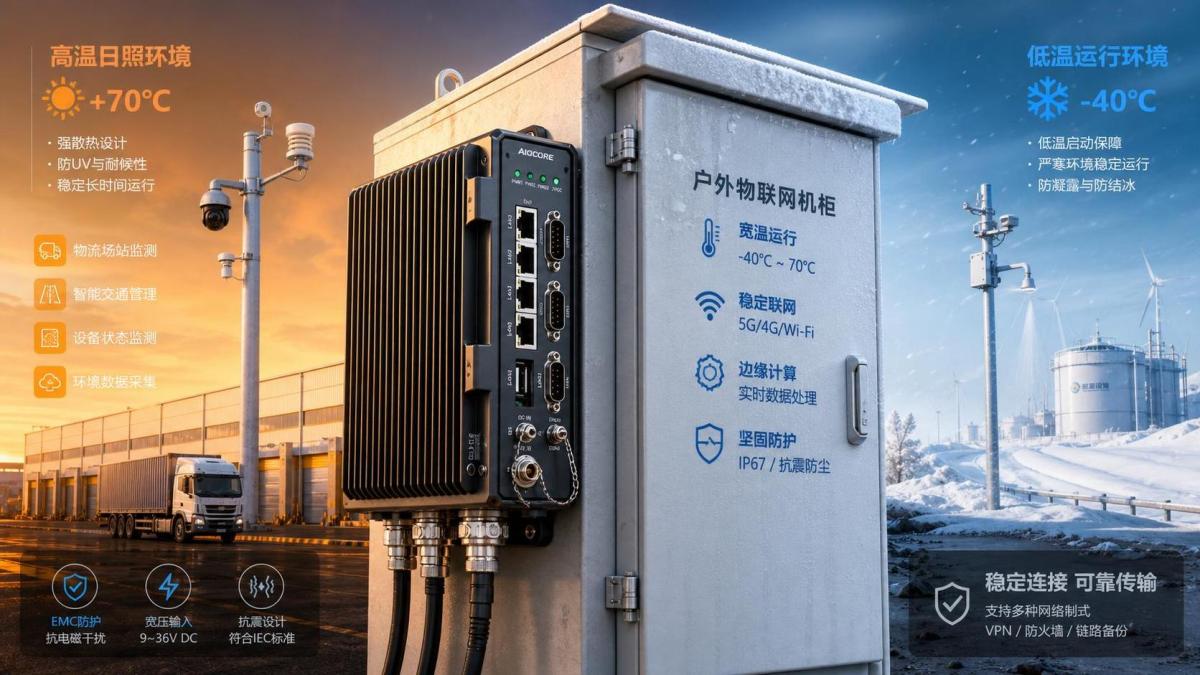
The phrase sounds simple, but it often hides important distinctions. A published range such as -40°C to 70°C does not automatically mean full performance at every point.
Some devices can operate across that range only with reduced CPU frequency, restricted I/O loading, or specific airflow assumptions. Others quote component-level limits rather than validated system-level results.
For outdoor IoT deployment, a meaningful wide-temperature claim should answer four questions clearly:
- Is the temperature range verified at the complete system level?
- Does the range apply during startup, steady operation, and storage?
- Are compute, networking, and storage performance maintained without severe derating?
- What test method supports the claim: chamber tests, burn-in, field records, or both?
In practical terms, industrial edge devices with wide temperature support should preserve system integrity when ambient conditions shift faster than service teams can respond.
The specifications that matter most
Not every specification carries equal value. Several parameters consistently determine whether an outdoor node becomes dependable infrastructure or a maintenance burden.
Thermal operating range and derating curve
The nominal operating range should be the starting point, not the conclusion. Ask for the derating curve under CPU, GPU, and I/O load.
A device that reaches thermal throttling at 55°C cabinet temperature may be unsuitable in desert, rooftop, or steel-yard installations, even if the brochure states 70°C operation.
Cold-start and power conditioning behavior
Many outdoor failures happen during startup, not continuous running. Batteries sag, heaters cycle, and input voltage drifts during cold mornings.
Check acceptable input range, surge protection, reverse polarity tolerance, ignition control if relevant, and validated boot performance at low temperature.
Storage media endurance
Edge systems log continuously, cache models, and store event footage. SSD type, write endurance, and controller behavior under heat deserve close review.
Industrial-grade storage, wear-leveling strategy, and power-loss protection often matter more than raw capacity.
Ingress, vibration, and connector integrity
Outdoor thermal stress rarely appears alone. It usually combines with dust, moisture, shock, and cable movement.
For that reason, industrial edge devices with wide temperature ratings should be evaluated alongside IP level, mounting design, connector locking, and vibration validation.
EMC and network continuity
Outdoor assets often sit near motors, inverters, radios, and long cable runs. Electrical noise can corrupt data long before hardware fully fails.
Ethernet resilience, serial stability, LTE or 5G module behavior, and EMC compliance should be reviewed as part of the same reliability picture.
Where these devices create business value
The value of industrial edge devices with wide temperature support is not limited to extreme climate sites. Their business impact appears wherever downtime costs exceed hardware premiums.
In smart logistics yards, edge systems process camera feeds, gate events, and fleet telemetry without relying on uninterrupted cloud access. Thermal instability there can halt throughput and disrupt site visibility.
In remote utilities, the edge node often serves as the only local compute layer for alarms, data buffering, and protocol conversion. Failure means blind periods, truck rolls, and delayed fault response.
In UAV ground support, roadside sensing, and mining vehicles, wide-temperature performance also protects timing-sensitive workloads. Sensor fusion, inferencing, and local control are less tolerant of intermittent resets.
The larger benefit is qualification speed. When performance data is clear and environmental margins are documented, technical comparison becomes faster and supplier screening becomes less subjective.
Common evaluation mistakes during sourcing
A frequent mistake is treating enclosure cooling as a separate problem. Device choice and cabinet design should be reviewed together, especially under solar load.
Another mistake is accepting maximum temperature claims without asking about processor utilization, AI acceleration, or simultaneous network traffic.
Storage is often underestimated. Edge workloads with vision, analytics, or protocol buffering can wear consumer-grade flash much faster than expected.
The last issue is weak traceability. If test reports, component revisions, and certification details are vague, future maintenance and multi-region rollout become harder to control.
This is where TSV’s preference for benchmark-style evidence is useful. A cleaner specification process reduces trial deployments that consume time without improving confidence.
A practical framework for comparing options
A grounded comparison starts with the deployment envelope, not the device catalog. Define the true ambient range, enclosure conditions, data workload, power quality, and maintenance interval.
Then match candidates against a short list of evidence-based checks:
- Temperature range verified under expected compute and I/O load
- Cold boot success at the lowest expected startup condition
- Documented MTBF, storage endurance, and component lifecycle status
- EMC, shock, vibration, and ingress validation relevant to the site
- Remote management, watchdog recovery, and secure firmware update support
Industrial edge devices with wide temperature characteristics should also be judged for serviceability. Accessible diagnostics, modular I/O, and stable long-term supply can outweigh a small performance advantage.
The next step is straightforward. Build a site-specific spec sheet, request test evidence against that profile, and compare suppliers on measurable margins rather than generic rugged claims. That approach turns outdoor IoT deployment into an engineering decision, not a branding exercise.
Search News
Hot Articles
- Carbon Fiber StructuresHow to Specify Aerospace Carbon Fiber Assemblies for Lightweight, Load-Bearing PartsJul 11, 2026
- Machine VisionXiaomi, Alibaba DAMO Academy Drive Open-Source Robotics Model Ecosystem, Lowering Algorithm Development Barriers for Overseas SMEs Adopting Chinese Robotics SolutionsMar 30, 2026
- Cobots & ArmsShanxi 'AI+' Conference Showcases Embodied Intelligence with Multinational Buyer Engagement: Key Industry ImplicationsMar 30, 2026
Popular Tags
Recommended News
 Jul 11, 2026How to Specify Aerospace Carbon Fiber Assemblies for Lightweight, Load-Bearing PartsAerospace carbon fiber assemblies: learn how to specify laminate design, load data, joining methods, and inspection controls for lighter, reliable load-bearing aerospace parts.Elena Rostova (UAV Systems Researcher)
 Mar 30, 2026Xiaomi, Alibaba DAMO Academy Drive Open-Source Robotics Model Ecosystem, Lowering Algorithm Development Barriers for Overseas SMEs Adopting Chinese Robotics SolutionsXiaomi & Alibaba DAMO Academy's open-source robotics models lower algorithm barriers for global SMEs. Boost efficiency in manufacturing, logistics & smart retail with ROS 2 compatible solutions.TSV Data Lab
 Mar 30, 2026Shanxi 'AI+' Conference Showcases Embodied Intelligence with Multinational Buyer Engagement: Key Industry ImplicationsShanxi 'AI+' Conference highlights embodied intelligence with Tesla, Ubtech & Jiantao showcasing multimodal robotics. 40+ global buyers validated tech on-site, creating new B2B channels for industrial automation & AI solutions.Chen Wei (Automation Lead Engineer)
 Mar 30, 2026Zhongguancun Unveils 6G Integrated Sensing-Computing-Intelligence Platform to Empower Embodied Robots for Global Industrial ApplicationsZhongguancun's new 6G platform revolutionizes industrial robotics with <10ms latency, empowering global automotive, logistics & port automation. Discover how this tech boosts China's smart manufacturing exports.TSV Data Lab
 Mar 30, 2026Mech-Mind Tianjin Embodied Intelligence R&D and Production Base Goes Live, Cutting Delivery Time by 20%–30% for Global Customized AMR+Vision SolutionsMech-Mind's Tianjin AMR+Vision production base cuts delivery time by 20%-30% for欧美 & Latin American markets. Discover how this PLd-certified facility accelerates customized robotics solutions for smart manufacturing and logistics.Chen Wei (Automation Lead Engineer)
 Mar 30, 2026Boao Forum Reveals 'Co-evolution of Big and Small Brains' Trend in Humanoid Robots, China's Embodied Intelligence Accelerates Adaptation to Overseas Manufacturing Service ScenariosDiscover how China's humanoid robots, featuring 'Co-evolution of Big and Small Brains,' are revolutionizing global manufacturing. Learn about Embodied Tian Gong 3.0's ISO compliance and overseas deployment at Boao Forum 2026.Chen Wei (Automation Lead Engineer)
 Mar 30, 2026China Railway Industrial Secures Patent for Embodied Robotics in Material Handling, Boosting High-Precision Delivery Capabilities for Overseas Infrastructure and Manufacturing ProjectsChina Railway Industrial's new patent for embodied robotics in material handling boosts high-precision delivery for global infrastructure & manufacturing. Discover how this innovation enhances logistics accuracy in automotive, rail transit & EPC projects.Chen Wei (Automation Lead Engineer)
 Sep 27, 2026How to Select Wall-Mount Edge Devices for Space-Constrained Factory NetworksWall mount edge devices for space-constrained factories: evaluate workload, thermal design, power resilience, cable access, and network reliability for smarter deployments.TSV Data Lab
 Sep 26, 2026Machining Tolerance Analysis: How to Set Limits That Meet Function and Cost TargetsMachining tolerance analysis: learn how to set functional limits, control tolerance stacks, reduce inspection risk, and balance precision with production cost.Dr. Marcus Vance
 Sep 25, 2026How to Evaluate an Industrial Infrastructure Data Platform for Multi-Site OperationsIndustrial infrastructure data platform evaluation guide for multi-site operations: compare data quality, edge resilience, interoperability, governance, and scalable proof-of-value criteria.Victor Lin (Chief Software Architect)
 Sep 24, 2026How to Select Machine Vision Optics for Accurate Inspection at Different Working DistancesMachine vision optics selection guide for accurate inspection at every working distance. Compare FOV, pixel scale, DOF, distortion, lighting, and telecentric options.TSV Data Lab
 Sep 23, 2026How to Evaluate a Machine Vision System Integrator for High-Speed Inspection LinesChoose a machine vision system integrator with proven expertise in high-speed inspection, reliable reject timing, robust optics, and measurable acceptance criteria.TSV Data Lab
 Sep 27, 2026How SCADA data integration improves traceability across production linesSCADA data integration connects production-line data to improve traceability, accelerate quality investigations, and strengthen safety decisions.Victor Lin (Chief Software Architect)
 Sep 26, 2026What to define before starting SCADA integration planningSCADA integration planning starts with clear scope, control boundaries, data models, cybersecurity, and testing. Discover the definitions that reduce risk and costly rework.Victor Lin (Chief Software Architect)
 Sep 25, 2026How a smart factory with Industrial IoT reduces production blind spotsDiscover how a smart factory with Industrial IoT turns real-time machine, quality, and workflow data into actionable insights that reduce production blind spots and delivery risks.Victor Lin (Chief Software Architect)
 Sep 24, 2026When does Industrial IoT make smart manufacturing easier to scale?Smart manufacturing Industrial IoT scales when trusted data, interoperable systems, and secure workflows turn connected assets into measurable gains.TSV Data Lab
 Sep 23, 2026What drives ultra-precision machining cost at 1-micron tolerance?Ultra precision machining cost per part at 1 micron tolerance depends on process, material, metrology, and yield. Learn how to compare quotes confidently.Dr. Marcus Vance
 Sep 22, 2026Drone Engine-T550CC Applications: Build the UAV Power System Around the MissionAn application guide for Drone Engine-T550CC integration, covering payload planning, airframe matching, cooling, fuel, vibration, test procedures, documentation, and service preparation.Elena Rostova (UAV Systems Researcher)
 Sep 22, 2026How to Evaluate Industrial Edge Computing Vendors for Factory DeploymentIndustrial edge computing vendor evaluation guide for factories: compare latency, protocol fit, reliability, security, and lifecycle support before deployment.TSV Data Lab
 Sep 21, 2026Drone Payload Integration: Matching Power, Data, and Center of Gravity for Reliable FlightsDrone payload integration made practical: balance power, data, center of gravity, and endurance to build safer, more reliable mission-ready flights.Elena Rostova (UAV Systems Researcher)
 Sep 20, 2026Autonomous Navigation Pricing: Cost Drivers and Budget Benchmarks for AMR ProjectsAutonomous navigation price explained: compare AMR cost drivers, software, sensors, integration, safety, and lifecycle budgets to build a scalable project plan.Chen Wei (Automation Lead Engineer)
 Sep 19, 2026How to Scope Automation Integration Services for Multi-System Factory ProjectsAutomation integration services: learn how to scope multi-system factory projects with clear workflows, interface contracts, safety boundaries, and acceptance criteria.Victor Lin (Chief Software Architect)
 Sep 18, 2026Selecting UAV Aerospace Structural Parts for Strength, Weight, and Fatigue LifeUAV aerospace structural parts guide: compare strength, weight, stiffness, fatigue life, joints, and traceability to select reliable flight-ready components.Elena Rostova (UAV Systems Researcher)
 Sep 17, 2026Selecting Commercial Drone Payloads for European Inspection ProjectsCommercial drone payloads Europe: learn how to select RGB, thermal and LiDAR systems for compliant, reliable inspection data and better project outcomes.Elena Rostova (UAV Systems Researcher)