How to Evaluate a Low Latency Edge AI Box for Real-Time Vision and Control
Publication Date
author
Selecting a low latency edge AI box for real-time vision and control requires more than vendor claims or headline specs. For technical evaluators, the real question is how consistently a system can deliver deterministic inference, fast sensor-to-action response, and stable operation under industrial workloads. This guide outlines the core benchmarks, interface checks, and latency validation criteria that matter when engineering precision, uptime, and deployment confidence are on the line.
In practice, many evaluation failures happen because teams buy a compute platform as if they were buying a server. Real-time vision and control is not a server problem. It is a timing problem. A device may offer strong TOPS figures, a modern GPU, and multiple high-speed interfaces, yet still miss cycle deadlines once cameras, fieldbus traffic, control loops, thermal constraints, and software scheduling begin interacting under load.
That is why a low latency edge AI box should be evaluated as part of an end-to-end execution chain: sensor capture, pre-processing, inference, decision logic, control output, and recovery behavior when something goes wrong. If any one of those stages is unstable, average latency numbers become meaningless.
Start with the application deadline, not the processor datasheet
The first technical mistake is evaluating hardware before defining the maximum acceptable response time. Real-time vision means very different things depending on the use case.
A pick-and-place guidance task may tolerate tens of milliseconds if conveyor speed is moderate and buffering is predictable. A collision-avoidance node on an AGV, a UAV perception module, or a high-speed reject mechanism on a packaging line may have far tighter limits. In these systems, what matters is not just inference time, but total sensor-to-action delay and its jitter envelope.
Before comparing platforms, define at least four timing values:
- Maximum allowed sensor-to-decision latency
- Maximum allowed decision-to-actuator latency
- Worst-case jitter tolerance
- Recovery time after dropped frames, overload, or network interruption
Only after this should the edge AI box be benchmarked. Otherwise, teams end up buying excessive compute for the wrong bottleneck, or worse, insufficient I/O determinism for a seemingly fast model.
Latency must be measured as a chain, not as isolated inference speed
Vendor literature commonly highlights per-frame inference time. For control applications, that number is too narrow to support a serious decision. A 6 ms model runtime says little if image acquisition adds 12 ms, memory copies add 4 ms, software queueing adds 10 ms under burst load, and output signaling is non-deterministic.
A usable evaluation framework should separate latency into measurable stages:
- Sensor exposure and frame delivery
- Interface transfer to host memory or accelerator memory
- Image decoding, resizing, normalization, or filtering
- Inference execution
- Post-processing and decision logic
- Control command output through GPIO, serial, Ethernet, CAN, or industrial bus
For technical evaluators, percentile latency is usually more informative than averages. P50 may look excellent while P99 or worst-case latency breaks the machine cycle. In a real deployment, a system that is fast most of the time but unpredictable during thermal rise, background logging, or camera resynchronization is often less useful than a slower but stable platform.
Ask vendors or integrators for measured results under sustained load, ideally including P95, P99, and worst-case figures. If they only provide average inference speed, the evaluation is incomplete.
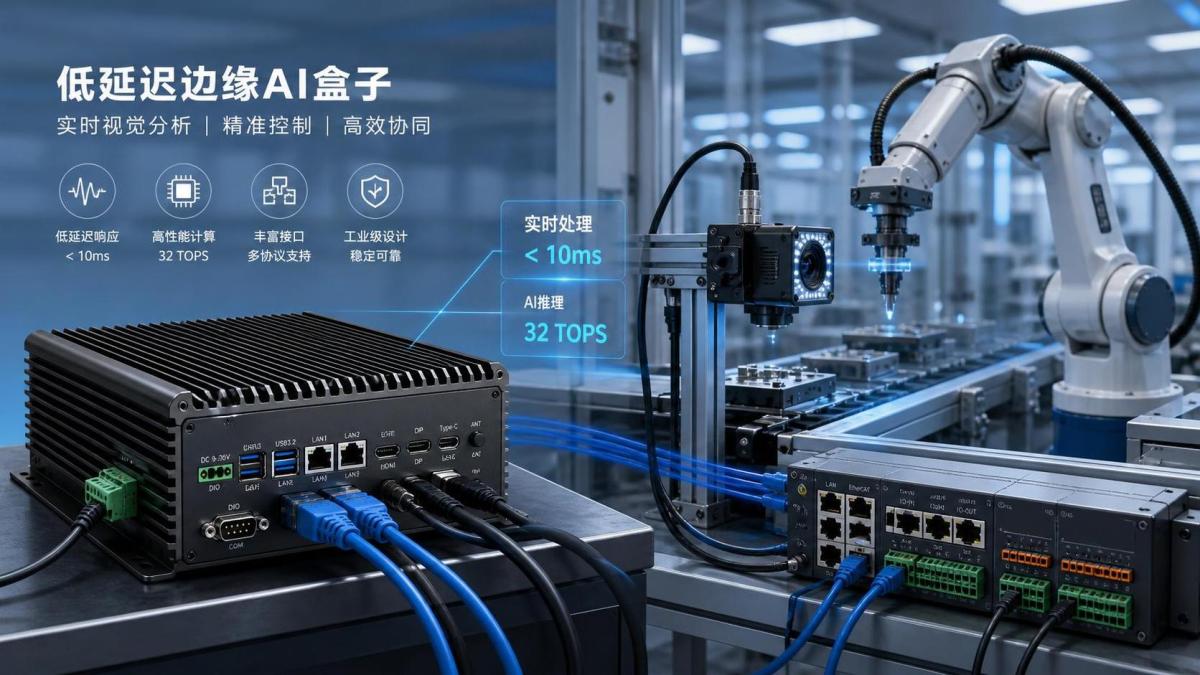
Compute architecture matters, but balance matters more
When comparing a low latency edge AI box, buyers often over-focus on the accelerator: GPU, NPU, FPGA, VPU, or SoC AI engine. The better question is whether the compute architecture matches the data path and model behavior.
GPU-heavy systems are often attractive for flexible model deployment and strong ecosystem support, but they may draw more power and require tighter thermal management. NPU-based systems can offer strong efficiency and lower power for specific optimized networks, but portability and operator support may be narrower. FPGA-based platforms may provide excellent determinism for selected pipelines, though development complexity and maintenance burden are higher. x86 plus discrete accelerator designs can simplify software integration, but data movement overhead can erode latency benefits if the pipeline is not carefully engineered.
Technical evaluation should therefore include:
- Model compatibility with the hardware toolchain
- Precision support such as FP32, FP16, INT8, or mixed precision
- Pre-processing acceleration availability
- Memory bandwidth and memory size under concurrent streams
- Multi-camera or multi-task scheduling behavior
- Latency impact of host-to-accelerator transfers
A common field issue is that benchmark demos use one optimized model in isolation, while production workloads involve multiple concurrent tasks: detection, tracking, OCR, PLC communications, HMI output, and telemetry. The right platform is rarely the one with the highest peak AI number. It is the one that maintains timing margins once the full software stack is active.
I/O and industrial interface design often decide deployment success
For vision and control, interfaces are not secondary features. They are often the actual system constraint.
Camera input should be checked beyond connector count. Interface type affects latency, synchronization, cable length, and software maturity. GigE Vision, USB3 Vision, MIPI CSI, GMSL, CoaXPress, and Camera Link each bring different trade-offs. A box that looks strong on paper may struggle if your deployment depends on hardware trigger support, precision time synchronization, long cable runs, or multi-camera deterministic capture.
The same applies to control-side connectivity. If the edge box must exchange data with PLCs, robot controllers, drives, or industrial gateways, protocol support needs close review. Ethernet alone is not enough. Teams may need EtherCAT, PROFINET, Modbus TCP, CAN, CANopen, RS-485, or digital I/O with known timing behavior. Some devices can support these only through add-on modules or external gateways, which may add latency and integration risk.
For machine builders and plant deployments, check these points early:
- Hardware-triggered acquisition support
- Timestamp precision and clock synchronization
- Digital input/output response timing
- Isolation design for industrial electrical noise
- EMC performance claims and test basis
- Protocol stack maturity and long-term support
If the application closes the loop directly from AI output to machine actuation, digital output timing and software interrupt behavior deserve the same scrutiny as model throughput.
Thermal behavior is not a maintenance issue; it is a latency issue
Many edge AI systems meet target performance only in short test windows. In production, thermal saturation changes everything. Once throttling starts, inference times stretch, frame queues deepen, and control confidence degrades.
This matters especially in sealed enclosures, mobile platforms, outdoor cabinets, and high-dust manufacturing sites where active cooling is limited or filter maintenance is irregular. A fanless design may improve reliability in harsh environments, but only if the thermal envelope truly supports sustained AI workloads at the required ambient temperature.
Evaluation should not stop at maximum TDP or operating temperature claims. Ask for sustained performance data across realistic ambient ranges and mounting conditions. If unavailable, run your own soak tests with full camera load, communications traffic, storage activity, and application software enabled for several hours. Record latency drift over time, not just CPU and accelerator temperatures.
What matters is not whether the box remains powered on. What matters is whether it still meets the control deadline after thermal equilibrium.
Software stack quality is often the hidden determinant of real-time behavior
Hardware can be competent while the software environment undermines determinism. Drivers, runtime libraries, model conversion tools, container overhead, kernel configuration, and update management all affect stability.
For real-time vision and control, a few software questions are more important than many buyers assume:
- Can the OS and runtime prioritize time-critical tasks predictably?
- Is there support for real-time Linux configurations if required?
- How mature is the SDK for camera integration and accelerator deployment?
- What happens to latency when logs, remote monitoring, or OTA services run in parallel?
- How difficult is model conversion, quantization, and validation after deployment?
This is where many pilot projects stall. The platform may support a model in theory, but engineering effort rises sharply because unsupported operators, unstable driver revisions, or inefficient pre-processing pipelines force workarounds. For technical evaluators, software friction is not just a development inconvenience. It directly influences deployment schedule, maintainability, and long-term supplier dependence.
Reliability evaluation should include failure behavior, not just normal operation
Real systems face dropped packets, corrupted frames, storage wear, sudden power loss, network disconnects, and sensor replacement events. The question is whether the edge AI box fails safely and recovers predictably.
In control-linked applications, a graceful degradation strategy is often more valuable than maximum peak performance. If one camera stream fails, does the application stall, switch to fallback logic, or continue on a reduced pipeline? After reboot, how quickly does the system restore synchronization and inference readiness? If the accelerator runtime crashes, is watchdog recovery available?
These are not edge cases in industrial operation. They are normal lifecycle conditions. A box intended for unmanned sites, mobile assets, or globally distributed machine fleets should be assessed for:
- Power event resilience
- Watchdog and remote recovery mechanisms
- Storage endurance and file-system robustness
- Firmware and software rollback capability
- Cybersecurity maintenance path
- Lifecycle availability of core compute modules
Lifecycle stability matters particularly for OEMs. A technically attractive platform with a short component roadmap or frequent silent BOM changes can create expensive redesign cycles later.
Benchmark with your own workload, or the selection remains theoretical
No generic benchmark fully predicts field behavior. The only credible method is to test with your camera format, your model, your pre-processing path, and your control logic.
An effective validation plan usually includes three layers. The first is synthetic stress testing to identify raw throughput and thermal limits. The second is application-level measurement with representative image streams, communication traffic, and output signaling. The third is scenario testing under upset conditions such as burst events, poor lighting, network congestion, or actuator feedback delays.
At minimum, record:
- End-to-end sensor-to-action latency
- Latency distribution over time
- Frame drop rate
- Recovery behavior after overload
- Performance drift across ambient temperature and duty cycle
For teams comparing multiple vendors, keep the model version, camera settings, OS image, and test script constant. Without that discipline, benchmark results become procurement theater rather than technical evidence.
What experienced evaluators treat as warning signs
Some signs repeatedly indicate that a low latency edge AI box may not survive industrial deployment without significant rework.
- Latency claims are given only for isolated inference, with no sensor or output path data
- Thermal performance is described qualitatively but not measured under sustained load
- Industrial protocol support depends on third-party bridges with unclear timing impact
- SDK support is broad in marketing language but thin in version-controlled documentation
- Lifecycle and component availability commitments are vague
- EMC, safety, or environmental test references are absent or marked 【待核实】
None of these automatically disqualifies a platform. But they do increase validation burden, integration risk, and total engineering cost.
The best choice is usually the platform with the lowest validation uncertainty
For technical evaluation, the winning platform is not simply the smallest, fastest, or cheapest box. It is the one that gives the clearest evidence that timing requirements will still be met after integration, thermal stabilization, software updates, and field aging.
That usually means weighting deterministic behavior above peak benchmark headlines, verified interface compatibility above connector count, and sustained end-to-end latency above accelerator marketing metrics. In short: buy timing confidence, not just compute.
When teams treat the edge AI box as part of a controlled execution system rather than as a standalone processor, selection quality improves sharply. That is the difference between a successful pilot and a platform that looks impressive in the lab but becomes fragile on the factory floor, in a vehicle, or at the network edge.
Search News
Hot Articles
- Carbon Fiber StructuresHow to Specify Aerospace Carbon Fiber Assemblies for Lightweight, Load-Bearing PartsJul 11, 2026
- Machine VisionXiaomi, Alibaba DAMO Academy Drive Open-Source Robotics Model Ecosystem, Lowering Algorithm Development Barriers for Overseas SMEs Adopting Chinese Robotics SolutionsMar 30, 2026
- Cobots & ArmsShanxi 'AI+' Conference Showcases Embodied Intelligence with Multinational Buyer Engagement: Key Industry ImplicationsMar 30, 2026
Popular Tags
Recommended News
 Jul 11, 2026How to Specify Aerospace Carbon Fiber Assemblies for Lightweight, Load-Bearing PartsAerospace carbon fiber assemblies: learn how to specify laminate design, load data, joining methods, and inspection controls for lighter, reliable load-bearing aerospace parts.Elena Rostova (UAV Systems Researcher)
 Mar 30, 2026Xiaomi, Alibaba DAMO Academy Drive Open-Source Robotics Model Ecosystem, Lowering Algorithm Development Barriers for Overseas SMEs Adopting Chinese Robotics SolutionsXiaomi & Alibaba DAMO Academy's open-source robotics models lower algorithm barriers for global SMEs. Boost efficiency in manufacturing, logistics & smart retail with ROS 2 compatible solutions.TSV Data Lab
 Mar 30, 2026Shanxi 'AI+' Conference Showcases Embodied Intelligence with Multinational Buyer Engagement: Key Industry ImplicationsShanxi 'AI+' Conference highlights embodied intelligence with Tesla, Ubtech & Jiantao showcasing multimodal robotics. 40+ global buyers validated tech on-site, creating new B2B channels for industrial automation & AI solutions.Chen Wei (Automation Lead Engineer)
 Mar 30, 2026Zhongguancun Unveils 6G Integrated Sensing-Computing-Intelligence Platform to Empower Embodied Robots for Global Industrial ApplicationsZhongguancun's new 6G platform revolutionizes industrial robotics with <10ms latency, empowering global automotive, logistics & port automation. Discover how this tech boosts China's smart manufacturing exports.TSV Data Lab
 Mar 30, 2026Mech-Mind Tianjin Embodied Intelligence R&D and Production Base Goes Live, Cutting Delivery Time by 20%–30% for Global Customized AMR+Vision SolutionsMech-Mind's Tianjin AMR+Vision production base cuts delivery time by 20%-30% for欧美 & Latin American markets. Discover how this PLd-certified facility accelerates customized robotics solutions for smart manufacturing and logistics.Chen Wei (Automation Lead Engineer)
 Mar 30, 2026Boao Forum Reveals 'Co-evolution of Big and Small Brains' Trend in Humanoid Robots, China's Embodied Intelligence Accelerates Adaptation to Overseas Manufacturing Service ScenariosDiscover how China's humanoid robots, featuring 'Co-evolution of Big and Small Brains,' are revolutionizing global manufacturing. Learn about Embodied Tian Gong 3.0's ISO compliance and overseas deployment at Boao Forum 2026.Chen Wei (Automation Lead Engineer)
 Mar 30, 2026China Railway Industrial Secures Patent for Embodied Robotics in Material Handling, Boosting High-Precision Delivery Capabilities for Overseas Infrastructure and Manufacturing ProjectsChina Railway Industrial's new patent for embodied robotics in material handling boosts high-precision delivery for global infrastructure & manufacturing. Discover how this innovation enhances logistics accuracy in automotive, rail transit & EPC projects.Chen Wei (Automation Lead Engineer)
 Sep 23, 2026How to Evaluate a Machine Vision System Integrator for High-Speed Inspection LinesChoose a machine vision system integrator with proven expertise in high-speed inspection, reliable reject timing, robust optics, and measurable acceptance criteria.TSV Data Lab
 Sep 23, 2026What drives ultra-precision machining cost at 1-micron tolerance?Ultra precision machining cost per part at 1 micron tolerance depends on process, material, metrology, and yield. Learn how to compare quotes confidently.Dr. Marcus Vance
 Sep 22, 2026Drone Engine-T550CC Applications: Build the UAV Power System Around the MissionAn application guide for Drone Engine-T550CC integration, covering payload planning, airframe matching, cooling, fuel, vibration, test procedures, documentation, and service preparation.Elena Rostova (UAV Systems Researcher)
 Sep 22, 2026How to Evaluate Industrial Edge Computing Vendors for Factory DeploymentIndustrial edge computing vendor evaluation guide for factories: compare latency, protocol fit, reliability, security, and lifecycle support before deployment.TSV Data Lab
 Sep 21, 2026Drone Payload Integration: Matching Power, Data, and Center of Gravity for Reliable FlightsDrone payload integration made practical: balance power, data, center of gravity, and endurance to build safer, more reliable mission-ready flights.Elena Rostova (UAV Systems Researcher)
 Sep 20, 2026Autonomous Navigation Pricing: Cost Drivers and Budget Benchmarks for AMR ProjectsAutonomous navigation price explained: compare AMR cost drivers, software, sensors, integration, safety, and lifecycle budgets to build a scalable project plan.Chen Wei (Automation Lead Engineer)
 Sep 19, 2026How to Scope Automation Integration Services for Multi-System Factory ProjectsAutomation integration services: learn how to scope multi-system factory projects with clear workflows, interface contracts, safety boundaries, and acceptance criteria.Victor Lin (Chief Software Architect)
 Sep 18, 2026Selecting UAV Aerospace Structural Parts for Strength, Weight, and Fatigue LifeUAV aerospace structural parts guide: compare strength, weight, stiffness, fatigue life, joints, and traceability to select reliable flight-ready components.Elena Rostova (UAV Systems Researcher)
 Sep 17, 2026Selecting Commercial Drone Payloads for European Inspection ProjectsCommercial drone payloads Europe: learn how to select RGB, thermal and LiDAR systems for compliant, reliable inspection data and better project outcomes.Elena Rostova (UAV Systems Researcher)
 Sep 16, 2026Machining Tolerance Validation: How to Verify Critical Dimensions Before Production ReleaseMachining tolerance analysis validation: verify critical dimensions, measurement systems, process capability, and tolerance stacks before production release.Dr. Marcus Vance
 Sep 15, 2026AGV Tape Guidance vs Laser Navigation: Which Fits Your Warehouse Layout?AGV tape guidance comparison: discover how tape and laser navigation fit changing warehouse layouts, docking needs, floor conditions, maintenance, and route flexibility.Chen Wei (Automation Lead Engineer)
 Sep 14, 2026How Point Cloud Analytics Improves Asset Inspection Workflows Across GCC ProjectsPoint cloud analytics GCC helps project leaders improve asset inspections with accurate change detection, safer workflows, and faster maintenance decisions.TSV Data Lab
 Sep 13, 2026How Aerospace Manufacturers Can Build a Digital Thread From Design to Certified ProductionDigital manufacturing for aerospace: learn how to build a traceable digital thread from design through certified production, supplier control, and audit-ready compliance.Victor Lin (Chief Software Architect)
 Sep 12, 2026How to Select a Thermal Sensor for Mapping Drones in Surveying ProjectsMapping drone thermal sensor selection made simple: compare GSD, radiometric data, NETD, calibration, and workflow fit for accurate, survey-ready thermal maps.Elena Rostova (UAV Systems Researcher)
 Sep 11, 2026Integrating Photogrammetry Workflows into Digital Twin Projects Without Data BottlenecksPhotogrammetry workflow integration for digital twins: learn how to streamline capture, validation, versioning, and delivery to prevent data bottlenecks.Victor Lin (Chief Software Architect)
 Sep 10, 2026Hard-Tech Supply Chain Procurement: Qualifying Suppliers to Cut Lead-Time RiskHard-tech supply chain procurement guide: qualify suppliers with proven process, traceability, capacity, and change control to reduce lead-time risk.Chen Wei (Automation Lead Engineer)
 Sep 09, 2026Industrial Application Notes: Cost Factors That Shape Automation Project BudgetsIndustrial application notes cost factors explained: uncover the engineering, safety, integration, and commissioning variables that shape accurate automation budgets.Victor Lin (Chief Software Architect)