Industrial Servo Motor with Encoder Selection Guide for Precision Motion Control
Publication Date
author
Industrial Servo Motor with Encoder: What Actually Matters in Selection
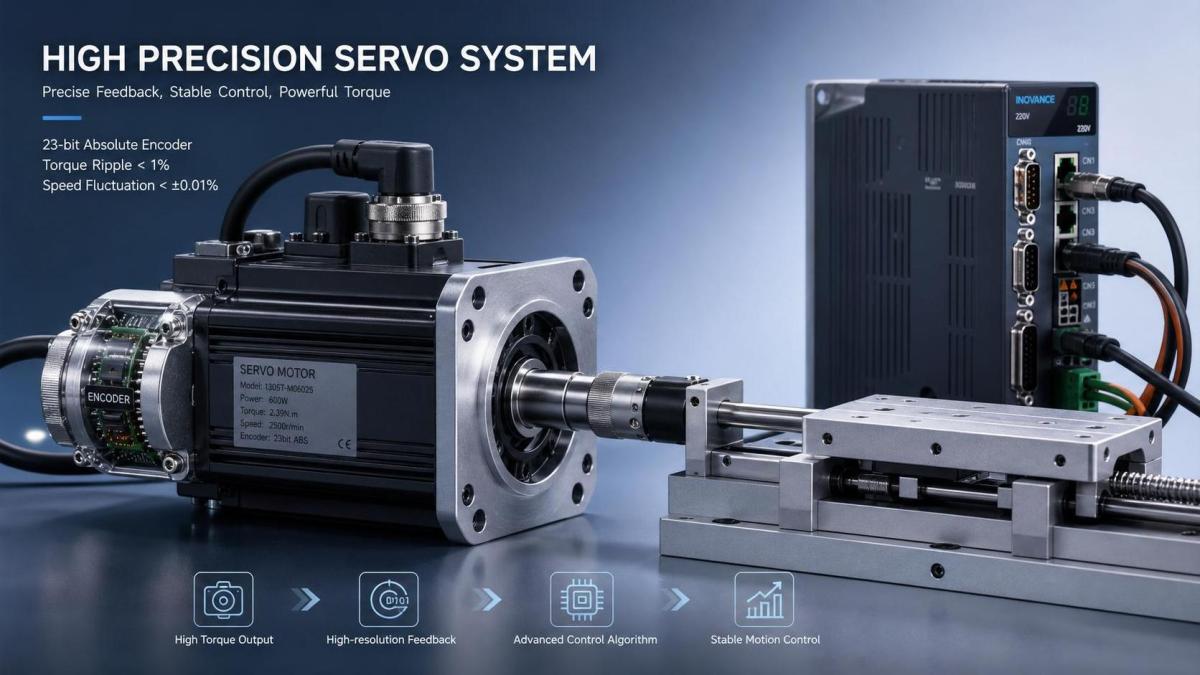
Choosing the right industrial servo motor with encoder shapes the stability, accuracy, and service life of a motion system.
A poor match often looks acceptable during trials, then drifts under real load, heat, vibration, or duty cycle pressure.
That is why selection should start with engineering facts, not catalog claims.
For an industrial servo motor with encoder, torque and speed are only part of the decision.
Feedback resolution, signal integrity, thermal margin, and controller compatibility usually decide long-term performance.
This also means teams should evaluate the full motion loop, not the motor in isolation.
At TechStat Vanguard, the consistent pattern is simple: parameters do not lie, and tolerances decide results.
The guide below focuses on practical selection factors that support confident precision motion control decisions.
Start with the Motion Profile, Not the Datasheet Headline
Every industrial servo motor with encoder should be evaluated against the actual axis behavior.
That includes acceleration peaks, steady-state speed, indexing frequency, dwell time, and direction changes.
Many projects fail because teams size around nominal torque instead of dynamic demand.
In actual production, inertia mismatch and repeated peak loading create more trouble than top speed limits.
Key motion inputs to define early
- Load inertia and reflected inertia at the motor shaft
- Required positioning accuracy and repeatability
- Move distance, cycle time, and settling time
- Duty cycle, ambient temperature, and enclosure conditions
- Shock loads, backlash sources, and external disturbances
Once these values are clear, the industrial servo motor with encoder can be sized on a defensible basis.
Without that discipline, selection becomes guesswork dressed as standard practice.
Encoder Type Changes the Quality of Precision Motion Control
The encoder is not a minor accessory.
In an industrial servo motor with encoder, feedback quality directly affects loop stability, positioning accuracy, and low-speed smoothness.
Broadly, teams compare incremental and absolute encoder options.
Incremental encoder
This option is common, cost-effective, and suitable for many packaging, conveyor, and general automation axes.
However, it usually needs homing after power loss.
That may be acceptable for simple machines, but risky for high-value tooling or multi-axis synchronization.
Absolute encoder
An absolute encoder preserves position reference through power cycles.
That reduces startup time and lowers the risk of referencing errors.
For semiconductor tools, CNC stages, robotics, and aerospace assemblies, this is often the safer choice.
Resolution is important, but not alone
Higher bit count looks attractive, yet resolution alone does not guarantee better motion quality.
Signal noise, interpolation quality, latency, and controller tuning also matter.
A well-integrated industrial servo motor with encoder will outperform a higher-resolution unit with weak noise immunity.
Check Torque, Inertia, and Thermal Margin Together
Selection errors usually appear where mechanical demand meets heat.
A compact industrial servo motor with encoder may meet peak torque on paper, then overheat in continuous operation.
This is especially common in dense machine layouts with poor ventilation.
Three checks that prevent undersizing
- Compare continuous torque against RMS torque, not only peak demand.
- Review inertia ratio for responsiveness and tuning stability.
- Validate thermal performance at real ambient temperature and duty cycle.
In high-precision systems, oversizing also has a cost.
It can reduce efficiency, increase current demand, and make fine control harder at low loads.
The target is not the largest industrial servo motor with encoder.
The target is the most stable one within realistic operating limits.
Communication, Drive Matching, and Signal Integrity
An industrial servo motor with encoder only performs as well as the drive and network around it.
This becomes more obvious in fast coordinated motion, where feedback delay and communication jitter can degrade accuracy.
Before approval, confirm protocol support, cable limits, shielding requirements, and diagnostic access.
Questions worth asking suppliers
- Is the encoder native to the drive, or does it rely on converters?
- What is the update rate for position feedback?
- How does the system behave under electromagnetic interference?
- What fault logs are available for field troubleshooting?
- Are spare cables, connectors, and encoder parts globally available?
These points often look secondary during procurement.
In service, they determine uptime, maintenance speed, and integration risk.
Application-Specific Priorities for an Industrial Servo Motor with Encoder
Different industries value different failure margins.
The right industrial servo motor with encoder depends on how motion quality affects the final process.
From a project perspective, this avoids generic over-specification.
It also keeps capital spending aligned with the process outcome that matters most.
Common Selection Risks That Surface Too Late
Several recurring issues appear after factory acceptance, not before.
That delay makes them expensive.
Watch for these problems
- Encoder resolution exceeds process need, but noise immunity is weak.
- Motor sizing ignores gearbox losses or coupling stiffness.
- Catalog torque assumes cooling conditions unavailable on site.
- Servo tuning is validated with empty load, not production load.
- Supplier documentation lacks failure mode data and maintenance intervals.
A reliable industrial servo motor with encoder should hold performance under the worst credible operating case.
That benchmark is far more useful than a polished brochure.
A Practical Evaluation Framework Before Final Approval
When comparing suppliers, use a short scoring model.
That keeps the industrial servo motor with encoder decision tied to measurable criteria.
- Define required torque, speed, accuracy, and thermal duty.
- Select encoder type based on restart behavior and traceability needs.
- Verify drive, controller, and fieldbus compatibility.
- Request data on vibration, temperature, and endurance testing.
- Run a loaded validation test with realistic cycle conditions.
- Score lifecycle support, spare parts access, and failure diagnostics.
This approach reflects the TSV view that procurement quality improves when engineering evidence leads the discussion.
It shortens rework cycles and improves supplier confidence.
Final Decision: Choose for Stability Over Spec Sheet Theater
The best industrial servo motor with encoder is the one that stays accurate, tunable, and supportable across real operating conditions.
That usually means balancing encoder performance, mechanical fit, thermal headroom, and control integration with equal discipline.
In practical terms, selection should answer one question clearly.
Can this motion system hold its target precision after installation, scaling, and months of production stress?
When the answer is based on measured data, the industrial servo motor with encoder becomes a controlled investment, not a hidden risk.
That is the standard worth using before any final purchase decision.
Search News
Hot Articles
- Carbon Fiber StructuresHow to Specify Aerospace Carbon Fiber Assemblies for Lightweight, Load-Bearing PartsJul 11, 2026
- Machine VisionXiaomi, Alibaba DAMO Academy Drive Open-Source Robotics Model Ecosystem, Lowering Algorithm Development Barriers for Overseas SMEs Adopting Chinese Robotics SolutionsMar 30, 2026
- Cobots & ArmsShanxi 'AI+' Conference Showcases Embodied Intelligence with Multinational Buyer Engagement: Key Industry ImplicationsMar 30, 2026
Popular Tags
Recommended News
 Jul 11, 2026How to Specify Aerospace Carbon Fiber Assemblies for Lightweight, Load-Bearing PartsAerospace carbon fiber assemblies: learn how to specify laminate design, load data, joining methods, and inspection controls for lighter, reliable load-bearing aerospace parts.Elena Rostova (UAV Systems Researcher)
 Mar 30, 2026Xiaomi, Alibaba DAMO Academy Drive Open-Source Robotics Model Ecosystem, Lowering Algorithm Development Barriers for Overseas SMEs Adopting Chinese Robotics SolutionsXiaomi & Alibaba DAMO Academy's open-source robotics models lower algorithm barriers for global SMEs. Boost efficiency in manufacturing, logistics & smart retail with ROS 2 compatible solutions.TSV Data Lab
 Mar 30, 2026Shanxi 'AI+' Conference Showcases Embodied Intelligence with Multinational Buyer Engagement: Key Industry ImplicationsShanxi 'AI+' Conference highlights embodied intelligence with Tesla, Ubtech & Jiantao showcasing multimodal robotics. 40+ global buyers validated tech on-site, creating new B2B channels for industrial automation & AI solutions.Chen Wei (Automation Lead Engineer)
 Mar 30, 2026Zhongguancun Unveils 6G Integrated Sensing-Computing-Intelligence Platform to Empower Embodied Robots for Global Industrial ApplicationsZhongguancun's new 6G platform revolutionizes industrial robotics with <10ms latency, empowering global automotive, logistics & port automation. Discover how this tech boosts China's smart manufacturing exports.TSV Data Lab
 Mar 30, 2026Mech-Mind Tianjin Embodied Intelligence R&D and Production Base Goes Live, Cutting Delivery Time by 20%–30% for Global Customized AMR+Vision SolutionsMech-Mind's Tianjin AMR+Vision production base cuts delivery time by 20%-30% for欧美 & Latin American markets. Discover how this PLd-certified facility accelerates customized robotics solutions for smart manufacturing and logistics.Chen Wei (Automation Lead Engineer)
 Mar 30, 2026Boao Forum Reveals 'Co-evolution of Big and Small Brains' Trend in Humanoid Robots, China's Embodied Intelligence Accelerates Adaptation to Overseas Manufacturing Service ScenariosDiscover how China's humanoid robots, featuring 'Co-evolution of Big and Small Brains,' are revolutionizing global manufacturing. Learn about Embodied Tian Gong 3.0's ISO compliance and overseas deployment at Boao Forum 2026.Chen Wei (Automation Lead Engineer)
 Mar 30, 2026China Railway Industrial Secures Patent for Embodied Robotics in Material Handling, Boosting High-Precision Delivery Capabilities for Overseas Infrastructure and Manufacturing ProjectsChina Railway Industrial's new patent for embodied robotics in material handling boosts high-precision delivery for global infrastructure & manufacturing. Discover how this innovation enhances logistics accuracy in automotive, rail transit & EPC projects.Chen Wei (Automation Lead Engineer)
 Sep 27, 2026How to Select Wall-Mount Edge Devices for Space-Constrained Factory NetworksWall mount edge devices for space-constrained factories: evaluate workload, thermal design, power resilience, cable access, and network reliability for smarter deployments.TSV Data Lab
 Sep 26, 2026Machining Tolerance Analysis: How to Set Limits That Meet Function and Cost TargetsMachining tolerance analysis: learn how to set functional limits, control tolerance stacks, reduce inspection risk, and balance precision with production cost.Dr. Marcus Vance
 Sep 25, 2026How to Evaluate an Industrial Infrastructure Data Platform for Multi-Site OperationsIndustrial infrastructure data platform evaluation guide for multi-site operations: compare data quality, edge resilience, interoperability, governance, and scalable proof-of-value criteria.Victor Lin (Chief Software Architect)
 Sep 24, 2026How to Select Machine Vision Optics for Accurate Inspection at Different Working DistancesMachine vision optics selection guide for accurate inspection at every working distance. Compare FOV, pixel scale, DOF, distortion, lighting, and telecentric options.TSV Data Lab
 Sep 23, 2026How to Evaluate a Machine Vision System Integrator for High-Speed Inspection LinesChoose a machine vision system integrator with proven expertise in high-speed inspection, reliable reject timing, robust optics, and measurable acceptance criteria.TSV Data Lab
 Sep 27, 2026How SCADA data integration improves traceability across production linesSCADA data integration connects production-line data to improve traceability, accelerate quality investigations, and strengthen safety decisions.Victor Lin (Chief Software Architect)
 Sep 26, 2026What to define before starting SCADA integration planningSCADA integration planning starts with clear scope, control boundaries, data models, cybersecurity, and testing. Discover the definitions that reduce risk and costly rework.Victor Lin (Chief Software Architect)
 Sep 25, 2026How a smart factory with Industrial IoT reduces production blind spotsDiscover how a smart factory with Industrial IoT turns real-time machine, quality, and workflow data into actionable insights that reduce production blind spots and delivery risks.Victor Lin (Chief Software Architect)
 Sep 24, 2026When does Industrial IoT make smart manufacturing easier to scale?Smart manufacturing Industrial IoT scales when trusted data, interoperable systems, and secure workflows turn connected assets into measurable gains.TSV Data Lab
 Sep 23, 2026What drives ultra-precision machining cost at 1-micron tolerance?Ultra precision machining cost per part at 1 micron tolerance depends on process, material, metrology, and yield. Learn how to compare quotes confidently.Dr. Marcus Vance
 Sep 22, 2026Drone Engine-T550CC Applications: Build the UAV Power System Around the MissionAn application guide for Drone Engine-T550CC integration, covering payload planning, airframe matching, cooling, fuel, vibration, test procedures, documentation, and service preparation.Elena Rostova (UAV Systems Researcher)
 Sep 22, 2026How to Evaluate Industrial Edge Computing Vendors for Factory DeploymentIndustrial edge computing vendor evaluation guide for factories: compare latency, protocol fit, reliability, security, and lifecycle support before deployment.TSV Data Lab
 Sep 21, 2026Drone Payload Integration: Matching Power, Data, and Center of Gravity for Reliable FlightsDrone payload integration made practical: balance power, data, center of gravity, and endurance to build safer, more reliable mission-ready flights.Elena Rostova (UAV Systems Researcher)
 Sep 20, 2026Autonomous Navigation Pricing: Cost Drivers and Budget Benchmarks for AMR ProjectsAutonomous navigation price explained: compare AMR cost drivers, software, sensors, integration, safety, and lifecycle budgets to build a scalable project plan.Chen Wei (Automation Lead Engineer)
 Sep 19, 2026How to Scope Automation Integration Services for Multi-System Factory ProjectsAutomation integration services: learn how to scope multi-system factory projects with clear workflows, interface contracts, safety boundaries, and acceptance criteria.Victor Lin (Chief Software Architect)
 Sep 18, 2026Selecting UAV Aerospace Structural Parts for Strength, Weight, and Fatigue LifeUAV aerospace structural parts guide: compare strength, weight, stiffness, fatigue life, joints, and traceability to select reliable flight-ready components.Elena Rostova (UAV Systems Researcher)
 Sep 17, 2026Selecting Commercial Drone Payloads for European Inspection ProjectsCommercial drone payloads Europe: learn how to select RGB, thermal and LiDAR systems for compliant, reliable inspection data and better project outcomes.Elena Rostova (UAV Systems Researcher)