How MTBF Changes for Servo Motors in Harsh Heat and Dust
Publication Date
author
For after-sales maintenance teams, understanding servo motors MTBF under extreme conditions is critical when heat, dust, and continuous duty push systems beyond nominal ratings. This article examines how harsh environments accelerate wear, destabilize performance, and shorten service intervals, helping you identify failure patterns earlier and make data-driven maintenance decisions that reduce downtime and protect equipment reliability.
A checklist-based approach works best because MTBF does not collapse for one reason alone. In the field, servo motors fail sooner when temperature, airborne contaminants, load profile, enclosure quality, cable routing, and maintenance intervals interact. For after-sales personnel, the fastest path to better uptime is not a theoretical definition of reliability, but a practical sequence: confirm operating stress, inspect contamination paths, verify thermal margins, compare actual duty to rated duty, and then adjust maintenance actions based on evidence. That is the most useful way to evaluate servo motors MTBF under extreme conditions without guessing.
Start Here: The First Checks That Explain Most MTBF Loss
Before replacing parts or blaming the motor itself, maintenance teams should confirm whether the environment is forcing the servo system outside its realistic reliability window. In harsh heat and dust, even a premium motor can show reduced Mean Time Between Failures if installation, sealing, or cooling assumptions no longer match site conditions.
- Check ambient temperature against the motor, encoder, brake, and drive specifications, not just the headline motor rating. Encoders and insulation systems often become the limiting factor first.
- Verify cabinet temperature during peak production, because servo drive heat can raise the motor’s effective thermal stress even if room temperature seems acceptable.
- Inspect dust type and particle behavior. Conductive dust, abrasive dust, oily dust, and hygroscopic dust create very different failure risks.
- Review actual duty cycle, peak torque duration, acceleration frequency, and overload events from machine logs.
- Confirm enclosure integrity, connector sealing, fan condition, air filter loading, and cable gland quality.
- Compare field cleaning intervals with contamination rates. If dust accumulation is faster than the planned service schedule, MTBF will drop even when hardware is technically compliant.
These first checks usually reveal whether the root cause is thermal overload, contamination ingress, lubrication degradation, insulation aging, or unstable feedback from a compromised encoder. Each mechanism directly affects servo motors MTBF under extreme conditions.
How Harsh Heat Changes Servo Motor Reliability
Heat shortens MTBF mainly by accelerating all the wear processes that are already present at lower temperatures. Insulation ages faster, bearing grease oxidizes sooner, magnets can lose performance margin, brake friction material deteriorates, and encoder electronics become less stable. The key point for after-sales teams is that thermal damage is often cumulative and not immediately visible.
Thermal warning signs worth prioritizing
- Frequent overtemperature alarms during high-load cycles but not during idle or low-speed operation.
- Rising motor current for the same motion profile, suggesting increased friction or reduced efficiency.
- Discolored connectors, hardened cable jackets, or brittle insulation near hot zones.
- Unexpected encoder faults or drifting feedback after long continuous runs.
- Brake release delays, holding torque inconsistency, or repeat faults after hot restarts.
Maintenance teams should also remember that local heat is often more harmful than average ambient temperature. A motor mounted close to furnaces, compressors, or enclosed process equipment may experience radiant heating and reduced air circulation. In these cases, the published MTBF from controlled laboratory assumptions can differ sharply from the field result.
How Dust Reduces MTBF Faster Than Many Sites Expect
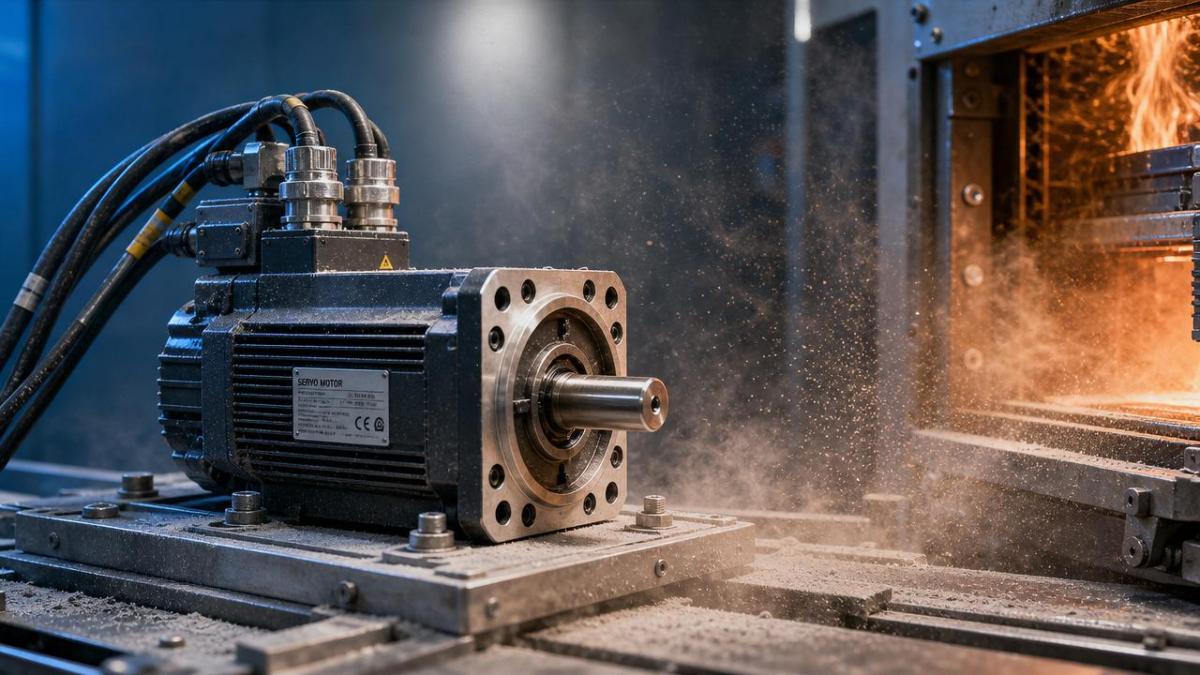
Dust is not a minor housekeeping issue. It changes cooling efficiency, attacks seals, contaminates bearings, interferes with encoder signals, and increases the chance of electrical tracking or connector corrosion. For servo motors MTBF under extreme conditions, dust severity should be judged by composition, concentration, and exposure duration rather than by visible appearance alone.
Different dust types create different failure patterns
Abrasive mineral dust tends to wear seals and bearing interfaces. Conductive metallic dust can create short circuits or unstable feedback signals. Oily dust traps heat and blocks cooling surfaces. Organic dust may absorb moisture and promote corrosion. Fine dust is especially dangerous because it penetrates weak seals and connectors more easily than coarse particles.
The practical lesson is simple: if a site reports repeated encoder alarms, elevated bearing noise, or unexplained thermal trips, dust should be treated as a system-level reliability variable, not just a cleaning issue. That is particularly true in woodworking, foundry, cement, agricultural processing, packaging, and outdoor mobile equipment applications.
Field Checklist: Judge Servo Motors MTBF Under Extreme Conditions More Accurately
Use the following checklist when you need a fast but disciplined reliability assessment. It helps maintenance teams decide whether the observed MTBF decline comes from environment, duty mismatch, or a specific component weakness.
- Record actual thermal exposure: Measure ambient temperature, cabinet temperature, motor case temperature, and temperature variation across the shift. Spot checks are less useful than trend data.
- Map contamination entry points: Inspect shaft seals, connectors, fan paths, cable glands, terminal boxes, and damaged conduit interfaces.
- Review motion profile data: Compare real acceleration, deceleration, overload duration, and standstill holding torque with the original design assumptions.
- Check power quality and drive tuning: Poor tuning, current ripple, or unstable supply can raise temperature and vibration, indirectly reducing MTBF.
- Assess bearing condition: Listen for rising noise, check vibration trend, and confirm whether grease life is realistic for the site temperature.
- Evaluate encoder reliability: Look for intermittent feedback faults, thermal drift, contamination around interfaces, or cable shielding damage.
- Confirm enclosure suitability: IP rating on paper is not enough if covers are warped, filters are saturated, or maintenance access points are left unsealed.
- Review cleaning practices: High-pressure air can force dust deeper into sensitive zones; incorrect solvents can damage seals and cable jackets.
- Compare failure intervals by season: If summer failures or dry-season failures spike, environmental stress is likely dominating MTBF.
- Separate motor failure from system failure: Sometimes the motor is blamed when the real problem is cooling design, gearbox load, misalignment, or cabinet contamination.
Quick Reference Table for Maintenance Decisions
Scenario Differences: What to Check by Application Type
Not every harsh environment damages servo systems in the same way. After-sales teams should adjust their checklist based on application context instead of using one generic reliability assumption.
Indoor production lines with heat buildup
Focus on cabinet airflow, filter maintenance, duty spikes, regenerative heat around drives, and machine spacing. Many MTBF complaints originate from poor thermal layout rather than defective motors.
Dust-heavy processing sites
Prioritize seal wear, connector cleanliness, fan path contamination, and abrasive residue around shafts. Review whether cleaning methods are pushing contaminants inward.
Outdoor or semi-outdoor equipment
Look at daily thermal cycling, UV exposure on cables, moisture mixed with dust, and shutdown periods that allow condensation. These factors can sharply alter servo motors MTBF under extreme conditions even if average operating hours are moderate.
Commonly Overlooked Risks That Distort MTBF Analysis
Several issues cause maintenance teams to misread the real failure mechanism. First, many sites rely on nominal ambient temperature instead of peak localized temperature. Second, replacement history may group encoder, cable, brake, and motor body failures into one category, making trends harder to diagnose. Third, downtime logs often ignore contamination level and cleaning events, even though those events strongly influence failure timing.
Another overlooked point is maintenance-induced damage. Over-tightened connectors, damaged seals during inspection, aggressive compressed-air cleaning, and incorrect relubrication intervals can all lower reliability. If you want a realistic view of servo motors MTBF under extreme conditions, your records must distinguish environmental wear from service-related disturbances.
Execution Plan: What After-Sales Teams Should Do Next
A useful field plan should be simple enough to execute consistently and detailed enough to support engineering decisions. Start by selecting a small set of critical assets with repeat failures or high downtime cost. Then collect comparable data for at least one operating cycle or one seasonal period.
- Create a site-specific MTBF worksheet that includes ambient heat, case temperature, dust type, load profile, alarm code, and maintenance action.
- Set threshold-based inspections, such as cleaning when dust loading exceeds a visible benchmark or when temperature trend rises above a defined delta.
- Coordinate with operations to identify process changes that increased thermal or contamination exposure.
- Escalate repeated failures with evidence: trend logs, photos of ingress points, vibration data, and event timing.
- Reassess spare parts strategy. In harsh sites, stocking feedback cables, seals, fans, and encoders may reduce downtime more than stocking motor bodies alone.
FAQ for Faster Maintenance Decisions
Does a higher IP rating automatically guarantee better MTBF?
No. A suitable IP rating helps, but real MTBF depends on installation quality, seal condition, cable entry protection, cleaning practice, and thermal management.
Should we treat encoder faults as separate from motor MTBF?
For component analysis, yes. For machine availability, no. After-sales teams should track both component-level and system-level failure intervals.
When should we move from standard maintenance to redesign or re-specification?
If repeated failures continue after cleaning, sealing, cooling, and tuning improvements, the original motor, encoder, enclosure, or duty rating may no longer fit the real environment.
Final Action Guide
The most practical way to improve servo motors MTBF under extreme conditions is to stop treating heat and dust as background issues and start documenting them as primary reliability drivers. For after-sales maintenance teams, the priority is clear: confirm real thermal exposure, identify contamination paths, compare actual duty to rating assumptions, and update service intervals based on measured evidence instead of fixed schedules.
If you need to move from troubleshooting to a more durable solution, prepare the following information before discussing next steps with engineering, procurement, or suppliers: operating temperature range, dust composition, enclosure details, seasonal failure pattern, alarm history, load profile, cleaning method, spare parts consumption, and expected uptime target. With those inputs, it becomes much easier to evaluate parameter suitability, maintenance cycle changes, replacement options, budget impact, and long-term service strategy with confidence.
Search News
Hot Articles
- Carbon Fiber StructuresHow to Specify Aerospace Carbon Fiber Assemblies for Lightweight, Load-Bearing PartsJul 11, 2026
- Machine VisionXiaomi, Alibaba DAMO Academy Drive Open-Source Robotics Model Ecosystem, Lowering Algorithm Development Barriers for Overseas SMEs Adopting Chinese Robotics SolutionsMar 30, 2026
- Cobots & ArmsShanxi 'AI+' Conference Showcases Embodied Intelligence with Multinational Buyer Engagement: Key Industry ImplicationsMar 30, 2026
Popular Tags
Recommended News
 Jul 11, 2026How to Specify Aerospace Carbon Fiber Assemblies for Lightweight, Load-Bearing PartsAerospace carbon fiber assemblies: learn how to specify laminate design, load data, joining methods, and inspection controls for lighter, reliable load-bearing aerospace parts.Elena Rostova (UAV Systems Researcher)
 Mar 30, 2026Xiaomi, Alibaba DAMO Academy Drive Open-Source Robotics Model Ecosystem, Lowering Algorithm Development Barriers for Overseas SMEs Adopting Chinese Robotics SolutionsXiaomi & Alibaba DAMO Academy's open-source robotics models lower algorithm barriers for global SMEs. Boost efficiency in manufacturing, logistics & smart retail with ROS 2 compatible solutions.TSV Data Lab
 Mar 30, 2026Shanxi 'AI+' Conference Showcases Embodied Intelligence with Multinational Buyer Engagement: Key Industry ImplicationsShanxi 'AI+' Conference highlights embodied intelligence with Tesla, Ubtech & Jiantao showcasing multimodal robotics. 40+ global buyers validated tech on-site, creating new B2B channels for industrial automation & AI solutions.Chen Wei (Automation Lead Engineer)
 Mar 30, 2026Zhongguancun Unveils 6G Integrated Sensing-Computing-Intelligence Platform to Empower Embodied Robots for Global Industrial ApplicationsZhongguancun's new 6G platform revolutionizes industrial robotics with <10ms latency, empowering global automotive, logistics & port automation. Discover how this tech boosts China's smart manufacturing exports.TSV Data Lab
 Mar 30, 2026Mech-Mind Tianjin Embodied Intelligence R&D and Production Base Goes Live, Cutting Delivery Time by 20%–30% for Global Customized AMR+Vision SolutionsMech-Mind's Tianjin AMR+Vision production base cuts delivery time by 20%-30% for欧美 & Latin American markets. Discover how this PLd-certified facility accelerates customized robotics solutions for smart manufacturing and logistics.Chen Wei (Automation Lead Engineer)
 Mar 30, 2026Boao Forum Reveals 'Co-evolution of Big and Small Brains' Trend in Humanoid Robots, China's Embodied Intelligence Accelerates Adaptation to Overseas Manufacturing Service ScenariosDiscover how China's humanoid robots, featuring 'Co-evolution of Big and Small Brains,' are revolutionizing global manufacturing. Learn about Embodied Tian Gong 3.0's ISO compliance and overseas deployment at Boao Forum 2026.Chen Wei (Automation Lead Engineer)
 Mar 30, 2026China Railway Industrial Secures Patent for Embodied Robotics in Material Handling, Boosting High-Precision Delivery Capabilities for Overseas Infrastructure and Manufacturing ProjectsChina Railway Industrial's new patent for embodied robotics in material handling boosts high-precision delivery for global infrastructure & manufacturing. Discover how this innovation enhances logistics accuracy in automotive, rail transit & EPC projects.Chen Wei (Automation Lead Engineer)
 Sep 29, 2026ISO 9283 Repeatability: How to Evaluate Cobot Positioning PerformanceISO 9283 cobot repeatability explained: learn how payload, reach, approach direction, and test conditions affect positioning performance and cell capability.Chen Wei (Automation Lead Engineer)
 Sep 28, 2026Spindle Runout Measurement in Germany: DIN Standards, Methods, and Acceptance LimitsSpindle runout measurement Germany: explore DIN standards, proven methods, acceptance limits, and audit-ready practices for reliable machining quality.Dr. Marcus Vance
 Sep 27, 2026How to Select Wall-Mount Edge Devices for Space-Constrained Factory NetworksWall mount edge devices for space-constrained factories: evaluate workload, thermal design, power resilience, cable access, and network reliability for smarter deployments.TSV Data Lab
 Sep 26, 2026Machining Tolerance Analysis: How to Set Limits That Meet Function and Cost TargetsMachining tolerance analysis: learn how to set functional limits, control tolerance stacks, reduce inspection risk, and balance precision with production cost.Dr. Marcus Vance
 Sep 25, 2026How to Evaluate an Industrial Infrastructure Data Platform for Multi-Site OperationsIndustrial infrastructure data platform evaluation guide for multi-site operations: compare data quality, edge resilience, interoperability, governance, and scalable proof-of-value criteria.Victor Lin (Chief Software Architect)
 Sep 24, 2026How to Select Machine Vision Optics for Accurate Inspection at Different Working DistancesMachine vision optics selection guide for accurate inspection at every working distance. Compare FOV, pixel scale, DOF, distortion, lighting, and telecentric options.TSV Data Lab
 Sep 23, 2026How to Evaluate a Machine Vision System Integrator for High-Speed Inspection LinesChoose a machine vision system integrator with proven expertise in high-speed inspection, reliable reject timing, robust optics, and measurable acceptance criteria.TSV Data Lab
 Sep 28, 2026When is a SCADA API the right choice for connecting plant systems?SCADA API guide: learn when governed plant data integration improves traceability, security, and scalability—without compromising real-time control.Victor Lin (Chief Software Architect)
 Sep 27, 2026How SCADA data integration improves traceability across production linesSCADA data integration connects production-line data to improve traceability, accelerate quality investigations, and strengthen safety decisions.Victor Lin (Chief Software Architect)
 Sep 26, 2026What to define before starting SCADA integration planningSCADA integration planning starts with clear scope, control boundaries, data models, cybersecurity, and testing. Discover the definitions that reduce risk and costly rework.Victor Lin (Chief Software Architect)
 Sep 25, 2026How a smart factory with Industrial IoT reduces production blind spotsDiscover how a smart factory with Industrial IoT turns real-time machine, quality, and workflow data into actionable insights that reduce production blind spots and delivery risks.Victor Lin (Chief Software Architect)
 Sep 24, 2026When does Industrial IoT make smart manufacturing easier to scale?Smart manufacturing Industrial IoT scales when trusted data, interoperable systems, and secure workflows turn connected assets into measurable gains.TSV Data Lab
 Sep 23, 2026What drives ultra-precision machining cost at 1-micron tolerance?Ultra precision machining cost per part at 1 micron tolerance depends on process, material, metrology, and yield. Learn how to compare quotes confidently.Dr. Marcus Vance
 Sep 22, 2026Drone Engine-T550CC Applications: Build the UAV Power System Around the MissionAn application guide for Drone Engine-T550CC integration, covering payload planning, airframe matching, cooling, fuel, vibration, test procedures, documentation, and service preparation.Elena Rostova (UAV Systems Researcher)
 Sep 22, 2026How to Evaluate Industrial Edge Computing Vendors for Factory DeploymentIndustrial edge computing vendor evaluation guide for factories: compare latency, protocol fit, reliability, security, and lifecycle support before deployment.TSV Data Lab
 Sep 21, 2026Drone Payload Integration: Matching Power, Data, and Center of Gravity for Reliable FlightsDrone payload integration made practical: balance power, data, center of gravity, and endurance to build safer, more reliable mission-ready flights.Elena Rostova (UAV Systems Researcher)
 Sep 20, 2026Autonomous Navigation Pricing: Cost Drivers and Budget Benchmarks for AMR ProjectsAutonomous navigation price explained: compare AMR cost drivers, software, sensors, integration, safety, and lifecycle budgets to build a scalable project plan.Chen Wei (Automation Lead Engineer)