
High precision servo drive supplier evaluation starts with heat
Publication Date
author
When evaluating a high precision servo drive supplier, heat is not a side issue—it is the first engineering truth to verify. For procurement teams, operators, and technical decision-makers comparing an industrial servo motor supplier, thermal stability directly affects MTBF, backlash control, repeatability, and long-cycle reliability across robotics, AGV, and CNC automation systems.
The core search intent behind this topic is practical supplier evaluation: readers want to know how to judge whether a servo drive supplier can maintain precision under thermal stress, not just whether their brochure looks convincing. The most important questions are straightforward: What thermal data should be requested? How does heat influence performance drift and failure risk? Which supplier claims matter, and which are just marketing language? If a buyer needs to shortlist a high precision servo drive supplier, the fastest path is to examine how the drive behaves when temperature rises, when ambient conditions worsen, and when duty cycles stay high for extended periods.
Why heat is the first filter in high precision servo drive supplier evaluation
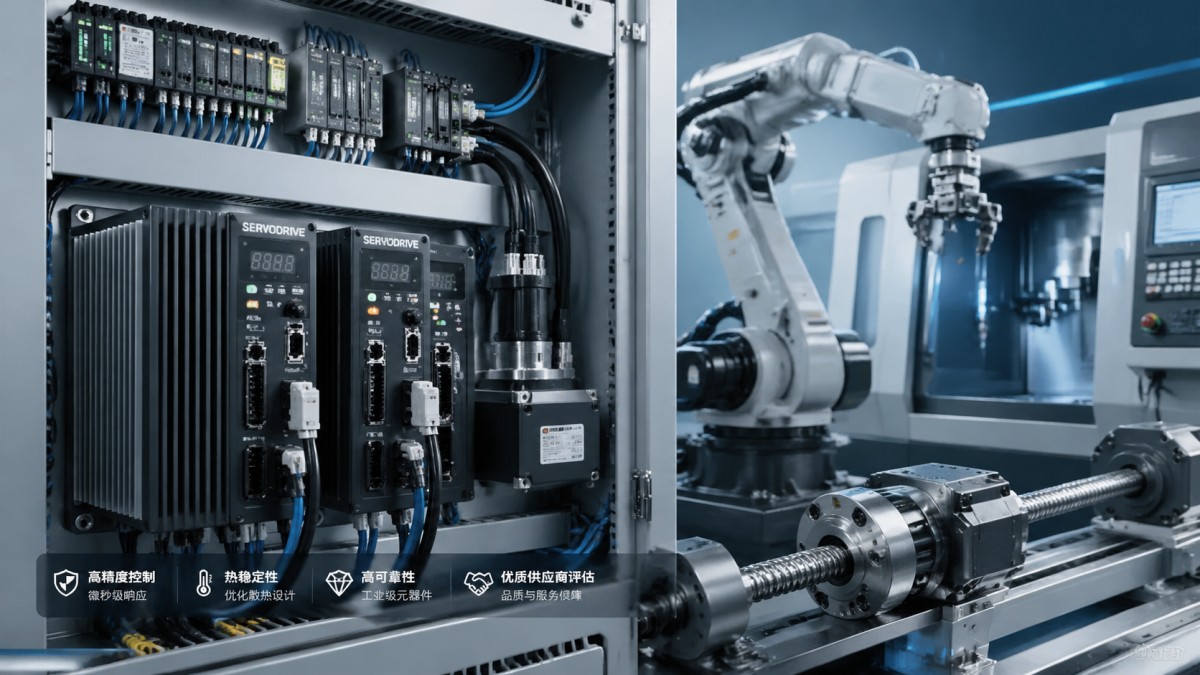
Heat reveals what static specifications often hide. A servo drive may look excellent on paper at room temperature and under short test conditions, but actual industrial use rarely stays in that comfort zone. In robot joints, CNC feed axes, packaging lines, and AGV traction systems, drives operate under changing loads, rapid acceleration and deceleration, confined cabinet airflow, and long duty cycles. Under these conditions, thermal behavior becomes a direct indicator of engineering quality.
For buyers and technical evaluators, this matters because thermal instability affects several business-critical outcomes:
- Precision drift: rising temperature can alter current control accuracy and loop stability, reducing repeatability.
- Component life: capacitors, power semiconductors, and control boards degrade faster at elevated temperatures.
- Unexpected downtime: frequent thermal alarms or derating events lead to production interruption.
- System-level risk: excess heat in the drive cabinet can influence neighboring PLC, I/O, and power modules.
- Total cost of ownership: cooling redesign, maintenance, and shorter replacement cycles increase lifecycle cost.
In other words, if a supplier cannot show stable thermal performance, it is difficult to trust claims about high precision, high reliability, or long MTBF. Heat is often the earliest measurable sign of whether a supplier truly understands power electronics, control tuning, packaging design, and real-world industrial operation.
What target readers actually care about when comparing an industrial servo motor supplier
Different roles view the same supplier through different risks, but the thermal question connects all of them.
Information researchers want a structured way to compare suppliers beyond vague adjectives such as “high efficiency” or “industrial grade.” They need concrete parameters and an evaluation framework.
Operators and maintenance teams care about whether the drive runs cool enough to avoid nuisance alarms, unstable motion, or repeated shutdowns. They also want to know whether thermal issues are easy to diagnose in the field.
Procurement teams want to reduce supplier qualification risk. They need to identify whether a lower quoted price hides future failure cost, support delays, or non-compliance with actual operating conditions.
Business decision-makers and engineering leaders care about long-term production stability, warranty exposure, line uptime, and whether the supplier can support global scaling with consistent quality.
That means the article should not spend too much space on generic explanations of what a servo drive is. The valuable content is how to evaluate thermal performance, what evidence to request, how to detect weak suppliers early, and how heat links directly to precision, reliability, and procurement risk.
Which thermal indicators actually help you judge supplier quality
If you are evaluating a high precision servo drive supplier, ask for measurable thermal evidence rather than marketing claims. The following indicators are far more useful than broad statements about performance.
1. Rated output under defined ambient temperature
A serious supplier should specify rated and peak performance under clear ambient conditions such as 40°C, 45°C, or 50°C. If performance is only quoted at ideal laboratory temperature, the data is incomplete.
2. Derating curve
Request the output derating profile as ambient temperature rises. This tells you whether the drive can sustain application demand in enclosed cabinets, summer factory environments, or high-density installations.
3. Internal temperature monitoring strategy
Good suppliers can explain where temperatures are monitored, how protection thresholds are defined, and whether thermal data can be read through software or industrial communication protocols.
4. Continuous current vs peak current thermal behavior
Many drives advertise impressive peak current figures. What matters in actual use is how long that peak can be sustained before thermal limiting begins, and how the drive recovers during repeated cycles.
5. Thermal test reports under real duty cycles
Ask for validation data under representative motion profiles: acceleration-heavy robotics, repetitive pick-and-place, spindle positioning, AGV stop-start duty, or long CNC feed movements. This is much more meaningful than unloaded bench data.
6. Cooling architecture
Suppliers should clearly explain whether the design uses passive cooling, forced air, heat sink optimization, backplane heat extraction, or cabinet-assisted thermal design. Better thermal engineering is usually visible in the architecture.
7. Failure rate and field return patterns related to heat
For procurement and management teams, this is especially important. Ask what percentage of field failures are temperature-related, what root causes were identified, and what corrective actions were implemented.
How heat affects precision, repeatability, and long-cycle reliability
Thermal behavior is not only about avoiding shutdown. In precision automation, temperature affects the quality of control itself. A servo drive experiencing thermal stress may still run, but run worse.
Common effects include:
- Current loop variation: as components heat up, electrical characteristics shift, potentially affecting current control accuracy.
- Torque consistency loss: fluctuating thermal conditions can reduce stable torque delivery during dynamic motion.
- Positioning repeatability degradation: in tightly controlled applications, even small control deviations can accumulate into visible performance loss.
- Encoder and feedback interaction issues: if system integration is poor, heat can amplify noise sensitivity and reduce motion smoothness.
- Accelerated aging: repeated high-temperature cycles stress solder joints, capacitors, and semiconductors, reducing long-term reliability.
For robotics and CNC users, this often appears as harder-to-explain problems: tolerance drift after long operation, unstable contouring performance, occasional following errors, or increased tuning sensitivity. For AGV and automation line operators, it may show up as intermittent protection trips during high-load periods. These are not always application problems. Very often, they are supplier thermal design problems.
Questions procurement teams should ask before approving a servo drive supplier
Procurement teams do not need to become thermal simulation experts, but they do need a disciplined supplier questioning process. These questions help expose weak technical foundations quickly:
- At what ambient temperature is the drive’s rated current guaranteed?
- What derating occurs at higher cabinet temperatures?
- Can you provide thermal imaging, endurance test, or burn-in validation reports?
- How is thermal protection triggered, and what warning signals are available before shutdown?
- What is the recommended cabinet clearance, airflow, and mounting orientation?
- How does the drive perform in continuous high-duty applications rather than intermittent loads?
- What is the expected lifetime of key thermal-sensitive components such as electrolytic capacitors?
- What thermal failure trends have appeared in field deployments similar to ours?
- Can your technical support team help validate heat load in our control cabinet layout?
Strong suppliers usually answer these questions with data, graphs, design notes, and application-specific guidance. Weak suppliers often respond with general claims or insist that “standard industrial environments” are not a problem. That is a warning sign.
How operators and engineers can verify thermal quality during pilot testing
If you are in the testing, commissioning, or operation stage, supplier evaluation should not stop at catalog review. A short pilot test can reveal whether the thermal design is genuinely robust.
During evaluation, pay attention to the following:
- Measure cabinet temperature rise during peak and steady-state operation.
- Track whether the drive surface and heat sink temperature stabilize or continue climbing.
- Observe whether control performance changes after extended runtime.
- Check for alarms, derating, fan overactivity, or sudden protective behavior.
- Compare morning cold-start performance with performance after several hours.
- Review software logs for thermal warnings and current limiting events.
This is especially important in compact automation cabinets, mobile equipment, dusty workshops, and high-ambient production sites. A drive that passes a short demonstration may still fail under realistic thermal loading. Real supplier quality is visible only when the system is pushed close to actual operating conditions.
Red flags that suggest a servo drive supplier may not be suitable
In the market for industrial servo motor suppliers, some patterns repeatedly indicate elevated risk. Watch for these issues:
- Specifications without test conditions or ambient temperature references
- Large claims about precision but no endurance or thermal stability data
- Peak performance emphasized while continuous output is unclear
- No guidance on cabinet integration, cooling, or spacing
- Limited diagnostics for internal temperature or thermal history
- Support teams unable to explain thermal protection logic
- Very low pricing combined with vague reliability commitments
- No case evidence in applications with similar duty cycles
None of these automatically disqualify a supplier, but together they suggest a greater probability of hidden lifecycle cost. For enterprise buyers, this is where a technically “cheap” supplier can become commercially expensive.
What a strong high precision servo drive supplier should provide
A capable supplier does more than sell hardware. They reduce engineering uncertainty. In thermal terms, that usually means they can provide:
- Clear thermal specifications with defined test boundaries
- Derating curves and application notes for cabinet design
- Evidence from lifecycle, endurance, and stress testing
- Diagnostic visibility for internal thermal status
- Failure analysis discipline and documented corrective actions
- Support for motion tuning under real thermal conditions
- Cross-functional coordination between sales, application engineering, and after-sales teams
This is where supplier evaluation shifts from product comparison to supply chain trust assessment. A supplier that understands thermal behavior deeply is usually better positioned to support precision, uptime, maintainability, and global deployment consistency.
Conclusion: if the heat story is weak, the supplier story is incomplete
For anyone evaluating a high precision servo drive supplier, heat should be one of the first technical filters, not a final checklist item. Thermal stability influences precision retention, long-cycle reliability, field failure rates, and the real economic value of the drive across its service life.
The practical takeaway is simple: do not evaluate an industrial servo motor supplier only by nominal power, price, or brochure-level accuracy claims. Ask how the drive behaves when temperatures rise, when runtime extends, and when installation conditions are less than ideal. Suppliers that can answer with real data, transparent limits, and application-level guidance are far more likely to deliver dependable precision in the field.
In hard-tech procurement, parameters do not lie. If a supplier’s thermal evidence is strong, their broader engineering credibility is usually stronger as well. If the thermal evidence is weak, treat every other performance claim with caution.
Search News
Hot Articles
- Carbon Fiber StructuresHow to Specify Aerospace Carbon Fiber Assemblies for Lightweight, Load-Bearing PartsJul 11, 2026
- Machine VisionXiaomi, Alibaba DAMO Academy Drive Open-Source Robotics Model Ecosystem, Lowering Algorithm Development Barriers for Overseas SMEs Adopting Chinese Robotics SolutionsMar 30, 2026
- Cobots & ArmsShanxi 'AI+' Conference Showcases Embodied Intelligence with Multinational Buyer Engagement: Key Industry ImplicationsMar 30, 2026
Popular Tags
Recommended News
 Jul 11, 2026How to Specify Aerospace Carbon Fiber Assemblies for Lightweight, Load-Bearing PartsAerospace carbon fiber assemblies: learn how to specify laminate design, load data, joining methods, and inspection controls for lighter, reliable load-bearing aerospace parts.Elena Rostova (UAV Systems Researcher)
 Mar 30, 2026Xiaomi, Alibaba DAMO Academy Drive Open-Source Robotics Model Ecosystem, Lowering Algorithm Development Barriers for Overseas SMEs Adopting Chinese Robotics SolutionsXiaomi & Alibaba DAMO Academy's open-source robotics models lower algorithm barriers for global SMEs. Boost efficiency in manufacturing, logistics & smart retail with ROS 2 compatible solutions.TSV Data Lab
 Mar 30, 2026Shanxi 'AI+' Conference Showcases Embodied Intelligence with Multinational Buyer Engagement: Key Industry ImplicationsShanxi 'AI+' Conference highlights embodied intelligence with Tesla, Ubtech & Jiantao showcasing multimodal robotics. 40+ global buyers validated tech on-site, creating new B2B channels for industrial automation & AI solutions.Chen Wei (Automation Lead Engineer)
 Mar 30, 2026Zhongguancun Unveils 6G Integrated Sensing-Computing-Intelligence Platform to Empower Embodied Robots for Global Industrial ApplicationsZhongguancun's new 6G platform revolutionizes industrial robotics with <10ms latency, empowering global automotive, logistics & port automation. Discover how this tech boosts China's smart manufacturing exports.TSV Data Lab
 Mar 30, 2026Mech-Mind Tianjin Embodied Intelligence R&D and Production Base Goes Live, Cutting Delivery Time by 20%–30% for Global Customized AMR+Vision SolutionsMech-Mind's Tianjin AMR+Vision production base cuts delivery time by 20%-30% for欧美 & Latin American markets. Discover how this PLd-certified facility accelerates customized robotics solutions for smart manufacturing and logistics.Chen Wei (Automation Lead Engineer)
 Mar 30, 2026Boao Forum Reveals 'Co-evolution of Big and Small Brains' Trend in Humanoid Robots, China's Embodied Intelligence Accelerates Adaptation to Overseas Manufacturing Service ScenariosDiscover how China's humanoid robots, featuring 'Co-evolution of Big and Small Brains,' are revolutionizing global manufacturing. Learn about Embodied Tian Gong 3.0's ISO compliance and overseas deployment at Boao Forum 2026.Chen Wei (Automation Lead Engineer)
 Mar 30, 2026China Railway Industrial Secures Patent for Embodied Robotics in Material Handling, Boosting High-Precision Delivery Capabilities for Overseas Infrastructure and Manufacturing ProjectsChina Railway Industrial's new patent for embodied robotics in material handling boosts high-precision delivery for global infrastructure & manufacturing. Discover how this innovation enhances logistics accuracy in automotive, rail transit & EPC projects.Chen Wei (Automation Lead Engineer)
 Oct 25, 2026Hesai Leads Global ADAS Main Lidar Shipments in Yole’s 2026 ReportHesai led global ADAS main lidar shipments with a 43% share in 2025, according to Yole’s 2026 report. Explore what this ranking reveals about its automotive market position.TSV Data Lab
 Oct 25, 2026Choosing an Aerospace Materials Manufacturer: Quality and Traceability ChecksChoosing an aerospace materials manufacturer? Learn how to verify certifications, test reports, and lot traceability to qualify suppliers confidently and reduce costly sourcing risks.Dr. Marcus Vance
 Oct 24, 2026Guotai Haitong: Global Entry-Level 3D Printer Shipments Rose 39% in Q1 2026Entry-level 3D printer shipments rose 39% in Q1 2026, Guotai Haitong reports. Explore how AI, multicolor printing and print farms are shaping market growth.Dr. Marcus Vance
 Oct 24, 2026Choosing an Industrial Vision Inspection Supplier: Acceptance Tests That MatterChoose an industrial vision inspection supplier with confidence. Discover acceptance tests for defect detection, false rejects, production speed, and reliable part rejection before you buy.TSV Data Lab
 Oct 23, 2026US Navy Raises Gecko Robotics Contract Ceiling to $300M for Robotic Fleet MaintenanceUS Navy raises Gecko Robotics’ contract ceiling to $300M for Pacific Fleet robotic inspections. Explore potential opportunities for maintenance suppliers and key procurement considerations.Chen Wei (Automation Lead Engineer)
 Oct 23, 2026Choosing Industrial Sensing Systems for Global Plants: Protocol CompatibilityCompare industrial sensing systems international buyers can trust. Explore protocol compatibility, reduce integration risks, and select proven configurations for reliable global plant deployments.TSV Data Lab
 Oct 22, 2026KUKA Showcases Physical AI and iiQKA.AI Vision at NVIDIA GTC BerlinExplore KUKA’s Physical AI showcase at NVIDIA GTC Berlin and discover how iiQKA.AI Vision aims to simplify robotic vision integration and improve 2D and 3D scene recognition.TSV Data Lab
 Oct 22, 2026Robotic Machining of Advanced Composites: What Tolerances Are Achievable?Explore advanced materials machining robotics: discover what drives achievable composite tolerances and how to validate accuracy before investing in your next machining system.Dr. Marcus Vance
 Oct 21, 2026China’s Industrial Robot Exports Near RMB 10 Billion in First Nine Months of 2026China’s industrial robot exports neared RMB 10 billion in January–September 2026, with value rising faster than volume. Explore the data and what it could mean for suppliers.Chen Wei (Automation Lead Engineer)
 Oct 21, 2026Low-Latency Industrial Data Processing: Pricing and Key Cost DriversExplore industrial data latency price drivers, from edge hardware to integration and support. Learn how to compare quotes, verify performance, and avoid unnecessary costs.TSV Data Lab
 Oct 20, 2026KUKA Launches iiQKA.AI Vision to Simplify Industrial Image ProcessingKUKA iiQKA.AI Vision simplifies industrial image processing with controller-based 2D and 3D vision. Explore drag-and-drop setup for vision-guided automation.TSV Data Lab
 Oct 20, 2026Smart Industrial Edge Devices: Key Criteria for Legacy PLC IntegrationChoose smart industrial edge devices for legacy PLC integration. Discover key criteria for compatibility, data quality, security, and reliable collection without disrupting control.TSV Data Lab
 Oct 19, 2026Choosing a Radar Sensor by Application: Range, Resolution, and Field of ViewSimplify radar sensor application based product selection. Compare range, resolution, and field of view to avoid blind spots and choose with confidence. Explore the guide.TSV Data Lab
 Oct 18, 2026Comparing Material Options for Procurement: Specs, Costs, and Supply RisksExplore procurement oriented technical content on material options, specs, costs, and supply risks. Compare alternatives to cut hidden expenses and make confident sourcing decisions.Dr. Marcus Vance
 Oct 17, 20265-Axis CNC Positioning Accuracy: How to Interpret ISO 230-2 Test ResultsAssess 5 axis CNC machining positioning accuracy with ISO 230-2. Learn to interpret repeatability, reversal error, and test conditions to compare suppliers and make confident acceptance decisions.Dr. Marcus Vance
 Oct 16, 2026Choosing a Rugged Edge AI Box Supplier: Thermal Tests and Lifecycle SupportChoose a rugged edge AI box supplier with proven thermal performance and reliable lifecycle support. Discover the tests and commitments to verify before you buy.TSV Data Lab
 Oct 15, 2026R&D Cost Reduction Services: How to Evaluate Fees, Savings, and ROIEvaluate R&D cost reduction services with confidence. Compare fees, verify savings, and calculate ROI without compromising performance. Discover how to choose a provider that delivers real value.Chen Wei (Automation Lead Engineer)























