
When a robotic arm for injection molding actually pays off
Publication Date
author
For many manufacturers, a robotic arm for injection molding sounds promising—but when does it truly deliver ROI? This article cuts through the hype with a data-driven look at cycle time, labor savings, scrap reduction, maintenance risk, and integration costs, helping procurement teams, plant operators, and decision-makers judge whether automation fits their production economics and broader cnc automation systems strategy.
In injection molding, the business case for automation is rarely decided by one factor alone. A robotic arm may reduce part handling time by 2–6 seconds per cycle, but that gain only matters when multiplied across mold cavitation, annual run hours, labor availability, reject rates, and downstream packaging requirements. What looks attractive in a brochure may underperform on a low-volume line with frequent mold changes.
For operators, the key question is practical: will the system improve consistency without adding daily headaches? For procurement teams, the issue is broader: does the total cost of ownership over 3–5 years compare favorably with manual unloading, semi-automation, or a larger cnc automation systems investment roadmap? For management, the answer depends on utilization, not aspiration.
A data-first evaluation usually reveals that robotic arm for injection molding projects pay off fastest in stable, repetitive production cells with labor pressure, high output, or quality-sensitive parts. They are less compelling where changeovers are constant, parts are low-value, or upstream machine uptime is already unstable. The sections below break down where ROI is created, where it is lost, and how to evaluate a real deployment case.
Where a robotic arm creates measurable value in injection molding
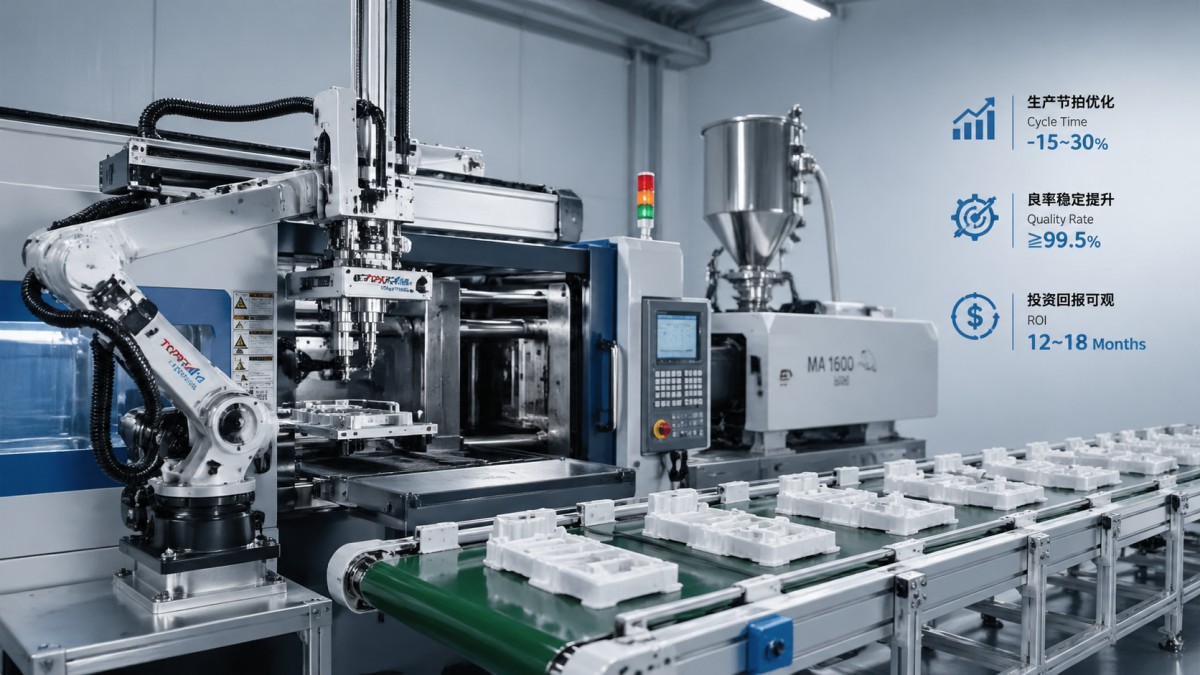
A robotic arm for injection molding typically creates value in five areas: cycle time stability, labor substitution, scrap reduction, workplace safety, and downstream process integration. The strongest projects do not rely on all five equally. In many factories, one or two factors generate more than 70% of the financial return.
Cycle time gains are often the most visible metric, but they must be interpreted carefully. If a press runs a 24-second cycle and automation cuts extraction and placement by 3 seconds, the theoretical gain is 12.5%. However, if cooling time still dominates and machine response is inconsistent, actual throughput improvement may land closer to 4%–8%. That difference matters when forecasting annual output.
Labor savings depend on staffing structure. A single operator may supervise 2–4 molding machines with robotic unloading, compared with 1–2 machines in manual handling environments. In regions with high turnover, absenteeism, or rising wages, automation often pays back faster because it reduces labor volatility as much as direct headcount dependence.
Scrap reduction is especially important for thin-wall parts, cosmetic parts, medical consumables, and insert-molded components. Consistent take-out timing reduces part deformation, drop damage, and contamination risk. Even a 1%–3% scrap improvement can be meaningful when resin costs are high or when secondary inspection is expensive.
Typical value drivers by production condition
The table below shows how value drivers change depending on the production profile. It helps buyers avoid the common mistake of using the same ROI logic for every molding line.
The key takeaway is simple: the same robotic arm for injection molding can be a high-return asset in one cell and a marginal improvement in another. Decision-makers should map value to actual plant bottlenecks, not general automation trends.
Early indicators that automation is likely to work
- The molding machine runs one part family for at least 3–6 months with limited end-of-arm changes.
- Manual part removal creates either quality variation or ergonomic strain over 8–12 hour shifts.
- The cell has downstream steps such as trimming, vision check, conveyor transfer, or boxing that benefit from synchronized handling.
- Annual machine utilization is high enough that even small cycle gains compound into significant output.
How to calculate ROI without overstating the business case
The most common ROI mistake is counting every theoretical benefit while ignoring utilization losses and support costs. A sound calculation starts with four inputs: annual production hours, average cycle time, labor allocation per machine, and total installed system cost. From there, the evaluation should model best-case, expected-case, and conservative-case outcomes over at least 36 months.
For example, assume one press runs 6,000 hours per year with a 20-second cycle. If a robotic arm cuts effective cycle time by 2 seconds, that is a 10% theoretical gain. But if unplanned stoppages, gripper adjustments, and changeovers reduce realized improvement to 5%, the business case changes materially. The same applies to labor: if one operator still remains for inspection and packing, automation may reduce labor load by 0.5–1.0 full-time equivalent rather than a full position.
Installed cost should include more than the robot itself. Buyers need to account for EOAT, safety guarding, interface hardware, conveyor or drop chute modifications, programming, commissioning, and training. In many projects, integration adds 15%–35% above the robot list price. Ignoring that layer leads to misleading payback claims.
Maintenance cost also deserves realistic treatment. A robotic arm for injection molding is not inherently maintenance-heavy, but consumables, lubrication schedules, sensor replacement, and occasional servo or cable issues still matter. Over 3 years, annual maintenance budgets often fall in the low single-digit percentage of installed system value, assuming clean operating conditions and disciplined preventive maintenance.
A practical ROI framework for procurement teams
The table below converts common ROI drivers into decision variables that engineering, operations, and procurement can review together before approving capital expenditure.
In practice, many manufacturers target a payback window of 12–24 months for a standalone robotic arm for injection molding project. A 24–36 month payback may still be acceptable when safety improvement, labor continuity, or quality compliance justifies the investment. Anything longer should trigger a deeper review of machine selection, cell design, and expected run schedule.
Three calculation rules that prevent inflated forecasts
- Use realized uptime, not scheduled uptime. If the press is planned for 7,200 hours but historically runs 5,400 productive hours, base ROI on the lower number.
- Separate labor redeployment from labor elimination. If operators move to inspection or material handling, count the net saved labor cost only.
- Model at least one downside scenario where throughput gain is 30%–50% lower than expected during the first 6 months.
Selection criteria: matching robot type to molding reality
A robotic arm for injection molding pays off only when the machine architecture matches the application. Selection begins with payload, reach, extraction path, part sensitivity, mold opening stroke, and required take-out speed. A mismatch in any one of these variables can increase downtime, damage parts, or create unnecessary complexity in end-of-arm tooling.
For simple vertical take-out on stable parts, a linear robot can be a cost-effective choice. For insert loading, complex orientation, or multi-step downstream transfer, articulated robots may justify their added programming burden. The right answer depends less on category labels and more on motion profile, repeatability requirement, and how many tasks must be completed inside a cycle window of 10–30 seconds.
End-of-arm tooling is often underestimated during procurement. Lightweight grippers reduce cycle burden, but fragile parts may require vacuum circuits, soft fingers, anti-static materials, or dual-stage release. In short-run environments, tooling changeover time can decide whether the cell remains productive. Saving money on EOAT at the purchasing stage often creates a larger cost later in setup losses.
Compatibility with broader cnc automation systems planning also matters. If the factory intends to connect molding, trimming, inspection, and packaging into a semi-automated flow over the next 12–24 months, interface openness becomes a strategic buying factor. A cheap standalone robot with limited I/O flexibility may become expensive once expansion begins.
Core technical checks before purchase
- Payload margin: keep at least 20%–30% reserve above part plus gripper weight to avoid borderline sizing.
- Repeatability target: tighter applications may need sub-millimeter consistency, especially for insert handling or camera alignment.
- Take-out time: verify actual in-mold extraction timing, not only free-space speed claims.
- Interface support: check machine communication, safety logic, alarm diagnostics, and spare parts access.
Selection pitfalls that reduce payback
One common mistake is buying for peak flexibility when the application is actually repetitive. Another is selecting the lowest-cost unit without assessing local service response. If a robot failure stops a high-output press for even 6–10 hours, the cost of lost production may exceed the price difference between a better supported platform and a cheaper one.
A second mistake is evaluating only robot performance while ignoring cell balance. If conveyors jam, boxes fill unevenly, or operator handoff remains awkward, the molding machine still waits. In other words, a robotic arm for injection molding should be purchased as a cell solution, not as isolated hardware.
Implementation risks, maintenance load, and hidden cost drivers
The fastest way to lose ROI is through poor implementation. Most underperforming projects are not caused by robot technology limits, but by weak integration planning, rushed commissioning, incomplete operator training, or unrealistic acceptance criteria. If startup takes 6 weeks longer than planned, the lost production opportunity should be counted as part of project cost.
Maintenance risk is manageable when routines are defined early. Typical preventive tasks include lubrication checks, cable inspection, vacuum line review, gripper wear monitoring, and backup verification. Many plants can handle first-line upkeep internally with a weekly checklist of 15–30 minutes per cell, while advanced diagnostics remain with the integrator or vendor.
Training depth matters more than many buyers expect. Operators need to recover from simple faults, change grippers, reset alarms safely, and understand what affects repeatability. Maintenance staff need a different layer of training covering sensors, motion references, and spare part replacement. Without that division, every minor stop escalates into service calls and lost uptime.
Another hidden cost is product changeover. If a plant runs 8–12 SKUs on one press family, each with different pick points or stacking logic, the engineering burden can offset labor savings. Before approval, management should ask how many recipe changes occur each month and how long each change takes in real operating conditions.
Common hidden costs in robotic molding cells
The following table highlights cost elements that are frequently missed during early budgeting but strongly affect total ownership cost over the first 24 months.
The lesson is that ROI is protected by engineering discipline. Plants that treat implementation as a 4-step process—cell review, offline validation, commissioning, and operator stabilization—usually achieve better first-year performance than plants that focus only on purchase price.
Operational questions to ask before go-live
- What is the acceptable restart time after a minor alarm: 2 minutes, 5 minutes, or 15 minutes?
- How many spare EOAT wear parts should be stocked on-site for the first 6 months?
- Who owns recipe changes: operator, process engineer, or integrator?
- What uptime threshold defines success after ramp-up: 90%, 95%, or another realistic target?
When it pays off fastest—and when manual handling may still win
The best-fit scenario for a robotic arm for injection molding is a line with consistent demand, moderate-to-high annual volume, repetitive extraction, and either labor scarcity or strict quality expectations. In such conditions, the robot does not merely replace a person; it stabilizes output and allows the molding cell to operate with fewer disruptions over multiple shifts.
Fast payback is common where the press runs 20 hours per day, 5–6 days per week, and where one automation package can support part removal, placement, and basic transfer. Plants producing packaging components, appliance parts, electronic housings, or repeat consumer goods often fit this profile. Even a modest 4% throughput gain becomes financially meaningful when annual output reaches millions of parts.
By contrast, manual handling may remain rational when batch sizes are small, molds change every few days, and each job needs unique gripping logic. In those cases, engineering and setup time can consume the expected savings. A semi-automatic approach—such as guided chutes, pick-assist tools, or simplified conveyors—may deliver 50% of the benefit with lower capital risk.
Decision-makers should also consider timing within their wider automation roadmap. If the factory is preparing a phased cnc automation systems upgrade across molding, trimming, machining, and inspection, it may be better to deploy robotic handling first on the most stable 20% of SKUs rather than force a plant-wide rollout. Targeted wins create cleaner data for future investment decisions.
FAQ: real buying questions from plants and sourcing teams
How long does implementation usually take?
For a standard take-out application, total lead time often falls in the 4–12 week range depending on tooling complexity, machine interface readiness, and on-site scheduling. More complex insert or vision-guided cells may take longer. Buyers should separate equipment delivery time from production stabilization time, which can require an additional 1–3 weeks.
What payback period is considered reasonable?
Many manufacturers aim for 12–24 months. A longer payback may still be valid when the robotic arm reduces injury risk, supports night shifts, or protects quality on high-value parts. What matters is whether the forecast is built on real utilization, real staffing patterns, and actual integration cost.
Is a robotic arm suitable for low-volume, high-mix production?
Sometimes, but only if changeovers are engineered for speed. If grippers, recipes, and part presentation can be switched in under 10–15 minutes, the business case may hold. If each change needs manual teaching and trial runs, manual or semi-automatic handling may be more efficient.
Which procurement indicators matter most?
Four indicators usually matter most: realized cycle impact, support response capability, integration scope clarity, and changeover practicality. These often determine true ownership cost more than the headline robot price.
A robotic arm for injection molding pays off when it is matched to stable production economics, not when it is purchased for automation optics. The strongest business cases come from measurable labor leverage, controlled cycle gains, lower scrap, and a cell design that can be maintained by the people who actually run it.
For procurement leaders, plant engineers, and executives, the right next step is to evaluate one molding cell with real run data: annual hours, cycle profile, reject history, staffing pattern, and changeover frequency. That approach turns automation from a vague upgrade into a quantified capital decision.
If you are assessing where a robotic arm fits within a broader cnc automation systems strategy, TechStat Vanguard can help structure the evaluation around engineering parameters, integration risk, and procurement logic rather than generic marketing claims. Contact us to discuss a tailored assessment, compare implementation options, and get a decision framework aligned with your production reality.
Search News
Hot Articles
- Carbon Fiber StructuresHow to Specify Aerospace Carbon Fiber Assemblies for Lightweight, Load-Bearing PartsJul 11, 2026
- Machine VisionXiaomi, Alibaba DAMO Academy Drive Open-Source Robotics Model Ecosystem, Lowering Algorithm Development Barriers for Overseas SMEs Adopting Chinese Robotics SolutionsMar 30, 2026
- Cobots & ArmsShanxi 'AI+' Conference Showcases Embodied Intelligence with Multinational Buyer Engagement: Key Industry ImplicationsMar 30, 2026
Popular Tags
Recommended News
 Jul 11, 2026How to Specify Aerospace Carbon Fiber Assemblies for Lightweight, Load-Bearing PartsAerospace carbon fiber assemblies: learn how to specify laminate design, load data, joining methods, and inspection controls for lighter, reliable load-bearing aerospace parts.Elena Rostova (UAV Systems Researcher)
 Mar 30, 2026Xiaomi, Alibaba DAMO Academy Drive Open-Source Robotics Model Ecosystem, Lowering Algorithm Development Barriers for Overseas SMEs Adopting Chinese Robotics SolutionsXiaomi & Alibaba DAMO Academy's open-source robotics models lower algorithm barriers for global SMEs. Boost efficiency in manufacturing, logistics & smart retail with ROS 2 compatible solutions.TSV Data Lab
 Mar 30, 2026Shanxi 'AI+' Conference Showcases Embodied Intelligence with Multinational Buyer Engagement: Key Industry ImplicationsShanxi 'AI+' Conference highlights embodied intelligence with Tesla, Ubtech & Jiantao showcasing multimodal robotics. 40+ global buyers validated tech on-site, creating new B2B channels for industrial automation & AI solutions.Chen Wei (Automation Lead Engineer)
 Mar 30, 2026Zhongguancun Unveils 6G Integrated Sensing-Computing-Intelligence Platform to Empower Embodied Robots for Global Industrial ApplicationsZhongguancun's new 6G platform revolutionizes industrial robotics with <10ms latency, empowering global automotive, logistics & port automation. Discover how this tech boosts China's smart manufacturing exports.TSV Data Lab
 Mar 30, 2026Mech-Mind Tianjin Embodied Intelligence R&D and Production Base Goes Live, Cutting Delivery Time by 20%–30% for Global Customized AMR+Vision SolutionsMech-Mind's Tianjin AMR+Vision production base cuts delivery time by 20%-30% for欧美 & Latin American markets. Discover how this PLd-certified facility accelerates customized robotics solutions for smart manufacturing and logistics.Chen Wei (Automation Lead Engineer)
 Mar 30, 2026Boao Forum Reveals 'Co-evolution of Big and Small Brains' Trend in Humanoid Robots, China's Embodied Intelligence Accelerates Adaptation to Overseas Manufacturing Service ScenariosDiscover how China's humanoid robots, featuring 'Co-evolution of Big and Small Brains,' are revolutionizing global manufacturing. Learn about Embodied Tian Gong 3.0's ISO compliance and overseas deployment at Boao Forum 2026.Chen Wei (Automation Lead Engineer)
 Mar 30, 2026China Railway Industrial Secures Patent for Embodied Robotics in Material Handling, Boosting High-Precision Delivery Capabilities for Overseas Infrastructure and Manufacturing ProjectsChina Railway Industrial's new patent for embodied robotics in material handling boosts high-precision delivery for global infrastructure & manufacturing. Discover how this innovation enhances logistics accuracy in automotive, rail transit & EPC projects.Chen Wei (Automation Lead Engineer)
 Oct 25, 2026Hesai Leads Global ADAS Main Lidar Shipments in Yole’s 2026 ReportHesai led global ADAS main lidar shipments with a 43% share in 2025, according to Yole’s 2026 report. Explore what this ranking reveals about its automotive market position.TSV Data Lab
 Oct 25, 2026Choosing an Aerospace Materials Manufacturer: Quality and Traceability ChecksChoosing an aerospace materials manufacturer? Learn how to verify certifications, test reports, and lot traceability to qualify suppliers confidently and reduce costly sourcing risks.Dr. Marcus Vance
 Oct 24, 2026Guotai Haitong: Global Entry-Level 3D Printer Shipments Rose 39% in Q1 2026Entry-level 3D printer shipments rose 39% in Q1 2026, Guotai Haitong reports. Explore how AI, multicolor printing and print farms are shaping market growth.Dr. Marcus Vance
 Oct 24, 2026Choosing an Industrial Vision Inspection Supplier: Acceptance Tests That MatterChoose an industrial vision inspection supplier with confidence. Discover acceptance tests for defect detection, false rejects, production speed, and reliable part rejection before you buy.TSV Data Lab
 Oct 23, 2026US Navy Raises Gecko Robotics Contract Ceiling to $300M for Robotic Fleet MaintenanceUS Navy raises Gecko Robotics’ contract ceiling to $300M for Pacific Fleet robotic inspections. Explore potential opportunities for maintenance suppliers and key procurement considerations.Chen Wei (Automation Lead Engineer)
 Oct 23, 2026Choosing Industrial Sensing Systems for Global Plants: Protocol CompatibilityCompare industrial sensing systems international buyers can trust. Explore protocol compatibility, reduce integration risks, and select proven configurations for reliable global plant deployments.TSV Data Lab
 Oct 22, 2026KUKA Showcases Physical AI and iiQKA.AI Vision at NVIDIA GTC BerlinExplore KUKA’s Physical AI showcase at NVIDIA GTC Berlin and discover how iiQKA.AI Vision aims to simplify robotic vision integration and improve 2D and 3D scene recognition.TSV Data Lab
 Oct 22, 2026Robotic Machining of Advanced Composites: What Tolerances Are Achievable?Explore advanced materials machining robotics: discover what drives achievable composite tolerances and how to validate accuracy before investing in your next machining system.Dr. Marcus Vance
 Oct 21, 2026China’s Industrial Robot Exports Near RMB 10 Billion in First Nine Months of 2026China’s industrial robot exports neared RMB 10 billion in January–September 2026, with value rising faster than volume. Explore the data and what it could mean for suppliers.Chen Wei (Automation Lead Engineer)
 Oct 21, 2026Low-Latency Industrial Data Processing: Pricing and Key Cost DriversExplore industrial data latency price drivers, from edge hardware to integration and support. Learn how to compare quotes, verify performance, and avoid unnecessary costs.TSV Data Lab
 Oct 20, 2026KUKA Launches iiQKA.AI Vision to Simplify Industrial Image ProcessingKUKA iiQKA.AI Vision simplifies industrial image processing with controller-based 2D and 3D vision. Explore drag-and-drop setup for vision-guided automation.TSV Data Lab
 Oct 20, 2026Smart Industrial Edge Devices: Key Criteria for Legacy PLC IntegrationChoose smart industrial edge devices for legacy PLC integration. Discover key criteria for compatibility, data quality, security, and reliable collection without disrupting control.TSV Data Lab
 Oct 19, 2026Choosing a Radar Sensor by Application: Range, Resolution, and Field of ViewSimplify radar sensor application based product selection. Compare range, resolution, and field of view to avoid blind spots and choose with confidence. Explore the guide.TSV Data Lab
 Oct 18, 2026Comparing Material Options for Procurement: Specs, Costs, and Supply RisksExplore procurement oriented technical content on material options, specs, costs, and supply risks. Compare alternatives to cut hidden expenses and make confident sourcing decisions.Dr. Marcus Vance
 Oct 17, 20265-Axis CNC Positioning Accuracy: How to Interpret ISO 230-2 Test ResultsAssess 5 axis CNC machining positioning accuracy with ISO 230-2. Learn to interpret repeatability, reversal error, and test conditions to compare suppliers and make confident acceptance decisions.Dr. Marcus Vance
 Oct 16, 2026Choosing a Rugged Edge AI Box Supplier: Thermal Tests and Lifecycle SupportChoose a rugged edge AI box supplier with proven thermal performance and reliable lifecycle support. Discover the tests and commitments to verify before you buy.TSV Data Lab
 Oct 15, 2026R&D Cost Reduction Services: How to Evaluate Fees, Savings, and ROIEvaluate R&D cost reduction services with confidence. Compare fees, verify savings, and calculate ROI without compromising performance. Discover how to choose a provider that delivers real value.Chen Wei (Automation Lead Engineer)























