
Where does industrial robot integration cost go during deployment?
Publication Date
author
The purchase order is only the visible part of the budget
An industrial robot project can look affordable when the quotation is reduced to the robot arm, controller, and a basic warranty. That view is rarely sufficient for financial approval. The larger question is how much engineering and operational change is required to turn that equipment into a dependable production cell.
In many deployments, integration costs accumulate around the robot rather than inside it. The arm may be a relatively defined line item; the uncertainty sits in tooling, controls, safety, material presentation, site conditions, commissioning effort, and the time needed to reach stable output. A useful industrial robot integration cost breakdown therefore separates equipment cost from the work required to make the process repeatable.
For an approver, the objective is not to force every project into a fixed percentage model. Welding, palletizing, machine tending, dispensing, inspection, and assembly have very different risk profiles. The objective is to identify what the proposal assumes, what it excludes, and which costs will appear only after installation has started.
Start with the process, not the robot price
A robot automates a task only when the surrounding process is sufficiently controlled. If parts arrive in predictable positions, variations are limited, cycle time is understood, and downstream handling is stable, the integration scope can be comparatively straightforward. If the robot must cope with mixed parts, inconsistent orientation, variable surfaces, frequent product changes, or manual exceptions, the engineering burden rises quickly.
This is why two cells built around similar robot models can carry very different budgets. The difference may have little to do with the nominal payload or reach of the arm. It may come from a vision system needed to locate parts, custom grippers needed to handle delicate products, a fixture that must compensate for part variation, or software logic required to manage several product recipes.
Financial approval should therefore begin with a process definition that is specific enough to price. A proposal based on “automate packing” is vulnerable to scope growth. A proposal based on carton dimensions, product presentation, pick locations, required rate, changeover procedure, rejection handling, uptime expectations, and operating shifts is far easier to evaluate.
Where the deployment budget usually goes
Robot, controller, and core hardware
The robot arm and controller are the most recognizable costs, but they are only the starting point. This category may also include robot bases, seventh axes, tracks, cable management, teach pendants, network hardware, and spare parts specified for startup support. Collaborative robots can reduce some guarding requirements in suitable applications, but they do not automatically eliminate the need for risk assessment, safety design, or peripheral equipment.
Approvers should ask whether the quoted robot configuration has adequate payload once the end-of-arm tool, cabling, hoses, and expected product mass are included. A robot selected near its practical capacity may produce hidden costs later: a larger arm, a revised tool, slower motion, or reduced process flexibility.
End-of-arm tooling and part presentation
End-of-arm tooling is often where a simple automation concept becomes a custom engineering project. Grippers, vacuum systems, weld torches, screwdrivers, dispensing heads, force sensors, tool changers, and compliance devices all need to suit the real part conditions, not just the ideal drawing.
Part presentation can be equally material. A robot cannot reliably pick or process items that arrive unpredictably without an added method to control position and orientation. That may involve pallets, trays, conveyors, escapements, feeders, locators, nests, fixtures, or vision guidance. A quotation that treats these as minor accessories can understate both the design work and the production risk.
- How many product variants must the cell handle at launch?
- Are parts rigid, consistent, clean, and presented in known locations?
- Does the tool need quick change capability, sensing, or verification?
- Who owns future fixture changes when product design or packaging changes?
These questions matter because a gripper that works for a demonstration sample may not work for production parts with normal manufacturing variation. Financial models should account for the engineering allowance required to resolve that variation before go-live, rather than treating every change as an unforeseen event.
Safety systems and cell enclosure
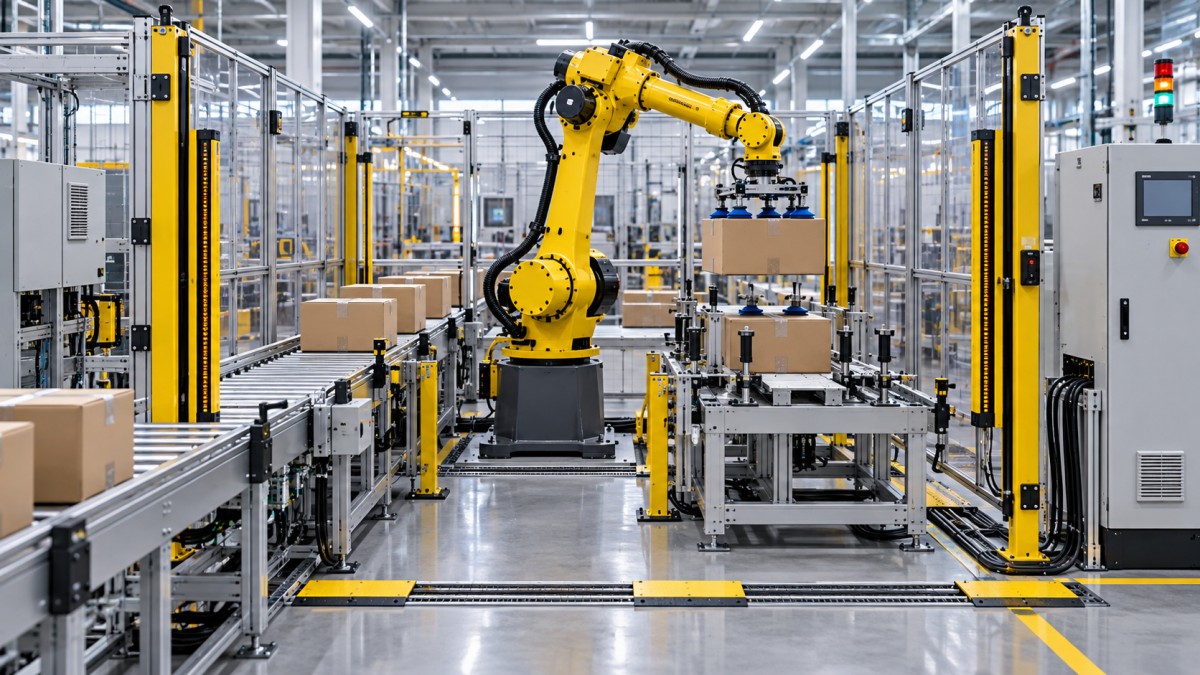
Safety hardware is a core part of the integration scope. Depending on the application, it can include perimeter guarding, doors, interlocks, light curtains, safety scanners, emergency-stop circuits, safety PLC hardware, area scanners, and safety-rated controls integration. The required design depends on the hazards of the complete cell: robot movement, sharp workpieces, welding arc exposure, machine interfaces, stored energy, conveyors, and human access patterns.
A low initial quote can become misleading when it lists safety as an allowance without defining the production layout. Changes to aisle access, material loading, forklift routes, maintenance access, or operator stations can require revised guarding and controls after the design is supposedly complete. Those changes are expensive because they affect mechanical design, electrical work, software, and validation at the same time.
The approval package should identify the assumed safety concept and show the boundaries of responsibility. It should also state whether the system price includes formal risk assessment support, safety validation, and any modifications required after the final layout review.
Controls, software, and plant integration
The robot needs to communicate with the production environment. This category includes electrical panel design, PLC programming, robot programming, human-machine interfaces, safety logic, network integration, machine signals, barcode or traceability interfaces, and data exchange with plant systems where required.
The important cost driver is the number and quality of interfaces. A stand-alone palletizing cell with a defined infeed and outfeed may have limited controls scope. A cell that exchanges recipes with several machines, tracks serialized components, reads inspection results, manages rework paths, and reports production data needs more software design and more testing.
Integration proposals should distinguish between standard machine signals and custom software obligations. “Connect to the customer network” has no reliable price unless the required protocols, cyber-security conditions, data ownership, plant-side support, and acceptance tests are stated. The same applies to machine interfaces. An integrator may price a conventional start/stop handshake while the plant expects coordinated recipe control and fault recovery.
Mechanical, electrical, and site preparation
Factory readiness is often underestimated because it is distributed across facilities, operations, engineering, and external contractors. Costs can include floor assessment, anchors, foundations, compressed air, power distribution, ventilation, extraction, cable trays, fire protection changes, network drops, machine relocation, and production-area modifications.
These expenses may not appear in the integrator’s proposal even though they are necessary for deployment. A realistic budget identifies them separately and assigns an owner. It should also make the production interruption visible. Lost output during relocation, installation, utility shutdowns, and commissioning may be more significant than minor hardware differences, particularly in constrained facilities.
For this reason, a financial approver should request a site-readiness checklist before issuing a final approval. The checklist should show conditions that must be complete before delivery, which party performs each task, and what happens to the schedule if a prerequisite is late.
Engineering hours are often the variable that matters most
Custom engineering is not an undesirable addition to an automation project. It is frequently the work that turns a technically possible cell into a usable one. The risk arises when engineering hours are presented as a vague lump sum or when the scope is deliberately left open.
Concept development, detailed design, tooling design, programming, electrical drafting, simulation, build support, factory acceptance testing, site commissioning, and documentation all consume engineering effort. The amount depends on how mature the application is before the project begins. A proven cell replicated with stable products has a different cost profile from a first-of-its-kind application with several unknown interfaces.
Approval should examine the commercial model attached to that work. A fixed-price proposal can provide useful protection when deliverables and assumptions are precise. It provides much less protection when exclusions are broad enough to move normal integration work into change orders. A time-and-materials arrangement can be appropriate for uncertain technical work, but it needs a defined ceiling, reporting cadence, decision gates, and a clear process for approving additional spend.
- Ask for design assumptions in writing, including product variation and throughput targets.
- Separate included engineering deliverables from optional enhancements and future phases.
- Require a defined change-control process, including pricing and schedule impact before work begins.
- Identify dependencies owned by internal teams, such as part samples, plant data, network access, and machine documentation.
Acceptance testing determines whether the budget buys output or only installation
A cell can be physically installed and still fail to deliver the business case. The distinction is usually found in acceptance criteria. If the contract only requires the robot to move parts under controlled conditions, it may be accepted long before it can sustain the intended production rate with normal operators, normal material variation, and ordinary fault conditions.
Financial approvers should link milestone payments to measurable outcomes. The right measures vary by application, but they may include cycle time, product quality, repeatability, successful handling rate, changeover performance, safety function verification, interface performance, and agreed availability during a defined trial period. The language should establish how the test is run, which materials are used, who provides them, and how failures are classified.
Factory acceptance testing is useful because it catches mechanical and controls issues before shipment. Site acceptance testing is equally important because plant utilities, operator behavior, upstream equipment, and actual production materials can expose problems that were invisible at the integrator’s facility. A budget that allows time for both phases is more credible than one that assumes full production immediately after installation.
Ramp-up also has a cost. Operators require training, maintenance teams need access to documentation and spare-parts information, and process owners need time to establish fault-response routines. During this period, throughput may not match the final target. Treating ramp-up as an operational contingency rather than an integrator problem can improve planning, but it should not become an excuse for undefined performance obligations.
Common cost assumptions that deserve challenge
“The robot will replace one operator” is not a complete investment case. The relevant calculation includes labour actually removed from the process, supervision still required, maintenance needs, production scheduling, quality effects, and the ability to redeploy people to valuable work. A cell that needs frequent intervention may improve ergonomics or consistency while delivering less direct labour reduction than initially assumed.
“The cobot needs no safety infrastructure” is another statement that requires context. Collaborative operation depends on the task, tool, workpiece, speed, layout, and validated risk controls. A cobot handling sharp parts, operating beside other automated equipment, or running at production speeds may still require significant protective measures.
“Integration is included” should be translated into a scope of work. Does it include on-site installation? Utility connections? Production data interfaces? Operator training? Spare parts? Revisions after acceptance testing? Support during the first production weeks? The phrase has little value until those boundaries are explicit.
“A standard cell can be deployed quickly” may be true for a stable, repeatable application. It is less reliable when the site layout, product mix, internal approvals, or upstream equipment remain unsettled. Standard hardware does not eliminate the cost of resolving local constraints.
Build the approval around controllable uncertainty
The strongest automation budget does not claim that every cost is known at the first quotation. It distinguishes between defined costs, allowances, and unresolved risks. Defined costs should be tied to specified deliverables. Allowances should state the basis used to calculate them. Unresolved risks should have owners, decision dates, and a commercial mechanism for handling change.
A practical approval view groups the project into four financial questions: what equipment is being bought, what engineering is required to make it work, what the facility must provide, and what operational cost is needed before the cell reaches stable production. That structure exposes gaps that a single turnkey number can conceal.
The purpose of an industrial robot integration cost breakdown is not to reduce every proposal to the lowest initial price. It is to determine whether the quoted scope can deliver the output on which the return calculation depends. When tooling, safety, controls, site work, acceptance, and ramp-up are visible early, capital approval becomes a decision about a defined operating capability rather than a purchase of hardware with uncertain follow-on cost.
Search News
Hot Articles
- Carbon Fiber StructuresHow to Specify Aerospace Carbon Fiber Assemblies for Lightweight, Load-Bearing PartsJul 11, 2026
- Machine VisionXiaomi, Alibaba DAMO Academy Drive Open-Source Robotics Model Ecosystem, Lowering Algorithm Development Barriers for Overseas SMEs Adopting Chinese Robotics SolutionsMar 30, 2026
- Cobots & ArmsShanxi 'AI+' Conference Showcases Embodied Intelligence with Multinational Buyer Engagement: Key Industry ImplicationsMar 30, 2026
Popular Tags
Recommended News
 Jul 11, 2026How to Specify Aerospace Carbon Fiber Assemblies for Lightweight, Load-Bearing PartsAerospace carbon fiber assemblies: learn how to specify laminate design, load data, joining methods, and inspection controls for lighter, reliable load-bearing aerospace parts.Elena Rostova (UAV Systems Researcher)
 Mar 30, 2026Xiaomi, Alibaba DAMO Academy Drive Open-Source Robotics Model Ecosystem, Lowering Algorithm Development Barriers for Overseas SMEs Adopting Chinese Robotics SolutionsXiaomi & Alibaba DAMO Academy's open-source robotics models lower algorithm barriers for global SMEs. Boost efficiency in manufacturing, logistics & smart retail with ROS 2 compatible solutions.TSV Data Lab
 Mar 30, 2026Shanxi 'AI+' Conference Showcases Embodied Intelligence with Multinational Buyer Engagement: Key Industry ImplicationsShanxi 'AI+' Conference highlights embodied intelligence with Tesla, Ubtech & Jiantao showcasing multimodal robotics. 40+ global buyers validated tech on-site, creating new B2B channels for industrial automation & AI solutions.Chen Wei (Automation Lead Engineer)
 Mar 30, 2026Zhongguancun Unveils 6G Integrated Sensing-Computing-Intelligence Platform to Empower Embodied Robots for Global Industrial ApplicationsZhongguancun's new 6G platform revolutionizes industrial robotics with <10ms latency, empowering global automotive, logistics & port automation. Discover how this tech boosts China's smart manufacturing exports.TSV Data Lab
 Mar 30, 2026Mech-Mind Tianjin Embodied Intelligence R&D and Production Base Goes Live, Cutting Delivery Time by 20%–30% for Global Customized AMR+Vision SolutionsMech-Mind's Tianjin AMR+Vision production base cuts delivery time by 20%-30% for欧美 & Latin American markets. Discover how this PLd-certified facility accelerates customized robotics solutions for smart manufacturing and logistics.Chen Wei (Automation Lead Engineer)
 Mar 30, 2026Boao Forum Reveals 'Co-evolution of Big and Small Brains' Trend in Humanoid Robots, China's Embodied Intelligence Accelerates Adaptation to Overseas Manufacturing Service ScenariosDiscover how China's humanoid robots, featuring 'Co-evolution of Big and Small Brains,' are revolutionizing global manufacturing. Learn about Embodied Tian Gong 3.0's ISO compliance and overseas deployment at Boao Forum 2026.Chen Wei (Automation Lead Engineer)
 Mar 30, 2026China Railway Industrial Secures Patent for Embodied Robotics in Material Handling, Boosting High-Precision Delivery Capabilities for Overseas Infrastructure and Manufacturing ProjectsChina Railway Industrial's new patent for embodied robotics in material handling boosts high-precision delivery for global infrastructure & manufacturing. Discover how this innovation enhances logistics accuracy in automotive, rail transit & EPC projects.Chen Wei (Automation Lead Engineer)
 Oct 17, 20265-Axis CNC Positioning Accuracy: How to Interpret ISO 230-2 Test ResultsAssess 5 axis CNC machining positioning accuracy with ISO 230-2. Learn to interpret repeatability, reversal error, and test conditions to compare suppliers and make confident acceptance decisions.Dr. Marcus Vance
 Oct 16, 2026Choosing a Rugged Edge AI Box Supplier: Thermal Tests and Lifecycle SupportChoose a rugged edge AI box supplier with proven thermal performance and reliable lifecycle support. Discover the tests and commitments to verify before you buy.TSV Data Lab
 Oct 15, 2026R&D Cost Reduction Services: How to Evaluate Fees, Savings, and ROIEvaluate R&D cost reduction services with confidence. Compare fees, verify savings, and calculate ROI without compromising performance. Discover how to choose a provider that delivers real value.Chen Wei (Automation Lead Engineer)
 Oct 17, 2026How Should You Interpret Industrial Robot Repeatability Specs?Decode industrial robot repeatability specifications, understand ISO 9283 test conditions, and avoid costly selection mistakes. Learn how to verify performance for your process.Chen Wei (Automation Lead Engineer)
 Oct 16, 2026How Can You Fairly Compare MTBF Across Industrial Servo Motors?Make a fair industrial servo motor MTBF comparison with matched operating profiles, failure criteria, and confidence bounds. Discover how to assess reliability beyond advertised numbers.Chen Wei (Automation Lead Engineer)
 Oct 15, 2026How Should You Compare TechStat Vanguard 5-Axis CNC Tolerances?TechStat Vanguard 5-axis CNC tolerance comparison: learn how to verify part accuracy, assess inspection evidence, and choose suppliers that reliably meet your drawing requirements.Dr. Marcus Vance
 Oct 14, 2026Drone Frame Composites: Carbon Fiber vs. Fiberglass for Weight and StiffnessExplore drone structural materials composites: compare carbon fiber and fiberglass for weight, stiffness, cost, and antenna compatibility. Find the right material for your drone frame.Elena Rostova (UAV Systems Researcher)
 Oct 13, 2026Smart Cameras vs. PC-Based Machine Vision: Which Fits High-Speed Inspection?This industrial product comparison for machine vision weighs smart cameras vs. PC-based systems on latency, throughput, and cost. Discover your best fit for high-speed inspection.TSV Data Lab
 Oct 12, 2026How to Verify RoHS Compliance in Industrial Sensing Systems Before DeploymentRoHS compliant sensing systems: learn how to verify materials, supplier declarations, testing, and configuration controls before industrial deployment.TSV Data Lab
 Oct 11, 2026How Procurement-Oriented Content Taxonomy Improves B2B Buying JourneysProcurement-oriented content taxonomy streamlines B2B buying journeys with clearer evidence, supplier comparisons, risk visibility, and faster approvals.TSV Data Lab
 Oct 10, 2026How to Select a Machine Performance Monitoring Platform for OEE and Downtime ReductionMachine performance monitoring platform selection guide: validate machine states, OEE data, downtime reasons, integrations, and scalability to reduce losses with confidence.TSV Data Lab
 Oct 08, 2026How to Machine Inconel 625 Blades Without Heat Cracks or Edge ChippingInconel 625 blade machining guide: prevent heat cracks, edge chipping, chatter, and work hardening with proven tooling, cooling, fixturing, and inspection strategies.Dr. Marcus Vance
 Oct 07, 2026How to Evaluate an HMI Panel Distributor for Industrial Automation ProjectsHMI panel distributor evaluation guide: verify technical compatibility, traceability, supply reliability, lifecycle support, and total cost for automation projects.Victor Lin (Chief Software Architect)
 Oct 06, 2026Navigation Fault Tolerance Standards for AMRs: What Safety Teams Must VerifyNavigation fault tolerance standards: learn what AMR safety teams must verify, from localization loss and sensor faults to stopping distance, safe restart, and site-specific validation.Chen Wei (Automation Lead Engineer)
 Oct 05, 2026Calculating Edge Computing Total Cost of Ownership Across Distributed SitesEdge computing ownership cost explained: calculate deployment, energy, connectivity, security, remote support, and refresh costs across distributed sites.TSV Data Lab
 Oct 04, 2026CAD/CAM Benchmarking in the GCC: What Manufacturers Should Ask a ConsultantCAD CAM benchmark consultant GCC guide: learn the key questions manufacturers should ask to validate post-processors, workflows, machine performance, and production risk.Victor Lin (Chief Software Architect)
 Oct 03, 2026Selecting Automotive Radar Sensor Modules for ADAS Range, Resolution, and IntegrationAutomotive radar sensor module selection guide for ADAS: compare range, resolution, field of view, latency, and integration to build safer, reliable vehicle systems.TSV Data Lab























