When a 10kg Collaborative Robot Payload Is Enough—and When It Is Not
Publication Date
author
A collaborative robot payload 10kg rating can be the right fit for assembly, pick-and-place, inspection, and light machine tending—but only if real-world factors align with the spec sheet. For engineers and sourcing teams, the real question is not whether 10kg sounds sufficient, but when dynamic loads, reach, tooling weight, and safety margins make it inadequate. This article examines where a 10kg cobot delivers measurable value and where the data says otherwise.
For technical evaluators, the issue is rarely the published payload number alone. A 10kg collaborative robot may perform well in a controlled cell moving 6kg parts with a 1.5kg gripper at moderate speed, yet fail the business case when cycle time, reach, duty cycle, or part orientation changes. In procurement, this mismatch often appears after installation, when throughput targets slip or tool upgrades push the arm beyond stable operating limits.
TechStat Vanguard approaches this question from an engineering-first perspective. Rather than relying on headline claims, the correct way to assess a collaborative robot payload 10kg configuration is to examine total moving mass, moment load, acceleration, safety mode constraints, and integration margins. Those variables determine whether 10kg is a right-sized investment or an underpowered choice that will create avoidable redesign costs.
What a 10kg Cobot Payload Actually Means in Practice
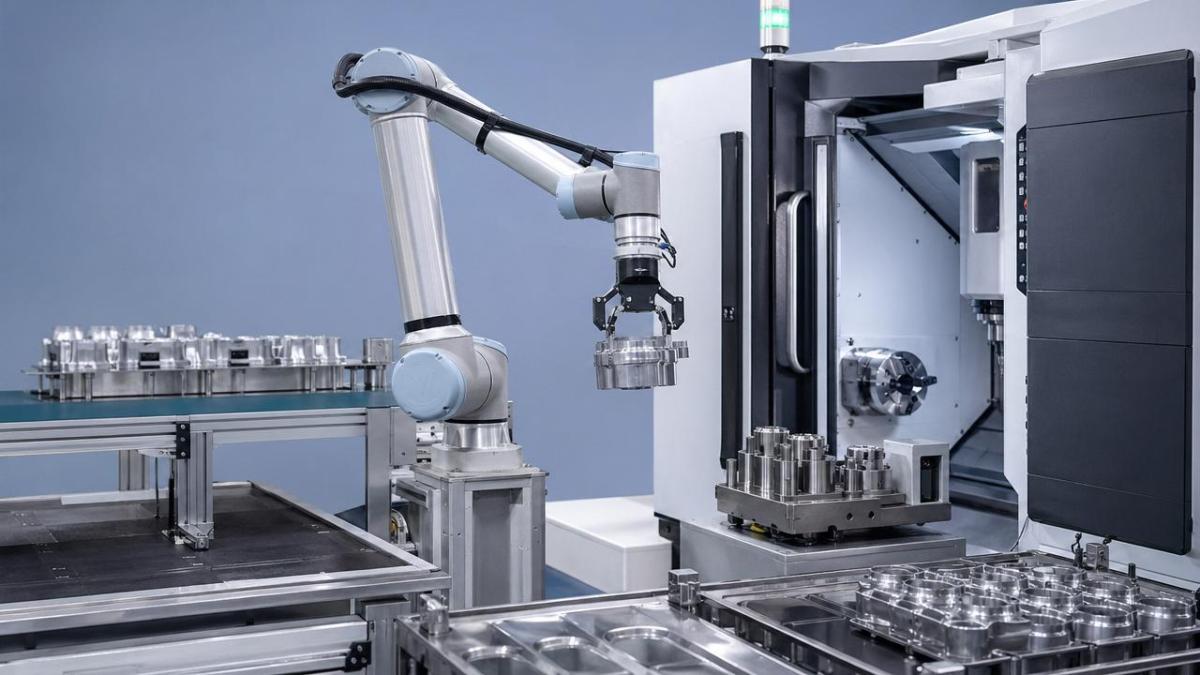
A published payload rating is typically the maximum allowable mass at defined operating conditions, not a universal promise across all motions. In most cases, the collaborative robot payload 10kg value assumes a specific center of gravity, a limited wrist moment, and a controlled acceleration profile. If the workpiece is bulky, offset, or handled at long reach, the usable payload can fall below the nominal rating.
This matters because end-of-arm tooling often consumes 10% to 35% of the available capacity. A vacuum gripper, force sensor, quick changer, and bracket can add 1.5kg to 3.5kg before the robot even touches a part. In a real pick-and-place cell, a 7kg workpiece plus a 2kg gripper already places the system near its practical upper band, especially if the arm must accelerate quickly or rotate through multiple axes.
Engineers should also separate static capacity from dynamic performance. A cobot may hold 10kg at low speed for positioning or inspection, but not sustain that load over a 16-hour shift with short cycle times. This is where thermal behavior, gearbox stress, and reduced speed in collaborative mode begin to shape actual output more than the catalog number.
Three variables that reduce effective payload
- Tooling mass: EOAT packages commonly add 1kg to 4kg depending on sensing, compliance, and changeover requirements.
- Center of gravity distance: a payload mounted 150mm off-axis creates a much higher moment than a compact part held close to the flange.
- Acceleration and reach: long extensions and fast moves can lower allowable payload well below the nominal 10kg value.
The table below shows how a nominal 10kg rating often translates into different practical limits once integration factors are included. These are general engineering ranges used for evaluation, not brand-specific claims.
The key conclusion is straightforward: a collaborative robot payload 10kg configuration usually works best when the actual part mass stays below the maximum rating by a clear margin. For many plants, that means designing around 50% to 80% of rated payload rather than treating 10kg as a target operating point for every cycle.
Where a Collaborative Robot Payload 10kg Is Usually Enough
A 10kg cobot is often a strong fit in applications where flexibility matters more than extreme throughput. Typical examples include electronics subassembly, consumer goods packaging, laboratory sample handling, vision inspection, and light machine tending. In these environments, parts often weigh 0.5kg to 6kg, tooling remains compact, and the collaborative robot can deliver reliable automation without the footprint or guarding burden of a larger industrial arm.
Assembly operations are a particularly good match when the robot must position components repeatedly within a controlled force range. If the end-of-arm tooling weighs 1kg and the part weighs 3kg, a collaborative robot payload 10kg setup still retains a healthy operating margin. That margin helps preserve smooth motion, repeatable path control, and lower mechanical stress over 2-shift production patterns.
Another favorable use case is light CNC or injection molding support. Many shops load blanks or finished components in the 2kg to 5kg range. Here, the value of a cobot comes from fast deployment, smaller cell redesign requirements, and easier redeployment across product families. If changeovers occur every 2 to 6 weeks, a medium-payload collaborative platform often offers better lifecycle value than a heavier fixed automation cell.
Application profiles that typically fit a 10kg class cobot
The table below summarizes common scenarios where a 10kg collaborative robot tends to be sufficient from both an engineering and sourcing perspective.
The strongest business case appears when the robot supports moderate daily volume, multi-SKU production, and limited floor space. In those cases, right-sizing matters. Buying a 16kg or 20kg platform “just in case” can increase capital cost, floor loading, and integration complexity without improving output if the process never exceeds a 7kg moving payload.
What buyers should confirm before approving
- Verify the combined weight of the part, gripper, brackets, sensors, and air fittings.
- Check whether the process requires full extension, vertical lifts, or abrupt stops.
- Review cycle time targets, such as 8-second, 12-second, or 20-second takt expectations.
- Confirm whether collaborative mode speed limits still meet throughput needs.
If these four checks remain within range, a collaborative robot payload 10kg solution can be both technically sound and financially efficient for information-driven sourcing teams.
When 10kg Is Not Enough: The Hidden Limits Behind the Number
The most common mistake is assuming that a part weighing less than 10kg automatically fits a 10kg cobot. In reality, larger castings, battery modules, metal fixtures, or long components may create excessive wrist torque even when their mass is nominally acceptable. A 9kg part held 250mm from the flange can be more demanding than a compact 10kg part held close to the wrist.
Another limit appears in high-duty applications. If a cell runs 20 cycles per minute for 2 shifts, the robot may perform more than 19,000 cycles per day. Under that workload, even a seemingly acceptable load can lead to reduced acceleration, higher wear, and less stable repeatability if the system operates continuously near its maximum rating. This is especially important in machining, pallet transfer, and packaging lines with narrow takt windows.
Safety mode constraints also matter. Collaborative operation often reduces speed and force to maintain human-robot interaction requirements. If your process already needs most of the 10kg capacity, these safety-related reductions can make the system too slow for production. In such cases, a larger payload class, partial guarding, or a different automation architecture may produce better overall economics.
Warning signs that 10kg is undersized
- The combined payload exceeds 8kg and the process needs fast acceleration or long reach.
- The part geometry is bulky, off-center, or difficult to grip consistently.
- The cell requires dual grippers, force sensing, or automatic tool change modules.
- The application targets less than 10-second takt time with frequent starts and stops.
- The robot must hold orientation accuracy during insertion, deburring, or press-fit support.
Typical scenarios where a higher class is safer
For heavy machine tending, dense metal parts in the 7kg to 10kg range often justify moving to a 12kg, 16kg, or even 20kg collaborative platform. The extra headroom is not wasted capacity. It improves acceleration reserve, protects cycle consistency, and allows later addition of sensors or stronger tooling without redesigning the entire workcell.
The same logic applies to end-of-line packing and pallet layer handling. If cartons vary from 5kg to 8kg but packaging formats change seasonally, procurement should evaluate the heaviest format plus tooling plus future options. A robot selected with only a 5% margin can become obsolete after one product update, while a 20% to 30% margin usually supports more stable long-term use.
In other words, the question is not whether 10kg can lift the item once. The question is whether the system can deliver the required precision, speed, and uptime over 12 to 36 months of production without forcing compromises elsewhere in the cell.
How to Evaluate Payload Correctly Before Purchase
A disciplined selection process reduces the risk of overbuying and underbuying. For information researchers and sourcing managers, the best method is to convert the published collaborative robot payload 10kg spec into a real operating model. That means listing total moved mass, center of gravity, reach, required orientation, target cycle time, and human interaction conditions before vendor comparison begins.
This evaluation should include at least five engineering checkpoints. First, define the maximum part weight, not only the average. Second, add tooling and interface mass. Third, map the farthest reach point in the cycle. Fourth, estimate acceleration needs based on takt time. Fifth, identify whether the robot will operate in collaborative, monitored stop, or fenced mode. Each of these factors changes usable payload.
Many procurement errors happen because buyers compare robots by payload and reach alone. A more useful comparison framework includes repeatability, allowable moment load, integration compatibility, and service access. A slightly more expensive model may produce a lower total cost of ownership if it avoids custom tooling redesign, repeated safety validation, or future payload upgrades.
Payload evaluation checklist for sourcing teams
The following checklist can be used in RFQ preparation or supplier qualification to test whether a 10kg class cobot is the right fit.
This table reinforces a practical rule: payload should be evaluated as a system variable, not a single catalog figure. When sourcing teams request these four data points early, they can filter out unsuitable options before simulation, fixture design, and safety review begin.
A simple 5-step pre-purchase process
- Record the heaviest part, average part, and future part variants.
- Add EOAT, adapters, cables, and sensor package mass.
- Map the longest reach and most demanding orientation change.
- Validate takt time with payload, not with unloaded robot motion.
- Request application-specific test data or simulation from suppliers.
For TSV-style benchmarking, this final step is critical. Application-specific test evidence is far more useful than broad claims because it ties performance to the variables that actually determine production success.
Common Misjudgments, Integration Risks, and Final Selection Guidance
One frequent misjudgment is focusing on initial lift capacity while ignoring future process expansion. A cell that starts with a 4kg part may later add a vision module, a force sensor, or dual-grip changeover tooling. Those upgrades can increase moving mass by 1kg to 3kg. If the original collaborative robot payload 10kg decision left minimal reserve, the upgrade path becomes expensive and disruptive.
A second risk is underestimating the interaction between payload and accuracy. Even when repeatability is acceptable on paper, heavier loads at longer reach can degrade path stability during insertion, screwdriving support, dispensing, or inspection positioning. In precision-oriented sectors, a small reduction in motion confidence can cause quality drift, false rejects, or operator intervention that erodes the automation ROI.
A third issue is serviceability. Heavier-duty applications tend to expose any payload mismatch quickly through slower cycles, overheating alarms, or unplanned stoppages. Buyers should therefore include support response time, spare parts access, and integrator capability in the decision matrix. A well-supported 10kg platform is better than an isolated purchase that looks attractive only at quote stage.
Selection guidance by decision profile
- Choose 10kg class when the full moving load is moderate, the process values flexibility, and takt is not extremely aggressive.
- Move above 10kg when tooling is complex, reach is long, duty is high, or future part growth is likely within 12 to 24 months.
- Request test validation when the application sits near the limit, especially above 75% of rated payload.
FAQ: What researchers and buyers ask most often
Is a 10kg cobot enough for machine tending? Often yes for 2kg to 5kg parts with standard grippers, but less often for dense metal parts near 8kg to 10kg or for high-speed loading cycles.
Should I size to average load or maximum load? Always size around the heaviest realistic load case, including tooling, because production failures occur at the extremes, not the average.
How much reserve should I keep? Many integrators prefer meaningful headroom, especially for multi-shift duty. A system operating continuously at the absolute limit usually sacrifices flexibility and lifecycle stability.
Does collaborative mode change the answer? Yes. If human interaction requires reduced speed, the effective production capability may become the limiting factor even when the robot can physically carry the load.
For engineers, CTOs, and procurement leaders, the right conclusion is evidence-based rather than generic. A collaborative robot payload 10kg rating is enough when the application stays inside a realistic operating envelope that includes tooling, reach, cycle time, safety constraints, and future change requests. It is not enough when the system depends on running close to the limit to meet output targets.
If your team is comparing cobot options, preparing a spec sheet, or validating whether 10kg is the correct payload class, use application-level data before approving the purchase. To reduce qualification time and avoid costly oversights, contact TechStat Vanguard to discuss your requirements, review decision criteria, or obtain a more tailored evaluation framework for your automation project.
Search News
Hot Articles
- Carbon Fiber StructuresHow to Specify Aerospace Carbon Fiber Assemblies for Lightweight, Load-Bearing PartsJul 11, 2026
- Machine VisionXiaomi, Alibaba DAMO Academy Drive Open-Source Robotics Model Ecosystem, Lowering Algorithm Development Barriers for Overseas SMEs Adopting Chinese Robotics SolutionsMar 30, 2026
- Cobots & ArmsShanxi 'AI+' Conference Showcases Embodied Intelligence with Multinational Buyer Engagement: Key Industry ImplicationsMar 30, 2026
Popular Tags
Recommended News
 Jul 11, 2026How to Specify Aerospace Carbon Fiber Assemblies for Lightweight, Load-Bearing PartsAerospace carbon fiber assemblies: learn how to specify laminate design, load data, joining methods, and inspection controls for lighter, reliable load-bearing aerospace parts.Elena Rostova (UAV Systems Researcher)
 Mar 30, 2026Xiaomi, Alibaba DAMO Academy Drive Open-Source Robotics Model Ecosystem, Lowering Algorithm Development Barriers for Overseas SMEs Adopting Chinese Robotics SolutionsXiaomi & Alibaba DAMO Academy's open-source robotics models lower algorithm barriers for global SMEs. Boost efficiency in manufacturing, logistics & smart retail with ROS 2 compatible solutions.TSV Data Lab
 Mar 30, 2026Shanxi 'AI+' Conference Showcases Embodied Intelligence with Multinational Buyer Engagement: Key Industry ImplicationsShanxi 'AI+' Conference highlights embodied intelligence with Tesla, Ubtech & Jiantao showcasing multimodal robotics. 40+ global buyers validated tech on-site, creating new B2B channels for industrial automation & AI solutions.Chen Wei (Automation Lead Engineer)
 Mar 30, 2026Zhongguancun Unveils 6G Integrated Sensing-Computing-Intelligence Platform to Empower Embodied Robots for Global Industrial ApplicationsZhongguancun's new 6G platform revolutionizes industrial robotics with <10ms latency, empowering global automotive, logistics & port automation. Discover how this tech boosts China's smart manufacturing exports.TSV Data Lab
 Mar 30, 2026Mech-Mind Tianjin Embodied Intelligence R&D and Production Base Goes Live, Cutting Delivery Time by 20%–30% for Global Customized AMR+Vision SolutionsMech-Mind's Tianjin AMR+Vision production base cuts delivery time by 20%-30% for欧美 & Latin American markets. Discover how this PLd-certified facility accelerates customized robotics solutions for smart manufacturing and logistics.Chen Wei (Automation Lead Engineer)
 Mar 30, 2026Boao Forum Reveals 'Co-evolution of Big and Small Brains' Trend in Humanoid Robots, China's Embodied Intelligence Accelerates Adaptation to Overseas Manufacturing Service ScenariosDiscover how China's humanoid robots, featuring 'Co-evolution of Big and Small Brains,' are revolutionizing global manufacturing. Learn about Embodied Tian Gong 3.0's ISO compliance and overseas deployment at Boao Forum 2026.Chen Wei (Automation Lead Engineer)
 Mar 30, 2026China Railway Industrial Secures Patent for Embodied Robotics in Material Handling, Boosting High-Precision Delivery Capabilities for Overseas Infrastructure and Manufacturing ProjectsChina Railway Industrial's new patent for embodied robotics in material handling boosts high-precision delivery for global infrastructure & manufacturing. Discover how this innovation enhances logistics accuracy in automotive, rail transit & EPC projects.Chen Wei (Automation Lead Engineer)
 Oct 28, 2026IDC: Global Quadruped Robot Shipments Rise 92.5% in H1 2026 as Volume and Value DivergeGlobal quadruped robot shipments rose 92.5% in H1 2026, according to IDC. Explore what diverging volume and value trends mean for industrial buyers and manufacturers.Chen Wei (Automation Lead Engineer)
 Oct 28, 2026Interpreting Industrial IoT Latency Data for Monitoring and Real-Time ControlInterpret industrial category latency data to assess jitter, deadline misses, and real-time readiness. Learn how to benchmark IIoT systems and choose monitoring and control solutions.TSV Data Lab
 Oct 27, 2026GXO and Agility Robotics Expand Partnership to Accelerate US Humanoid Robot DeploymentGXO and Agility Robotics plan to expand US humanoid robot deployment with Digit 4 in early 2027. Explore warehouse automation plans, service terms and future Digit 5 upgrades.Chen Wei (Automation Lead Engineer)
 Oct 27, 2026Robotic Automation Costs: Budgeting for Equipment, Integration, and MaintenancePlan your robotics automation cost with confidence. Explore equipment, integration, and maintenance expenses, compare quotes, and build a realistic budget for better ROI.Chen Wei (Automation Lead Engineer)
 Oct 26, 2026AMAXiMAL Releases Open-Source TopMod 3D v3 With Claude AIExplore AMAXiMAL’s free, open-source TopMod 3D v3 with Claude AI assistance, topology-based modeling and plywood fabrication tools that connect complex designs to physical builds.Dr. Marcus Vance
 Oct 26, 2026Choosing a SCADA System Integrator Company: PLC Compatibility and Long-Term SupportChoose a scada system integrator company with proven PLC compatibility and reliable long-term support. Discover what to test, compare, and require before investing.Victor Lin (Chief Software Architect)
 Oct 25, 2026Hesai Leads Global ADAS Main Lidar Shipments in Yole’s 2026 ReportHesai led global ADAS main lidar shipments with a 43% share in 2025, according to Yole’s 2026 report. Explore what this ranking reveals about its automotive market position.TSV Data Lab
 Oct 25, 2026Choosing an Aerospace Materials Manufacturer: Quality and Traceability ChecksChoosing an aerospace materials manufacturer? Learn how to verify certifications, test reports, and lot traceability to qualify suppliers confidently and reduce costly sourcing risks.Dr. Marcus Vance
 Oct 24, 2026Guotai Haitong: Global Entry-Level 3D Printer Shipments Rose 39% in Q1 2026Entry-level 3D printer shipments rose 39% in Q1 2026, Guotai Haitong reports. Explore how AI, multicolor printing and print farms are shaping market growth.Dr. Marcus Vance
 Oct 24, 2026Choosing an Industrial Vision Inspection Supplier: Acceptance Tests That MatterChoose an industrial vision inspection supplier with confidence. Discover acceptance tests for defect detection, false rejects, production speed, and reliable part rejection before you buy.TSV Data Lab
 Oct 23, 2026US Navy Raises Gecko Robotics Contract Ceiling to $300M for Robotic Fleet MaintenanceUS Navy raises Gecko Robotics’ contract ceiling to $300M for Pacific Fleet robotic inspections. Explore potential opportunities for maintenance suppliers and key procurement considerations.Chen Wei (Automation Lead Engineer)
 Oct 23, 2026Choosing Industrial Sensing Systems for Global Plants: Protocol CompatibilityCompare industrial sensing systems international buyers can trust. Explore protocol compatibility, reduce integration risks, and select proven configurations for reliable global plant deployments.TSV Data Lab
 Oct 22, 2026KUKA Showcases Physical AI and iiQKA.AI Vision at NVIDIA GTC BerlinExplore KUKA’s Physical AI showcase at NVIDIA GTC Berlin and discover how iiQKA.AI Vision aims to simplify robotic vision integration and improve 2D and 3D scene recognition.TSV Data Lab
 Oct 22, 2026Robotic Machining of Advanced Composites: What Tolerances Are Achievable?Explore advanced materials machining robotics: discover what drives achievable composite tolerances and how to validate accuracy before investing in your next machining system.Dr. Marcus Vance
 Oct 21, 2026China’s Industrial Robot Exports Near RMB 10 Billion in First Nine Months of 2026China’s industrial robot exports neared RMB 10 billion in January–September 2026, with value rising faster than volume. Explore the data and what it could mean for suppliers.Chen Wei (Automation Lead Engineer)
 Oct 21, 2026Low-Latency Industrial Data Processing: Pricing and Key Cost DriversExplore industrial data latency price drivers, from edge hardware to integration and support. Learn how to compare quotes, verify performance, and avoid unnecessary costs.TSV Data Lab
 Oct 20, 2026KUKA Launches iiQKA.AI Vision to Simplify Industrial Image ProcessingKUKA iiQKA.AI Vision simplifies industrial image processing with controller-based 2D and 3D vision. Explore drag-and-drop setup for vision-guided automation.TSV Data Lab