Heavy Duty AGV Manufacturer Comparison for High-Load Factory Transport
Publication Date
author
Choosing a heavy duty agv manufacturer is no longer a branding exercise—it is a high-stakes engineering decision that affects payload safety, uptime, navigation accuracy, and total cost of ownership. For enterprise decision-makers, this comparison cuts past vague claims to focus on the measurable factors that determine whether high-load factory transport systems can perform reliably at scale.
Why scenario differences matter in high-load factory transport
A heavy duty agv manufacturer may look competitive on a brochure, yet still be the wrong fit for your plant. The reason is simple: high-load transport is not one use case. Moving steel coils, aircraft structures, battery trays, large molds, or palletized subassemblies creates very different demands in floor conditions, turning radius, safety zoning, docking precision, and duty cycle.
For enterprise buyers, the most expensive mistake is comparing suppliers only by headline payload. A vehicle rated for 10 tons on a smooth test floor may perform poorly when ramps, uneven joints, congested aisles, or 24/7 shifts are introduced. That is why any useful heavy duty agv manufacturer comparison must start with the application environment rather than the marketing claim.
This is especially true in complex manufacturing programs where transport reliability directly affects takt time, worker safety, and line balance. In those settings, the best supplier is usually not the one with the longest feature list, but the one whose engineering assumptions match the plant reality.
What should be compared first
Before reviewing brands, define the operational scene in terms of payload profile, route length, traffic mix, localization method, and integration depth with MES, WMS, or PLC systems. Once those conditions are explicit, manufacturer differences become much easier to evaluate objectively.
- Static payload vs dynamic payload during acceleration, braking, and cornering
- Indoor clean floor routes vs mixed surfaces with cracks, expansion joints, or gradients
- Fixed repetitive transport vs variable dispatch with frequent rerouting
- Standalone vehicle purchase vs full software and fleet orchestration project
Three common application scenarios that reshape manufacturer selection
In practice, most heavy-load AGV projects fall into a few recurring scenarios. Each one changes what a decision-maker should prioritize in a heavy duty agv manufacturer. The key is not just asking who can build the machine, but who can keep the transport workflow stable under actual production pressure.
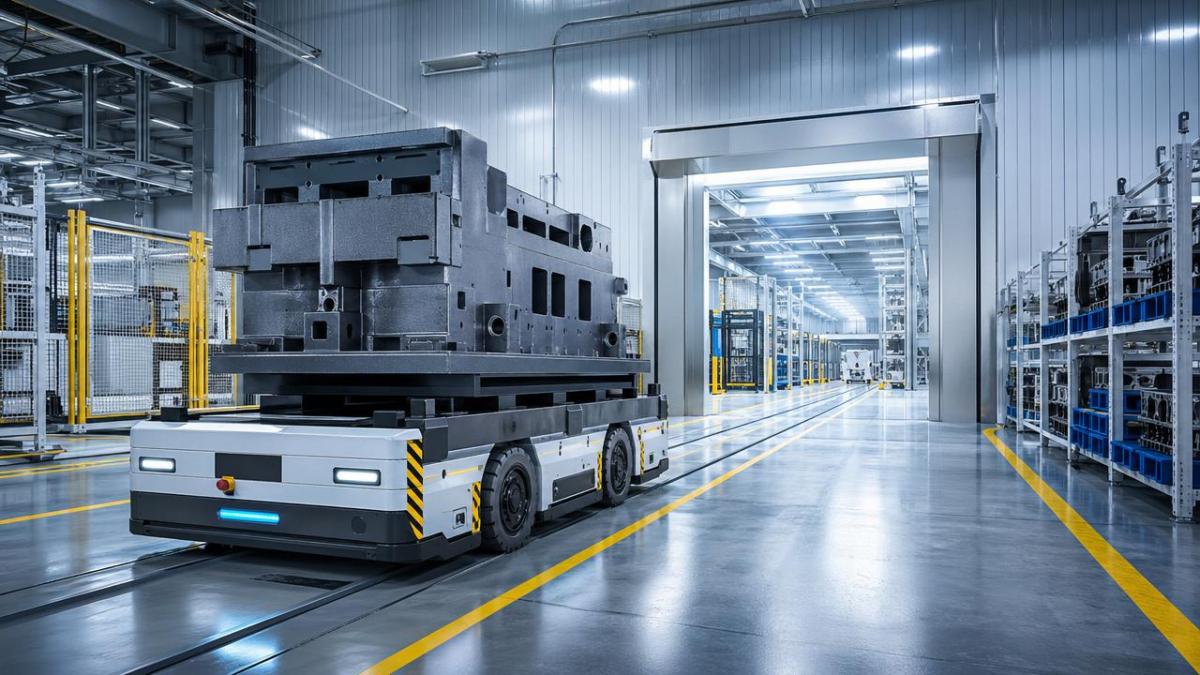
The table below frames the comparison through real factory situations rather than generic vendor categories. This helps procurement, operations, and engineering teams align on measurable requirements before entering commercial negotiations.
Scenario 1: automotive lines and battery plants
This environment favors a heavy duty agv manufacturer with strong software integration and repeatable docking performance. Payload matters, but line-side timing matters more. If the AGV arrives late, queues the aisle, or misses an interface point by a few millimeters, the production effect can be larger than the transport task itself.
Decision-makers should examine fleet scheduling logic, traffic conflict handling, battery swap or opportunity charging options, and recovery behavior after an obstruction. In high-volume plants, uptime resilience often matters more than top speed.
Scenario 2: steel, foundry, and fabrication workshops
In this setting, the heavy duty agv manufacturer must prove mechanical robustness. Floors may be uneven, debris may be present, and loads may have shifting centers of gravity. A structurally conservative design with accessible maintenance points can outperform a more advanced-looking but fragile platform.
Ask for frame design methodology, wheel material selection, gearbox sizing margin, and thermal behavior under continuous heavy duty cycles. Harsh-shop transport is where weak engineering assumptions become visible very quickly.
Scenario 3: aerospace, molds, and oversized parts
Here the selection priority shifts toward motion smoothness, synchronized lifting, and protection of high-value parts. A heavy duty agv manufacturer serving this space should demonstrate stable low-speed control, anti-sway behavior, and custom load interface design rather than merely quoting a high tonnage number.
Projects in this category often need engineering collaboration early. The vehicle, fixture, and process route must be evaluated together, especially when transporting long or asymmetrical structures through constrained paths.
How requirements change from one factory scene to another
Two plants may both ask for a 5-ton or 10-ton AGV, yet their best supplier shortlist can be completely different. That is because the correct heavy duty agv manufacturer depends on the interaction between load behavior, environment, and system integration expectations.
Decision-makers should break the project into requirement layers instead of treating the AGV as a single equipment line item. That approach reduces the risk of overbuying on features while underbuying on reliability or maintainability.
The following dimensions create the biggest differences across applications.
Payload is not just a rated number
Check dynamic load behavior
A qualified heavy duty agv manufacturer should explain how the vehicle behaves during acceleration, emergency stop, uneven loading, and turning with offset center of gravity. Static rating alone says little about safe operation in production.
Review load interface engineering
Factories moving fixtures, racks, molds, or custom pallets should compare the manufacturer’s ability to design top modules, lift decks, roller transfer interfaces, or conveyor docking systems. The wrong interface can create recurring alignment and safety issues.
Navigation method must match the route reality
Laser SLAM, reflector guidance, magnetic navigation, and hybrid methods each suit different conditions. A heavy duty agv manufacturer that recommends one method for every plant is usually simplifying the problem. Dust, reflective surfaces, outdoor crossover sections, or frequent layout changes all influence the correct choice.
Serviceability affects lifecycle cost
In many plants, downtime cost exceeds the original vehicle price difference within months. Compare component accessibility, remote diagnostics capability, spare parts localization, and mean time to repair. These factors separate a promising demo from a sustainable deployment.
- Battery chemistry and charging windows aligned to shift design
- Brake redundancy and safety PLC architecture
- Sensor coverage in mixed pedestrian and forklift traffic
- Software update process and cybersecurity governance
A practical heavy duty agv manufacturer comparison framework
For enterprise teams, the most useful comparison model is weighted by scenario. Instead of asking which heavy duty agv manufacturer is “best” in general, score each supplier against the conditions that matter most to your transport mission. This creates a defensible sourcing process and helps technical and procurement teams speak the same language.
A robust framework should combine engineering suitability, integration readiness, and lifecycle support. It should also distinguish between vendor promises and validated field evidence.
Below is a practical decision structure for factory transport programs.
What separates strong manufacturers from average ones
A strong heavy duty agv manufacturer usually shows traceable engineering discipline: clear derating logic, transparent safety architecture, documented integration boundaries, and realistic commissioning plans. Average suppliers tend to hide behind generic payload labels and polished visuals.
From a TSV-style evaluation perspective, trustworthy suppliers are willing to discuss tolerance bands, floor assumptions, duty cycle limits, and maintenance intervals in detail. That level of specificity reduces procurement ambiguity and shortens supplier qualification cycles.
Common scenario misjudgments that lead to expensive AGV projects
Many failed or underperforming deployments do not fail because AGV technology is immature. They fail because the chosen heavy duty agv manufacturer was evaluated against the wrong criteria. In other words, the project team compared catalog features instead of operational fit.
These errors are common across industries and often appear late, after contracts are signed or routes are already built. Recognizing them early can save significant capex and commissioning time.
The following pitfalls deserve attention from plant directors, procurement leaders, and automation engineers alike.
- Using payload rating as the primary selection metric while ignoring floor tolerance, braking distance, and center-of-gravity variation
- Assuming navigation performance from lab demos will transfer directly to reflective, dusty, or changing plant environments
- Underestimating integration work between AGV software, line controls, doors, elevators, and call stations
- Ignoring service response and spare parts strategy in multi-shift production
- Requesting too much customization too early, which increases delivery risk without proving the base workflow first
A smarter project path
Start with route and load validation
Before final vendor selection, validate floor condition, route congestion, load envelope, and docking interfaces. This allows a heavy duty agv manufacturer to quote against real constraints rather than assumptions.
Pilot the hardest scene first
If your plant has one bottleneck route, one problematic ramp, or one oversized load, test that condition first. A supplier that passes the toughest scene is more likely to scale across the rest of the factory with fewer surprises.
How enterprise buyers should move from comparison to decision
The final selection of a heavy duty agv manufacturer should be based on a scenario-fit decision matrix, not an isolated equipment quote. For enterprise decision-makers, the best outcome comes when operations, maintenance, EHS, automation, and procurement all review the same technical assumptions.
If your transport needs involve high-load, high-frequency, or high-value movement, request more than a proposal. Ask for route analysis, safety logic explanation, integration boundaries, maintenance planning, and measurable acceptance criteria. This shifts the conversation from sales narrative to engineering truth.
In real factory transport, the right heavy duty agv manufacturer is the one that fits your scene with the fewest hidden assumptions. Define the scene well, compare evidence rigorously, and you will reduce both supplier qualification risk and long-term operating cost.
Final checklist before supplier shortlisting
- Document actual payload, center of gravity, route length, and shift pattern
- Identify the most difficult floor and traffic conditions in the plant
- Define docking accuracy, throughput, and uptime targets in measurable terms
- Require technical evidence, not only reference names or marketing claims
- Compare support model, spare strategy, and commissioning capability alongside price
For organizations evaluating suppliers globally, this scenario-based approach creates a more defensible procurement process and a clearer path to scalable automation. In high-load transport, accuracy in requirements is what makes manufacturer comparison meaningful.
Search News
Hot Articles
- Carbon Fiber StructuresHow to Specify Aerospace Carbon Fiber Assemblies for Lightweight, Load-Bearing PartsJul 11, 2026
- Machine VisionXiaomi, Alibaba DAMO Academy Drive Open-Source Robotics Model Ecosystem, Lowering Algorithm Development Barriers for Overseas SMEs Adopting Chinese Robotics SolutionsMar 30, 2026
- Cobots & ArmsShanxi 'AI+' Conference Showcases Embodied Intelligence with Multinational Buyer Engagement: Key Industry ImplicationsMar 30, 2026
Popular Tags
Recommended News
 Jul 11, 2026How to Specify Aerospace Carbon Fiber Assemblies for Lightweight, Load-Bearing PartsAerospace carbon fiber assemblies: learn how to specify laminate design, load data, joining methods, and inspection controls for lighter, reliable load-bearing aerospace parts.Elena Rostova (UAV Systems Researcher)
 Mar 30, 2026Xiaomi, Alibaba DAMO Academy Drive Open-Source Robotics Model Ecosystem, Lowering Algorithm Development Barriers for Overseas SMEs Adopting Chinese Robotics SolutionsXiaomi & Alibaba DAMO Academy's open-source robotics models lower algorithm barriers for global SMEs. Boost efficiency in manufacturing, logistics & smart retail with ROS 2 compatible solutions.TSV Data Lab
 Mar 30, 2026Shanxi 'AI+' Conference Showcases Embodied Intelligence with Multinational Buyer Engagement: Key Industry ImplicationsShanxi 'AI+' Conference highlights embodied intelligence with Tesla, Ubtech & Jiantao showcasing multimodal robotics. 40+ global buyers validated tech on-site, creating new B2B channels for industrial automation & AI solutions.Chen Wei (Automation Lead Engineer)
 Mar 30, 2026Zhongguancun Unveils 6G Integrated Sensing-Computing-Intelligence Platform to Empower Embodied Robots for Global Industrial ApplicationsZhongguancun's new 6G platform revolutionizes industrial robotics with <10ms latency, empowering global automotive, logistics & port automation. Discover how this tech boosts China's smart manufacturing exports.TSV Data Lab
 Mar 30, 2026Mech-Mind Tianjin Embodied Intelligence R&D and Production Base Goes Live, Cutting Delivery Time by 20%–30% for Global Customized AMR+Vision SolutionsMech-Mind's Tianjin AMR+Vision production base cuts delivery time by 20%-30% for欧美 & Latin American markets. Discover how this PLd-certified facility accelerates customized robotics solutions for smart manufacturing and logistics.Chen Wei (Automation Lead Engineer)
 Mar 30, 2026Boao Forum Reveals 'Co-evolution of Big and Small Brains' Trend in Humanoid Robots, China's Embodied Intelligence Accelerates Adaptation to Overseas Manufacturing Service ScenariosDiscover how China's humanoid robots, featuring 'Co-evolution of Big and Small Brains,' are revolutionizing global manufacturing. Learn about Embodied Tian Gong 3.0's ISO compliance and overseas deployment at Boao Forum 2026.Chen Wei (Automation Lead Engineer)
 Mar 30, 2026China Railway Industrial Secures Patent for Embodied Robotics in Material Handling, Boosting High-Precision Delivery Capabilities for Overseas Infrastructure and Manufacturing ProjectsChina Railway Industrial's new patent for embodied robotics in material handling boosts high-precision delivery for global infrastructure & manufacturing. Discover how this innovation enhances logistics accuracy in automotive, rail transit & EPC projects.Chen Wei (Automation Lead Engineer)
 Oct 28, 2026IDC: Global Quadruped Robot Shipments Rise 92.5% in H1 2026 as Volume and Value DivergeGlobal quadruped robot shipments rose 92.5% in H1 2026, according to IDC. Explore what diverging volume and value trends mean for industrial buyers and manufacturers.Chen Wei (Automation Lead Engineer)
 Oct 28, 2026Interpreting Industrial IoT Latency Data for Monitoring and Real-Time ControlInterpret industrial category latency data to assess jitter, deadline misses, and real-time readiness. Learn how to benchmark IIoT systems and choose monitoring and control solutions.TSV Data Lab
 Oct 27, 2026GXO and Agility Robotics Expand Partnership to Accelerate US Humanoid Robot DeploymentGXO and Agility Robotics plan to expand US humanoid robot deployment with Digit 4 in early 2027. Explore warehouse automation plans, service terms and future Digit 5 upgrades.Chen Wei (Automation Lead Engineer)
 Oct 27, 2026Robotic Automation Costs: Budgeting for Equipment, Integration, and MaintenancePlan your robotics automation cost with confidence. Explore equipment, integration, and maintenance expenses, compare quotes, and build a realistic budget for better ROI.Chen Wei (Automation Lead Engineer)
 Oct 26, 2026AMAXiMAL Releases Open-Source TopMod 3D v3 With Claude AIExplore AMAXiMAL’s free, open-source TopMod 3D v3 with Claude AI assistance, topology-based modeling and plywood fabrication tools that connect complex designs to physical builds.Dr. Marcus Vance
 Oct 26, 2026Choosing a SCADA System Integrator Company: PLC Compatibility and Long-Term SupportChoose a scada system integrator company with proven PLC compatibility and reliable long-term support. Discover what to test, compare, and require before investing.Victor Lin (Chief Software Architect)
 Oct 25, 2026Hesai Leads Global ADAS Main Lidar Shipments in Yole’s 2026 ReportHesai led global ADAS main lidar shipments with a 43% share in 2025, according to Yole’s 2026 report. Explore what this ranking reveals about its automotive market position.TSV Data Lab
 Oct 25, 2026Choosing an Aerospace Materials Manufacturer: Quality and Traceability ChecksChoosing an aerospace materials manufacturer? Learn how to verify certifications, test reports, and lot traceability to qualify suppliers confidently and reduce costly sourcing risks.Dr. Marcus Vance
 Oct 24, 2026Guotai Haitong: Global Entry-Level 3D Printer Shipments Rose 39% in Q1 2026Entry-level 3D printer shipments rose 39% in Q1 2026, Guotai Haitong reports. Explore how AI, multicolor printing and print farms are shaping market growth.Dr. Marcus Vance
 Oct 24, 2026Choosing an Industrial Vision Inspection Supplier: Acceptance Tests That MatterChoose an industrial vision inspection supplier with confidence. Discover acceptance tests for defect detection, false rejects, production speed, and reliable part rejection before you buy.TSV Data Lab
 Oct 23, 2026US Navy Raises Gecko Robotics Contract Ceiling to $300M for Robotic Fleet MaintenanceUS Navy raises Gecko Robotics’ contract ceiling to $300M for Pacific Fleet robotic inspections. Explore potential opportunities for maintenance suppliers and key procurement considerations.Chen Wei (Automation Lead Engineer)
 Oct 23, 2026Choosing Industrial Sensing Systems for Global Plants: Protocol CompatibilityCompare industrial sensing systems international buyers can trust. Explore protocol compatibility, reduce integration risks, and select proven configurations for reliable global plant deployments.TSV Data Lab
 Oct 22, 2026KUKA Showcases Physical AI and iiQKA.AI Vision at NVIDIA GTC BerlinExplore KUKA’s Physical AI showcase at NVIDIA GTC Berlin and discover how iiQKA.AI Vision aims to simplify robotic vision integration and improve 2D and 3D scene recognition.TSV Data Lab
 Oct 22, 2026Robotic Machining of Advanced Composites: What Tolerances Are Achievable?Explore advanced materials machining robotics: discover what drives achievable composite tolerances and how to validate accuracy before investing in your next machining system.Dr. Marcus Vance
 Oct 21, 2026China’s Industrial Robot Exports Near RMB 10 Billion in First Nine Months of 2026China’s industrial robot exports neared RMB 10 billion in January–September 2026, with value rising faster than volume. Explore the data and what it could mean for suppliers.Chen Wei (Automation Lead Engineer)
 Oct 21, 2026Low-Latency Industrial Data Processing: Pricing and Key Cost DriversExplore industrial data latency price drivers, from edge hardware to integration and support. Learn how to compare quotes, verify performance, and avoid unnecessary costs.TSV Data Lab
 Oct 20, 2026KUKA Launches iiQKA.AI Vision to Simplify Industrial Image ProcessingKUKA iiQKA.AI Vision simplifies industrial image processing with controller-based 2D and 3D vision. Explore drag-and-drop setup for vision-guided automation.TSV Data Lab