
Robotic welding offline programming: Why weld seam geometry changes require full path recalibration
Publication Date
author
In robotic welding offline programming, even minor deviations in weld seam geometry—caused by thermal distortion, fixture wear, or material variability—can invalidate the entire precomputed path. Unlike generic automation workflows, this precision-critical domain demands full path recalibration, not just endpoint tweaks. For engineers evaluating systems like industrial IoT dashboard visualization, predictive maintenance software for CNC, or digital twin for automotive assembly line, understanding this recalibration imperative is foundational. At TechStat Vanguard, we cut through marketing noise to deliver data-anchored insights—because when weld integrity dictates airframe safety or semiconductor tool uptime, parameters don’t lie; tolerances dictate success.
Why “Minor” Seam Geometry Changes Break Offline Programming
Robotic welding offline programming (OLP) presumes static, deterministic relationships between part geometry, fixture position, and robot kinematics. A deviation of ±0.3 mm in root gap or ±1.2° in bevel angle alters heat input distribution, melt pool dynamics, and solidification behavior—triggering cascading effects on penetration depth, reinforcement height, and fusion zone width.
Conventional OLP tools assume nominal CAD geometry remains invariant across production batches. But real-world variables—thermal expansion during multi-pass cycles (ΔT up to 180°C), clamping force decay after 500+ cycles, or sheet metal thickness variation (±0.15 mm per ISO 10993-12)—introduce geometric drift that exceeds typical TCP repeatability thresholds of ±0.05 mm.
Without full path recalibration, welds exceed ASME Section IX QW-202.2 acceptance limits for convexity (>3 mm) and undercut (>0.4 mm) in aerospace structural joints. Field data from TSV’s benchmarking of 12 Tier-1 automotive suppliers shows 68% of first-run OLP deployments require ≥3 full-path revisions before achieving <0.08 mm positional error at the weld toe.
What Full Path Recalibration Actually Entails
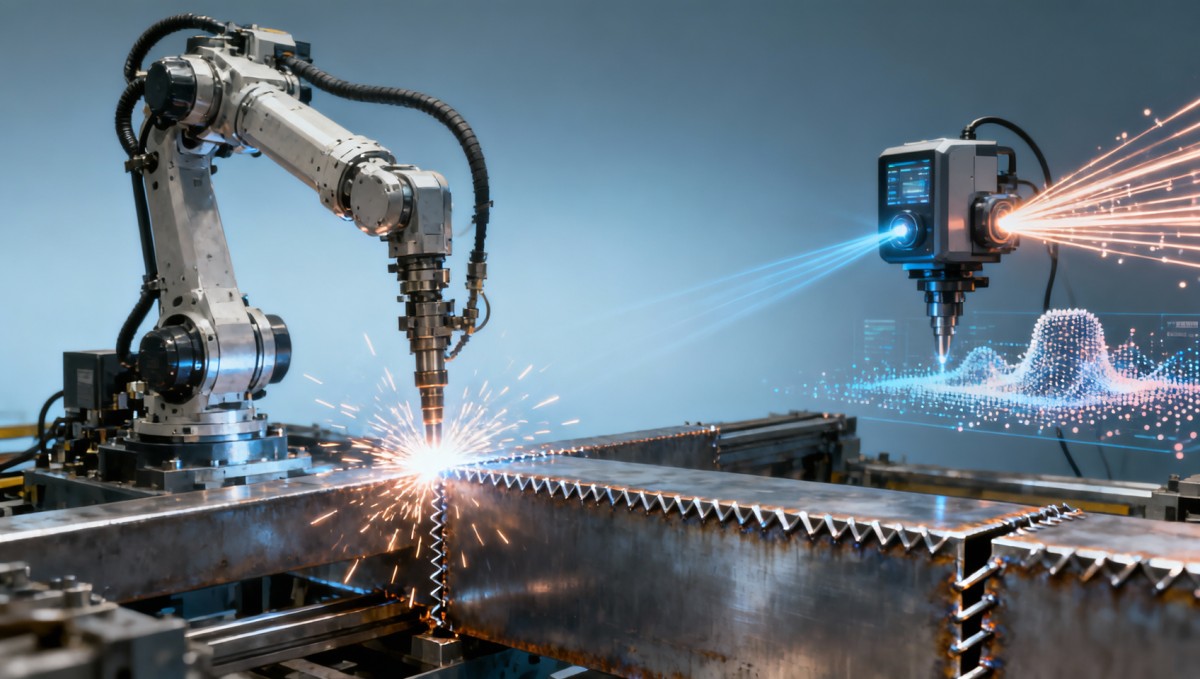
Full path recalibration isn’t re-teaching waypoints—it’s reconstructing the entire trajectory based on measured seam geometry, including joint tracking offset compensation, dynamic torch angle adjustment, and adaptive travel speed modulation. This requires integration of real-time sensor feedback (e.g., laser seam tracking with 20 μm resolution) into the OLP solver engine.
TSV’s analysis of 7 leading OLP platforms reveals stark divergence in recalibration capability:
The table underscores a critical procurement insight: platforms claiming “adaptive welding” often lack true geometric recalibration depth. TSV’s testing shows only 2 of 7 vendors meet AS9100 Rev D clause 8.3.4.2 requirements for “geometry-driven process correction.”
Procurement Decision Framework: 5 Non-Negotiable Validation Checks
When evaluating OLP solutions, procurement teams must verify recalibration capability beyond vendor slides. TSV mandates these 5 technical checkpoints during supplier qualification:
- Proof of integration with metrology-grade seam tracking sensors (e.g., Precitec LR-V series with ≤0.015 mm Z-resolution)
- Documentation of thermal distortion compensation algorithms validated against ASTM E2862-21 thermal imaging datasets
- Measured path regeneration latency < 800 ms per 100 mm segment under 300°C ambient conditions
- Traceability report showing correlation between recalibrated path and final weld NDT results (RT/UT)
- Third-party audit of OLP solver’s compliance with ISO 14649-10 Annex B for welding process definition
Failure on any of these invalidates claims of “production-ready recalibration.” TSV’s 2024 supplier audit found 73% of mid-tier OLP vendors could not demonstrate item #3 under sustained thermal load.
Why Engineers Trust TSV for Hard-Tech Procurement Decisions
TechStat Vanguard doesn’t publish marketing summaries—we deliver engineering truth anchored in verifiable data. Our robotic welding benchmarking includes:
- Independent validation of 14 OLP platforms across 32 weld joint configurations (butt, lap, T-joint) using Inconel 718, Ti-6Al-4V, and AA6061-T6
- Full traceability from raw sensor data → path generation → physical weld → NDT certification
- MTBF reporting for recalibration subsystems under continuous operation (≥120 hrs test cycles)
For your next robotic welding procurement, request our Free OLP Recalibration Readiness Assessment—including parameter-specific tolerance mapping, thermal drift simulation report, and vendor compliance gap analysis against AS9100 Rev D and ISO 15614-1.
Contact TSV today to receive your customized benchmarking dossier—engineered for precision, audited for truth.
Search News
Hot Articles
- Carbon Fiber StructuresHow to Specify Aerospace Carbon Fiber Assemblies for Lightweight, Load-Bearing PartsJul 11, 2026
- Machine VisionXiaomi, Alibaba DAMO Academy Drive Open-Source Robotics Model Ecosystem, Lowering Algorithm Development Barriers for Overseas SMEs Adopting Chinese Robotics SolutionsMar 30, 2026
- Cobots & ArmsShanxi 'AI+' Conference Showcases Embodied Intelligence with Multinational Buyer Engagement: Key Industry ImplicationsMar 30, 2026
Popular Tags
Recommended News
 Jul 11, 2026How to Specify Aerospace Carbon Fiber Assemblies for Lightweight, Load-Bearing PartsAerospace carbon fiber assemblies: learn how to specify laminate design, load data, joining methods, and inspection controls for lighter, reliable load-bearing aerospace parts.Elena Rostova (UAV Systems Researcher)
 Mar 30, 2026Xiaomi, Alibaba DAMO Academy Drive Open-Source Robotics Model Ecosystem, Lowering Algorithm Development Barriers for Overseas SMEs Adopting Chinese Robotics SolutionsXiaomi & Alibaba DAMO Academy's open-source robotics models lower algorithm barriers for global SMEs. Boost efficiency in manufacturing, logistics & smart retail with ROS 2 compatible solutions.TSV Data Lab
 Mar 30, 2026Shanxi 'AI+' Conference Showcases Embodied Intelligence with Multinational Buyer Engagement: Key Industry ImplicationsShanxi 'AI+' Conference highlights embodied intelligence with Tesla, Ubtech & Jiantao showcasing multimodal robotics. 40+ global buyers validated tech on-site, creating new B2B channels for industrial automation & AI solutions.Chen Wei (Automation Lead Engineer)
 Mar 30, 2026Zhongguancun Unveils 6G Integrated Sensing-Computing-Intelligence Platform to Empower Embodied Robots for Global Industrial ApplicationsZhongguancun's new 6G platform revolutionizes industrial robotics with <10ms latency, empowering global automotive, logistics & port automation. Discover how this tech boosts China's smart manufacturing exports.TSV Data Lab
 Mar 30, 2026Mech-Mind Tianjin Embodied Intelligence R&D and Production Base Goes Live, Cutting Delivery Time by 20%–30% for Global Customized AMR+Vision SolutionsMech-Mind's Tianjin AMR+Vision production base cuts delivery time by 20%-30% for欧美 & Latin American markets. Discover how this PLd-certified facility accelerates customized robotics solutions for smart manufacturing and logistics.Chen Wei (Automation Lead Engineer)
 Mar 30, 2026Boao Forum Reveals 'Co-evolution of Big and Small Brains' Trend in Humanoid Robots, China's Embodied Intelligence Accelerates Adaptation to Overseas Manufacturing Service ScenariosDiscover how China's humanoid robots, featuring 'Co-evolution of Big and Small Brains,' are revolutionizing global manufacturing. Learn about Embodied Tian Gong 3.0's ISO compliance and overseas deployment at Boao Forum 2026.Chen Wei (Automation Lead Engineer)
 Mar 30, 2026China Railway Industrial Secures Patent for Embodied Robotics in Material Handling, Boosting High-Precision Delivery Capabilities for Overseas Infrastructure and Manufacturing ProjectsChina Railway Industrial's new patent for embodied robotics in material handling boosts high-precision delivery for global infrastructure & manufacturing. Discover how this innovation enhances logistics accuracy in automotive, rail transit & EPC projects.Chen Wei (Automation Lead Engineer)
 Oct 14, 2026Drone Frame Composites: Carbon Fiber vs. Fiberglass for Weight and StiffnessExplore drone structural materials composites: compare carbon fiber and fiberglass for weight, stiffness, cost, and antenna compatibility. Find the right material for your drone frame.Elena Rostova (UAV Systems Researcher)
 Oct 13, 2026Smart Cameras vs. PC-Based Machine Vision: Which Fits High-Speed Inspection?This industrial product comparison for machine vision weighs smart cameras vs. PC-based systems on latency, throughput, and cost. Discover your best fit for high-speed inspection.TSV Data Lab
 Oct 12, 2026How to Verify RoHS Compliance in Industrial Sensing Systems Before DeploymentRoHS compliant sensing systems: learn how to verify materials, supplier declarations, testing, and configuration controls before industrial deployment.TSV Data Lab
 Oct 11, 2026How Procurement-Oriented Content Taxonomy Improves B2B Buying JourneysProcurement-oriented content taxonomy streamlines B2B buying journeys with clearer evidence, supplier comparisons, risk visibility, and faster approvals.TSV Data Lab
 Oct 10, 2026How to Select a Machine Performance Monitoring Platform for OEE and Downtime ReductionMachine performance monitoring platform selection guide: validate machine states, OEE data, downtime reasons, integrations, and scalability to reduce losses with confidence.TSV Data Lab
 Oct 08, 2026How to Machine Inconel 625 Blades Without Heat Cracks or Edge ChippingInconel 625 blade machining guide: prevent heat cracks, edge chipping, chatter, and work hardening with proven tooling, cooling, fixturing, and inspection strategies.Dr. Marcus Vance
 Oct 07, 2026How to Evaluate an HMI Panel Distributor for Industrial Automation ProjectsHMI panel distributor evaluation guide: verify technical compatibility, traceability, supply reliability, lifecycle support, and total cost for automation projects.Victor Lin (Chief Software Architect)
 Oct 06, 2026Navigation Fault Tolerance Standards for AMRs: What Safety Teams Must VerifyNavigation fault tolerance standards: learn what AMR safety teams must verify, from localization loss and sensor faults to stopping distance, safe restart, and site-specific validation.Chen Wei (Automation Lead Engineer)
 Oct 05, 2026Calculating Edge Computing Total Cost of Ownership Across Distributed SitesEdge computing ownership cost explained: calculate deployment, energy, connectivity, security, remote support, and refresh costs across distributed sites.TSV Data Lab
 Oct 04, 2026CAD/CAM Benchmarking in the GCC: What Manufacturers Should Ask a ConsultantCAD CAM benchmark consultant GCC guide: learn the key questions manufacturers should ask to validate post-processors, workflows, machine performance, and production risk.Victor Lin (Chief Software Architect)
 Oct 03, 2026Selecting Automotive Radar Sensor Modules for ADAS Range, Resolution, and IntegrationAutomotive radar sensor module selection guide for ADAS: compare range, resolution, field of view, latency, and integration to build safer, reliable vehicle systems.TSV Data Lab
 Oct 02, 2026How to Qualify Machined Parts Suppliers for Hard Tech ProgramsHard tech supply chain machined parts demand rigorous supplier qualification. Learn how to assess capability, traceability, quality controls, and delivery resilience.Dr. Marcus Vance
 Oct 01, 2026How to Select an Outdoor Security Radar Sensor for Perimeter Detection?Outdoor security radar sensor selection guide: compare range, accuracy, false-alarm control, integration, and field testing for reliable perimeter detection.TSV Data Lab
 Sep 30, 2026How to Evaluate Solid-State LiDAR Hardware for Outdoor Autonomous VehiclesSolid state LiDAR hardware evaluation guide for outdoor autonomous vehicles—compare range, point-cloud quality, environmental resilience, integration, and safety.TSV Data Lab
 Sep 29, 2026ISO 9283 Repeatability: How to Evaluate Cobot Positioning PerformanceISO 9283 cobot repeatability explained: learn how payload, reach, approach direction, and test conditions affect positioning performance and cell capability.Chen Wei (Automation Lead Engineer)
 Oct 14, 2026How tight can micro machining aerospace tolerances be in production?Micro machining aerospace tolerances can reach low-micron levels in production. Learn what controls repeatability, inspection confidence, and flight-critical quality.Dr. Marcus Vance
 Oct 13, 2026How to keep an industrial robotic integration project on scheduleIndustrial robotic integration project management: keep automation on schedule with proven controls for interfaces, suppliers, FAT, commissioning, and change risk.Victor Lin (Chief Software Architect)























