
Robotic arm IP67 waterproof test often misses cable weak points
Publication Date
author
Many robotic arm IP67 waterproof test reports look convincing, yet real failures often start at the cable interface, bend radius, or connector seal. For engineers, buyers, and plant decision-makers comparing automation reliability, this hidden risk directly affects uptime, maintenance cost, and supplier qualification. At TSV, we examine where waterproof validation breaks down, how cable weak points are overlooked, and what data-driven checks should be added before deployment.
In industrial automation, an IP67 claim usually creates a sense of closure: the enclosure passed dust ingress testing, survived temporary immersion, and appears suitable for wet or washdown environments. However, the robotic arm is not only an enclosure. It is a moving electromechanical system with repeated torsion, cable flex, connector loading, thermal cycling, and exposure to oils, coolants, or cleaning agents. That is where many waterproof assumptions fail.
For procurement teams, this is not a minor technical footnote. A single cable-related ingress fault can trigger unplanned downtime within 3 to 12 months, raise spare part usage, and complicate supplier accountability. For operators, the issue often appears as intermittent signal loss, encoder alarms, unstable end-effector behavior, or corrosion discovered only after maintenance teardown. For decision-makers, the question is simple: did the IP67 waterproof test reflect real operating stress, or only a limited lab condition?
Why IP67 Test Results Can Mislead Real-World Robotic Arm Selection
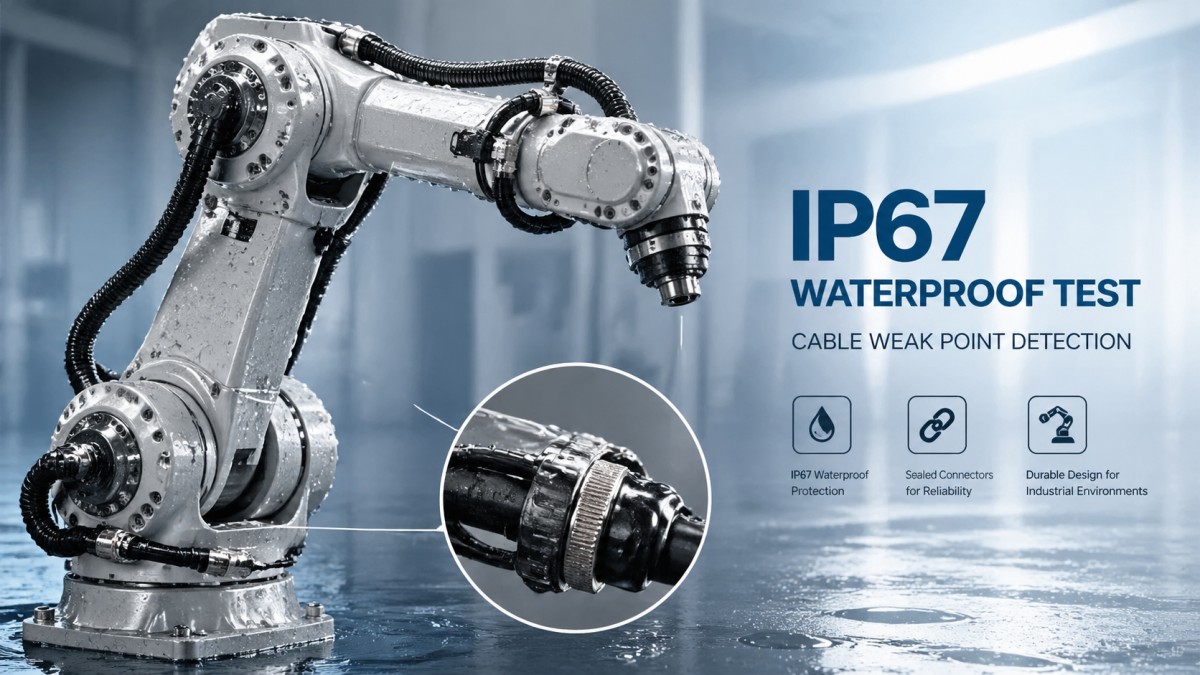
IP67 is a defined ingress protection rating, but it is often misunderstood as a complete durability certification. In practice, the rating confirms resistance to dust and short-term immersion under controlled conditions. It does not automatically validate long-term resistance to dynamic cable movement, repetitive joint articulation, or seal degradation after 500,000 to 5,000,000 motion cycles. A robotic arm used in welding, food handling, battery assembly, or outdoor automation may face all of these conditions simultaneously.
A common failure pattern begins at the transition zone where the cable exits the arm body or enters a connector housing. During qualification, the robot may pass a static water ingress test with the arm parked. In production, that same cable may experience bend radii below design recommendation, torsional stress above specification, or abrasion against guides and brackets. Once the jacket, gland, or internal conductor support is compromised, water ingress may begin at a weak point not captured by the original report.
This matters because many buyers compare robots using headline ratings instead of test scope. Two robotic arms can both carry an IP67 label, yet one supplier may have validated only the wrist housing and connectors in a static setup, while another may have tested cable assemblies under immersion after repeated dynamic motion. The difference is significant for lifecycle cost, maintenance planning, and line reliability.
At TSV, we advise evaluating waterproof performance as a system-level property with at least 4 linked dimensions: enclosure sealing, cable assembly durability, connector integrity, and post-motion ingress resistance. Without this broader view, the IP67 label can become a procurement shortcut that hides engineering risk.
Static pass versus dynamic operating reality
The gap between static laboratory testing and actual production use is one of the biggest blind spots in automation sourcing. In a lab, test water exposure may last 30 minutes under controlled depth and temperature. On the factory floor, the arm may run 16 to 24 hours per day, with washdown events, coolant mist, condensation, and frequent acceleration changes. Under these conditions, seals age differently and cable microcracks become meaningful.
Typical hidden limitations in vendor documents
- IP67 result shown for the arm housing, but not for the full cable routing path.
- Connector protection declared without stating mating cycles, torque control, or seal replacement interval.
- No disclosure of minimum bend radius, torsion angle, or cable flex cycle count.
- No retest data after exposure to detergents, cutting fluids, UV, or thermal shock.
Where Cable Weak Points Usually Appear in Robotic Arm Waterproof Systems
Cable weak points are rarely random. They tend to appear in predictable locations where mechanical stress and sealing complexity overlap. The first is the cable entry point, where a gland or strain relief must resist both movement and moisture. The second is the moving joint region, especially near wrist axes with high articulation frequency. The third is the connector interface, where O-rings, threads, alignment, and torque consistency determine whether the sealing design works in field conditions.
Another frequent issue is bend radius misuse. Many robotic cables are specified with a dynamic bend radius such as 7.5× to 10× cable outer diameter. If routing forces the cable below that threshold, the jacket can deform, internal shielding can shift, and local stress concentration can weaken sealing over time. Even when water does not enter immediately, reduced cable life often leads to insulation failure, intermittent communication faults, or corrosion under the jacket.
Suppliers and integrators also underestimate connector assembly variation. A connector that is rated for wet environments can still fail if thread engagement is incomplete, torque is too low, O-rings are twisted, or field replacement parts differ from original build spec. In many plants, maintenance technicians are asked to reconnect cables during short downtime windows. If the design is sensitive to installation error, the nominal waterproof rating loses practical value.
The table below summarizes the most common cable-related waterproof weak points and the operational consequences that buyers should include in technical evaluation.
The procurement lesson is straightforward: waterproof integrity depends on repeatable mechanical design and field assembly discipline, not just on a single protection label. Buyers should ask for evidence from the cable path, not only from the main arm shell.
Applications with elevated cable ingress risk
Risk is higher in environments with daily washdown, outdoor humidity swings, airborne abrasive particles, or oil-rich mist. Food packaging, metalworking, battery production, chemical dosing, and autonomous outdoor stations often create mixed stress conditions. In these use cases, a robotic arm may pass a standard immersion test yet still show cable or connector degradation within 6 to 18 months if routing and sealing were not engineered for motion-heavy duty.
What Data-Driven Waterproof Validation Should Include Before Deployment
For engineering teams and procurement managers, the most useful question is not “Is it IP67?” but “What exactly was tested, under what motion profile, and with what failure criteria?” A credible validation package should include preconditioning, dynamic movement, environmental exposure, and post-test electrical checks. Without those layers, the reported waterproof performance is incomplete.
As a working benchmark, TSV recommends a 5-part verification logic. First, document all ingress-protected components, including cable glands, connectors, and tool-side interfaces. Second, run dynamic flex and torsion cycles representative of use, often 100,000 to 1,000,000 cycles depending on application class. Third, perform water exposure or immersion after motion, not only before motion. Fourth, measure insulation resistance, contact stability, and communication continuity. Fifth, inspect for seal compression set, microcracking, and corrosion traces.
For higher-risk deployments, a more realistic protocol also includes temperature cycling from 0°C to 40°C or wider, depending on site conditions, because thermal expansion can change seal compression. If the robotic arm will work around coolants or cleaning chemistry, compatibility testing should be part of supplier qualification. A seal that survives clean water may degrade faster in alkaline detergents or hydrocarbon-rich mist.
The table below provides a practical checklist that engineering, sourcing, and quality teams can use when comparing robotic arm waterproof claims.
This framework helps reduce supplier ambiguity. It also creates a better basis for technical negotiation, acceptance criteria, and maintenance planning. In many cases, a vendor willing to disclose dynamic waterproof validation is more trustworthy than one relying only on a headline IP rating.
Minimum request list for RFQ and supplier qualification
- Ask whether the IP67 waterproof test covered the complete robot, external cable set, and end-of-arm connector interfaces.
- Request stated minimum dynamic bend radius, torsion limit, and expected flex cycle life.
- Ask for post-test photos or inspection notes showing cable gland and connector condition.
- Define maintenance intervals for seal replacement, connector inspection, and cable re-routing checks.
- Confirm whether field cable replacement preserves the original waterproof rating.
How Buyers, Operators, and Plant Leaders Should Evaluate Waterproof Risk in Practice
Different stakeholders see different symptoms, but the root risk is shared. Operators need stable uptime and easy serviceability. Buyers need comparable technical evidence across vendors. Plant leaders need predictable total cost of ownership over 2 to 5 years. A robotic arm IP67 waterproof test is useful only when it supports all three goals with clear engineering detail.
For operators, the first priority is inspection access. If cable routing near joints cannot be visually checked, small cracks or seal displacement may go unnoticed until a fault occurs. Good designs simplify routine inspection every 1 to 3 months, especially in wet production lines. For maintenance teams, connector orientation, torque guidance, and spare seal availability matter as much as the original rating.
For procurement, the key is comparing validation depth rather than catalog wording. A lower-priced arm may appear equivalent on paper but carry higher downstream cost if cable failure leads to replacement labor, calibration time, and delayed output. Even a 2-hour stop on a high-throughput line can outweigh the initial purchase difference between two suppliers. That is why RFQ documents should include waterproof validation questions, not only payload, reach, and repeatability.
For decision-makers, one effective approach is to classify robotic arm applications into three exposure levels: low, medium, and high. Low exposure may involve dust and occasional splash. Medium exposure may include coolant mist, high humidity, or weekly washdown. High exposure usually involves daily cleaning, chemical contact, or outdoor condensation cycles. The required validation effort should rise with the exposure class.
A practical decision matrix for deployment planning
The matrix below helps translate technical waterproof concerns into purchasing and operational decisions. It is especially useful when comparing 2 to 4 candidate robotic arm suppliers for the same project.
The main conclusion is that waterproof selection should be matched to duty profile, not taken as a universal checkbox. This is where data-driven engineering review can prevent avoidable downtime and supplier disputes.
Common procurement mistakes to avoid
- Approving a robotic arm based only on enclosure IP rating without cable assembly evidence.
- Ignoring field service conditions, including connector remating and replacement part quality.
- Assuming static lab tests represent 12-month or 24-month production reality.
- Failing to align acceptance testing with the site’s actual washdown or contamination profile.
FAQ: Robotic Arm IP67 Waterproof Test and Cable Reliability
Below are practical questions frequently raised by engineers, sourcing teams, and plant managers when reviewing robotic arm waterproof claims. These questions also help expand supplier discussions from label-based comparison to evidence-based selection.
Does IP67 mean the robotic arm is safe for long-term washdown use?
Not necessarily. IP67 confirms a specific level of dust protection and temporary immersion resistance, but it does not automatically prove durability under repeated washdown, detergent exposure, or millions of movement cycles. For long-term wet-duty use, ask for dynamic cable validation and post-motion sealing results.
Which cable area fails first in most field cases?
The highest-risk areas are usually cable entry glands, high-motion bend zones near wrist joints, and connector seals that depend on correct assembly torque. These points combine movement, stress concentration, and sealing complexity. Even a small assembly deviation can reduce effective waterproof performance.
What service interval should be planned for wet-environment robotic arms?
There is no universal interval, but many facilities benefit from visual inspection every 1 to 3 months and a more detailed connector and seal review every 6 to 12 months. High-exposure applications may need shorter intervals, especially if the arm experiences daily cleaning, chemical spray, or outdoor humidity cycling.
What should be added to a supplier RFQ?
Add at least 6 items: test scope, cable routing specification, bend radius limit, torsion limit, post-motion ingress method, and maintenance guidance for seals and connectors. This creates a cleaner comparison across vendors and reduces ambiguity during acceptance and warranty discussions.
A robotic arm IP67 waterproof test can be useful, but only when interpreted in full engineering context. The most costly failures often begin outside the headline rating, at cable weak points that experience real motion, repeated handling, and imperfect field assembly. For information researchers, operators, procurement teams, and enterprise decision-makers, the smarter path is to evaluate waterproof performance as a dynamic system with measurable weak points, defined inspection routines, and application-specific validation depth.
TechStat Vanguard focuses on these details because parameters, tolerances, and validation boundaries shape real industrial outcomes. If you are comparing robotic arms for wet, washdown, or high-humidity environments, contact TSV to review waterproof test scope, build a supplier qualification checklist, or obtain a more rigorous evaluation framework before deployment. Get a tailored assessment and make your next automation decision with clearer engineering evidence.
Search News
Hot Articles
- Carbon Fiber StructuresHow to Specify Aerospace Carbon Fiber Assemblies for Lightweight, Load-Bearing PartsJul 11, 2026
- Machine VisionXiaomi, Alibaba DAMO Academy Drive Open-Source Robotics Model Ecosystem, Lowering Algorithm Development Barriers for Overseas SMEs Adopting Chinese Robotics SolutionsMar 30, 2026
- Cobots & ArmsShanxi 'AI+' Conference Showcases Embodied Intelligence with Multinational Buyer Engagement: Key Industry ImplicationsMar 30, 2026
Popular Tags
Recommended News
 Jul 11, 2026How to Specify Aerospace Carbon Fiber Assemblies for Lightweight, Load-Bearing PartsAerospace carbon fiber assemblies: learn how to specify laminate design, load data, joining methods, and inspection controls for lighter, reliable load-bearing aerospace parts.Elena Rostova (UAV Systems Researcher)
 Mar 30, 2026Xiaomi, Alibaba DAMO Academy Drive Open-Source Robotics Model Ecosystem, Lowering Algorithm Development Barriers for Overseas SMEs Adopting Chinese Robotics SolutionsXiaomi & Alibaba DAMO Academy's open-source robotics models lower algorithm barriers for global SMEs. Boost efficiency in manufacturing, logistics & smart retail with ROS 2 compatible solutions.TSV Data Lab
 Mar 30, 2026Shanxi 'AI+' Conference Showcases Embodied Intelligence with Multinational Buyer Engagement: Key Industry ImplicationsShanxi 'AI+' Conference highlights embodied intelligence with Tesla, Ubtech & Jiantao showcasing multimodal robotics. 40+ global buyers validated tech on-site, creating new B2B channels for industrial automation & AI solutions.Chen Wei (Automation Lead Engineer)
 Mar 30, 2026Zhongguancun Unveils 6G Integrated Sensing-Computing-Intelligence Platform to Empower Embodied Robots for Global Industrial ApplicationsZhongguancun's new 6G platform revolutionizes industrial robotics with <10ms latency, empowering global automotive, logistics & port automation. Discover how this tech boosts China's smart manufacturing exports.TSV Data Lab
 Mar 30, 2026Mech-Mind Tianjin Embodied Intelligence R&D and Production Base Goes Live, Cutting Delivery Time by 20%–30% for Global Customized AMR+Vision SolutionsMech-Mind's Tianjin AMR+Vision production base cuts delivery time by 20%-30% for欧美 & Latin American markets. Discover how this PLd-certified facility accelerates customized robotics solutions for smart manufacturing and logistics.Chen Wei (Automation Lead Engineer)
 Mar 30, 2026Boao Forum Reveals 'Co-evolution of Big and Small Brains' Trend in Humanoid Robots, China's Embodied Intelligence Accelerates Adaptation to Overseas Manufacturing Service ScenariosDiscover how China's humanoid robots, featuring 'Co-evolution of Big and Small Brains,' are revolutionizing global manufacturing. Learn about Embodied Tian Gong 3.0's ISO compliance and overseas deployment at Boao Forum 2026.Chen Wei (Automation Lead Engineer)
 Mar 30, 2026China Railway Industrial Secures Patent for Embodied Robotics in Material Handling, Boosting High-Precision Delivery Capabilities for Overseas Infrastructure and Manufacturing ProjectsChina Railway Industrial's new patent for embodied robotics in material handling boosts high-precision delivery for global infrastructure & manufacturing. Discover how this innovation enhances logistics accuracy in automotive, rail transit & EPC projects.Chen Wei (Automation Lead Engineer)
 Oct 25, 2026Hesai Leads Global ADAS Main Lidar Shipments in Yole’s 2026 ReportHesai led global ADAS main lidar shipments with a 43% share in 2025, according to Yole’s 2026 report. Explore what this ranking reveals about its automotive market position.TSV Data Lab
 Oct 25, 2026Choosing an Aerospace Materials Manufacturer: Quality and Traceability ChecksChoosing an aerospace materials manufacturer? Learn how to verify certifications, test reports, and lot traceability to qualify suppliers confidently and reduce costly sourcing risks.Dr. Marcus Vance
 Oct 24, 2026Guotai Haitong: Global Entry-Level 3D Printer Shipments Rose 39% in Q1 2026Entry-level 3D printer shipments rose 39% in Q1 2026, Guotai Haitong reports. Explore how AI, multicolor printing and print farms are shaping market growth.Dr. Marcus Vance
 Oct 24, 2026Choosing an Industrial Vision Inspection Supplier: Acceptance Tests That MatterChoose an industrial vision inspection supplier with confidence. Discover acceptance tests for defect detection, false rejects, production speed, and reliable part rejection before you buy.TSV Data Lab
 Oct 23, 2026US Navy Raises Gecko Robotics Contract Ceiling to $300M for Robotic Fleet MaintenanceUS Navy raises Gecko Robotics’ contract ceiling to $300M for Pacific Fleet robotic inspections. Explore potential opportunities for maintenance suppliers and key procurement considerations.Chen Wei (Automation Lead Engineer)
 Oct 23, 2026Choosing Industrial Sensing Systems for Global Plants: Protocol CompatibilityCompare industrial sensing systems international buyers can trust. Explore protocol compatibility, reduce integration risks, and select proven configurations for reliable global plant deployments.TSV Data Lab
 Oct 22, 2026KUKA Showcases Physical AI and iiQKA.AI Vision at NVIDIA GTC BerlinExplore KUKA’s Physical AI showcase at NVIDIA GTC Berlin and discover how iiQKA.AI Vision aims to simplify robotic vision integration and improve 2D and 3D scene recognition.TSV Data Lab
 Oct 22, 2026Robotic Machining of Advanced Composites: What Tolerances Are Achievable?Explore advanced materials machining robotics: discover what drives achievable composite tolerances and how to validate accuracy before investing in your next machining system.Dr. Marcus Vance
 Oct 21, 2026China’s Industrial Robot Exports Near RMB 10 Billion in First Nine Months of 2026China’s industrial robot exports neared RMB 10 billion in January–September 2026, with value rising faster than volume. Explore the data and what it could mean for suppliers.Chen Wei (Automation Lead Engineer)
 Oct 21, 2026Low-Latency Industrial Data Processing: Pricing and Key Cost DriversExplore industrial data latency price drivers, from edge hardware to integration and support. Learn how to compare quotes, verify performance, and avoid unnecessary costs.TSV Data Lab
 Oct 20, 2026KUKA Launches iiQKA.AI Vision to Simplify Industrial Image ProcessingKUKA iiQKA.AI Vision simplifies industrial image processing with controller-based 2D and 3D vision. Explore drag-and-drop setup for vision-guided automation.TSV Data Lab
 Oct 20, 2026Smart Industrial Edge Devices: Key Criteria for Legacy PLC IntegrationChoose smart industrial edge devices for legacy PLC integration. Discover key criteria for compatibility, data quality, security, and reliable collection without disrupting control.TSV Data Lab
 Oct 19, 2026Choosing a Radar Sensor by Application: Range, Resolution, and Field of ViewSimplify radar sensor application based product selection. Compare range, resolution, and field of view to avoid blind spots and choose with confidence. Explore the guide.TSV Data Lab
 Oct 18, 2026Comparing Material Options for Procurement: Specs, Costs, and Supply RisksExplore procurement oriented technical content on material options, specs, costs, and supply risks. Compare alternatives to cut hidden expenses and make confident sourcing decisions.Dr. Marcus Vance
 Oct 17, 20265-Axis CNC Positioning Accuracy: How to Interpret ISO 230-2 Test ResultsAssess 5 axis CNC machining positioning accuracy with ISO 230-2. Learn to interpret repeatability, reversal error, and test conditions to compare suppliers and make confident acceptance decisions.Dr. Marcus Vance
 Oct 16, 2026Choosing a Rugged Edge AI Box Supplier: Thermal Tests and Lifecycle SupportChoose a rugged edge AI box supplier with proven thermal performance and reliable lifecycle support. Discover the tests and commitments to verify before you buy.TSV Data Lab
 Oct 15, 2026R&D Cost Reduction Services: How to Evaluate Fees, Savings, and ROIEvaluate R&D cost reduction services with confidence. Compare fees, verify savings, and calculate ROI without compromising performance. Discover how to choose a provider that delivers real value.Chen Wei (Automation Lead Engineer)























