
AGV magnetic tape vs SLAM comparison for stable routes
Publication Date
author
For stable, repeatable intralogistics routes, the agv magnetic tape vs slam comparison is not just a technology choice but a cost, uptime, and risk decision. This guide examines where magnetic tape still outperforms flexible navigation in controlled environments, and where SLAM delivers greater long-term value for operators, procurement teams, and industrial automation planners evaluating AGV navigation systems factory capabilities.
Why does the AGV magnetic tape vs SLAM comparison matter for stable routes?
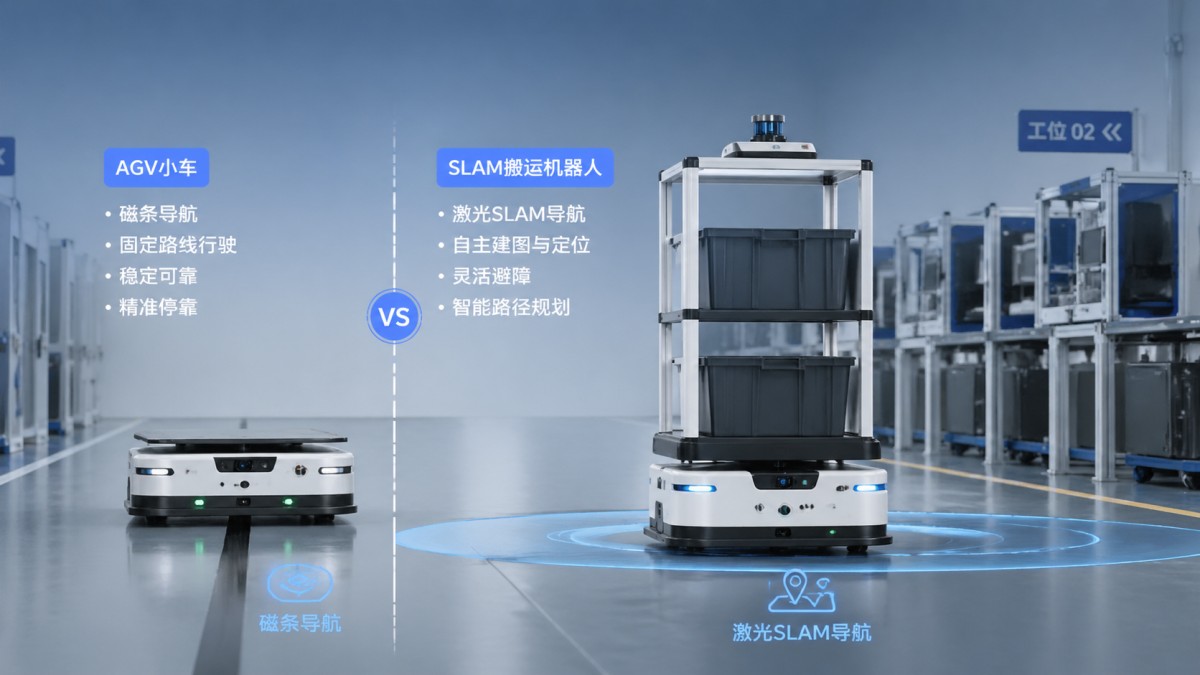
In factories, warehouses, and component handling lines, route stability is often more valuable than maximum navigation freedom. That is why the agv magnetic tape vs slam comparison matters most in facilities with fixed material flow, repeated stop points, and predictable shift patterns. For many users, the real question is not which technology sounds more advanced, but which one delivers repeatable movement, lower intervention frequency, and easier control over the next 3–5 years.
Magnetic tape AGVs follow a physical path installed on the floor. SLAM AGVs or AMRs build and update a map using sensors such as LiDAR, cameras, or fusion systems. On paper, SLAM appears more flexible. In practice, stable-route environments often reward simplicity. If the layout changes only every 12–24 months, tape guidance can still be a rational engineering decision, especially when uptime, training simplicity, and deployment speed outrank route variability.
TSV’s engineering perspective is straightforward: parameters and operating constraints should drive selection. Procurement teams should compare route accuracy, maintenance workload, environmental tolerance, and recovery behavior after interruptions. Operators should examine how easily a vehicle returns to path after an obstacle event. Decision-makers should ask whether flexibility is truly needed daily, quarterly, or only during future expansion.
For information researchers, this topic also sits at the intersection of robotics, sensors, and intralogistics ROI. The choice affects commissioning time, software integration depth, battery usage patterns, and site modification cost. In many projects, the difference between a smooth launch and six months of adjustment comes down to whether the navigation method matched the actual route discipline of the plant.
Two navigation philosophies, two different risk profiles
Magnetic tape represents controlled-path automation. It works best when traffic lanes, pickup points, drop points, and charging logic are preplanned and rarely altered. SLAM represents adaptive-path automation. It is more suitable when aisles change, racks move, temporary pallets appear, or one vehicle needs to serve multiple variable missions within a single shift.
This means the agv magnetic tape vs slam comparison should not begin with marketing language. It should begin with four questions: how often routes change, how cluttered the floor becomes, how critical stop-point precision is, and how much software complexity the site can support. These four factors usually narrow the answer faster than any brochure.
Which technical differences affect uptime, accuracy, and maintenance?
From a technical standpoint, magnetic tape and SLAM differ in path definition, perception dependency, and failure modes. Tape systems derive guidance from a physical marker. SLAM systems derive guidance from map recognition and live localization. That difference changes how each solution behaves under dust, floor wear, layout revisions, lighting variation, reflective surfaces, and temporary obstructions.
In stable-route operations, stopping accuracy often matters more than route intelligence. Towing, rack transfer, conveyor docking, and line-side feeding may require repeatable alignment in a narrow tolerance band, commonly discussed in ranges such as ±5 mm to ±20 mm depending on speed, load, and interface design. A tape-guided system can simplify this requirement when the mechanical path and station geometry are already fixed and validated.
SLAM systems introduce broader environmental awareness, but their performance depends heavily on sensor quality, map quality, and how dynamic the facility is. If metal reflections, changing pallet stacks, or seasonal reconfiguration alter the environment, the system may require remapping, filter tuning, or route logic adjustment. That does not make SLAM unreliable. It means maintenance shifts from floor tape inspection to sensor health, mapping quality, and software supervision.
The table below summarizes the agv magnetic tape vs slam comparison in a way procurement and engineering teams can use during specification review.
The most important interpretation is this: a technically simpler system can outperform a more advanced one when the operating boundary is narrow and well controlled. Conversely, if your site is expected to add lines, move racks, or reconfigure aisle logic 3–4 times per year, software-defined navigation usually becomes more economical over the medium term.
What should operators and maintenance teams watch?
- For magnetic tape, inspect floor adhesion, tape edge damage, contamination near turns, and station marker integrity at least weekly in busy lanes.
- For SLAM, verify sensor lens cleanliness, map consistency after layout updates, and localization drift in reflective or highly dynamic zones.
- For both systems, track recovery time after obstacle stop, docking repeatability, and manual intervention rate per shift.
These measures give a more useful picture than generic claims about intelligence. In a B2B procurement context, the true differentiator is often not navigation theory but how often technicians must intervene during a 16–24 hour operating window.
Which application scenarios favor magnetic tape, and when is SLAM the better choice?
Not every facility needs the same type of mobility. The agv magnetic tape vs slam comparison becomes clearer when tied to specific workflows rather than general product categories. Stable line feeding, pallet transfer on fixed corridors, and repetitive hospital logistics differ significantly from e-commerce, mixed manufacturing, or high-change contract production environments.
Magnetic tape remains practical where routes are standardized, floor conditions are manageable, and station count is relatively fixed. This includes assembly plants with repeated milk-run loops, electronics production with stable buffer zones, and packaging lines where material moves in a closed loop every 5–15 minutes. In these cases, the benefit is predictability. Training is easier, troubleshooting is faster, and route behavior is visible to both operators and supervisors.
SLAM becomes more attractive where route flexibility has direct business value. Contract manufacturers, distribution centers, and multi-product plants often need to reroute vehicles around temporary inventory, changing line priorities, or renovation zones. If your operation adds or removes stations within a quarter, or if new projects trigger recurring layout revisions, SLAM reduces the need to physically rebuild guidance paths.
The scenario table below helps researchers, operators, and purchasing managers match navigation technology to real intralogistics conditions instead of choosing by trend alone.
The takeaway is not that one method replaces the other. It is that route rigidity can be either a benefit or a constraint depending on how your plant changes over time. A stable route today may stay stable for years in one facility and become obsolete in 6 months in another.
A simple decision rule for stable-route projects
- If route changes are rare and docking points are critical, start with magnetic tape as the baseline option.
- If route changes occur every quarter, compare the accumulated floor modification cost against SLAM software and integration cost.
- If the site has mixed traffic, moving obstacles, and future expansion uncertainty, prioritize SLAM during long-term planning.
This three-step filter helps avoid a common error: paying for flexibility that is never used, or choosing simplicity in an environment that changes too often to remain simple.
What should procurement and decision-makers compare before buying?
For procurement teams, the agv magnetic tape vs slam comparison should move beyond unit price. Total decision quality depends on at least five dimensions: implementation time, site modification burden, expected route change frequency, maintenance skill requirements, and integration with WMS, MES, PLC, or elevator and door systems. A lower upfront quote may become the more expensive choice once floor rework, downtime, and engineering revisions are included.
Typical implementation windows vary by project complexity. In straightforward tape-guided deployments, physical route installation and validation may be relatively fast if the floor is prepared and traffic logic is simple. In SLAM projects, initial mapping and software commissioning can also be fast in clean environments, but integration and optimization may take longer when the site contains multiple dynamic zones. In both cases, pilot validation over 1–3 routes is often more informative than broad assumptions.
Decision-makers should also classify costs into visible and hidden categories. Visible costs include vehicles, chargers, controllers, sensors, and installation. Hidden costs include route redesign, production interruption during commissioning, operator retraining, remapping after layout updates, tape repair cycles, and internal engineering hours. These hidden items often decide actual ROI over 24–36 months.
The procurement checklist below is designed for buyers who need measurable discussion points when comparing AGV navigation systems for factory deployment.
Five checkpoints before RFQ or final approval
- Define route stability: confirm whether the path will stay fixed for at least 12 months, or whether expansion is expected within 2–4 quarters.
- Define stop-point tolerance: identify whether docking needs are coarse transport positioning or tighter machine interface alignment.
- Define environment: record floor damage, dust level, reflective materials, narrow aisles, and mixed human traffic conditions.
- Define integration scope: list whether dispatching must connect with ERP, MES, WMS, conveyor controls, or automated doors.
- Define service expectations: ask for preventive maintenance scope, spare parts list, software update policy, and response time commitments.
Common standards and compliance points to review
Although project details vary, buyers should ask suppliers how the solution aligns with general machinery safety and mobile robot safety expectations, and how risk assessment is handled for the intended site. Safety scanners, emergency stop behavior, speed zoning, warning methods, and traffic rules should be discussed early. For cross-border projects, site-level compliance review is often necessary before shipment and commissioning.
This is where TSV’s data-driven approach becomes useful. Instead of accepting vague claims, procurement teams should request parameter ranges, test conditions, fault recovery logic, and maintenance assumptions. Engineering truth starts with asking what happens not only in ideal operation, but also in obstructed aisles, worn floors, and partial system failure states.
What are the common misconceptions, risks, and practical next steps?
A frequent misconception is that SLAM always means better long-term value. That is only true when flexibility is regularly used. If 90% of movement follows the same loop every day, added navigation intelligence may not generate proportional business benefit. Another misconception is that magnetic tape is outdated by definition. In reality, mature, repetitive logistics tasks often reward technologies with fewer variables and faster fault localization.
The second risk is underestimating site condition. Tape systems may suffer when floors are damaged, wet, or frequently resurfaced. SLAM systems may suffer when visual or LiDAR landmarks change too often, when reflective surfaces are severe, or when users expect zero tuning in highly dynamic space. In both cases, the problem is usually not the technology category itself, but a mismatch between navigation method and plant conditions.
A third risk is buying around a demo rather than around a workflow. A clean showroom route does not reveal how vehicles perform near loading docks, intersections, charging queues, or mixed pedestrian traffic. Before final selection, test at least one real shift cycle, include start-stop density, and review what happens during route blockage lasting 30–120 seconds. Recovery behavior matters as much as nominal travel speed.
The practical next step is to build a short comparison document with route count, daily trip volume, stop precision requirement, floor condition notes, and expected layout change cycle. This converts the agv magnetic tape vs slam comparison from opinion into an engineering purchasing decision.
FAQ for buyers and industrial planners
Is magnetic tape still suitable for modern AGV projects?
Yes, especially in plants with fixed routes, repeated stations, and low layout change frequency. It can remain a cost-rational option when the objective is stable transport rather than dynamic rerouting. Suitability depends on floor condition, route permanence, and docking needs, not on whether the technology appears newer or older.
When does SLAM justify the higher complexity?
SLAM is easier to justify when the facility changes regularly, when stations are added or moved within a year, or when one fleet must support multiple workflows. It also gains value when floor modifications are difficult or disruptive. In these cases, software-defined adaptability can reduce future reinstallation effort.
What should operators ask during site acceptance?
Ask about docking repeatability, obstacle recovery logic, speed zoning, alarm handling, battery charging strategy, and manual takeover procedure. Also verify inspection frequency, spare parts that should be stocked locally, and which maintenance tasks can be done by onsite technicians versus supplier service staff.
Why work with TSV when evaluating AGV navigation systems?
TechStat Vanguard approaches automation selection the way engineering teams and procurement leaders actually need it: through measurable criteria, not inflated claims. We help filter information noise by focusing on route stability, navigation fault tolerance, maintenance burden, commissioning logic, and supplier comparison points that affect real deployment outcomes. This is especially valuable when internal teams must defend a capital decision across operations, engineering, and finance.
If you are comparing magnetic tape AGV and SLAM for a factory, warehouse, or mixed intralogistics site, contact TSV for support on parameter confirmation, navigation method selection, layout-change risk evaluation, implementation sequencing, compliance review, and supplier RFQ structure. You can also consult us on delivery cycle expectations, pilot scope definition, docking requirement clarification, and how to create a decision matrix that procurement and technical teams can both sign off on.
Search News
Hot Articles
- Carbon Fiber StructuresHow to Specify Aerospace Carbon Fiber Assemblies for Lightweight, Load-Bearing PartsJul 11, 2026
- Machine VisionXiaomi, Alibaba DAMO Academy Drive Open-Source Robotics Model Ecosystem, Lowering Algorithm Development Barriers for Overseas SMEs Adopting Chinese Robotics SolutionsMar 30, 2026
- Cobots & ArmsShanxi 'AI+' Conference Showcases Embodied Intelligence with Multinational Buyer Engagement: Key Industry ImplicationsMar 30, 2026
Popular Tags
Recommended News
 Jul 11, 2026How to Specify Aerospace Carbon Fiber Assemblies for Lightweight, Load-Bearing PartsAerospace carbon fiber assemblies: learn how to specify laminate design, load data, joining methods, and inspection controls for lighter, reliable load-bearing aerospace parts.Elena Rostova (UAV Systems Researcher)
 Mar 30, 2026Xiaomi, Alibaba DAMO Academy Drive Open-Source Robotics Model Ecosystem, Lowering Algorithm Development Barriers for Overseas SMEs Adopting Chinese Robotics SolutionsXiaomi & Alibaba DAMO Academy's open-source robotics models lower algorithm barriers for global SMEs. Boost efficiency in manufacturing, logistics & smart retail with ROS 2 compatible solutions.TSV Data Lab
 Mar 30, 2026Shanxi 'AI+' Conference Showcases Embodied Intelligence with Multinational Buyer Engagement: Key Industry ImplicationsShanxi 'AI+' Conference highlights embodied intelligence with Tesla, Ubtech & Jiantao showcasing multimodal robotics. 40+ global buyers validated tech on-site, creating new B2B channels for industrial automation & AI solutions.Chen Wei (Automation Lead Engineer)
 Mar 30, 2026Zhongguancun Unveils 6G Integrated Sensing-Computing-Intelligence Platform to Empower Embodied Robots for Global Industrial ApplicationsZhongguancun's new 6G platform revolutionizes industrial robotics with <10ms latency, empowering global automotive, logistics & port automation. Discover how this tech boosts China's smart manufacturing exports.TSV Data Lab
 Mar 30, 2026Mech-Mind Tianjin Embodied Intelligence R&D and Production Base Goes Live, Cutting Delivery Time by 20%–30% for Global Customized AMR+Vision SolutionsMech-Mind's Tianjin AMR+Vision production base cuts delivery time by 20%-30% for欧美 & Latin American markets. Discover how this PLd-certified facility accelerates customized robotics solutions for smart manufacturing and logistics.Chen Wei (Automation Lead Engineer)
 Mar 30, 2026Boao Forum Reveals 'Co-evolution of Big and Small Brains' Trend in Humanoid Robots, China's Embodied Intelligence Accelerates Adaptation to Overseas Manufacturing Service ScenariosDiscover how China's humanoid robots, featuring 'Co-evolution of Big and Small Brains,' are revolutionizing global manufacturing. Learn about Embodied Tian Gong 3.0's ISO compliance and overseas deployment at Boao Forum 2026.Chen Wei (Automation Lead Engineer)
 Mar 30, 2026China Railway Industrial Secures Patent for Embodied Robotics in Material Handling, Boosting High-Precision Delivery Capabilities for Overseas Infrastructure and Manufacturing ProjectsChina Railway Industrial's new patent for embodied robotics in material handling boosts high-precision delivery for global infrastructure & manufacturing. Discover how this innovation enhances logistics accuracy in automotive, rail transit & EPC projects.Chen Wei (Automation Lead Engineer)
 Oct 25, 2026Hesai Leads Global ADAS Main Lidar Shipments in Yole’s 2026 ReportHesai led global ADAS main lidar shipments with a 43% share in 2025, according to Yole’s 2026 report. Explore what this ranking reveals about its automotive market position.TSV Data Lab
 Oct 25, 2026Choosing an Aerospace Materials Manufacturer: Quality and Traceability ChecksChoosing an aerospace materials manufacturer? Learn how to verify certifications, test reports, and lot traceability to qualify suppliers confidently and reduce costly sourcing risks.Dr. Marcus Vance
 Oct 24, 2026Guotai Haitong: Global Entry-Level 3D Printer Shipments Rose 39% in Q1 2026Entry-level 3D printer shipments rose 39% in Q1 2026, Guotai Haitong reports. Explore how AI, multicolor printing and print farms are shaping market growth.Dr. Marcus Vance
 Oct 24, 2026Choosing an Industrial Vision Inspection Supplier: Acceptance Tests That MatterChoose an industrial vision inspection supplier with confidence. Discover acceptance tests for defect detection, false rejects, production speed, and reliable part rejection before you buy.TSV Data Lab
 Oct 23, 2026US Navy Raises Gecko Robotics Contract Ceiling to $300M for Robotic Fleet MaintenanceUS Navy raises Gecko Robotics’ contract ceiling to $300M for Pacific Fleet robotic inspections. Explore potential opportunities for maintenance suppliers and key procurement considerations.Chen Wei (Automation Lead Engineer)
 Oct 23, 2026Choosing Industrial Sensing Systems for Global Plants: Protocol CompatibilityCompare industrial sensing systems international buyers can trust. Explore protocol compatibility, reduce integration risks, and select proven configurations for reliable global plant deployments.TSV Data Lab
 Oct 22, 2026KUKA Showcases Physical AI and iiQKA.AI Vision at NVIDIA GTC BerlinExplore KUKA’s Physical AI showcase at NVIDIA GTC Berlin and discover how iiQKA.AI Vision aims to simplify robotic vision integration and improve 2D and 3D scene recognition.TSV Data Lab
 Oct 22, 2026Robotic Machining of Advanced Composites: What Tolerances Are Achievable?Explore advanced materials machining robotics: discover what drives achievable composite tolerances and how to validate accuracy before investing in your next machining system.Dr. Marcus Vance
 Oct 21, 2026China’s Industrial Robot Exports Near RMB 10 Billion in First Nine Months of 2026China’s industrial robot exports neared RMB 10 billion in January–September 2026, with value rising faster than volume. Explore the data and what it could mean for suppliers.Chen Wei (Automation Lead Engineer)
 Oct 21, 2026Low-Latency Industrial Data Processing: Pricing and Key Cost DriversExplore industrial data latency price drivers, from edge hardware to integration and support. Learn how to compare quotes, verify performance, and avoid unnecessary costs.TSV Data Lab
 Oct 20, 2026KUKA Launches iiQKA.AI Vision to Simplify Industrial Image ProcessingKUKA iiQKA.AI Vision simplifies industrial image processing with controller-based 2D and 3D vision. Explore drag-and-drop setup for vision-guided automation.TSV Data Lab
 Oct 20, 2026Smart Industrial Edge Devices: Key Criteria for Legacy PLC IntegrationChoose smart industrial edge devices for legacy PLC integration. Discover key criteria for compatibility, data quality, security, and reliable collection without disrupting control.TSV Data Lab
 Oct 19, 2026Choosing a Radar Sensor by Application: Range, Resolution, and Field of ViewSimplify radar sensor application based product selection. Compare range, resolution, and field of view to avoid blind spots and choose with confidence. Explore the guide.TSV Data Lab
 Oct 18, 2026Comparing Material Options for Procurement: Specs, Costs, and Supply RisksExplore procurement oriented technical content on material options, specs, costs, and supply risks. Compare alternatives to cut hidden expenses and make confident sourcing decisions.Dr. Marcus Vance
 Oct 17, 20265-Axis CNC Positioning Accuracy: How to Interpret ISO 230-2 Test ResultsAssess 5 axis CNC machining positioning accuracy with ISO 230-2. Learn to interpret repeatability, reversal error, and test conditions to compare suppliers and make confident acceptance decisions.Dr. Marcus Vance
 Oct 16, 2026Choosing a Rugged Edge AI Box Supplier: Thermal Tests and Lifecycle SupportChoose a rugged edge AI box supplier with proven thermal performance and reliable lifecycle support. Discover the tests and commitments to verify before you buy.TSV Data Lab
 Oct 15, 2026R&D Cost Reduction Services: How to Evaluate Fees, Savings, and ROIEvaluate R&D cost reduction services with confidence. Compare fees, verify savings, and calculate ROI without compromising performance. Discover how to choose a provider that delivers real value.Chen Wei (Automation Lead Engineer)























