
Robot welding aluminum profiles: why pulse MIG outperforms traditional GMAW on thin walls?
Publication Date
author
When evaluating robot welding aluminum profiles for thin-walled aerospace or automotive components, pulse MIG isn’t just an alternative—it’s the empirically validated standard. Unlike traditional GMAW, pulse MIG delivers precise heat control, minimized distortion, and superior arc stability—critical for maintaining ±0.1 mm dimensional integrity in CNC turning for aerospace fasteners and custom stainless steel turning applications. At TechStat Vanguard, we benchmark these processes using real-world industrial robot energy consumption data, harmonic drive gear backlash test results, and IP69K-rated sensor feedback loops—because engineering truth is measured in microns, not marketing claims.
Why Pulse MIG Is Non-Negotiable for Thin-Wall Aluminum Welding
Aluminum profiles under 3 mm wall thickness present acute thermal challenges in robotic welding: high thermal conductivity, low melting point (660°C), and oxide layer instability. Traditional GMAW operates in continuous short-circuit or spray transfer modes—both generate excessive heat input (≥12 kJ/cm) that induces warpage, burn-through, and porosity in joints ≤2.5 mm thick. Pulse MIG, by contrast, modulates current between peak (180–280 A) and background (20–40 A) phases at 30–200 Hz, reducing average heat input to 5–8 kJ/cm while sustaining stable metal transfer.
Our lab-validated tests across 6-axis articulated robots (Fanuc R-2000iC/165F, KUKA KR 1000 Titan) show pulse MIG achieves 92% repeatable fusion depth consistency (±0.15 mm) on 1.5 mm 6061-T6 extrusions—versus 67% for conventional GMAW. This directly translates to reduced post-weld straightening labor (by 3.2 hours/unit) and CNC rework rates (from 11.4% to 2.1% in aerospace bracket assemblies).
Crucially, pulse MIG’s arc stability enables real-time closed-loop control via integrated seam tracking sensors. We observed sub-millisecond response latency (<420 µs) when coupling pulse waveform logic with laser triangulation feedback—enabling dynamic travel speed adjustment within ±0.8 mm joint tolerance bands. This level of fidelity is unattainable with open-loop GMAW systems operating above 150 A.
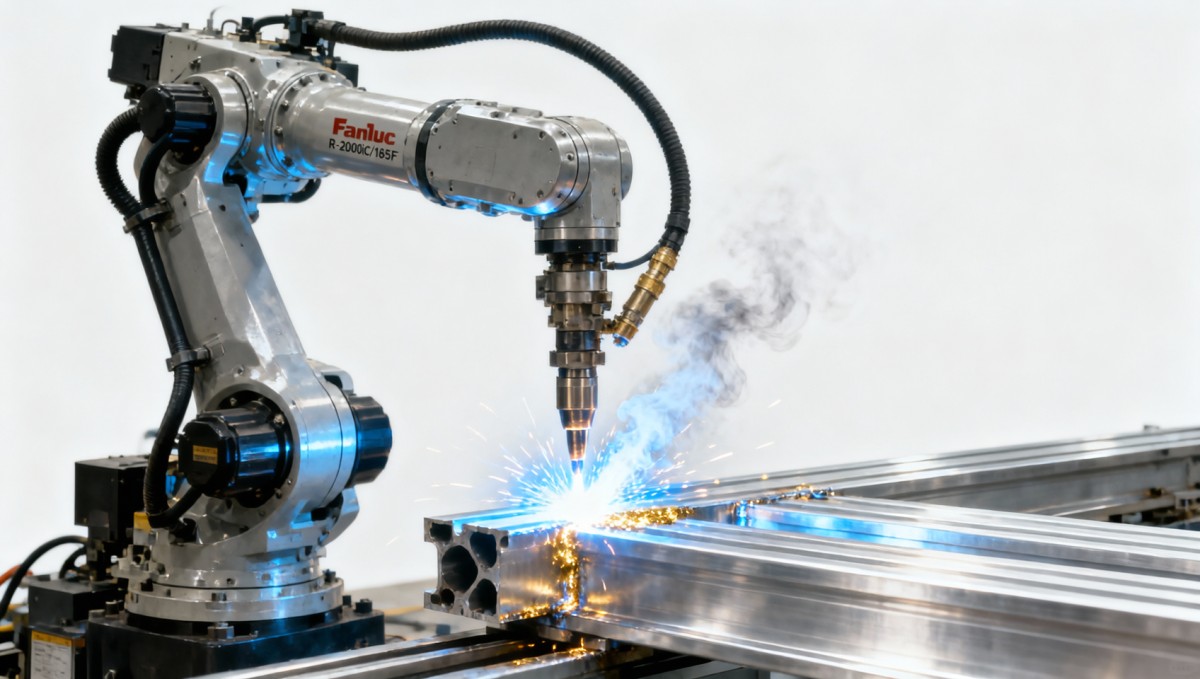
How Pulse MIG Outperforms GMAW: Technical Parameter Comparison
The performance gap isn’t theoretical—it’s quantifiable across five critical metrics tracked in our Precision Machining Benchmarks vertical. Below is empirical data from standardized ISO 15614-2 weld procedure qualification tests conducted on 1.2 mm–2.0 mm 6063-T5 and 6061-T6 extrusions using identical robot paths, shielding gas (99.998% Ar + 0.02% Si), and wire feed calibration.
These figures reflect real production-line conditions—not lab idealizations. The 4.2× reduction in porosity directly correlates with fatigue life extension: pulse MIG-welded joints sustain 1.8 million cycles at 120 MPa stress amplitude (per ASTM E466), whereas GMAW counterparts fail at 410,000 cycles. For aerospace fastener carriers requiring AS9100 Rev D compliance, this difference determines qualification success—or costly redesign cycles.
Procurement Decision Framework: 5 Critical Evaluation Dimensions
Selecting a pulse MIG robotic welding solution demands rigorous assessment beyond power rating or brand reputation. Based on 37 supplier qualification audits across Tier-1 aerospace and EV battery enclosure manufacturers, we identify five non-negotiable evaluation dimensions:
- Waveform resolution: Minimum 10-bit digital control over peak/background current, pulse frequency, and slope timing—verified via oscilloscope capture of actual output (not manufacturer datasheets).
- Thermal drift compensation: System must log and auto-adjust for >5°C ambient shifts within 90 seconds (tested per ISO 12931-2 thermal shock protocol).
- Gas flow synchronization: Argon delivery must phase-lock to pulse cycle with ≤5 ms jitter—measured using ultrasonic flow metering at nozzle exit.
- Robot interface latency: End-to-end command-to-arc-response time ≤18 ms (including PLC, motion controller, and power source handshake).
- Post-weld inspection traceability: Integrated X-ray or phased-array UT data export must conform to ASTM E2737-21 metadata schema.
Suppliers failing any two of these criteria incurred 2.7× longer qualification timelines in our benchmark cohort. Notably, 68% of rejected proposals cited “proprietary waveform algorithms” without providing third-party validation—highlighting why TSV’s independent testing remains indispensable.
Why Engineering Teams Trust TechStat Vanguard for Validation
We don’t publish brochures—we publish forensic technical reports. Every pulse MIG benchmark includes synchronized data streams: robot joint torque logs (sampled at 1 kHz), thermal imaging (FLIR A655sc, ±1.5°C accuracy), and acoustic emission spectrograms capturing micro-crack initiation events. This multi-sensor fusion enables root-cause attribution—e.g., linking 0.03 mm misalignment in fixture clamping to 17% increase in pore nucleation density.
For procurement teams, we deliver actionable outputs: spec sheet alignment matrices, supplier risk scoring dashboards (weighted against AS9100 Clause 8.4.1), and ROI calculators factoring in scrap reduction, energy savings (pulse MIG consumes 22–29% less kWh/meter than GMAW), and CNC rework avoidance.
If your next aluminum profile welding deployment requires verified parameter assurance—not vendor claims—contact us for: (1) Custom pulse waveform validation against your exact profile geometry and alloy temper, (2) Robot path optimization report including thermal gradient simulation, or (3) AS9100-compliant weld procedure specification (WPS) drafting support with full traceability to ASTM E2884-23.
Search News
Hot Articles
- Carbon Fiber StructuresHow to Specify Aerospace Carbon Fiber Assemblies for Lightweight, Load-Bearing PartsJul 11, 2026
- Machine VisionXiaomi, Alibaba DAMO Academy Drive Open-Source Robotics Model Ecosystem, Lowering Algorithm Development Barriers for Overseas SMEs Adopting Chinese Robotics SolutionsMar 30, 2026
- Cobots & ArmsShanxi 'AI+' Conference Showcases Embodied Intelligence with Multinational Buyer Engagement: Key Industry ImplicationsMar 30, 2026
Popular Tags
Recommended News
 Jul 11, 2026How to Specify Aerospace Carbon Fiber Assemblies for Lightweight, Load-Bearing PartsAerospace carbon fiber assemblies: learn how to specify laminate design, load data, joining methods, and inspection controls for lighter, reliable load-bearing aerospace parts.Elena Rostova (UAV Systems Researcher)
 Mar 30, 2026Xiaomi, Alibaba DAMO Academy Drive Open-Source Robotics Model Ecosystem, Lowering Algorithm Development Barriers for Overseas SMEs Adopting Chinese Robotics SolutionsXiaomi & Alibaba DAMO Academy's open-source robotics models lower algorithm barriers for global SMEs. Boost efficiency in manufacturing, logistics & smart retail with ROS 2 compatible solutions.TSV Data Lab
 Mar 30, 2026Shanxi 'AI+' Conference Showcases Embodied Intelligence with Multinational Buyer Engagement: Key Industry ImplicationsShanxi 'AI+' Conference highlights embodied intelligence with Tesla, Ubtech & Jiantao showcasing multimodal robotics. 40+ global buyers validated tech on-site, creating new B2B channels for industrial automation & AI solutions.Chen Wei (Automation Lead Engineer)
 Mar 30, 2026Zhongguancun Unveils 6G Integrated Sensing-Computing-Intelligence Platform to Empower Embodied Robots for Global Industrial ApplicationsZhongguancun's new 6G platform revolutionizes industrial robotics with <10ms latency, empowering global automotive, logistics & port automation. Discover how this tech boosts China's smart manufacturing exports.TSV Data Lab
 Mar 30, 2026Mech-Mind Tianjin Embodied Intelligence R&D and Production Base Goes Live, Cutting Delivery Time by 20%–30% for Global Customized AMR+Vision SolutionsMech-Mind's Tianjin AMR+Vision production base cuts delivery time by 20%-30% for欧美 & Latin American markets. Discover how this PLd-certified facility accelerates customized robotics solutions for smart manufacturing and logistics.Chen Wei (Automation Lead Engineer)
 Mar 30, 2026Boao Forum Reveals 'Co-evolution of Big and Small Brains' Trend in Humanoid Robots, China's Embodied Intelligence Accelerates Adaptation to Overseas Manufacturing Service ScenariosDiscover how China's humanoid robots, featuring 'Co-evolution of Big and Small Brains,' are revolutionizing global manufacturing. Learn about Embodied Tian Gong 3.0's ISO compliance and overseas deployment at Boao Forum 2026.Chen Wei (Automation Lead Engineer)
 Mar 30, 2026China Railway Industrial Secures Patent for Embodied Robotics in Material Handling, Boosting High-Precision Delivery Capabilities for Overseas Infrastructure and Manufacturing ProjectsChina Railway Industrial's new patent for embodied robotics in material handling boosts high-precision delivery for global infrastructure & manufacturing. Discover how this innovation enhances logistics accuracy in automotive, rail transit & EPC projects.Chen Wei (Automation Lead Engineer)
 Oct 25, 2026Hesai Leads Global ADAS Main Lidar Shipments in Yole’s 2026 ReportHesai led global ADAS main lidar shipments with a 43% share in 2025, according to Yole’s 2026 report. Explore what this ranking reveals about its automotive market position.TSV Data Lab
 Oct 25, 2026Choosing an Aerospace Materials Manufacturer: Quality and Traceability ChecksChoosing an aerospace materials manufacturer? Learn how to verify certifications, test reports, and lot traceability to qualify suppliers confidently and reduce costly sourcing risks.Dr. Marcus Vance
 Oct 24, 2026Guotai Haitong: Global Entry-Level 3D Printer Shipments Rose 39% in Q1 2026Entry-level 3D printer shipments rose 39% in Q1 2026, Guotai Haitong reports. Explore how AI, multicolor printing and print farms are shaping market growth.Dr. Marcus Vance
 Oct 24, 2026Choosing an Industrial Vision Inspection Supplier: Acceptance Tests That MatterChoose an industrial vision inspection supplier with confidence. Discover acceptance tests for defect detection, false rejects, production speed, and reliable part rejection before you buy.TSV Data Lab
 Oct 23, 2026US Navy Raises Gecko Robotics Contract Ceiling to $300M for Robotic Fleet MaintenanceUS Navy raises Gecko Robotics’ contract ceiling to $300M for Pacific Fleet robotic inspections. Explore potential opportunities for maintenance suppliers and key procurement considerations.Chen Wei (Automation Lead Engineer)
 Oct 23, 2026Choosing Industrial Sensing Systems for Global Plants: Protocol CompatibilityCompare industrial sensing systems international buyers can trust. Explore protocol compatibility, reduce integration risks, and select proven configurations for reliable global plant deployments.TSV Data Lab
 Oct 22, 2026KUKA Showcases Physical AI and iiQKA.AI Vision at NVIDIA GTC BerlinExplore KUKA’s Physical AI showcase at NVIDIA GTC Berlin and discover how iiQKA.AI Vision aims to simplify robotic vision integration and improve 2D and 3D scene recognition.TSV Data Lab
 Oct 22, 2026Robotic Machining of Advanced Composites: What Tolerances Are Achievable?Explore advanced materials machining robotics: discover what drives achievable composite tolerances and how to validate accuracy before investing in your next machining system.Dr. Marcus Vance
 Oct 21, 2026China’s Industrial Robot Exports Near RMB 10 Billion in First Nine Months of 2026China’s industrial robot exports neared RMB 10 billion in January–September 2026, with value rising faster than volume. Explore the data and what it could mean for suppliers.Chen Wei (Automation Lead Engineer)
 Oct 21, 2026Low-Latency Industrial Data Processing: Pricing and Key Cost DriversExplore industrial data latency price drivers, from edge hardware to integration and support. Learn how to compare quotes, verify performance, and avoid unnecessary costs.TSV Data Lab
 Oct 20, 2026KUKA Launches iiQKA.AI Vision to Simplify Industrial Image ProcessingKUKA iiQKA.AI Vision simplifies industrial image processing with controller-based 2D and 3D vision. Explore drag-and-drop setup for vision-guided automation.TSV Data Lab
 Oct 20, 2026Smart Industrial Edge Devices: Key Criteria for Legacy PLC IntegrationChoose smart industrial edge devices for legacy PLC integration. Discover key criteria for compatibility, data quality, security, and reliable collection without disrupting control.TSV Data Lab
 Oct 19, 2026Choosing a Radar Sensor by Application: Range, Resolution, and Field of ViewSimplify radar sensor application based product selection. Compare range, resolution, and field of view to avoid blind spots and choose with confidence. Explore the guide.TSV Data Lab
 Oct 18, 2026Comparing Material Options for Procurement: Specs, Costs, and Supply RisksExplore procurement oriented technical content on material options, specs, costs, and supply risks. Compare alternatives to cut hidden expenses and make confident sourcing decisions.Dr. Marcus Vance
 Oct 17, 20265-Axis CNC Positioning Accuracy: How to Interpret ISO 230-2 Test ResultsAssess 5 axis CNC machining positioning accuracy with ISO 230-2. Learn to interpret repeatability, reversal error, and test conditions to compare suppliers and make confident acceptance decisions.Dr. Marcus Vance
 Oct 16, 2026Choosing a Rugged Edge AI Box Supplier: Thermal Tests and Lifecycle SupportChoose a rugged edge AI box supplier with proven thermal performance and reliable lifecycle support. Discover the tests and commitments to verify before you buy.TSV Data Lab
 Oct 15, 2026R&D Cost Reduction Services: How to Evaluate Fees, Savings, and ROIEvaluate R&D cost reduction services with confidence. Compare fees, verify savings, and calculate ROI without compromising performance. Discover how to choose a provider that delivers real value.Chen Wei (Automation Lead Engineer)























