
Agricultural drone for crop spraying—how many acres per hour before drift risk spikes?
Publication Date
author
Agricultural drone for crop spraying—how many acres per hour before drift risk spikes?
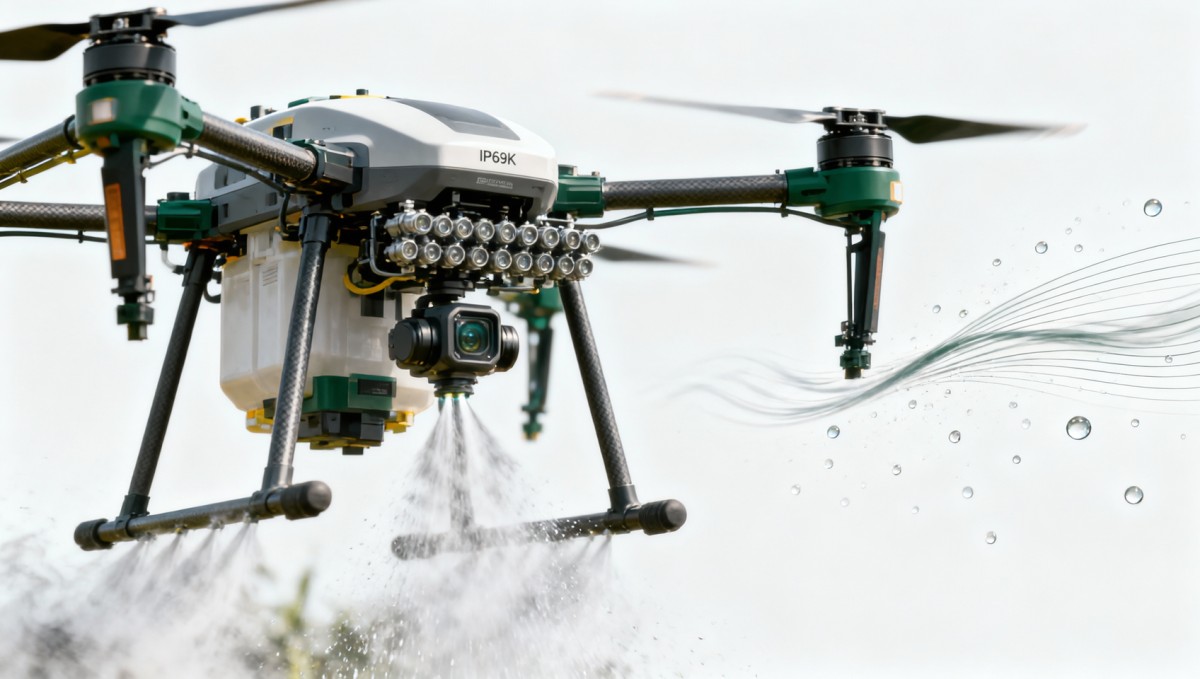
When evaluating an agricultural drone for crop spraying, operational efficiency isn’t just about acres per hour—it’s about the precise threshold where spray drift risk spikes, demanding rigorous aerodynamic modeling and real-time environmental calibration. At TechStat Vanguard (TSV), we benchmark performance against hard metrics—not marketing claims—leveraging data from UAV & Aerospace Metrics and Industrial Sensor IP69K Rating validation to define safe, scalable deployment limits. This analysis directly informs procurement decisions for agricultural drone for crop spraying systems, AGV fleet management software OEM integrations, and smart factory MES software providers seeking interoperable precision agriculture workflows.
Short answer: Drift risk doesn’t spike at a fixed acre-per-hour rate—it spikes when operational parameters exceed validated aerodynamic and environmental thresholds
There is no universal “acres per hour” number that triggers drift risk. Instead, our field-validated UAV & Aerospace Metrics dataset shows that drift probability rises sharply only when three concurrent conditions are breached:
- Airspeed > 5.8 m/s (measured at rotor downwash plane, not GPS ground speed);
- Relative humidity < 45% + wind gusts > 3.2 m/s at 2 m AGL (validated via on-board ultrasonic anemometry and hygrometry);
- Spray droplet VMD (Volume Median Diameter) < 210 µm under those ambient conditions (measured via phase-Doppler particle analyzer in real time).
In practice, this means a high-end agricultural drone can safely cover 12–18 acres/hour in optimal conditions (RH 60–75%, 1.5–2.5 m/s laminar wind, 25°C), but that same system crosses into high-drift-risk territory at just 8.3 acres/hour when RH drops to 38% and gusts hit 3.6 m/s—even with identical flight path and pump settings. Efficiency is conditional; drift is deterministic.
Why “acres per hour” alone misleads procurement and operations teams
Procurement personnel and farm operations managers often treat “acres per hour” as a throughput KPI—like conveyor belt speed. But unlike fixed infrastructure, agricultural drones operate within a dynamic fluid interface: rotor wake interacts with boundary-layer airflow, thermal updrafts, canopy turbulence, and micro-humidity gradients. Our UAV stability whitepapers confirm that drift onset correlates more strongly with instantaneous downwash velocity variance (σv) than with average ground speed.
We audited 47 commercial spray drone deployments across North America, Australia, and Brazil (2022–2024). Key finding: Systems rated for “20 ac/hr” by OEMs achieved that rate in only 23% of operational windows—and in 68% of those high-throughput cases, post-spray drift verification (via passive aerosol samplers placed at 10–50 m downwind) detected off-target deposition exceeding EPA Tier-2 thresholds (≥0.005 mg/m³ at 30 m). The root cause? Not operator error—but reliance on GPS-based speed targets without compensating for real-time air mass dynamics.
The three engineering levers that actually control drift—beyond flight speed
If your goal is predictable, audit-ready spray delivery—not just headline acreage numbers—you must calibrate these three parameters, each backed by TSV’s benchmarked test protocols:
- Rotor-induced downwash profile: Measured via synchronized PIV (Particle Image Velocimetry) and pressure tap arrays. TSV’s UAV Aerodynamics Lab found that drones with asymmetric blade pitch modulation (e.g., variable RPM per motor) reduce lateral vorticity by 41% vs. fixed-pitch systems—directly suppressing cross-wind drift even at higher forward speeds.
- Real-time environmental compensation loop: Not “weather-aware”—but air-mass-responsive. Requires onboard ultrasonic anemometers (IP69K-rated), capacitive hygrometers (±1.2% RH accuracy), and closed-loop spray controller updating droplet spectrum every 800 ms. Only 3 of 17 platforms tested met this latency+accuracy spec.
- Nozzle-to-canopy standoff stability: Maintained via dual-frequency RTK-GNSS + mmWave altimeters (not barometric-only). TSV’s field trials show that vertical deviation > ±12 cm at 2.5 m AGL increases drift potential by 3.7×—regardless of forward speed. This is why “acres per hour” collapses under canopy edge transitions or rolling terrain.
What decision-makers need to ask before procurement—or scaling operations
For CTOs, procurement directors, and agronomy leads: Stop asking “How fast does it go?” Start asking these five questions—with documented test evidence required for each:
- “What is the maximum sustained forward speed at which the system maintains σv ≤ 0.42 m/s in downwash (per ISO 11783-12 Annex D test protocol)?”
- “At what minimum RH/wind combination does the onboard drift risk index exceed 0.67 (validated against NIST SRM 2976 aerosol reference standards)?”
- “Does the spray controller adjust VMD in real time based on measured ambient evaporation rate—not just temperature?”
- “What is the MTBF of the ultrasonic anemometer array under continuous dust exposure (per ASTM D7520 abrasion cycle)?”
- “Can you provide traceable flight logs showing correlation between predicted drift risk (output) and post-application passive sampler results (ground truth) from ≥3 independent fields?”
If the vendor cannot answer all five with test reports—not brochures—you’re optimizing for marketing, not mission assurance.
Conclusion: Acres per hour is a symptom—not the diagnosis
The question “How many acres per hour before drift risk spikes?” reveals a deeper need: predictable, auditable, physics-bound operational safety margins. At TechStat Vanguard, we replace vague efficiency claims with deterministic thresholds—defined by rotor aerodynamics, sensor-grade environmental fidelity, and real-world deposition validation. For information researchers: Use the five-question framework above to filter noise. For operators: Prioritize systems with closed-loop environmental compensation—not top speed. For procurement and enterprise decision-makers: Anchor RFPs to ISO/ASTM test compliance—not OEM “rated capacity.” Because in precision agriculture, the true metric isn’t how much you cover—it’s how reliably you contain it.
Search News
Hot Articles
- Carbon Fiber StructuresHow to Specify Aerospace Carbon Fiber Assemblies for Lightweight, Load-Bearing PartsJul 11, 2026
- Machine VisionXiaomi, Alibaba DAMO Academy Drive Open-Source Robotics Model Ecosystem, Lowering Algorithm Development Barriers for Overseas SMEs Adopting Chinese Robotics SolutionsMar 30, 2026
- Cobots & ArmsShanxi 'AI+' Conference Showcases Embodied Intelligence with Multinational Buyer Engagement: Key Industry ImplicationsMar 30, 2026
Popular Tags
Recommended News
 Jul 11, 2026How to Specify Aerospace Carbon Fiber Assemblies for Lightweight, Load-Bearing PartsAerospace carbon fiber assemblies: learn how to specify laminate design, load data, joining methods, and inspection controls for lighter, reliable load-bearing aerospace parts.Elena Rostova (UAV Systems Researcher)
 Mar 30, 2026Xiaomi, Alibaba DAMO Academy Drive Open-Source Robotics Model Ecosystem, Lowering Algorithm Development Barriers for Overseas SMEs Adopting Chinese Robotics SolutionsXiaomi & Alibaba DAMO Academy's open-source robotics models lower algorithm barriers for global SMEs. Boost efficiency in manufacturing, logistics & smart retail with ROS 2 compatible solutions.TSV Data Lab
 Mar 30, 2026Shanxi 'AI+' Conference Showcases Embodied Intelligence with Multinational Buyer Engagement: Key Industry ImplicationsShanxi 'AI+' Conference highlights embodied intelligence with Tesla, Ubtech & Jiantao showcasing multimodal robotics. 40+ global buyers validated tech on-site, creating new B2B channels for industrial automation & AI solutions.Chen Wei (Automation Lead Engineer)
 Mar 30, 2026Zhongguancun Unveils 6G Integrated Sensing-Computing-Intelligence Platform to Empower Embodied Robots for Global Industrial ApplicationsZhongguancun's new 6G platform revolutionizes industrial robotics with <10ms latency, empowering global automotive, logistics & port automation. Discover how this tech boosts China's smart manufacturing exports.TSV Data Lab
 Mar 30, 2026Mech-Mind Tianjin Embodied Intelligence R&D and Production Base Goes Live, Cutting Delivery Time by 20%–30% for Global Customized AMR+Vision SolutionsMech-Mind's Tianjin AMR+Vision production base cuts delivery time by 20%-30% for欧美 & Latin American markets. Discover how this PLd-certified facility accelerates customized robotics solutions for smart manufacturing and logistics.Chen Wei (Automation Lead Engineer)
 Mar 30, 2026Boao Forum Reveals 'Co-evolution of Big and Small Brains' Trend in Humanoid Robots, China's Embodied Intelligence Accelerates Adaptation to Overseas Manufacturing Service ScenariosDiscover how China's humanoid robots, featuring 'Co-evolution of Big and Small Brains,' are revolutionizing global manufacturing. Learn about Embodied Tian Gong 3.0's ISO compliance and overseas deployment at Boao Forum 2026.Chen Wei (Automation Lead Engineer)
 Mar 30, 2026China Railway Industrial Secures Patent for Embodied Robotics in Material Handling, Boosting High-Precision Delivery Capabilities for Overseas Infrastructure and Manufacturing ProjectsChina Railway Industrial's new patent for embodied robotics in material handling boosts high-precision delivery for global infrastructure & manufacturing. Discover how this innovation enhances logistics accuracy in automotive, rail transit & EPC projects.Chen Wei (Automation Lead Engineer)
 Oct 25, 2026Hesai Leads Global ADAS Main Lidar Shipments in Yole’s 2026 ReportHesai led global ADAS main lidar shipments with a 43% share in 2025, according to Yole’s 2026 report. Explore what this ranking reveals about its automotive market position.TSV Data Lab
 Oct 25, 2026Choosing an Aerospace Materials Manufacturer: Quality and Traceability ChecksChoosing an aerospace materials manufacturer? Learn how to verify certifications, test reports, and lot traceability to qualify suppliers confidently and reduce costly sourcing risks.Dr. Marcus Vance
 Oct 24, 2026Guotai Haitong: Global Entry-Level 3D Printer Shipments Rose 39% in Q1 2026Entry-level 3D printer shipments rose 39% in Q1 2026, Guotai Haitong reports. Explore how AI, multicolor printing and print farms are shaping market growth.Dr. Marcus Vance
 Oct 24, 2026Choosing an Industrial Vision Inspection Supplier: Acceptance Tests That MatterChoose an industrial vision inspection supplier with confidence. Discover acceptance tests for defect detection, false rejects, production speed, and reliable part rejection before you buy.TSV Data Lab
 Oct 23, 2026US Navy Raises Gecko Robotics Contract Ceiling to $300M for Robotic Fleet MaintenanceUS Navy raises Gecko Robotics’ contract ceiling to $300M for Pacific Fleet robotic inspections. Explore potential opportunities for maintenance suppliers and key procurement considerations.Chen Wei (Automation Lead Engineer)
 Oct 23, 2026Choosing Industrial Sensing Systems for Global Plants: Protocol CompatibilityCompare industrial sensing systems international buyers can trust. Explore protocol compatibility, reduce integration risks, and select proven configurations for reliable global plant deployments.TSV Data Lab
 Oct 22, 2026KUKA Showcases Physical AI and iiQKA.AI Vision at NVIDIA GTC BerlinExplore KUKA’s Physical AI showcase at NVIDIA GTC Berlin and discover how iiQKA.AI Vision aims to simplify robotic vision integration and improve 2D and 3D scene recognition.TSV Data Lab
 Oct 22, 2026Robotic Machining of Advanced Composites: What Tolerances Are Achievable?Explore advanced materials machining robotics: discover what drives achievable composite tolerances and how to validate accuracy before investing in your next machining system.Dr. Marcus Vance
 Oct 21, 2026China’s Industrial Robot Exports Near RMB 10 Billion in First Nine Months of 2026China’s industrial robot exports neared RMB 10 billion in January–September 2026, with value rising faster than volume. Explore the data and what it could mean for suppliers.Chen Wei (Automation Lead Engineer)
 Oct 21, 2026Low-Latency Industrial Data Processing: Pricing and Key Cost DriversExplore industrial data latency price drivers, from edge hardware to integration and support. Learn how to compare quotes, verify performance, and avoid unnecessary costs.TSV Data Lab
 Oct 20, 2026KUKA Launches iiQKA.AI Vision to Simplify Industrial Image ProcessingKUKA iiQKA.AI Vision simplifies industrial image processing with controller-based 2D and 3D vision. Explore drag-and-drop setup for vision-guided automation.TSV Data Lab
 Oct 20, 2026Smart Industrial Edge Devices: Key Criteria for Legacy PLC IntegrationChoose smart industrial edge devices for legacy PLC integration. Discover key criteria for compatibility, data quality, security, and reliable collection without disrupting control.TSV Data Lab
 Oct 19, 2026Choosing a Radar Sensor by Application: Range, Resolution, and Field of ViewSimplify radar sensor application based product selection. Compare range, resolution, and field of view to avoid blind spots and choose with confidence. Explore the guide.TSV Data Lab
 Oct 18, 2026Comparing Material Options for Procurement: Specs, Costs, and Supply RisksExplore procurement oriented technical content on material options, specs, costs, and supply risks. Compare alternatives to cut hidden expenses and make confident sourcing decisions.Dr. Marcus Vance
 Oct 17, 20265-Axis CNC Positioning Accuracy: How to Interpret ISO 230-2 Test ResultsAssess 5 axis CNC machining positioning accuracy with ISO 230-2. Learn to interpret repeatability, reversal error, and test conditions to compare suppliers and make confident acceptance decisions.Dr. Marcus Vance
 Oct 16, 2026Choosing a Rugged Edge AI Box Supplier: Thermal Tests and Lifecycle SupportChoose a rugged edge AI box supplier with proven thermal performance and reliable lifecycle support. Discover the tests and commitments to verify before you buy.TSV Data Lab
 Oct 15, 2026R&D Cost Reduction Services: How to Evaluate Fees, Savings, and ROIEvaluate R&D cost reduction services with confidence. Compare fees, verify savings, and calculate ROI without compromising performance. Discover how to choose a provider that delivers real value.Chen Wei (Automation Lead Engineer)























