Industrial robots for palletizing applications with mixed loads
Publication Date
author
For enterprise decision-makers navigating labor volatility, throughput pressure, and SKU complexity, industrial robots for palletizing applications are no longer a future concept but a measurable automation strategy. When mixed loads, accuracy, uptime, and integration costs directly affect margins, selecting the right robotic system requires more than vendor claims—it demands clear engineering criteria, performance data, and application-specific evaluation.
What are industrial robots for palletizing applications, and why are mixed loads now a board-level concern?
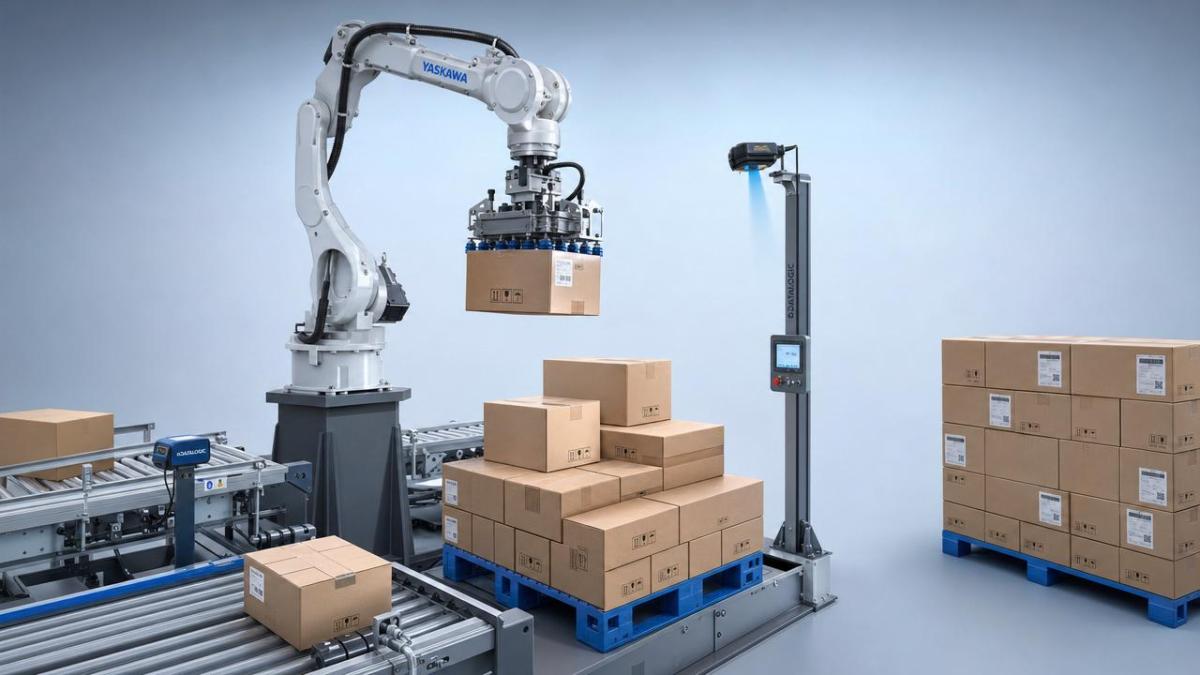
Industrial robots for palletizing applications are automated systems designed to pick, orient, stack, and stabilize products onto pallets for storage or shipment. In the past, many palletizing cells were optimized for uniform cases, predictable patterns, and long production runs. Today, however, decision-makers face shorter order cycles, e-commerce driven assortment growth, retailer-specific pallet rules, and greater pressure to ship mixed loads without sacrificing speed or safety.
Mixed-load palletizing changes the technical challenge. Instead of repeating one pattern for one SKU, the robot must often handle varying carton dimensions, different weights, changing center-of-gravity conditions, and layer-by-layer stability rules. That means the real question is not simply whether a robot can palletize, but whether the entire system can maintain stack integrity, scan or identify incoming items correctly, and adapt in real time without creating bottlenecks upstream or downstream.
This is why industrial robots for palletizing applications have become a strategic investment rather than a line-item automation expense. They affect labor dependency, damage rates, truck cube utilization, order accuracy, and the resilience of the shipping operation. For executives evaluating capital allocation, the engineering truth lies in measurable output per hour, mixed-SKU handling logic, downtime behavior, and total lifecycle cost.
Which businesses benefit most from industrial robots for palletizing applications with mixed loads?
The strongest fit is not limited to one vertical. Food and beverage plants, consumer goods manufacturers, logistics hubs, chemical packaging operations, building materials suppliers, and contract manufacturers all benefit when labor-intensive end-of-line tasks become unstable or expensive. Mixed-load palletizing is especially relevant where the outbound pallet must reflect customer order composition rather than single-product batching.
Enterprise teams should pay close attention if they face any of the following conditions: high worker turnover on repetitive palletizing lines, a growing number of SKUs, frequent retailer-specific pallet configurations, high rates of product damage during manual stacking, or increasing pressure to extend operating hours without proportional labor growth. In these environments, industrial robots for palletizing applications can shift performance from labor availability to engineered capacity.
There is also a strong case for companies running multiple facilities with inconsistent practices. Standardized robotic palletizing cells can improve process repeatability across sites, simplify KPI tracking, and create a clearer path for digital performance benchmarking. For decision-makers managing a network rather than a single plant, this standardization often matters as much as direct labor savings.
What should decision-makers evaluate first when comparing industrial robots for palletizing applications?
The first step is to define the application physics, not the brand shortlist. Too many evaluations begin with payload brochures and end with integration surprises. For mixed loads, the decision framework should start with real production data: carton size range, weight range, units per minute, pallet type, required pallet height, slip-sheet usage, infeed variability, and outbound stability requirements. Without that baseline, technical comparison becomes marketing comparison.
After the application baseline, buyers should assess five engineering layers: robot arm capability, end-of-arm tooling, vision or identification system, palletizing software intelligence, and line integration complexity. A robot with sufficient payload may still underperform if the gripper cannot securely handle deformable packaging or if the software cannot dynamically generate stable mixed-load patterns.
It is also important to distinguish rated performance from sustained performance. Some suppliers quote cycle time under ideal conditions using uniform boxes, fixed orientation, and no exception handling. Enterprise buyers should ask for throughput under realistic mixed-load conditions, including scan delays, product skew, rejected picks, and pallet changeover events. This is where practical uptime and true system efficiency become visible.
Quick evaluation table for mixed-load palletizing
How do mixed loads change the technology requirements compared with standard palletizing?
Standard palletizing is repetition. Mixed-load palletizing is decision-making. That difference affects both hardware and software architecture. In standard operations, the robot repeats a fixed trajectory and stack pattern. In mixed-load operations, the system must often identify product attributes, choose the next placement based on stability logic, and account for changing pallet geometry as the stack builds.
This usually requires more advanced software, whether rule-based, recipe-driven, or connected to warehouse execution systems. Vision systems, barcode readers, dimensioners, and conveyor tracking become more important because the palletizing cell can no longer assume perfect consistency at the infeed. If the incoming product orientation varies, the system needs either robust reorientation capability or enough perception to place each case correctly despite variation.
Mechanical design also matters more. Mixed loads often create unstable upper layers, overhang risks, and uneven weight distribution. As a result, industrial robots for palletizing applications may need adaptive grippers, slip-sheet handling, compression control, or dual-pick logic depending on package type. The right configuration depends on product fragility, target throughput, and downstream transport conditions such as stretch wrapping, forklift handling, and long-haul vibration exposure.
What are the most common mistakes when buying industrial robots for palletizing applications?
The first mistake is selecting by headline speed alone. A robot may achieve impressive cycles per minute in a lab while delivering weaker performance in a live mixed-load line with scanning delays, pallet exchange interruptions, and inconsistent packaging. Throughput claims should always be tied to a documented test case.
The second mistake is underestimating tooling complexity. End-of-arm tooling is not an accessory; it is the contact point between automation strategy and product reality. Vacuum systems, clamp grippers, fork tools, or hybrid solutions each have trade-offs involving package permeability, case rigidity, maintenance, and damage risk. For mixed loads, a flexible but weak gripper can destroy the business case by increasing exceptions.
A third mistake is ignoring data quality. If SKU dimensions, weight data, or order sequencing inputs are inaccurate, even sophisticated palletizing software will struggle. Many failed implementations are not caused by robot limitations but by weak upstream master data and poor process discipline. Enterprise leaders should treat data governance as part of automation readiness.
The fourth mistake is focusing only on initial ROI while overlooking serviceability. Spare parts strategy, remote diagnostics, software update policy, and local technical support all influence lifecycle resilience. Industrial robots for palletizing applications are capital assets, but they are also operational dependencies. If support coverage is thin, the cost of one prolonged outage can exceed the savings from a cheaper purchase price.
How should enterprises calculate cost, payback, and implementation risk?
A useful financial model includes more than labor replacement. Decision-makers should consider labor availability risk, overtime reduction, damage reduction, improved pallet consistency, lower safety exposure, and potential gains in shipment density or order accuracy. In mixed-load environments, the ability to sustain performance during peak periods may be as valuable as average annual labor savings.
Implementation cost should be divided into robot hardware, tooling, conveyors, safety systems, software, controls integration, commissioning, training, and ongoing support. This avoids the common trap of comparing robot list prices while ignoring the full project footprint. For many enterprises, integration and software adaptation determine both deployment speed and total risk.
Payback timelines vary by labor market, throughput profile, and SKU complexity, but the quality of the estimate depends on scenario modeling. Teams should test at least three cases: expected demand, peak demand, and disrupted demand with staffing shortages. If industrial robots for palletizing applications only make sense under ideal assumptions, the investment case is weak. If they protect output under adverse conditions, their strategic value is much stronger.
Common decision questions and practical answers
What should you ask suppliers before moving to specification, pilot, or procurement?
Before issuing an RFQ, ask suppliers to define the tested operating envelope. That includes product dimensions, weight limits, environmental conditions, target throughput, pallet patterns, and exception scenarios. Ask what assumptions are built into their performance claims and whether those assumptions match your line conditions. This simple discipline often eliminates confusion later in the project.
Next, request evidence, not adjectives. For industrial robots for palletizing applications, useful proof includes FAT or SAT references, sustained throughput data, damage-rate performance, sample recovery procedures, and examples of similar mixed-load deployments. A serious supplier should be able to discuss not only successful cases but also constraint boundaries and known failure modes.
Finally, align on ownership after startup. Who updates patterns when new SKUs are launched? How quickly can plant staff make adjustments? What training is required for maintenance teams? What remote diagnostics are available? These questions determine whether the solution remains an asset or becomes a specialist-dependent bottleneck.
How should enterprise leaders move forward?
Industrial robots for palletizing applications create value when they are evaluated as engineered systems, not catalog products. For mixed loads, the winning decision is usually the one grounded in data integrity, realistic throughput modeling, stack stability logic, support readiness, and integration fit with the broader operation. The objective is not simply to automate palletizing, but to improve shipping reliability under real business variability.
If you need to confirm a concrete direction, start by clarifying a small set of questions: what is the actual SKU and packaging variability, what throughput must be sustained at peak, what pallet rules must be met by customer or channel, what downtime can the operation tolerate, and what internal resources can support software and maintenance after commissioning. Once these points are clear, discussions about specific system architecture, implementation timeline, budget, and supplier fit become far more productive.
Search News
Hot Articles
- Carbon Fiber StructuresHow to Specify Aerospace Carbon Fiber Assemblies for Lightweight, Load-Bearing PartsJul 11, 2026
- Machine VisionXiaomi, Alibaba DAMO Academy Drive Open-Source Robotics Model Ecosystem, Lowering Algorithm Development Barriers for Overseas SMEs Adopting Chinese Robotics SolutionsMar 30, 2026
- Cobots & ArmsShanxi 'AI+' Conference Showcases Embodied Intelligence with Multinational Buyer Engagement: Key Industry ImplicationsMar 30, 2026
Popular Tags
Recommended News
 Jul 11, 2026How to Specify Aerospace Carbon Fiber Assemblies for Lightweight, Load-Bearing PartsAerospace carbon fiber assemblies: learn how to specify laminate design, load data, joining methods, and inspection controls for lighter, reliable load-bearing aerospace parts.Elena Rostova (UAV Systems Researcher)
 Mar 30, 2026Xiaomi, Alibaba DAMO Academy Drive Open-Source Robotics Model Ecosystem, Lowering Algorithm Development Barriers for Overseas SMEs Adopting Chinese Robotics SolutionsXiaomi & Alibaba DAMO Academy's open-source robotics models lower algorithm barriers for global SMEs. Boost efficiency in manufacturing, logistics & smart retail with ROS 2 compatible solutions.TSV Data Lab
 Mar 30, 2026Shanxi 'AI+' Conference Showcases Embodied Intelligence with Multinational Buyer Engagement: Key Industry ImplicationsShanxi 'AI+' Conference highlights embodied intelligence with Tesla, Ubtech & Jiantao showcasing multimodal robotics. 40+ global buyers validated tech on-site, creating new B2B channels for industrial automation & AI solutions.Chen Wei (Automation Lead Engineer)
 Mar 30, 2026Zhongguancun Unveils 6G Integrated Sensing-Computing-Intelligence Platform to Empower Embodied Robots for Global Industrial ApplicationsZhongguancun's new 6G platform revolutionizes industrial robotics with <10ms latency, empowering global automotive, logistics & port automation. Discover how this tech boosts China's smart manufacturing exports.TSV Data Lab
 Mar 30, 2026Mech-Mind Tianjin Embodied Intelligence R&D and Production Base Goes Live, Cutting Delivery Time by 20%–30% for Global Customized AMR+Vision SolutionsMech-Mind's Tianjin AMR+Vision production base cuts delivery time by 20%-30% for欧美 & Latin American markets. Discover how this PLd-certified facility accelerates customized robotics solutions for smart manufacturing and logistics.Chen Wei (Automation Lead Engineer)
 Mar 30, 2026Boao Forum Reveals 'Co-evolution of Big and Small Brains' Trend in Humanoid Robots, China's Embodied Intelligence Accelerates Adaptation to Overseas Manufacturing Service ScenariosDiscover how China's humanoid robots, featuring 'Co-evolution of Big and Small Brains,' are revolutionizing global manufacturing. Learn about Embodied Tian Gong 3.0's ISO compliance and overseas deployment at Boao Forum 2026.Chen Wei (Automation Lead Engineer)
 Mar 30, 2026China Railway Industrial Secures Patent for Embodied Robotics in Material Handling, Boosting High-Precision Delivery Capabilities for Overseas Infrastructure and Manufacturing ProjectsChina Railway Industrial's new patent for embodied robotics in material handling boosts high-precision delivery for global infrastructure & manufacturing. Discover how this innovation enhances logistics accuracy in automotive, rail transit & EPC projects.Chen Wei (Automation Lead Engineer)
 Sep 29, 2026ISO 9283 Repeatability: How to Evaluate Cobot Positioning PerformanceISO 9283 cobot repeatability explained: learn how payload, reach, approach direction, and test conditions affect positioning performance and cell capability.Chen Wei (Automation Lead Engineer)
 Sep 29, 2026How Do You Verify Servo Motor Torque Under Continuous Load?How do I verify servo motor torque under continuous load? Learn RMS torque checks, torque-speed limits, thermal derating, and real-machine testing.Chen Wei (Automation Lead Engineer)
 Sep 28, 2026Spindle Runout Measurement in Germany: DIN Standards, Methods, and Acceptance LimitsSpindle runout measurement Germany: explore DIN standards, proven methods, acceptance limits, and audit-ready practices for reliable machining quality.Dr. Marcus Vance
 Sep 27, 2026How to Select Wall-Mount Edge Devices for Space-Constrained Factory NetworksWall mount edge devices for space-constrained factories: evaluate workload, thermal design, power resilience, cable access, and network reliability for smarter deployments.TSV Data Lab
 Sep 26, 2026Machining Tolerance Analysis: How to Set Limits That Meet Function and Cost TargetsMachining tolerance analysis: learn how to set functional limits, control tolerance stacks, reduce inspection risk, and balance precision with production cost.Dr. Marcus Vance
 Sep 25, 2026How to Evaluate an Industrial Infrastructure Data Platform for Multi-Site OperationsIndustrial infrastructure data platform evaluation guide for multi-site operations: compare data quality, edge resilience, interoperability, governance, and scalable proof-of-value criteria.Victor Lin (Chief Software Architect)
 Sep 24, 2026How to Select Machine Vision Optics for Accurate Inspection at Different Working DistancesMachine vision optics selection guide for accurate inspection at every working distance. Compare FOV, pixel scale, DOF, distortion, lighting, and telecentric options.TSV Data Lab
 Sep 23, 2026How to Evaluate a Machine Vision System Integrator for High-Speed Inspection LinesChoose a machine vision system integrator with proven expertise in high-speed inspection, reliable reject timing, robust optics, and measurable acceptance criteria.TSV Data Lab
 Sep 29, 2026How MES and OEE work together to identify production lossesMES and OEE work together to uncover hidden production losses, connect downtime, speed, and quality data, and drive smarter shop-floor improvements.Victor Lin (Chief Software Architect)
 Sep 28, 2026When is a SCADA API the right choice for connecting plant systems?SCADA API guide: learn when governed plant data integration improves traceability, security, and scalability—without compromising real-time control.Victor Lin (Chief Software Architect)
 Sep 27, 2026How SCADA data integration improves traceability across production linesSCADA data integration connects production-line data to improve traceability, accelerate quality investigations, and strengthen safety decisions.Victor Lin (Chief Software Architect)
 Sep 26, 2026What to define before starting SCADA integration planningSCADA integration planning starts with clear scope, control boundaries, data models, cybersecurity, and testing. Discover the definitions that reduce risk and costly rework.Victor Lin (Chief Software Architect)
 Sep 25, 2026How a smart factory with Industrial IoT reduces production blind spotsDiscover how a smart factory with Industrial IoT turns real-time machine, quality, and workflow data into actionable insights that reduce production blind spots and delivery risks.Victor Lin (Chief Software Architect)
 Sep 24, 2026When does Industrial IoT make smart manufacturing easier to scale?Smart manufacturing Industrial IoT scales when trusted data, interoperable systems, and secure workflows turn connected assets into measurable gains.TSV Data Lab
 Sep 23, 2026What drives ultra-precision machining cost at 1-micron tolerance?Ultra precision machining cost per part at 1 micron tolerance depends on process, material, metrology, and yield. Learn how to compare quotes confidently.Dr. Marcus Vance
 Sep 22, 2026Drone Engine-T550CC Applications: Build the UAV Power System Around the MissionAn application guide for Drone Engine-T550CC integration, covering payload planning, airframe matching, cooling, fuel, vibration, test procedures, documentation, and service preparation.Elena Rostova (UAV Systems Researcher)
 Sep 22, 2026How to Evaluate Industrial Edge Computing Vendors for Factory DeploymentIndustrial edge computing vendor evaluation guide for factories: compare latency, protocol fit, reliability, security, and lifecycle support before deployment.TSV Data Lab