How to Choose a Robotic Arm for Injection Molding Without Overbuying
Publication Date
author
Choosing a robotic arm for injection molding should be a capacity-matching decision, not a costly bet on oversized specs. For procurement teams under pressure to balance cycle time, payload, mold layout, and long-term ROI, the real challenge is separating necessary performance from expensive redundancy. This guide breaks down the engineering and sourcing factors that help you buy with precision instead of overbuying with risk.
Why Scenario Differences Matter More Than Catalog Specs
A robotic arm for injection molding is rarely a one-size-fits-all purchase. Two factories can run machines with similar clamping force and still need very different automation configurations. The reason is simple: part geometry, mold layout, take-out speed, downstream handling, and floor constraints change the real duty profile more than headline specifications do.
For procurement teams, overbuying often starts with safe-sounding assumptions. Buyers choose a higher payload “just in case,” a longer reach “for future flexibility,” or a more complex multi-axis unit because it looks more advanced. In practice, those upgrades can increase capital cost, extend commissioning time, raise maintenance complexity, and even reduce return on investment if the production scenario does not need them.
The better path is to map the application first. Ask what the robotic arm for injection molding must do in one cycle, where it must travel, how fast it must exit the mold area, and what happens after part removal. When the workflow is defined clearly, the correct robot class becomes easier to identify.
The procurement risk behind generic specifications
Vendor brochures usually emphasize payload, axes, and speed. Those numbers matter, but they do not automatically reflect fit. A 5 kg payload robot may be excessive for lightweight packaging parts, while a lower-cost Cartesian picker may outperform an articulated unit in a simple top-entry extraction job. Spec inflation happens when selection is based on maximum machine capability instead of real production behavior.
Core buying questions before comparing models
- Is the task only part removal, or also insert loading, sprue cutting, stacking, inspection, or packaging?
- What is the actual end-of-arm tooling weight, including grippers, sensors, and vacuum circuits?
- How much horizontal and vertical travel is truly required inside the cell?
- What cycle time loss is acceptable if the robot is slightly slower but significantly cheaper?
- Will future product changes be frequent enough to justify extra flexibility now?
Three Common Injection Molding Scenarios and What They Really Need
The most effective way to choose a robotic arm for injection molding without overbuying is to classify your application by operating scenario. In general, procurement decisions become clearer when you separate high-volume simple extraction, medium-complexity part handling, and precision multi-step automation.
Each scenario changes the value of reach, speed, servo control, and software sophistication. A robot that is ideal for one plant can be economically wrong for another. The table below highlights where those differences usually appear.
Instead of starting with the most advanced option, start with the least complex solution that safely meets process stability, cycle targets, and integration needs.
Scenario 1: High-volume packaging or consumer goods
This is the classic case where buyers often overspend. Lightweight parts, short cycles, and simple take-out paths usually do not require a highly flexible articulated system. A top-entry or side-entry robot designed specifically for injection molding can deliver faster dry cycle performance with lower cost and easier maintenance.
In this scenario, the robotic arm for injection molding should be judged on extraction speed, uptime, controller simplicity, and how quickly operators can recover from stoppages. If downstream handling is only conveyor placement, flexibility is far less valuable than consistent rhythm.
The key procurement insight is that a specialized simpler robot often creates better economics than a more universal machine.
Scenario 2: Technical molded parts with secondary handling
Automotive subcomponents, appliance parts, and industrial housings often need more than extraction. Parts may require orientation, degating, tray placement, or transfer into a vision station. Here, the robotic arm for injection molding needs more controlled motion and better programmability.
However, this still does not automatically justify buying the largest or most flexible model. Many medium-complexity cells operate well with moderate payload, limited extra axes, and targeted end-of-arm tooling. The right selection depends on actual motion complexity, not on the buyer’s desire to future-proof every possibility.
A disciplined supplier evaluation should ask for a cycle simulation using your part, your mold opening stroke, and your downstream equipment footprint.
Scenario 3: Insert molding, medical components, or delicate surfaces
This is where precision matters more than raw speed. If the robot loads inserts, handles scratch-sensitive parts, or supports traceable production for regulated sectors, then smooth motion, repeatability, and process verification become central. In these environments, a robotic arm for injection molding should protect quality first and throughput second.
Overbuying in this scenario often appears in a different form: paying for very high speed because it sounds productive, even though the process window is limited by mold protection, insert accuracy, or downstream inspection. The robot should match the slowest critical step without creating unnecessary performance surplus.
For procurement teams, the winning decision is usually the robot that delivers stable validated cycles with the lowest practical complexity.
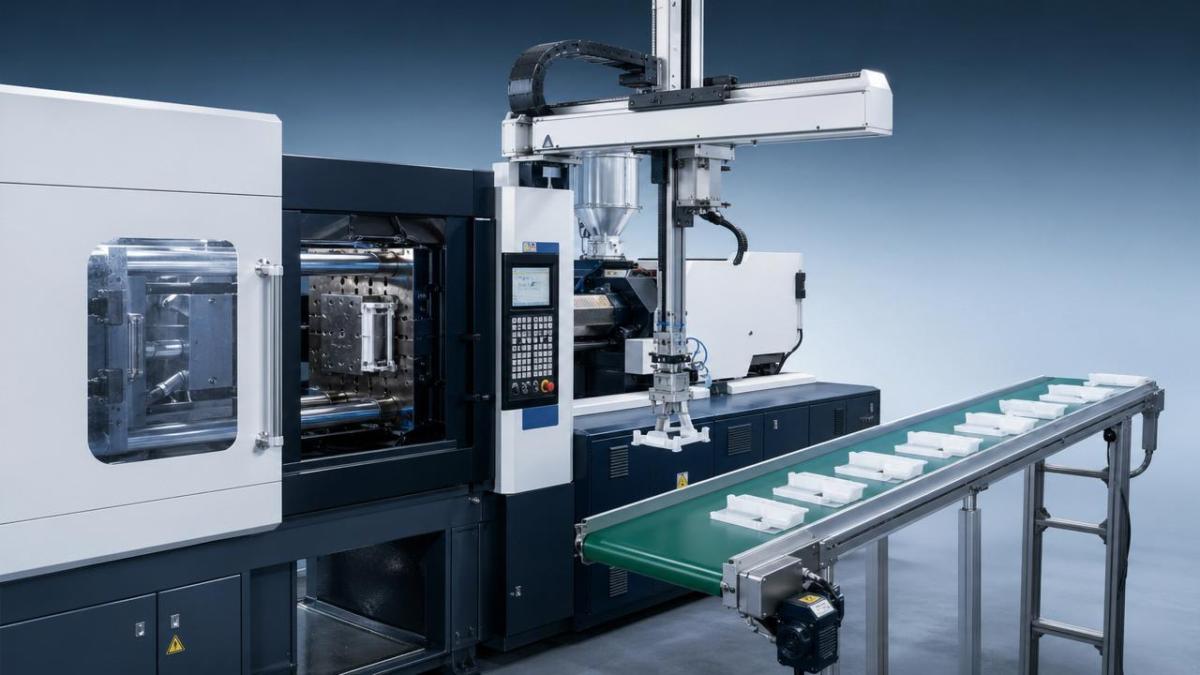
How to Size a Robotic Arm for Injection Molding Without Paying for Redundant Capacity
Once the application scenario is clear, sizing becomes an engineering exercise. Procurement should not rely only on machine tonnage or vendor recommendation. A robotic arm for injection molding must be sized against the combined load case, motion path, and cycle target.
Start with the true payload. That means part weight, runner or sprue weight, gripper mass, vacuum cups, brackets, sensors, cable dress, and a safety margin. Many overbuilt robots come from sloppy payload estimates that use broad assumptions instead of measured tooling data.
Reach is the next common source of excess cost. Buyers often request maximum envelope coverage even when actual pick-and-place positions are fixed and compact. Longer reach can increase structure size, inertia, and purchase price without improving output.
The four parameters that deserve priority
1. Effective payload, not brochure payload
Confirm the payload at the required speed and with the planned end-of-arm tooling. Some ratings assume ideal conditions that are different from real molding cells.
2. Required stroke and reach
Measure mold opening, gate side clearance, conveyor distance, and maintenance access. The shortest capable motion envelope is usually the most economical.
3. Cycle contribution
Separate total molding cycle from robot contribution. If mold cooling dominates the cycle, a faster robot may not produce meaningful output gains.
4. Cell integration needs
Consider communication with molding machines, conveyors, vision systems, and safety circuits. Integration requirements can justify a higher-spec controller even if mechanical demands are modest.
A practical procurement checklist
- Record actual part family dimensions and weights for current jobs.
- Document the heaviest planned end-of-arm tooling configuration.
- Define mandatory cycle time, not aspirational cycle time.
- Map the full motion path from mold to downstream destination.
- Ask suppliers to identify which quoted features are essential versus optional.
Common Overbuying Mistakes in Different Factory Contexts
Not all procurement mistakes come from misunderstanding the robot itself. Many come from the business context around the project. A new plant, a multi-site standardization effort, or a cautious quality team can all push the purchase toward excessive specification.
That does not mean conservative buying is always wrong. It means each premium feature should be linked to a credible use case. If a feature cannot be tied to a foreseeable production requirement, it should be treated as optional until proven otherwise.
For a robotic arm for injection molding, the most expensive errors are usually hidden in complexity rather than in the base machine alone.
Where buyers most often misjudge fit
- Buying for rare future parts instead of the current production mix.
- Assuming more axes always mean better productivity.
- Ignoring tooling weight growth until late in the project.
- Prioritizing peak speed over stable mold-area extraction.
- Selecting software features the plant cannot realistically use or maintain.
Different factory types, different caution points
High-mix job shops should be careful not to underbuy flexibility if part changeovers are frequent and customers demand varied handling. In contrast, dedicated high-volume plants should be careful not to overpay for reconfigurability they may never use. Medical and electronics producers should focus on repeatability, traceability, and contamination-sensitive handling before chasing speed metrics.
A procurement framework anchored in plant reality will outperform one based on generic “best available” equipment logic.
Supplier Questions That Help You Buy With Precision
The right vendor conversation is less about price per unit and more about application evidence. Procurement teams should ask suppliers to prove why a given robotic arm for injection molding fits the process with minimal waste. Good suppliers welcome that scrutiny because it shortens later disputes over performance gaps.
At TechStat Vanguard’s data-first standard, the goal is not to reward the most aggressive promise, but the clearest parameter match. Parameters do not lie; tolerances define whether a system will earn its cost.
When you compare offers, make every quote answer the same technical questions so commercial differences do not hide engineering mismatch.
Questions worth putting into your RFQ or supplier review
- What is the validated cycle time in a cell similar to ours, including mold open and part release steps?
- What payload rating applies with our proposed EOAT and motion profile?
- Which optional axes or software modules are truly necessary for our part family?
- What maintenance intervals and spare parts should we expect over three years?
- Can you provide a layout or simulation showing real stroke use and unused capacity?
What a strong proposal should include
A serious supplier should provide a cell concept, motion assumptions, utility requirements, controller interface details, and a breakdown between standard and optional features. If the quotation only highlights maximum capacity, treat it as incomplete. The best robotic arm for injection molding purchase is one supported by transparent engineering logic.
Procurement should also request references for similar applications, not just similar machine sizes. Application similarity is usually more predictive than tonnage similarity.
Final Decision Path for Procurement Teams
If you want to avoid overbuying, decide in this order: define the application scenario, measure the real load and travel, verify the cycle bottleneck, and then compare only the robots that meet those conditions. That sequence keeps the robotic arm for injection molding aligned with production economics instead of sales narratives.
In simple take-out scenarios, prioritize reliability and speed with minimal complexity. In medium-complexity cells, buy only the flexibility you can justify through actual handling steps. In precision or insert-molding environments, invest where repeatability and process protection matter most. Each scenario rewards a different balance of mechanics, controls, and cost.
For procurement teams building an RFQ, the most effective next step is to convert your process into a parameter sheet: payload with EOAT, stroke requirements, target cycle contribution, part sensitivity, integration interfaces, and expected product mix changes. Once those conditions are clear, choosing a robotic arm for injection molding becomes a disciplined sourcing decision rather than an expensive guess.
Search News
Hot Articles
- Carbon Fiber StructuresHow to Specify Aerospace Carbon Fiber Assemblies for Lightweight, Load-Bearing PartsJul 11, 2026
- Machine VisionXiaomi, Alibaba DAMO Academy Drive Open-Source Robotics Model Ecosystem, Lowering Algorithm Development Barriers for Overseas SMEs Adopting Chinese Robotics SolutionsMar 30, 2026
- Cobots & ArmsShanxi 'AI+' Conference Showcases Embodied Intelligence with Multinational Buyer Engagement: Key Industry ImplicationsMar 30, 2026
Popular Tags
Recommended News
 Jul 11, 2026How to Specify Aerospace Carbon Fiber Assemblies for Lightweight, Load-Bearing PartsAerospace carbon fiber assemblies: learn how to specify laminate design, load data, joining methods, and inspection controls for lighter, reliable load-bearing aerospace parts.Elena Rostova (UAV Systems Researcher)
 Mar 30, 2026Xiaomi, Alibaba DAMO Academy Drive Open-Source Robotics Model Ecosystem, Lowering Algorithm Development Barriers for Overseas SMEs Adopting Chinese Robotics SolutionsXiaomi & Alibaba DAMO Academy's open-source robotics models lower algorithm barriers for global SMEs. Boost efficiency in manufacturing, logistics & smart retail with ROS 2 compatible solutions.TSV Data Lab
 Mar 30, 2026Shanxi 'AI+' Conference Showcases Embodied Intelligence with Multinational Buyer Engagement: Key Industry ImplicationsShanxi 'AI+' Conference highlights embodied intelligence with Tesla, Ubtech & Jiantao showcasing multimodal robotics. 40+ global buyers validated tech on-site, creating new B2B channels for industrial automation & AI solutions.Chen Wei (Automation Lead Engineer)
 Mar 30, 2026Zhongguancun Unveils 6G Integrated Sensing-Computing-Intelligence Platform to Empower Embodied Robots for Global Industrial ApplicationsZhongguancun's new 6G platform revolutionizes industrial robotics with <10ms latency, empowering global automotive, logistics & port automation. Discover how this tech boosts China's smart manufacturing exports.TSV Data Lab
 Mar 30, 2026Mech-Mind Tianjin Embodied Intelligence R&D and Production Base Goes Live, Cutting Delivery Time by 20%–30% for Global Customized AMR+Vision SolutionsMech-Mind's Tianjin AMR+Vision production base cuts delivery time by 20%-30% for欧美 & Latin American markets. Discover how this PLd-certified facility accelerates customized robotics solutions for smart manufacturing and logistics.Chen Wei (Automation Lead Engineer)
 Mar 30, 2026Boao Forum Reveals 'Co-evolution of Big and Small Brains' Trend in Humanoid Robots, China's Embodied Intelligence Accelerates Adaptation to Overseas Manufacturing Service ScenariosDiscover how China's humanoid robots, featuring 'Co-evolution of Big and Small Brains,' are revolutionizing global manufacturing. Learn about Embodied Tian Gong 3.0's ISO compliance and overseas deployment at Boao Forum 2026.Chen Wei (Automation Lead Engineer)
 Mar 30, 2026China Railway Industrial Secures Patent for Embodied Robotics in Material Handling, Boosting High-Precision Delivery Capabilities for Overseas Infrastructure and Manufacturing ProjectsChina Railway Industrial's new patent for embodied robotics in material handling boosts high-precision delivery for global infrastructure & manufacturing. Discover how this innovation enhances logistics accuracy in automotive, rail transit & EPC projects.Chen Wei (Automation Lead Engineer)
 Oct 29, 2026Aerospace Aluminum Alloy Strength: 2024-T3 vs. 7075-T6 ComparedCompare aerospace aluminum alloy strength in 2024-T3 vs. 7075-T6. Explore fatigue, corrosion, and weight trade-offs to choose the right alloy for your design.Dr. Marcus Vance
 Oct 28, 2026IDC: Global Quadruped Robot Shipments Rise 92.5% in H1 2026 as Volume and Value DivergeGlobal quadruped robot shipments rose 92.5% in H1 2026, according to IDC. Explore what diverging volume and value trends mean for industrial buyers and manufacturers.Chen Wei (Automation Lead Engineer)
 Oct 28, 2026Interpreting Industrial IoT Latency Data for Monitoring and Real-Time ControlInterpret industrial category latency data to assess jitter, deadline misses, and real-time readiness. Learn how to benchmark IIoT systems and choose monitoring and control solutions.TSV Data Lab
 Oct 27, 2026GXO and Agility Robotics Expand Partnership to Accelerate US Humanoid Robot DeploymentGXO and Agility Robotics plan to expand US humanoid robot deployment with Digit 4 in early 2027. Explore warehouse automation plans, service terms and future Digit 5 upgrades.Chen Wei (Automation Lead Engineer)
 Oct 27, 2026Robotic Automation Costs: Budgeting for Equipment, Integration, and MaintenancePlan your robotics automation cost with confidence. Explore equipment, integration, and maintenance expenses, compare quotes, and build a realistic budget for better ROI.Chen Wei (Automation Lead Engineer)
 Oct 26, 2026AMAXiMAL Releases Open-Source TopMod 3D v3 With Claude AIExplore AMAXiMAL’s free, open-source TopMod 3D v3 with Claude AI assistance, topology-based modeling and plywood fabrication tools that connect complex designs to physical builds.Dr. Marcus Vance
 Oct 26, 2026Choosing a SCADA System Integrator Company: PLC Compatibility and Long-Term SupportChoose a scada system integrator company with proven PLC compatibility and reliable long-term support. Discover what to test, compare, and require before investing.Victor Lin (Chief Software Architect)
 Oct 25, 2026Hesai Leads Global ADAS Main Lidar Shipments in Yole’s 2026 ReportHesai led global ADAS main lidar shipments with a 43% share in 2025, according to Yole’s 2026 report. Explore what this ranking reveals about its automotive market position.TSV Data Lab
 Oct 25, 2026Choosing an Aerospace Materials Manufacturer: Quality and Traceability ChecksChoosing an aerospace materials manufacturer? Learn how to verify certifications, test reports, and lot traceability to qualify suppliers confidently and reduce costly sourcing risks.Dr. Marcus Vance
 Oct 24, 2026Guotai Haitong: Global Entry-Level 3D Printer Shipments Rose 39% in Q1 2026Entry-level 3D printer shipments rose 39% in Q1 2026, Guotai Haitong reports. Explore how AI, multicolor printing and print farms are shaping market growth.Dr. Marcus Vance
 Oct 24, 2026Choosing an Industrial Vision Inspection Supplier: Acceptance Tests That MatterChoose an industrial vision inspection supplier with confidence. Discover acceptance tests for defect detection, false rejects, production speed, and reliable part rejection before you buy.TSV Data Lab
 Oct 23, 2026US Navy Raises Gecko Robotics Contract Ceiling to $300M for Robotic Fleet MaintenanceUS Navy raises Gecko Robotics’ contract ceiling to $300M for Pacific Fleet robotic inspections. Explore potential opportunities for maintenance suppliers and key procurement considerations.Chen Wei (Automation Lead Engineer)
 Oct 23, 2026Choosing Industrial Sensing Systems for Global Plants: Protocol CompatibilityCompare industrial sensing systems international buyers can trust. Explore protocol compatibility, reduce integration risks, and select proven configurations for reliable global plant deployments.TSV Data Lab
 Oct 22, 2026KUKA Showcases Physical AI and iiQKA.AI Vision at NVIDIA GTC BerlinExplore KUKA’s Physical AI showcase at NVIDIA GTC Berlin and discover how iiQKA.AI Vision aims to simplify robotic vision integration and improve 2D and 3D scene recognition.TSV Data Lab
 Oct 22, 2026Robotic Machining of Advanced Composites: What Tolerances Are Achievable?Explore advanced materials machining robotics: discover what drives achievable composite tolerances and how to validate accuracy before investing in your next machining system.Dr. Marcus Vance
 Oct 21, 2026China’s Industrial Robot Exports Near RMB 10 Billion in First Nine Months of 2026China’s industrial robot exports neared RMB 10 billion in January–September 2026, with value rising faster than volume. Explore the data and what it could mean for suppliers.Chen Wei (Automation Lead Engineer)
 Oct 21, 2026Low-Latency Industrial Data Processing: Pricing and Key Cost DriversExplore industrial data latency price drivers, from edge hardware to integration and support. Learn how to compare quotes, verify performance, and avoid unnecessary costs.TSV Data Lab