
How to Choose a Playground Manufacturer for Custom Outdoor Projects
Publication Date
author
Selecting a playground manufacturer for a custom outdoor project is not a catalog exercise.
It is a sourcing decision affecting safety compliance, lifecycle cost, installation risk, and long-term user experience.
The real value lies in verifying materials, certifications, structural tolerances, weather resistance, and customization capability before budget commitment.
This guide filters marketing claims and focuses on measurable criteria for evaluating a playground manufacturer with engineering discipline.
Start with the Project Scenario, Not the Catalog
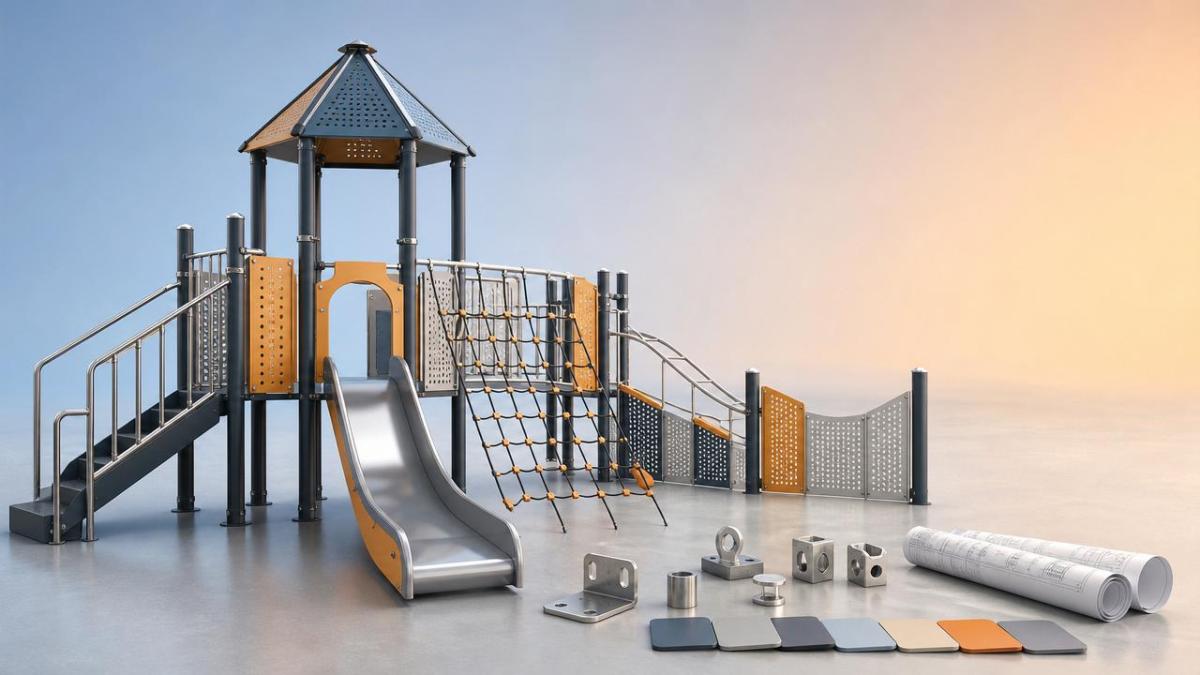
A custom playground is shaped by its environment, users, traffic volume, supervision model, and maintenance reality.
A reliable playground manufacturer should ask where the equipment will be installed before discussing colors or themed structures.
Different sites require different risk controls, anchoring methods, drainage planning, surfacing choices, and material specifications.
A coastal resort playground faces salt spray, ultraviolet exposure, and cosmetic corrosion risks.
A school playground faces high daily traffic, age-segment separation, supervision visibility, and predictable maintenance cycles.
A public park playground must balance vandal resistance, inclusive access, high load cycles, and municipal safety audits.
The right playground manufacturer translates each scenario into technical requirements, not generic product recommendations.
School and Early Learning Sites Need Controlled Risk
For schools, the main scenario is repetitive daily use by defined age groups under scheduled supervision.
A playground manufacturer should provide age-appropriate layouts, fall height data, guardrail dimensions, and clear circulation zones.
The design should separate toddlers, younger children, and older children through equipment scale and activity intensity.
Visibility also matters because hidden corners increase supervision difficulty and response time during incidents.
Ask whether the playground manufacturer can produce layout drawings showing sightlines, entry points, and conflict zones.
Materials should resist frequent contact, cleaning chemicals, moisture, and surface wear from repeated seasonal use.
For this scenario, documentation quality is as important as visual design.
Key checks for education environments
- Age-range suitability for every play element.
- Impact attenuation data for surfacing systems.
- Fall-zone drawings with clearance dimensions.
- Anti-pinch, anti-entrapment, and guardrail details.
- Maintenance instructions aligned with school calendars.
Public Parks Require Durability and Audit Readiness
Public parks usually combine heavy traffic, wide age diversity, and limited supervision.
Here, a playground manufacturer must prove durability through structural design, hardware protection, and coating performance.
Municipal outdoor projects also need transparent compliance records and inspection-friendly construction details.
Bolts, welds, joints, posts, and anchor systems should be designed for repeated loading and public exposure.
A qualified playground manufacturer should offer load assumptions, anchoring guidance, and corrosion protection specifications.
For parks, inclusive design is not a decoration; it affects access, circulation, transfer points, and sensory play options.
Pathways, ramps, ground-level activities, and resting areas must work together as a complete outdoor system.
Hospitality and Commercial Sites Depend on Brand Fit
Hotels, resorts, shopping centers, and family entertainment venues often require themed play experiences.
In this scenario, the playground manufacturer must combine safety engineering with brand identity, visitor flow, and photo appeal.
The challenge is avoiding decorative structures that look impressive but underperform in weather, drainage, or maintenance.
Custom shapes, towers, tunnels, panels, and sculptures should still meet structural and safety requirements.
A capable playground manufacturer should explain how themed components are engineered, fabricated, protected, and inspected.
Commercial projects also demand predictable downtime planning because repairs can affect visitor satisfaction and revenue.
Request spare-part lead times, coating repair guidance, and installation sequencing before approving final concepts.
Residential Communities Need Lifecycle Cost Control
Residential developments need playgrounds that serve mixed ages while staying affordable to inspect and maintain.
The playground manufacturer should balance design variety, safety, replacement part availability, and long-term wear behavior.
Budget pressure often leads to under-specified surfacing, weak anchoring, or coatings unsuitable for local weather.
Those savings usually become higher replacement costs, complaints, and service disruptions.
A practical playground manufacturer will provide options by lifecycle value, not only by initial purchase price.
For community sites, easy cleaning, replaceable panels, standard hardware, and clear inspection routines are valuable.
The best fit is usually a modular custom layout that allows later upgrades without full replacement.
Compare Scenario Requirements Before Choosing a Playground Manufacturer
This comparison prevents the wrong playground manufacturer from being selected only because a catalog image looks attractive.
A supplier suitable for a small daycare may not be qualified for a coastal public destination.
Verify Safety Standards and Certification Depth
Safety claims must be verified through standards, test records, and product-specific documentation.
A playground manufacturer should identify the standards applied to the target market, such as ASTM, EN, or local codes.
Generic certificates are not enough when custom structures, special themes, or modified dimensions are involved.
Ask whether certification applies to the exact configuration, material system, and installation method being proposed.
The playground manufacturer should also provide inspection checklists for commissioning and routine maintenance.
Good documentation reduces ambiguity during installation, handover, insurance review, and future safety audits.
Documents worth requesting
- Applicable safety standards and testing scope.
- Material data sheets for metals, plastics, coatings, and surfacing.
- Structural drawings with critical dimensions.
- Installation manual with foundation requirements.
- Maintenance checklist and replacement-part list.
Evaluate Materials by Climate and Use Intensity
Outdoor playground equipment operates under ultraviolet radiation, rain, temperature shifts, abrasion, and mechanical loading.
A serious playground manufacturer should define material choices according to climate and projected use intensity.
Powder-coated steel, stainless steel, aluminum, HDPE, HPL, rubber, and composite materials each behave differently.
The key question is not which material sounds premium, but which performs under the specific exposure profile.
For humid or coastal sites, corrosion resistance and coating adhesion are essential evaluation points.
For hot climates, surface temperature, color fading, and ultraviolet degradation require attention.
A data-led playground manufacturer should provide coating thickness, salt-spray references, UV resistance data, and material warranties.
Customization Capability Should Be Engineering-Led
Customization is often misunderstood as changing colors, logos, or decorative panels.
For custom outdoor projects, true customization involves layout engineering, structural adaptation, accessibility planning, and manufacturing control.
A playground manufacturer should demonstrate a workflow from concept sketch to technical drawing, prototype review, fabrication, and installation support.
Ask how the supplier controls dimensional tolerances when non-standard towers, bridges, roofs, or themed forms are created.
Also confirm how changes affect compliance, shipping, assembly, and later replacement parts.
A capable playground manufacturer does not treat customization as an aesthetic add-on.
It treats customization as a controlled engineering process with traceable decisions.
Use Factory Capability as a Risk Filter
Factory capability influences product consistency, delivery reliability, and warranty outcomes.
A playground manufacturer should be able to explain production equipment, welding control, surface treatment, quality inspection, and packaging methods.
The goal is not to collect impressive factory photos, but to verify process stability.
Important signs include incoming material inspection, batch tracking, coating quality checks, trial assembly, and final dimensional inspection.
For international projects, packaging quality is also critical because transit damage can delay installation.
A reliable playground manufacturer should provide packing lists, installation labeling, and component identification systems.
Match Installation Support to Site Complexity
Installation risk increases when equipment is large, themed, multi-level, or placed on complex terrain.
The playground manufacturer should provide foundation drawings, assembly instructions, torque guidance, and support for site coordination.
For custom projects, pre-installation review can prevent mismatches between design drawings and real site conditions.
Drainage, underground utilities, slope, soil conditions, and access routes can all affect final performance.
Confirm whether the playground manufacturer supports remote technical meetings, drawing revisions, and installation troubleshooting.
After installation, handover documents should include inspection procedures, maintenance intervals, and warranty boundaries.
Common Mistakes When Selecting a Playground Manufacturer
Many project failures begin with incomplete assumptions rather than poor intention.
Choosing a playground manufacturer by price alone can hide weak materials, limited documentation, or poor after-sales support.
- Ignoring local climate when selecting coatings and plastics.
- Approving themed concepts before checking structural feasibility.
- Using generic certificates for modified custom equipment.
- Underestimating fall-zone and surfacing requirements.
- Failing to confirm spare-part availability.
- Treating installation support as optional.
A strong playground manufacturer helps identify these risks early and converts them into practical design decisions.
A Practical Selection Framework for Custom Outdoor Projects
The final decision should combine scenario fit, compliance depth, engineering capability, factory control, and service reliability.
Use a weighted scorecard instead of relying on presentation quality or visual preference alone.
- Define user age ranges, site exposure, traffic intensity, and supervision model.
- Request compliance documents for the exact proposed configuration.
- Review material specifications against local climate conditions.
- Check customization workflow, drawing control, and tolerance management.
- Verify factory quality processes and packaging methods.
- Confirm installation support, maintenance guidance, and warranty terms.
This framework makes each playground manufacturer comparable through evidence, not assumptions.
Final Decision: Choose Evidence Over Claims
A custom playground succeeds when scenario requirements are translated into measurable specifications.
The right playground manufacturer provides more than attractive equipment; it provides traceability, risk control, and long-term usability.
Before placing an order, request drawings, standards, material data, installation documents, and maintenance commitments.
Then compare suppliers by verified engineering evidence, lifecycle value, and scenario fit.
For custom outdoor projects, the best playground manufacturer is the one that turns design ambition into safe, durable, inspectable reality.
Search News
Hot Articles
- Carbon Fiber StructuresHow to Specify Aerospace Carbon Fiber Assemblies for Lightweight, Load-Bearing PartsJul 11, 2026
- Machine VisionXiaomi, Alibaba DAMO Academy Drive Open-Source Robotics Model Ecosystem, Lowering Algorithm Development Barriers for Overseas SMEs Adopting Chinese Robotics SolutionsMar 30, 2026
- Cobots & ArmsShanxi 'AI+' Conference Showcases Embodied Intelligence with Multinational Buyer Engagement: Key Industry ImplicationsMar 30, 2026
Popular Tags
Recommended News
 Jul 11, 2026How to Specify Aerospace Carbon Fiber Assemblies for Lightweight, Load-Bearing PartsAerospace carbon fiber assemblies: learn how to specify laminate design, load data, joining methods, and inspection controls for lighter, reliable load-bearing aerospace parts.Elena Rostova (UAV Systems Researcher)
 Mar 30, 2026Xiaomi, Alibaba DAMO Academy Drive Open-Source Robotics Model Ecosystem, Lowering Algorithm Development Barriers for Overseas SMEs Adopting Chinese Robotics SolutionsXiaomi & Alibaba DAMO Academy's open-source robotics models lower algorithm barriers for global SMEs. Boost efficiency in manufacturing, logistics & smart retail with ROS 2 compatible solutions.TSV Data Lab
 Mar 30, 2026Shanxi 'AI+' Conference Showcases Embodied Intelligence with Multinational Buyer Engagement: Key Industry ImplicationsShanxi 'AI+' Conference highlights embodied intelligence with Tesla, Ubtech & Jiantao showcasing multimodal robotics. 40+ global buyers validated tech on-site, creating new B2B channels for industrial automation & AI solutions.Chen Wei (Automation Lead Engineer)
 Mar 30, 2026Zhongguancun Unveils 6G Integrated Sensing-Computing-Intelligence Platform to Empower Embodied Robots for Global Industrial ApplicationsZhongguancun's new 6G platform revolutionizes industrial robotics with <10ms latency, empowering global automotive, logistics & port automation. Discover how this tech boosts China's smart manufacturing exports.TSV Data Lab
 Mar 30, 2026Mech-Mind Tianjin Embodied Intelligence R&D and Production Base Goes Live, Cutting Delivery Time by 20%–30% for Global Customized AMR+Vision SolutionsMech-Mind's Tianjin AMR+Vision production base cuts delivery time by 20%-30% for欧美 & Latin American markets. Discover how this PLd-certified facility accelerates customized robotics solutions for smart manufacturing and logistics.Chen Wei (Automation Lead Engineer)
 Mar 30, 2026Boao Forum Reveals 'Co-evolution of Big and Small Brains' Trend in Humanoid Robots, China's Embodied Intelligence Accelerates Adaptation to Overseas Manufacturing Service ScenariosDiscover how China's humanoid robots, featuring 'Co-evolution of Big and Small Brains,' are revolutionizing global manufacturing. Learn about Embodied Tian Gong 3.0's ISO compliance and overseas deployment at Boao Forum 2026.Chen Wei (Automation Lead Engineer)
 Mar 30, 2026China Railway Industrial Secures Patent for Embodied Robotics in Material Handling, Boosting High-Precision Delivery Capabilities for Overseas Infrastructure and Manufacturing ProjectsChina Railway Industrial's new patent for embodied robotics in material handling boosts high-precision delivery for global infrastructure & manufacturing. Discover how this innovation enhances logistics accuracy in automotive, rail transit & EPC projects.Chen Wei (Automation Lead Engineer)
 Oct 17, 20265-Axis CNC Positioning Accuracy: How to Interpret ISO 230-2 Test ResultsAssess 5 axis CNC machining positioning accuracy with ISO 230-2. Learn to interpret repeatability, reversal error, and test conditions to compare suppliers and make confident acceptance decisions.Dr. Marcus Vance
 Oct 16, 2026Choosing a Rugged Edge AI Box Supplier: Thermal Tests and Lifecycle SupportChoose a rugged edge AI box supplier with proven thermal performance and reliable lifecycle support. Discover the tests and commitments to verify before you buy.TSV Data Lab
 Oct 15, 2026R&D Cost Reduction Services: How to Evaluate Fees, Savings, and ROIEvaluate R&D cost reduction services with confidence. Compare fees, verify savings, and calculate ROI without compromising performance. Discover how to choose a provider that delivers real value.Chen Wei (Automation Lead Engineer)
 Oct 16, 2026How Can You Fairly Compare MTBF Across Industrial Servo Motors?Make a fair industrial servo motor MTBF comparison with matched operating profiles, failure criteria, and confidence bounds. Discover how to assess reliability beyond advertised numbers.Chen Wei (Automation Lead Engineer)
 Oct 15, 2026How Should You Compare TechStat Vanguard 5-Axis CNC Tolerances?TechStat Vanguard 5-axis CNC tolerance comparison: learn how to verify part accuracy, assess inspection evidence, and choose suppliers that reliably meet your drawing requirements.Dr. Marcus Vance
 Oct 14, 2026Drone Frame Composites: Carbon Fiber vs. Fiberglass for Weight and StiffnessExplore drone structural materials composites: compare carbon fiber and fiberglass for weight, stiffness, cost, and antenna compatibility. Find the right material for your drone frame.Elena Rostova (UAV Systems Researcher)
 Oct 13, 2026Smart Cameras vs. PC-Based Machine Vision: Which Fits High-Speed Inspection?This industrial product comparison for machine vision weighs smart cameras vs. PC-based systems on latency, throughput, and cost. Discover your best fit for high-speed inspection.TSV Data Lab
 Oct 12, 2026How to Verify RoHS Compliance in Industrial Sensing Systems Before DeploymentRoHS compliant sensing systems: learn how to verify materials, supplier declarations, testing, and configuration controls before industrial deployment.TSV Data Lab
 Oct 11, 2026How Procurement-Oriented Content Taxonomy Improves B2B Buying JourneysProcurement-oriented content taxonomy streamlines B2B buying journeys with clearer evidence, supplier comparisons, risk visibility, and faster approvals.TSV Data Lab
 Oct 10, 2026How to Select a Machine Performance Monitoring Platform for OEE and Downtime ReductionMachine performance monitoring platform selection guide: validate machine states, OEE data, downtime reasons, integrations, and scalability to reduce losses with confidence.TSV Data Lab
 Oct 08, 2026How to Machine Inconel 625 Blades Without Heat Cracks or Edge ChippingInconel 625 blade machining guide: prevent heat cracks, edge chipping, chatter, and work hardening with proven tooling, cooling, fixturing, and inspection strategies.Dr. Marcus Vance
 Oct 07, 2026How to Evaluate an HMI Panel Distributor for Industrial Automation ProjectsHMI panel distributor evaluation guide: verify technical compatibility, traceability, supply reliability, lifecycle support, and total cost for automation projects.Victor Lin (Chief Software Architect)
 Oct 06, 2026Navigation Fault Tolerance Standards for AMRs: What Safety Teams Must VerifyNavigation fault tolerance standards: learn what AMR safety teams must verify, from localization loss and sensor faults to stopping distance, safe restart, and site-specific validation.Chen Wei (Automation Lead Engineer)
 Oct 05, 2026Calculating Edge Computing Total Cost of Ownership Across Distributed SitesEdge computing ownership cost explained: calculate deployment, energy, connectivity, security, remote support, and refresh costs across distributed sites.TSV Data Lab
 Oct 04, 2026CAD/CAM Benchmarking in the GCC: What Manufacturers Should Ask a ConsultantCAD CAM benchmark consultant GCC guide: learn the key questions manufacturers should ask to validate post-processors, workflows, machine performance, and production risk.Victor Lin (Chief Software Architect)
 Oct 03, 2026Selecting Automotive Radar Sensor Modules for ADAS Range, Resolution, and IntegrationAutomotive radar sensor module selection guide for ADAS: compare range, resolution, field of view, latency, and integration to build safer, reliable vehicle systems.TSV Data Lab
 Oct 02, 2026How to Qualify Machined Parts Suppliers for Hard Tech ProgramsHard tech supply chain machined parts demand rigorous supplier qualification. Learn how to assess capability, traceability, quality controls, and delivery resilience.Dr. Marcus Vance























