Custom Robotic End Effectors: Fixing Grip Issues at the Source
Publication Date
author
When grip failures disrupt cycle time, damage parts, or create safety risks, the root cause often starts at the tool—not the robot.
Custom robotic end effectors solve unstable handling at the source.
They align contact geometry, gripping force, compliance, and sensing with real part behavior.
For mixed production environments, this often improves uptime faster than changing robot arms, software, or line speed.
At TechStat Vanguard, engineering decisions begin with data.
In that spirit, this guide examines where custom robotic end effectors fit, which scenarios justify customization, and how to avoid costly misalignment.
When standard grippers fail, the operating scene usually explains why
Not every grip problem has the same cause.
A vacuum cup that works on sealed cartons may fail on textured castings.
A parallel gripper that handles rigid blocks may crush thin-walled parts.
This is why custom robotic end effectors matter across the broader industrial landscape.
The correct tool depends on part mass, center of gravity, surface friction, deformability, presentation accuracy, contamination, and allowable marking.
Cycle time, operator interaction, and downstream process tolerance also shape the design window.
In practical terms, custom robotic end effectors are less about customization for its own sake.
They are about matching the tool to the exact failure mode seen on the line.
Scenario 1: Fragile or cosmetic parts need controlled contact, not maximum force
Glass, coated metal, consumer housings, and polished assemblies often fail under generic gripping logic.
The issue is rarely simple slippage.
More often, micro-scratches, edge chipping, or compression marks cause rejection.
Here, custom robotic end effectors should distribute pressure evenly and control contact materials.
Soft pads, shaped nests, compliant joints, and closed-loop force feedback become more valuable than raw gripping strength.
A useful judgment point is defect traceability.
If visual defects appear at random locations, the part may be shifting during acceleration.
If defects repeat at contact points, jaw geometry or material selection is usually wrong.
Scenario 2: Irregular, heavy, or off-center parts demand stability under motion
Stamped parts, cast components, welded frames, and aerospace subassemblies create a different challenge.
The tool may grip successfully at pickup, then lose control during travel.
That usually points to poor moment resistance, center-of-gravity mismatch, or insufficient anti-rotation design.
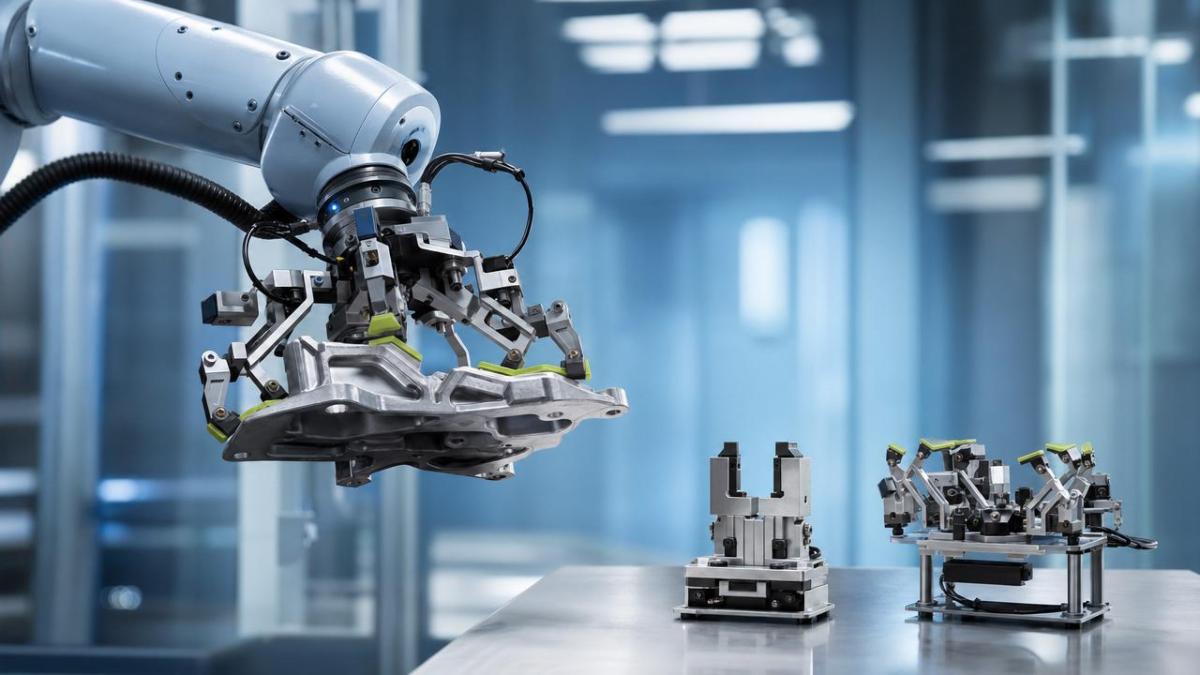
Custom robotic end effectors for these scenes often combine multiple contact points, locating features, and structural reinforcement.
The goal is to hold the part as a dynamic load, not a static object.
Acceleration profile matters here.
A grip that survives manual testing may still fail when robot jerk, cornering speed, or orientation changes increase inertial loads.
Scenario 3: High-mix lines require custom robotic end effectors with fast change capability
Many facilities no longer run a single part family for long periods.
Product variation, shorter batch runs, and frequent engineering updates increase handling complexity.
In these environments, fixed tooling can create hidden downtime.
Custom robotic end effectors should support modular fingers, quick-connect utilities, recipe-based adjustment, or passive compliance for dimensional variation.
The core judgment point is changeover cost.
If line stoppage, reteaching, or frequent manual intervention offsets automation gains, the end effector is underdesigned for the mix.
Good customization reduces setup friction while keeping repeatability measurable.
Scenario 4: Food, medical, and clean processes need grip solutions shaped by compliance rules
Some handling scenes are defined as much by hygiene and traceability as by mechanics.
Materials, cleanability, particle generation, and washdown resistance influence the end-effector architecture.
Custom robotic end effectors in regulated environments often require smooth surfaces, sealed cavities, corrosion-resistant hardware, and validated contact materials.
The key question is not only whether the tool grips well.
It is whether the tool remains stable, clean, and inspectable across repeated sanitation or sterile handling cycles.
How scene requirements change the design logic
A practical selection framework for custom robotic end effectors
A useful approach is to score the application before selecting tooling.
- Define the exact failure event: slip, mark, miss-pick, double-pick, or drop.
- Measure part variation, including tolerance stack-up and surface condition drift.
- Check dynamic loads across robot speed, orientation, and acceleration changes.
- Map utility constraints such as air supply, payload budget, and cable routing.
- Add sensing only where it closes a known uncertainty.
This method keeps custom robotic end effectors tied to verified process needs.
It also prevents overdesign, which can increase mass, cost, and maintenance without improving grip reliability.
Common misjudgments that weaken end-effector performance
- Assuming the robot is inaccurate when the contact interface is unstable.
- Sizing gripping force from part weight alone, ignoring motion-induced loads.
- Selecting pad or jaw materials without testing friction under contaminants.
- Ignoring part presentation error from upstream conveyors, trays, or feeders.
- Adding vision or sensors before fixing geometry and mechanical support.
- Overlooking maintenance access, wear parts, and cleaning intervals.
Across industries, these mistakes create a false impression that automation is unreliable.
In reality, many lines simply need better custom robotic end effectors with clearer engineering criteria.
What to evaluate before the next tooling decision
Start with evidence from the current process.
Capture failure frequency, part orientation at pickup, defect location, and robot motion state during each event.
Then compare that data against the part’s actual geometry, surface condition, and allowable contact zones.
If recurring issues point to mismatch at the interface, custom robotic end effectors are usually the highest-leverage correction.
The next step is straightforward.
Build a short requirement sheet covering part variation, dynamic load case, environment, and success criteria.
Use that sheet to benchmark tooling concepts before committing to line changes.
That is how custom robotic end effectors move from reactive fixes to measurable performance improvements.
At TSV, that data-first discipline remains the shortest path to engineering truth.
Search News
Hot Articles
- Carbon Fiber StructuresHow to Specify Aerospace Carbon Fiber Assemblies for Lightweight, Load-Bearing PartsJul 11, 2026
- Machine VisionXiaomi, Alibaba DAMO Academy Drive Open-Source Robotics Model Ecosystem, Lowering Algorithm Development Barriers for Overseas SMEs Adopting Chinese Robotics SolutionsMar 30, 2026
- Cobots & ArmsShanxi 'AI+' Conference Showcases Embodied Intelligence with Multinational Buyer Engagement: Key Industry ImplicationsMar 30, 2026
Popular Tags
Recommended News
 Jul 11, 2026How to Specify Aerospace Carbon Fiber Assemblies for Lightweight, Load-Bearing PartsAerospace carbon fiber assemblies: learn how to specify laminate design, load data, joining methods, and inspection controls for lighter, reliable load-bearing aerospace parts.Elena Rostova (UAV Systems Researcher)
 Mar 30, 2026Xiaomi, Alibaba DAMO Academy Drive Open-Source Robotics Model Ecosystem, Lowering Algorithm Development Barriers for Overseas SMEs Adopting Chinese Robotics SolutionsXiaomi & Alibaba DAMO Academy's open-source robotics models lower algorithm barriers for global SMEs. Boost efficiency in manufacturing, logistics & smart retail with ROS 2 compatible solutions.TSV Data Lab
 Mar 30, 2026Shanxi 'AI+' Conference Showcases Embodied Intelligence with Multinational Buyer Engagement: Key Industry ImplicationsShanxi 'AI+' Conference highlights embodied intelligence with Tesla, Ubtech & Jiantao showcasing multimodal robotics. 40+ global buyers validated tech on-site, creating new B2B channels for industrial automation & AI solutions.Chen Wei (Automation Lead Engineer)
 Mar 30, 2026Zhongguancun Unveils 6G Integrated Sensing-Computing-Intelligence Platform to Empower Embodied Robots for Global Industrial ApplicationsZhongguancun's new 6G platform revolutionizes industrial robotics with <10ms latency, empowering global automotive, logistics & port automation. Discover how this tech boosts China's smart manufacturing exports.TSV Data Lab
 Mar 30, 2026Mech-Mind Tianjin Embodied Intelligence R&D and Production Base Goes Live, Cutting Delivery Time by 20%–30% for Global Customized AMR+Vision SolutionsMech-Mind's Tianjin AMR+Vision production base cuts delivery time by 20%-30% for欧美 & Latin American markets. Discover how this PLd-certified facility accelerates customized robotics solutions for smart manufacturing and logistics.Chen Wei (Automation Lead Engineer)
 Mar 30, 2026Boao Forum Reveals 'Co-evolution of Big and Small Brains' Trend in Humanoid Robots, China's Embodied Intelligence Accelerates Adaptation to Overseas Manufacturing Service ScenariosDiscover how China's humanoid robots, featuring 'Co-evolution of Big and Small Brains,' are revolutionizing global manufacturing. Learn about Embodied Tian Gong 3.0's ISO compliance and overseas deployment at Boao Forum 2026.Chen Wei (Automation Lead Engineer)
 Mar 30, 2026China Railway Industrial Secures Patent for Embodied Robotics in Material Handling, Boosting High-Precision Delivery Capabilities for Overseas Infrastructure and Manufacturing ProjectsChina Railway Industrial's new patent for embodied robotics in material handling boosts high-precision delivery for global infrastructure & manufacturing. Discover how this innovation enhances logistics accuracy in automotive, rail transit & EPC projects.Chen Wei (Automation Lead Engineer)
 Sep 28, 2026Spindle Runout Measurement in Germany: DIN Standards, Methods, and Acceptance LimitsSpindle runout measurement Germany: explore DIN standards, proven methods, acceptance limits, and audit-ready practices for reliable machining quality.Dr. Marcus Vance
 Sep 27, 2026How to Select Wall-Mount Edge Devices for Space-Constrained Factory NetworksWall mount edge devices for space-constrained factories: evaluate workload, thermal design, power resilience, cable access, and network reliability for smarter deployments.TSV Data Lab
 Sep 26, 2026Machining Tolerance Analysis: How to Set Limits That Meet Function and Cost TargetsMachining tolerance analysis: learn how to set functional limits, control tolerance stacks, reduce inspection risk, and balance precision with production cost.Dr. Marcus Vance
 Sep 25, 2026How to Evaluate an Industrial Infrastructure Data Platform for Multi-Site OperationsIndustrial infrastructure data platform evaluation guide for multi-site operations: compare data quality, edge resilience, interoperability, governance, and scalable proof-of-value criteria.Victor Lin (Chief Software Architect)
 Sep 24, 2026How to Select Machine Vision Optics for Accurate Inspection at Different Working DistancesMachine vision optics selection guide for accurate inspection at every working distance. Compare FOV, pixel scale, DOF, distortion, lighting, and telecentric options.TSV Data Lab
 Sep 23, 2026How to Evaluate a Machine Vision System Integrator for High-Speed Inspection LinesChoose a machine vision system integrator with proven expertise in high-speed inspection, reliable reject timing, robust optics, and measurable acceptance criteria.TSV Data Lab
 Sep 28, 2026When is a SCADA API the right choice for connecting plant systems?SCADA API guide: learn when governed plant data integration improves traceability, security, and scalability—without compromising real-time control.Victor Lin (Chief Software Architect)
 Sep 27, 2026How SCADA data integration improves traceability across production linesSCADA data integration connects production-line data to improve traceability, accelerate quality investigations, and strengthen safety decisions.Victor Lin (Chief Software Architect)
 Sep 26, 2026What to define before starting SCADA integration planningSCADA integration planning starts with clear scope, control boundaries, data models, cybersecurity, and testing. Discover the definitions that reduce risk and costly rework.Victor Lin (Chief Software Architect)
 Sep 25, 2026How a smart factory with Industrial IoT reduces production blind spotsDiscover how a smart factory with Industrial IoT turns real-time machine, quality, and workflow data into actionable insights that reduce production blind spots and delivery risks.Victor Lin (Chief Software Architect)
 Sep 24, 2026When does Industrial IoT make smart manufacturing easier to scale?Smart manufacturing Industrial IoT scales when trusted data, interoperable systems, and secure workflows turn connected assets into measurable gains.TSV Data Lab
 Sep 23, 2026What drives ultra-precision machining cost at 1-micron tolerance?Ultra precision machining cost per part at 1 micron tolerance depends on process, material, metrology, and yield. Learn how to compare quotes confidently.Dr. Marcus Vance
 Sep 22, 2026Drone Engine-T550CC Applications: Build the UAV Power System Around the MissionAn application guide for Drone Engine-T550CC integration, covering payload planning, airframe matching, cooling, fuel, vibration, test procedures, documentation, and service preparation.Elena Rostova (UAV Systems Researcher)
 Sep 22, 2026How to Evaluate Industrial Edge Computing Vendors for Factory DeploymentIndustrial edge computing vendor evaluation guide for factories: compare latency, protocol fit, reliability, security, and lifecycle support before deployment.TSV Data Lab
 Sep 21, 2026Drone Payload Integration: Matching Power, Data, and Center of Gravity for Reliable FlightsDrone payload integration made practical: balance power, data, center of gravity, and endurance to build safer, more reliable mission-ready flights.Elena Rostova (UAV Systems Researcher)
 Sep 20, 2026Autonomous Navigation Pricing: Cost Drivers and Budget Benchmarks for AMR ProjectsAutonomous navigation price explained: compare AMR cost drivers, software, sensors, integration, safety, and lifecycle budgets to build a scalable project plan.Chen Wei (Automation Lead Engineer)
 Sep 19, 2026How to Scope Automation Integration Services for Multi-System Factory ProjectsAutomation integration services: learn how to scope multi-system factory projects with clear workflows, interface contracts, safety boundaries, and acceptance criteria.Victor Lin (Chief Software Architect)