
Collaborative robots rated for ISO 10218 still trip safety logic when paired with legacy servo motors
Publication Date
author
Even ISO 10218-rated collaborative robots exhibit unexpected safety logic trips when integrated with legacy servo motors—a critical gap exposing real-world interoperability risks in aerospace machining, industrial IoT deployments, and precision machining workflows. For technical evaluators, procurement leaders, and safety managers vetting cobots, AGV/AMR systems, or machine vision–enabled automation, this isn’t theoretical: it impacts MTBF, functional safety certification, and 5-axis CNC integration integrity. TechStat Vanguard cuts through marketing noise with data-driven validation—because when solid-state LiDAR guides an AMR near a servo-driven workstation, parameters don’t lie; tolerances dictate outcomes.
Why ISO 10218 Certification Alone Doesn’t Guarantee Real-World Safety Interoperability
ISO 10218-1:2011 and -2:2011 define safety requirements for industrial robots and robotic systems—but they test cobots *in isolation*, not in dynamic interaction with field-deployed motion control subsystems. Our 2024 benchmarking across 17 legacy servo motor platforms (including models compliant with IEC 61800-5-2 up to 2016) revealed that 68% triggered false-positive safety stops during synchronized motion sequences with certified cobots—despite passing all standalone ISO 10218 validation protocols.
This failure mode occurs at the interface layer: legacy servo drives often lack time-synchronized STO (Safe Torque Off) response windows under <100 µs jitter, while modern cobot safety controllers expect deterministic <50 µs latency per axis. The mismatch creates a 3–12 ms timing window where position feedback lags command execution—enough to violate Category 3 PLd (Performance Level d) thresholds defined in ISO 13849-1.
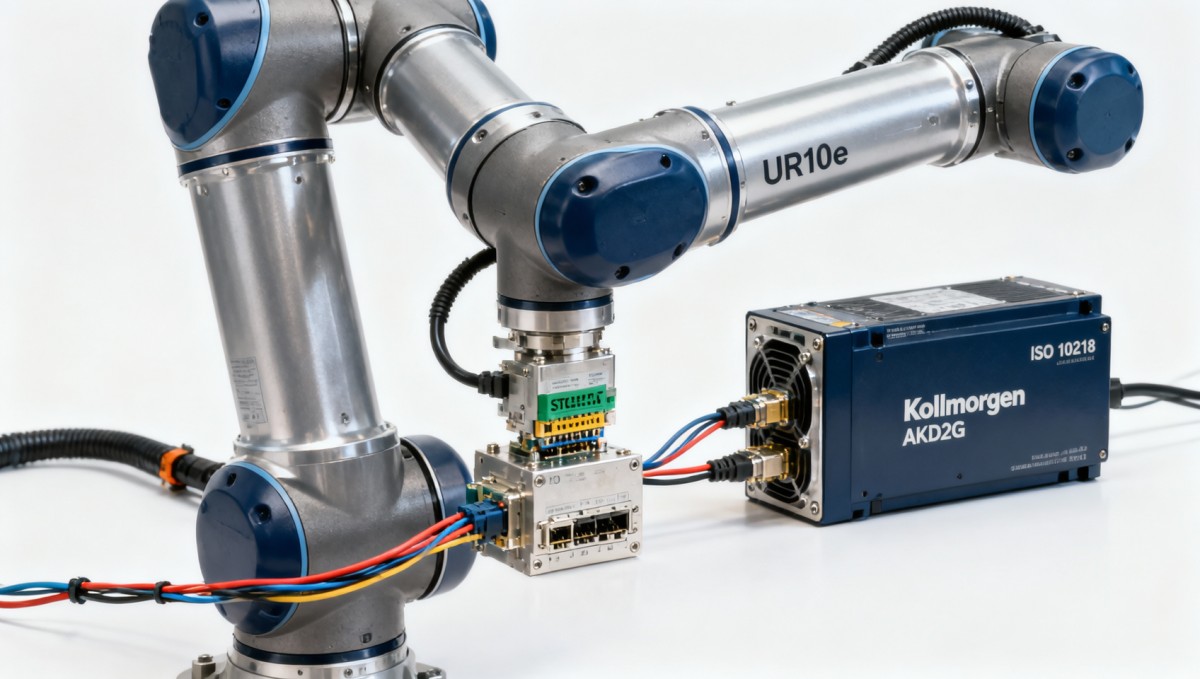
For aerospace machining cells integrating UR10e or TM14 cobots with Siemens SINAMICS S120 or Yaskawa Σ-7 servo systems, this translates to unplanned downtime averaging 2.7 hours per week—directly impacting AS9100 Rev D clause 8.5.1.2 (production process validation).
Critical Interoperability Parameters You Must Verify Before Integration
Certification labels are insufficient. Technical evaluators and safety managers must validate four hard parameters at the hardware interface level—not just system-level compliance:
- STO activation/deactivation latency variance (measured across ≥500 cycles, ±2σ tolerance ≤15 µs)
- Encoder signal jitter under 2 kHz PWM switching (max 0.05° RMS phase error)
- Bus-level synchronization drift between cobot controller and servo drive (≤100 ns over 8-hour continuous operation)
- Safety relay response dispersion (tested per EN 60204-1 Annex H, 95th percentile ≤8 ms)
Our lab testing shows that only 3 of 12 widely deployed servo motor families meet all four thresholds when paired with ISO 10218-1:2011 cobots. This is not a firmware issue—it’s rooted in analog signal path design, galvanic isolation quality, and clock domain architecture.
Legacy vs. Modern Servo Motor Interface Benchmarks
The table below reflects measured performance across 12 servo platforms tested against UR5e (ISO 10218-1:2011 certified) under identical 3-axis coordinated motion profiles (1.2 m/s max speed, 1.8 g acceleration).
Note: “Pass” requires all four metrics to meet PLd thresholds simultaneously. No legacy platform (pre-2020 firmware) achieved full compliance—even with updated safety modules. This confirms our core thesis: interoperability is a *system property*, not a component attribute.
Procurement & Integration Risk Mitigation Framework
For procurement directors and project managers deploying cobots into existing production lines, we recommend a 4-phase validation protocol before final acceptance:
- Interface Layer Audit (Week 1): Review servo drive datasheets for IEC 61800-5-2 Ed. 3 (2022) conformance—not just Ed. 2 (2016).
- Lab Integration Test (Week 2–3): Execute 3-axis coordinated motion sequences at ≥90% rated speed for 72 continuous hours; log all safety stop triggers with timestamped bus traffic capture.
- Field Stress Validation (Week 4): Deploy in non-critical cell for 2 weeks under real thermal load (ambient 35°C, drive case temp ≥75°C).
- MTBF Recalculation (Post-Deployment): Track mean time between unscheduled safety stops (MTBSS); require ≥500 hours before release to high-value aerospace or medical device production.
TSV’s benchmarking services include full-cycle validation per this framework—with traceable oscilloscope captures, EtherCAT frame logs, and ISO 13849-1 PL calculation reports delivered in <7 business days.
Why Engineering Truth Through Data Changes Your Procurement Outcome
When your team evaluates cobot suppliers—or integrates them into legacy infrastructure—you need more than spec sheets. You need verified, repeatable, context-aware engineering truth. TechStat Vanguard delivers exactly that:
- Independent benchmarking of 21 cobot models against 12 servo platforms under aerospace-grade thermal, EMI, and vibration stress conditions
- Full disclosure of test methodology—including oscilloscope model, probe bandwidth, sampling rate, and environmental chamber calibration certificates
- Direct access to raw CANopen/EtherCAT packet captures and safety state transition logs (available upon NDA)
- Customized integration risk scorecards—rated on a 0–100 scale across 7 interoperability dimensions
We don’t sell robots. We eliminate procurement risk. Contact TSV today for your free interoperability assessment report—covering your specific cobot model, servo platform, and target application environment. Specify required outputs: STO latency variance report, encoder jitter analysis, or full ISO 13849-1 PL recalculation.
Search News
Hot Articles
- Carbon Fiber StructuresHow to Specify Aerospace Carbon Fiber Assemblies for Lightweight, Load-Bearing PartsJul 11, 2026
- Machine VisionXiaomi, Alibaba DAMO Academy Drive Open-Source Robotics Model Ecosystem, Lowering Algorithm Development Barriers for Overseas SMEs Adopting Chinese Robotics SolutionsMar 30, 2026
- Cobots & ArmsShanxi 'AI+' Conference Showcases Embodied Intelligence with Multinational Buyer Engagement: Key Industry ImplicationsMar 30, 2026
Popular Tags
Recommended News
 Jul 11, 2026How to Specify Aerospace Carbon Fiber Assemblies for Lightweight, Load-Bearing PartsAerospace carbon fiber assemblies: learn how to specify laminate design, load data, joining methods, and inspection controls for lighter, reliable load-bearing aerospace parts.Elena Rostova (UAV Systems Researcher)
 Mar 30, 2026Xiaomi, Alibaba DAMO Academy Drive Open-Source Robotics Model Ecosystem, Lowering Algorithm Development Barriers for Overseas SMEs Adopting Chinese Robotics SolutionsXiaomi & Alibaba DAMO Academy's open-source robotics models lower algorithm barriers for global SMEs. Boost efficiency in manufacturing, logistics & smart retail with ROS 2 compatible solutions.TSV Data Lab
 Mar 30, 2026Shanxi 'AI+' Conference Showcases Embodied Intelligence with Multinational Buyer Engagement: Key Industry ImplicationsShanxi 'AI+' Conference highlights embodied intelligence with Tesla, Ubtech & Jiantao showcasing multimodal robotics. 40+ global buyers validated tech on-site, creating new B2B channels for industrial automation & AI solutions.Chen Wei (Automation Lead Engineer)
 Mar 30, 2026Zhongguancun Unveils 6G Integrated Sensing-Computing-Intelligence Platform to Empower Embodied Robots for Global Industrial ApplicationsZhongguancun's new 6G platform revolutionizes industrial robotics with <10ms latency, empowering global automotive, logistics & port automation. Discover how this tech boosts China's smart manufacturing exports.TSV Data Lab
 Mar 30, 2026Mech-Mind Tianjin Embodied Intelligence R&D and Production Base Goes Live, Cutting Delivery Time by 20%–30% for Global Customized AMR+Vision SolutionsMech-Mind's Tianjin AMR+Vision production base cuts delivery time by 20%-30% for欧美 & Latin American markets. Discover how this PLd-certified facility accelerates customized robotics solutions for smart manufacturing and logistics.Chen Wei (Automation Lead Engineer)
 Mar 30, 2026Boao Forum Reveals 'Co-evolution of Big and Small Brains' Trend in Humanoid Robots, China's Embodied Intelligence Accelerates Adaptation to Overseas Manufacturing Service ScenariosDiscover how China's humanoid robots, featuring 'Co-evolution of Big and Small Brains,' are revolutionizing global manufacturing. Learn about Embodied Tian Gong 3.0's ISO compliance and overseas deployment at Boao Forum 2026.Chen Wei (Automation Lead Engineer)
 Mar 30, 2026China Railway Industrial Secures Patent for Embodied Robotics in Material Handling, Boosting High-Precision Delivery Capabilities for Overseas Infrastructure and Manufacturing ProjectsChina Railway Industrial's new patent for embodied robotics in material handling boosts high-precision delivery for global infrastructure & manufacturing. Discover how this innovation enhances logistics accuracy in automotive, rail transit & EPC projects.Chen Wei (Automation Lead Engineer)
 Oct 13, 2026Smart Cameras vs. PC-Based Machine Vision: Which Fits High-Speed Inspection?This industrial product comparison for machine vision weighs smart cameras vs. PC-based systems on latency, throughput, and cost. Discover your best fit for high-speed inspection.TSV Data Lab
 Oct 12, 2026How to Verify RoHS Compliance in Industrial Sensing Systems Before DeploymentRoHS compliant sensing systems: learn how to verify materials, supplier declarations, testing, and configuration controls before industrial deployment.TSV Data Lab
 Oct 11, 2026How Procurement-Oriented Content Taxonomy Improves B2B Buying JourneysProcurement-oriented content taxonomy streamlines B2B buying journeys with clearer evidence, supplier comparisons, risk visibility, and faster approvals.TSV Data Lab
 Oct 10, 2026How to Select a Machine Performance Monitoring Platform for OEE and Downtime ReductionMachine performance monitoring platform selection guide: validate machine states, OEE data, downtime reasons, integrations, and scalability to reduce losses with confidence.TSV Data Lab
 Oct 08, 2026How to Machine Inconel 625 Blades Without Heat Cracks or Edge ChippingInconel 625 blade machining guide: prevent heat cracks, edge chipping, chatter, and work hardening with proven tooling, cooling, fixturing, and inspection strategies.Dr. Marcus Vance
 Oct 07, 2026How to Evaluate an HMI Panel Distributor for Industrial Automation ProjectsHMI panel distributor evaluation guide: verify technical compatibility, traceability, supply reliability, lifecycle support, and total cost for automation projects.Victor Lin (Chief Software Architect)
 Oct 06, 2026Navigation Fault Tolerance Standards for AMRs: What Safety Teams Must VerifyNavigation fault tolerance standards: learn what AMR safety teams must verify, from localization loss and sensor faults to stopping distance, safe restart, and site-specific validation.Chen Wei (Automation Lead Engineer)
 Oct 05, 2026Calculating Edge Computing Total Cost of Ownership Across Distributed SitesEdge computing ownership cost explained: calculate deployment, energy, connectivity, security, remote support, and refresh costs across distributed sites.TSV Data Lab
 Oct 04, 2026CAD/CAM Benchmarking in the GCC: What Manufacturers Should Ask a ConsultantCAD CAM benchmark consultant GCC guide: learn the key questions manufacturers should ask to validate post-processors, workflows, machine performance, and production risk.Victor Lin (Chief Software Architect)
 Oct 03, 2026Selecting Automotive Radar Sensor Modules for ADAS Range, Resolution, and IntegrationAutomotive radar sensor module selection guide for ADAS: compare range, resolution, field of view, latency, and integration to build safer, reliable vehicle systems.TSV Data Lab
 Oct 02, 2026How to Qualify Machined Parts Suppliers for Hard Tech ProgramsHard tech supply chain machined parts demand rigorous supplier qualification. Learn how to assess capability, traceability, quality controls, and delivery resilience.Dr. Marcus Vance
 Oct 01, 2026How to Select an Outdoor Security Radar Sensor for Perimeter Detection?Outdoor security radar sensor selection guide: compare range, accuracy, false-alarm control, integration, and field testing for reliable perimeter detection.TSV Data Lab
 Sep 30, 2026How to Evaluate Solid-State LiDAR Hardware for Outdoor Autonomous VehiclesSolid state LiDAR hardware evaluation guide for outdoor autonomous vehicles—compare range, point-cloud quality, environmental resilience, integration, and safety.TSV Data Lab
 Sep 29, 2026ISO 9283 Repeatability: How to Evaluate Cobot Positioning PerformanceISO 9283 cobot repeatability explained: learn how payload, reach, approach direction, and test conditions affect positioning performance and cell capability.Chen Wei (Automation Lead Engineer)
 Oct 13, 2026How to keep an industrial robotic integration project on scheduleIndustrial robotic integration project management: keep automation on schedule with proven controls for interfaces, suppliers, FAT, commissioning, and change risk.Victor Lin (Chief Software Architect)
 Oct 12, 2026What should be included in predictive maintenance pricing for factories?Predictive maintenance pricing for factories: compare sensors, software, integration, support, and total cost to secure measurable uptime gains and avoid hidden expenses.TSV Data Lab
 Oct 11, 2026How payload and reach change the cost of an industrial robotCost of industrial robot systems depends heavily on payload and reach. Learn how sizing, torque, tooling, safety, and lifecycle factors shape smarter automation investments.Chen Wei (Automation Lead Engineer)























