Cobot for CNC Machine Tending: Which Part Sizes, Cycle Times, and CNC Tasks Fit Best?
Publication Date
author
Cobot for CNC Machine Tending: Which Part Sizes, Cycle Times, and CNC Tasks Fit Best?
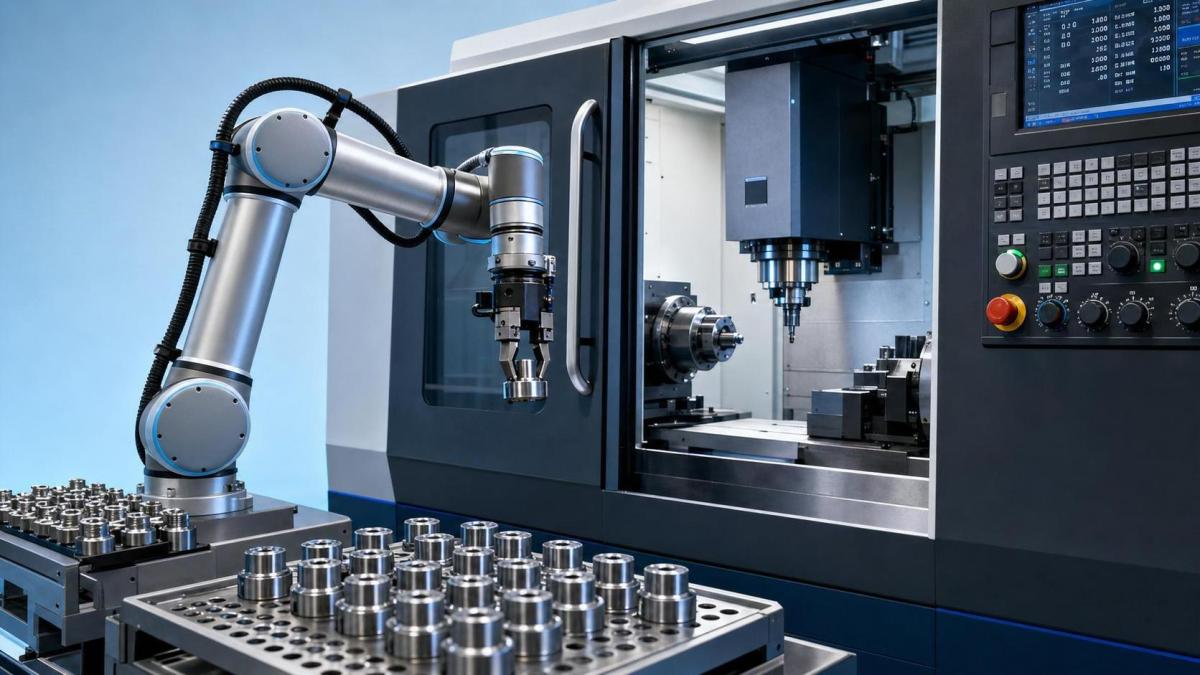
Selecting a cobot for CNC machine tending starts with fit, not hype.
The strongest results come from matching payload, reach, cycle time, and gripper behavior to a real CNC workflow.
That matters because a cobot for CNC machine tending is rarely limited by marketing claims.
It is limited by spindle uptime, door access, chip control, part presentation, and repeatable loading accuracy.
In practical terms, the best projects are often boring in a good way.
They involve predictable parts, stable fixtures, and machine cycles long enough to justify robotic loading and unloading.
This guide focuses on where a cobot for CNC machine tending fits best, where risk rises, and how to judge technical feasibility fast.
Start With the Real Fit Criteria
A good application review begins with measurable constraints.
For a cobot for CNC machine tending, four variables shape success more than anything else.
- Part size and mass, including raw stock and finished part differences.
- Machine cycle time, especially the ratio between cut time and handling time.
- Machine access, including door width, chuck position, and fixture clearance.
- Task complexity, such as orientation checks, blowing chips, gauging, or tray loading.
If these inputs are stable, the application usually moves forward smoothly.
If they vary widely, the integration cost rises before any robot even moves.
From a TSV-style engineering view, fit means repeatability under production conditions, not just a successful demo cycle.
Which Part Sizes Work Best?
The best part sizes for a cobot for CNC machine tending are usually small to medium.
Think compact billets, turned blanks, valve bodies, brackets, housings, and medical or aerospace subcomponents.
These parts are easier to grip, easier to orient, and less likely to challenge wrist torque limits.
A common sweet spot is parts under 10 kg, including gripper margin and any chip load on the surface.
Many applications remain viable above that range, but the risk profile changes.
Long shafts, awkward castings, and wide plates create moment-arm issues even when nominal payload looks acceptable.
That is why payload alone is a weak filter.
For a cobot for CNC machine tending, evaluators should check three dimensions together.
- Part envelope relative to machine door and chuck.
- Center of gravity relative to the gripper face.
- Total moving mass during the longest reach position.
More clearly, a compact 12 kg block may be easier than a 6 kg long shaft.
That also explains why soft jaws, nest design, and part staging matter so much.
Best-fit part categories
- Prismatic parts with stable pickup faces.
- Round blanks with reliable orientation references.
- Parts with low burr sensitivity during gripping.
- Short-run families sharing the same handling logic.
Harder part categories
- Oily parts that shift inside simple parallel grippers.
- Thin-wall components that distort under clamp force.
- Heavy castings with variable surface geometry.
- Large parts needing deep machine reach and reorientation.
What Cycle Times Justify a Cobot for CNC Machine Tending?
Cycle time is often the make-or-break variable.
A cobot for CNC machine tending performs best when machine cycle time is long enough to absorb door motion, part exchange, and confirmation signals.
In many shops, that means machining cycles above 45 seconds are worth serious review.
Applications above 90 seconds are usually easier to justify.
Once cycles pass two to five minutes, the labor and uptime case gets much stronger.
Short cycles are not impossible, but they reduce margin.
In those cases, every second of door actuation, chuck confirmation, and gripper release starts to matter.
That is where an industrial robot may outperform a collaborative platform.
So the question is not only whether the cobot can do the task.
The better question is whether it preserves spindle utilization.
A practical cycle-time screen
- Under 30 seconds: difficult for most cobot for CNC machine tending projects.
- 30 to 60 seconds: possible, but motion and interface losses must be tightly controlled.
- 60 to 180 seconds: strong range for standard machine tending cells.
- Over 180 seconds: excellent range when part flow and buffering are organized well.
This also affects how many machines one cobot can serve.
Longer cycles can support dual-machine tending.
Very short cycles usually cannot, unless part presentation is extremely simple.
Which CNC Tasks Fit Best?
Not every CNC-related task creates the same automation value.
The strongest use cases for a cobot for CNC machine tending are consistent, repeatable, and low in process variation.
Basic load and unload remains the highest-fit scenario.
But value increases when the robot also handles simple secondary actions.
- Opening and closing machine doors.
- Starting the cycle through mapped I/O.
- Part flipping between Op10 and Op20.
- Blowing chips before reload.
- Moving finished parts into trays or conveyor buffers.
- Presenting parts to a gauge station or vision check.
These tasks work because they are structured and bounded.
A cobot for CNC machine tending becomes less attractive when the process needs constant manual judgment.
Examples include random part orientation, unstable chip nests, frequent tool-break inspections, or fixture adjustments every few cycles.
Those conditions usually signal an upstream process problem, not a robot problem.
Best CNC machine types
- CNC lathes with predictable chuck access.
- Vertical machining centers with stable fixture positions.
- Dual-pallet setups where robot timing can overlap machining.
- Compact mill-turn cells with clear loading paths.
Where Limits Usually Appear
The main limits are rarely hidden.
They usually show up during the first serious process map.
For a cobot for CNC machine tending, the most common blockers are mechanical, not software-related.
- Door openings too narrow for gripper and part clearance.
- Fixtures that require hand feel instead of positive location.
- Hot chips and coolant splash reducing sensor reliability.
- Raw parts arriving with too much positional variation.
- Machine I/O access that is undocumented or difficult to validate.
A more subtle issue is tolerance stack-up in the handling path.
Robot repeatability may be acceptable, yet the full system may still drift.
That includes gripper compliance, jaw wear, fixture float, and part-stop contamination.
This is why engineering evaluation should treat the cell as one mechanism.
A cobot for CNC machine tending is only as stable as its least-controlled interface.
How to Evaluate ROI Without Guesswork
ROI becomes clearer when the labor case and uptime case are separated.
Labor savings alone may support a cobot for CNC machine tending.
But the stronger business case often comes from unattended hours, reduced idle time, and more predictable throughput.
A simple evaluation framework helps.
- Measure current spindle idle time per shift.
- Calculate manual load and unload time variation.
- Estimate recoverable machine hours per week.
- Add scrap risk, changeover time, and staffing constraints.
- Compare one-machine and two-machine tending scenarios.
This method keeps the analysis grounded.
It also filters out projects that look attractive in presentations but collapse on the shop floor.
A Practical Decision Checklist
Before approving a cobot for CNC machine tending, run through a short technical checklist.
- Is the part family dimensionally stable across batches?
- Does the machine cycle leave enough time for safe handling?
- Can the gripper manage coolant, chips, and surface variation?
- Is fixture loading positive, repeatable, and sensor-confirmable?
- Can machine I/O be integrated without workaround logic?
- Does the cell still perform during longest reach and heaviest load?
If most answers are yes, the application is likely strong.
If several answers depend on operator skill, the process may need redesign first.
That is often the clearest signal during early screening.
Final Take
The best cobot for CNC machine tending applications are not the most dramatic ones.
They are the ones with stable part geometry, manageable payloads, clear machine access, and cycle times that protect spindle utilization.
In most factories, that means small to medium parts, repeatable loading conditions, and tasks centered on structured load and unload sequences.
When the process is data-checked and interface risks are controlled, a cobot for CNC machine tending can deliver steady uptime and practical ROI.
The right next step is simple: map the exact part envelope, cycle profile, and machine interface points before comparing robot models.
Search News
Hot Articles
- Carbon Fiber StructuresHow to Specify Aerospace Carbon Fiber Assemblies for Lightweight, Load-Bearing PartsJul 11, 2026
- Machine VisionXiaomi, Alibaba DAMO Academy Drive Open-Source Robotics Model Ecosystem, Lowering Algorithm Development Barriers for Overseas SMEs Adopting Chinese Robotics SolutionsMar 30, 2026
- Cobots & ArmsShanxi 'AI+' Conference Showcases Embodied Intelligence with Multinational Buyer Engagement: Key Industry ImplicationsMar 30, 2026
Popular Tags
Recommended News
 Jul 11, 2026How to Specify Aerospace Carbon Fiber Assemblies for Lightweight, Load-Bearing PartsAerospace carbon fiber assemblies: learn how to specify laminate design, load data, joining methods, and inspection controls for lighter, reliable load-bearing aerospace parts.Elena Rostova (UAV Systems Researcher)
 Mar 30, 2026Xiaomi, Alibaba DAMO Academy Drive Open-Source Robotics Model Ecosystem, Lowering Algorithm Development Barriers for Overseas SMEs Adopting Chinese Robotics SolutionsXiaomi & Alibaba DAMO Academy's open-source robotics models lower algorithm barriers for global SMEs. Boost efficiency in manufacturing, logistics & smart retail with ROS 2 compatible solutions.TSV Data Lab
 Mar 30, 2026Shanxi 'AI+' Conference Showcases Embodied Intelligence with Multinational Buyer Engagement: Key Industry ImplicationsShanxi 'AI+' Conference highlights embodied intelligence with Tesla, Ubtech & Jiantao showcasing multimodal robotics. 40+ global buyers validated tech on-site, creating new B2B channels for industrial automation & AI solutions.Chen Wei (Automation Lead Engineer)
 Mar 30, 2026Zhongguancun Unveils 6G Integrated Sensing-Computing-Intelligence Platform to Empower Embodied Robots for Global Industrial ApplicationsZhongguancun's new 6G platform revolutionizes industrial robotics with <10ms latency, empowering global automotive, logistics & port automation. Discover how this tech boosts China's smart manufacturing exports.TSV Data Lab
 Mar 30, 2026Mech-Mind Tianjin Embodied Intelligence R&D and Production Base Goes Live, Cutting Delivery Time by 20%–30% for Global Customized AMR+Vision SolutionsMech-Mind's Tianjin AMR+Vision production base cuts delivery time by 20%-30% for欧美 & Latin American markets. Discover how this PLd-certified facility accelerates customized robotics solutions for smart manufacturing and logistics.Chen Wei (Automation Lead Engineer)
 Mar 30, 2026Boao Forum Reveals 'Co-evolution of Big and Small Brains' Trend in Humanoid Robots, China's Embodied Intelligence Accelerates Adaptation to Overseas Manufacturing Service ScenariosDiscover how China's humanoid robots, featuring 'Co-evolution of Big and Small Brains,' are revolutionizing global manufacturing. Learn about Embodied Tian Gong 3.0's ISO compliance and overseas deployment at Boao Forum 2026.Chen Wei (Automation Lead Engineer)
 Mar 30, 2026China Railway Industrial Secures Patent for Embodied Robotics in Material Handling, Boosting High-Precision Delivery Capabilities for Overseas Infrastructure and Manufacturing ProjectsChina Railway Industrial's new patent for embodied robotics in material handling boosts high-precision delivery for global infrastructure & manufacturing. Discover how this innovation enhances logistics accuracy in automotive, rail transit & EPC projects.Chen Wei (Automation Lead Engineer)
 Sep 19, 2026How to Scope Automation Integration Services for Multi-System Factory ProjectsAutomation integration services: learn how to scope multi-system factory projects with clear workflows, interface contracts, safety boundaries, and acceptance criteria.Victor Lin (Chief Software Architect)
 Sep 18, 2026Selecting UAV Aerospace Structural Parts for Strength, Weight, and Fatigue LifeUAV aerospace structural parts guide: compare strength, weight, stiffness, fatigue life, joints, and traceability to select reliable flight-ready components.Elena Rostova (UAV Systems Researcher)
 Sep 17, 2026Selecting Commercial Drone Payloads for European Inspection ProjectsCommercial drone payloads Europe: learn how to select RGB, thermal and LiDAR systems for compliant, reliable inspection data and better project outcomes.Elena Rostova (UAV Systems Researcher)
 Sep 16, 2026Machining Tolerance Validation: How to Verify Critical Dimensions Before Production ReleaseMachining tolerance analysis validation: verify critical dimensions, measurement systems, process capability, and tolerance stacks before production release.Dr. Marcus Vance
 Sep 15, 2026AGV Tape Guidance vs Laser Navigation: Which Fits Your Warehouse Layout?AGV tape guidance comparison: discover how tape and laser navigation fit changing warehouse layouts, docking needs, floor conditions, maintenance, and route flexibility.Chen Wei (Automation Lead Engineer)
 Sep 14, 2026How Point Cloud Analytics Improves Asset Inspection Workflows Across GCC ProjectsPoint cloud analytics GCC helps project leaders improve asset inspections with accurate change detection, safer workflows, and faster maintenance decisions.TSV Data Lab
 Sep 13, 2026How Aerospace Manufacturers Can Build a Digital Thread From Design to Certified ProductionDigital manufacturing for aerospace: learn how to build a traceable digital thread from design through certified production, supplier control, and audit-ready compliance.Victor Lin (Chief Software Architect)
 Sep 12, 2026How to Select a Thermal Sensor for Mapping Drones in Surveying ProjectsMapping drone thermal sensor selection made simple: compare GSD, radiometric data, NETD, calibration, and workflow fit for accurate, survey-ready thermal maps.Elena Rostova (UAV Systems Researcher)
 Sep 11, 2026Integrating Photogrammetry Workflows into Digital Twin Projects Without Data BottlenecksPhotogrammetry workflow integration for digital twins: learn how to streamline capture, validation, versioning, and delivery to prevent data bottlenecks.Victor Lin (Chief Software Architect)
 Sep 10, 2026Hard-Tech Supply Chain Procurement: Qualifying Suppliers to Cut Lead-Time RiskHard-tech supply chain procurement guide: qualify suppliers with proven process, traceability, capacity, and change control to reduce lead-time risk.Chen Wei (Automation Lead Engineer)
 Sep 09, 2026Industrial Application Notes: Cost Factors That Shape Automation Project BudgetsIndustrial application notes cost factors explained: uncover the engineering, safety, integration, and commissioning variables that shape accurate automation budgets.Victor Lin (Chief Software Architect)
 Sep 08, 2026Supplier Discovery for Sourcing: How Buyers Can Verify Capability and Supply RiskSupplier discovery for sourcing: learn how to verify supplier capability, traceability, quote assumptions, and supply risk before placing production orders.TSV Data Lab
 Sep 07, 2026What Determines Process Control Systems Pricing? A Buyer’s Cost GuideProcess control systems pricing explained: compare hardware, engineering, integration, cybersecurity, validation, and lifecycle costs to choose the right-value solution.Victor Lin (Chief Software Architect)
 Sep 07, 2026AMR Robots in ASEAN: Which Industries Are Adopting Them—and Why?AMR robots ASEAN adoption is accelerating in electronics, automotive, warehousing, healthcare, and cold chain. Explore use cases, risks, and deployment insights.Chen Wei (Automation Lead Engineer)
 Sep 05, 2026How to Evaluate Supplier Qualification Support Tools for Industrial Procurement TeamsSupplier qualification support tools help industrial procurement teams verify technical evidence, manage risk, and make defensible supplier approvals. Learn what to evaluate.Victor Lin (Chief Software Architect)
 Sep 04, 2026Grinding Tolerance Analysis: How to Set Realistic Limits for Precision PartsGrinding tolerance analysis explains how to set realistic limits for precision parts, balance fit, geometry, process capability, and inspection for reliable performance.Dr. Marcus Vance
 Sep 03, 2026Warehouse Automation Strategies to Increase Storage Capacity Without ExpansionWarehouse automation space saving strategies help unlock vertical capacity, optimize slotting, and improve storage density without costly building expansion.Victor Lin (Chief Software Architect)