
Cobot collision detection threshold set too low causes new problems
Publication Date
author
When a cobot collision detection threshold is set too low, the system may appear “safer” on paper, but in practice it often creates a different class of operational problems: nuisance stops, inconsistent takt time, unexplained fault events, and avoidable wear on the broader cell workflow. For engineers, operators, procurement teams, and manufacturing leaders, the real question is not whether collision detection should be sensitive—it should—but whether it is tuned appropriately for the robot, tool, payload, process dynamics, and risk level of the application. In most real deployments, an overly low threshold is a sign of poor tuning, incomplete validation, or a misunderstanding of how collaborative safety, force monitoring, and productivity interact.
What actually happens when the collision detection threshold is set too low?
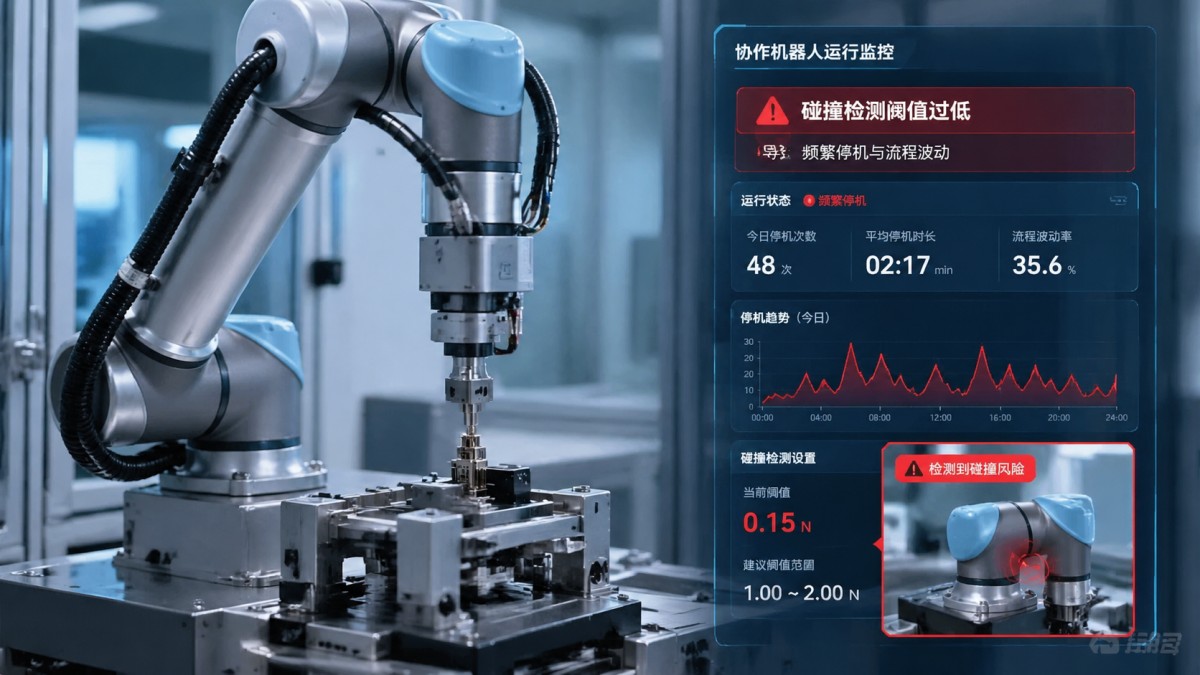
A low collision detection threshold means the cobot is configured to interpret relatively small torque deviations, force changes, or dynamic disturbances as collision events. That can sound conservative, but on the factory floor it often causes the robot to stop during normal operation rather than true unsafe contact.
Common symptoms include:
- Frequent false collision alarms during acceleration, deceleration, or direction changes
- Stops triggered by normal process resistance such as insertion force, cable drag, vacuum cup variation, or tool vibration
- Unstable cycle times that make line balancing difficult
- Operator frustration and eventual workarounds that reduce real safety discipline
- Lower overall equipment effectiveness due to micro-stoppages and fault recovery time
In other words, setting the threshold too low does not simply “add safety margin.” It can reduce process robustness and make the system less predictable. In severe cases, teams begin ignoring alarms or loosening settings without structured validation, which creates a new layer of operational risk.
Why this matters beyond safety: the hidden cost of nuisance stops
For target readers evaluating automation performance, the issue is not only technical. It directly affects throughput, labor efficiency, maintenance burden, and supplier credibility.
For operators and cell technicians, repeated unnecessary stops increase reset frequency and disrupt workflow rhythm. For process engineers, low thresholds obscure root causes because the system generates collision faults that are not actually related to hazardous contact. For procurement teams, a cobot that “meets safety specs” but cannot maintain stable runtime may turn into a poor investment. For business decision-makers, the financial impact appears in reduced utilization, delayed payback, and increased support dependency.
Typical business-side consequences include:
- Lower realized output versus quoted cycle time
- Higher commissioning and retuning time
- Extra engineering hours spent separating false positives from genuine mechanical issues
- Production planning instability from inconsistent stoppage rates
- Potential supplier disputes over whether the issue is application setup, robot sensitivity, end-effector design, or payload mismatch
This is why serious buyers should never assess cobot safety performance in isolation. Collision detection threshold behavior should be reviewed together with cobot repeatability tolerance, servo motor MTBF expectations, payload characteristics, tool compliance, and application dynamics.
How to tell whether the threshold is too low or the process really has a mechanical problem
This is one of the most important practical questions. Frequent collision triggers do not always mean the threshold is wrong. They can also point to genuine system instability.
Start by separating process disturbance from actual collision events:
- Review event timing: Do faults occur at the same motion segment, speed transition, or insertion point?
- Check payload and inertia data: Incorrect payload modeling can distort force estimation and trigger false collision detection.
- Inspect end-effector mechanics: Loose tooling, cable whip, pneumatic recoil, and suction variation often mimic abnormal contact.
- Examine path planning: Sharp corners, aggressive acceleration, and poor approach vectors increase transient loads.
- Compare with process force requirements: Applications like press-fit, screwdriving, deburring, and polishing naturally generate contact loads that must be distinguished from unsafe impacts.
If alarms appear during free-space motion under repeatable conditions, the threshold may indeed be too low. If they occur only under contact or variable part conditions, the root cause may be process inconsistency, fixture tolerance drift, or tool alignment problems.
A useful engineering approach is to classify every stop into one of three buckets:
- Real unsafe contact
- Expected process force misidentified as collision
- Motion-induced or setup-induced false trigger
Without this classification, teams often make poor tuning decisions based on anecdotal complaints rather than measured behavior.
What engineers and operators should optimize instead of simply lowering sensitivity
If the goal is safe, stable, collaborative automation, the answer is not to keep lowering the threshold until every disturbance is detected. The better strategy is to tune the complete system.
Priority areas include:
- Motion profile optimization: Reduce jerk, smooth acceleration changes, and improve path transitions.
- Payload identification: Confirm actual tool mass, center of gravity, and part variation.
- Tool and fixture design: Add compliance where needed, reduce vibration, and improve part presentation accuracy.
- Process-specific force mapping: Establish expected force signatures for insertion, contact, screwdriving, or finishing tasks.
- Threshold zoning: If supported by the platform, use different sensitivity settings for different motion or task stages rather than one global setting.
- Safety validation by task: Match threshold strategy to actual risk level, human interaction pattern, and workspace conditions.
For example, a pick-and-place cell with minimal contact force requirements can often tolerate higher sensitivity than a machine-tending or insertion application. A sanding or polishing task may require a more nuanced setup because continuous contact is part of normal operation. The “right” cobot collision detection threshold is therefore application-dependent, not universal.
What buyers and decision-makers should ask suppliers before selecting a cobot
For procurement and leadership teams, supplier evaluation should go beyond brochure claims such as “advanced collision detection” or “high collaborative safety.” Those phrases do not reveal how the robot behaves under real production disturbances.
Ask practical questions such as:
- How is collision detection implemented: joint torque estimation, force sensing, current monitoring, or hybrid logic?
- Can thresholds be configured by task segment, speed zone, or tool state?
- What validation data exists for nuisance stop rate in similar applications?
- How does sensitivity tuning affect cycle time and repeatability in real deployments?
- What payload and inertia modeling tools are included?
- How are false positives diagnosed in commissioning?
- What is the relationship between safety configuration, servo behavior, and long-term reliability metrics such as servo motor MTBF?
Strong vendors should be able to discuss collision detection in the context of full-cell engineering, not just compliance language. They should also be willing to share test methodology, application boundaries, and trade-offs. This matters especially when comparing different automation investments, including cobots, industrial robots with external sensing, and AMR-integrated robotic workcells where obstacle avoidance latency and cell interaction timing also influence system stability.
How to set a realistic decision framework for deployment
A sound decision framework balances three things:
- Protection against hazardous or damaging contact
- Process stability under expected production variation
- Economic performance across uptime, output, and support cost
Before final acceptance, teams should validate:
- False stop frequency per shift
- Recovery time per event
- Cycle time variation after threshold tuning
- Task success rate across part tolerance bands
- Operator intervention rate
- Any downstream impact on line balance or buffer inventory
This kind of acceptance testing produces much more useful insight than asking whether the cobot is simply “sensitive enough.” In high-value automation environments, the right question is whether the robot can maintain safe collaboration without destabilizing production.
Conclusion: lower is not always safer
A cobot collision detection threshold set too low can create new problems that are easy to underestimate: nuisance stops, lost throughput, poor operator experience, and confusing fault behavior that hides genuine process issues. For engineers and operators, the fix is usually disciplined tuning and system-level validation rather than blindly increasing sensitivity. For buyers and enterprise decision-makers, the lesson is to evaluate collision detection as part of broader automation performance, alongside repeatability, application fit, support quality, and long-term reliability.
The most effective cobot deployments are not the ones with the most aggressive threshold settings. They are the ones where safety logic, task mechanics, and production realities are engineered to work together. That is the standard that should guide specification, procurement, and commissioning.
Search News
Hot Articles
- Carbon Fiber StructuresHow to Specify Aerospace Carbon Fiber Assemblies for Lightweight, Load-Bearing PartsJul 11, 2026
- Machine VisionXiaomi, Alibaba DAMO Academy Drive Open-Source Robotics Model Ecosystem, Lowering Algorithm Development Barriers for Overseas SMEs Adopting Chinese Robotics SolutionsMar 30, 2026
- Cobots & ArmsShanxi 'AI+' Conference Showcases Embodied Intelligence with Multinational Buyer Engagement: Key Industry ImplicationsMar 30, 2026
Popular Tags
Recommended News
 Jul 11, 2026How to Specify Aerospace Carbon Fiber Assemblies for Lightweight, Load-Bearing PartsAerospace carbon fiber assemblies: learn how to specify laminate design, load data, joining methods, and inspection controls for lighter, reliable load-bearing aerospace parts.Elena Rostova (UAV Systems Researcher)
 Mar 30, 2026Xiaomi, Alibaba DAMO Academy Drive Open-Source Robotics Model Ecosystem, Lowering Algorithm Development Barriers for Overseas SMEs Adopting Chinese Robotics SolutionsXiaomi & Alibaba DAMO Academy's open-source robotics models lower algorithm barriers for global SMEs. Boost efficiency in manufacturing, logistics & smart retail with ROS 2 compatible solutions.TSV Data Lab
 Mar 30, 2026Shanxi 'AI+' Conference Showcases Embodied Intelligence with Multinational Buyer Engagement: Key Industry ImplicationsShanxi 'AI+' Conference highlights embodied intelligence with Tesla, Ubtech & Jiantao showcasing multimodal robotics. 40+ global buyers validated tech on-site, creating new B2B channels for industrial automation & AI solutions.Chen Wei (Automation Lead Engineer)
 Mar 30, 2026Zhongguancun Unveils 6G Integrated Sensing-Computing-Intelligence Platform to Empower Embodied Robots for Global Industrial ApplicationsZhongguancun's new 6G platform revolutionizes industrial robotics with <10ms latency, empowering global automotive, logistics & port automation. Discover how this tech boosts China's smart manufacturing exports.TSV Data Lab
 Mar 30, 2026Mech-Mind Tianjin Embodied Intelligence R&D and Production Base Goes Live, Cutting Delivery Time by 20%–30% for Global Customized AMR+Vision SolutionsMech-Mind's Tianjin AMR+Vision production base cuts delivery time by 20%-30% for欧美 & Latin American markets. Discover how this PLd-certified facility accelerates customized robotics solutions for smart manufacturing and logistics.Chen Wei (Automation Lead Engineer)
 Mar 30, 2026Boao Forum Reveals 'Co-evolution of Big and Small Brains' Trend in Humanoid Robots, China's Embodied Intelligence Accelerates Adaptation to Overseas Manufacturing Service ScenariosDiscover how China's humanoid robots, featuring 'Co-evolution of Big and Small Brains,' are revolutionizing global manufacturing. Learn about Embodied Tian Gong 3.0's ISO compliance and overseas deployment at Boao Forum 2026.Chen Wei (Automation Lead Engineer)
 Mar 30, 2026China Railway Industrial Secures Patent for Embodied Robotics in Material Handling, Boosting High-Precision Delivery Capabilities for Overseas Infrastructure and Manufacturing ProjectsChina Railway Industrial's new patent for embodied robotics in material handling boosts high-precision delivery for global infrastructure & manufacturing. Discover how this innovation enhances logistics accuracy in automotive, rail transit & EPC projects.Chen Wei (Automation Lead Engineer)
 Oct 25, 2026Hesai Leads Global ADAS Main Lidar Shipments in Yole’s 2026 ReportHesai led global ADAS main lidar shipments with a 43% share in 2025, according to Yole’s 2026 report. Explore what this ranking reveals about its automotive market position.TSV Data Lab
 Oct 25, 2026Choosing an Aerospace Materials Manufacturer: Quality and Traceability ChecksChoosing an aerospace materials manufacturer? Learn how to verify certifications, test reports, and lot traceability to qualify suppliers confidently and reduce costly sourcing risks.Dr. Marcus Vance
 Oct 24, 2026Guotai Haitong: Global Entry-Level 3D Printer Shipments Rose 39% in Q1 2026Entry-level 3D printer shipments rose 39% in Q1 2026, Guotai Haitong reports. Explore how AI, multicolor printing and print farms are shaping market growth.Dr. Marcus Vance
 Oct 24, 2026Choosing an Industrial Vision Inspection Supplier: Acceptance Tests That MatterChoose an industrial vision inspection supplier with confidence. Discover acceptance tests for defect detection, false rejects, production speed, and reliable part rejection before you buy.TSV Data Lab
 Oct 23, 2026US Navy Raises Gecko Robotics Contract Ceiling to $300M for Robotic Fleet MaintenanceUS Navy raises Gecko Robotics’ contract ceiling to $300M for Pacific Fleet robotic inspections. Explore potential opportunities for maintenance suppliers and key procurement considerations.Chen Wei (Automation Lead Engineer)
 Oct 23, 2026Choosing Industrial Sensing Systems for Global Plants: Protocol CompatibilityCompare industrial sensing systems international buyers can trust. Explore protocol compatibility, reduce integration risks, and select proven configurations for reliable global plant deployments.TSV Data Lab
 Oct 22, 2026KUKA Showcases Physical AI and iiQKA.AI Vision at NVIDIA GTC BerlinExplore KUKA’s Physical AI showcase at NVIDIA GTC Berlin and discover how iiQKA.AI Vision aims to simplify robotic vision integration and improve 2D and 3D scene recognition.TSV Data Lab
 Oct 22, 2026Robotic Machining of Advanced Composites: What Tolerances Are Achievable?Explore advanced materials machining robotics: discover what drives achievable composite tolerances and how to validate accuracy before investing in your next machining system.Dr. Marcus Vance
 Oct 21, 2026China’s Industrial Robot Exports Near RMB 10 Billion in First Nine Months of 2026China’s industrial robot exports neared RMB 10 billion in January–September 2026, with value rising faster than volume. Explore the data and what it could mean for suppliers.Chen Wei (Automation Lead Engineer)
 Oct 21, 2026Low-Latency Industrial Data Processing: Pricing and Key Cost DriversExplore industrial data latency price drivers, from edge hardware to integration and support. Learn how to compare quotes, verify performance, and avoid unnecessary costs.TSV Data Lab
 Oct 20, 2026KUKA Launches iiQKA.AI Vision to Simplify Industrial Image ProcessingKUKA iiQKA.AI Vision simplifies industrial image processing with controller-based 2D and 3D vision. Explore drag-and-drop setup for vision-guided automation.TSV Data Lab
 Oct 20, 2026Smart Industrial Edge Devices: Key Criteria for Legacy PLC IntegrationChoose smart industrial edge devices for legacy PLC integration. Discover key criteria for compatibility, data quality, security, and reliable collection without disrupting control.TSV Data Lab
 Oct 19, 2026Choosing a Radar Sensor by Application: Range, Resolution, and Field of ViewSimplify radar sensor application based product selection. Compare range, resolution, and field of view to avoid blind spots and choose with confidence. Explore the guide.TSV Data Lab
 Oct 18, 2026Comparing Material Options for Procurement: Specs, Costs, and Supply RisksExplore procurement oriented technical content on material options, specs, costs, and supply risks. Compare alternatives to cut hidden expenses and make confident sourcing decisions.Dr. Marcus Vance
 Oct 17, 20265-Axis CNC Positioning Accuracy: How to Interpret ISO 230-2 Test ResultsAssess 5 axis CNC machining positioning accuracy with ISO 230-2. Learn to interpret repeatability, reversal error, and test conditions to compare suppliers and make confident acceptance decisions.Dr. Marcus Vance
 Oct 16, 2026Choosing a Rugged Edge AI Box Supplier: Thermal Tests and Lifecycle SupportChoose a rugged edge AI box supplier with proven thermal performance and reliable lifecycle support. Discover the tests and commitments to verify before you buy.TSV Data Lab
 Oct 15, 2026R&D Cost Reduction Services: How to Evaluate Fees, Savings, and ROIEvaluate R&D cost reduction services with confidence. Compare fees, verify savings, and calculate ROI without compromising performance. Discover how to choose a provider that delivers real value.Chen Wei (Automation Lead Engineer)























