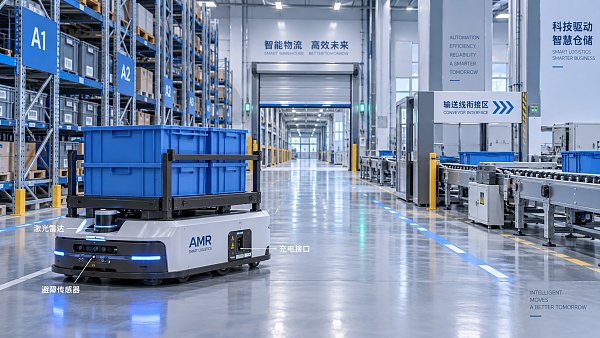
Shenzhen Industrial AGV Exports Up 67%; EN ISO 12100:2026 Transition Ends Dec 2026
Publication Date
author
Shenzhen’s industrial AGV exports rose 67% year-on-year in Q1 2026, primarily to Germany, Poland, and Turkey; concurrently, the EU’s updated machinery safety standard EN ISO 12100:2026 enters full force on 9 May 2026, with a transition deadline of 31 December 2026 — a development directly affecting compliance pathways and certification timelines for Chinese AGV/AMR manufacturers exporting to the EU.
Event Overview
On 9 May 2026, the European Union formally implemented EN ISO 12100:2026, the revised harmonized standard for machinery safety. Under this standard, all collaborative AGVs and autonomous mobile robots (AMRs) placed on the EU market must complete formal risk assessment and functional safety validation meeting at least Performance Level d (PLd). The transition period — during which the previous version (EN ISO 12100:2010) remains acceptable — expires on 31 December 2026. Separately, Shenzhen-based robot manufacturers reported a 67% year-on-year increase in industrial AGV exports in Q1 2026, with Germany, Poland, and Turkey identified as the top destination markets.
Industries Affected
Direct Exporters (OEMs & System Integrators)
Export-oriented AGV/AMR manufacturers face immediate implications: products intended for the EU must now comply with EN ISO 12100:2026’s updated risk assessment methodology and PLd-level functional safety requirements. This affects design documentation, verification testing scope, and third-party certification timelines — particularly where legacy safety architectures lack redundancy or diagnostic coverage required for PLd.
Component Suppliers (Safety Controllers, Sensors, Drive Systems)
Suppliers providing safety-critical components — such as safety PLCs, safety-rated laser scanners, or SIL2/PLd-certified motor drives — may see increased demand for pre-validated modules. However, integration into end-systems must still undergo full system-level validation under EN ISO 12100:2026; component-level certification alone does not satisfy the standard’s holistic risk assessment requirement.
Testing & Certification Service Providers
Certification bodies accredited under EU Regulation (EU) 2016/425 and/or notified under the Machinery Regulation (EU) 2023/1230 are now required to assess conformity against EN ISO 12100:2026. Workloads for functional safety audits and technical file reviews are expected to rise significantly in late 2026, especially for applicants seeking CE marking before the transition ends.
Logistics & Distribution Partners Serving EU Markets
Distributors and importers placing AGVs/AMRs on the EU market bear legal responsibility as ‘importers’ under the new Machinery Regulation. They must verify that the manufacturer has performed the required risk assessment, compiled a compliant technical file, and affixed the CE marking with correct declaration of conformity referencing EN ISO 12100:2026 — increasing due diligence obligations ahead of customs clearance.
What Enterprises and Practitioners Should Focus On Now
Monitor official guidance from EU national authorities and Notified Bodies
The European Commission and national market surveillance authorities have not yet issued consolidated interpretative guidance on applying EN ISO 12100:2026 to mobile robots. Enterprises should track updates from key Notified Bodies (e.g., TÜV Rheinland, Dekra, SGS) and national competent authorities (e.g., Germany’s BAuA), particularly regarding accepted methodologies for dynamic risk assessment of AMRs operating in shared human-robot workspaces.
Prioritize technical file readiness for high-volume EU-bound SKUs
Rather than delaying action across entire product portfolios, exporters should identify top-selling models destined for Germany, Poland, and other EU markets with active enforcement records. For these SKUs, initiate gap analysis against EN ISO 12100:2026’s Clause 6 (risk assessment process) and Annex A (functional safety requirements), focusing on hazard identification related to navigation unpredictability, sensor blind spots, and emergency stop reliability.
Distinguish between regulatory signal and enforceable obligation
While EN ISO 12100:2026 is harmonized under the EU Machinery Regulation, its application becomes mandatory only when referenced in a Declaration of Conformity. Until 31 December 2026, use of EN ISO 12100:2010 remains permissible — but market access may be constrained if major EU customers or distributors require alignment with the newer standard ahead of the deadline.
Allocate time for certification lead times and supplier coordination
Functional safety validation for PLd typically requires 8–12 weeks for test execution and report issuance, assuming existing hardware architecture supports required diagnostics. Exporters should engage certified labs by Q3 2026 at the latest and confirm upstream suppliers’ ability to provide updated safety evidence (e.g., FMEDA reports, failure mode databases) needed for system-level evaluation.
Editorial Observation / Industry Insight
Observably, this dual development — robust export growth alongside tightening regulatory alignment — signals a maturing phase for China’s industrial mobile robotics sector. The 67% export surge reflects growing global acceptance of Shenzhen-made AGVs, while the EN ISO 12100:2026 deadline underscores that market access is increasingly contingent on systematic safety engineering, not just performance metrics. Analysis shows this is less a sudden disruption and more a formalization of expectations already emerging among leading EU integrators and end users. From an industry perspective, the transition period ending in December 2026 functions less as a hard cutoff and more as a de facto benchmark: post-deadline, non-compliant units risk detention at EU borders or rejection by major logistics providers — even if technically placed on the market before 31 December. Continued attention is warranted as enforcement patterns emerge across member states in early 2027.
This update highlights how export momentum intersects with regulatory infrastructure — a dynamic increasingly central to competitiveness in industrial automation. It is best understood not as a one-off compliance hurdle, but as an indicator of evolving global expectations for safety-by-design in autonomous material handling systems.
Source: Official EU Commission publication of harmonized standards list (OJ C 155/1, 9 May 2026); Shenzhen Municipal Bureau of Statistics, Q1 2026 Robotics Industry Export Report; CEN/CENELEC Official Journal notice on EN ISO 12100:2026.
Note: Ongoing monitoring is recommended for national enforcement practices and Notified Body interpretations, which remain subject to clarification beyond the current official record.
Search News
Hot Articles
- Carbon Fiber StructuresHow to Specify Aerospace Carbon Fiber Assemblies for Lightweight, Load-Bearing PartsJul 11, 2026
- Machine VisionXiaomi, Alibaba DAMO Academy Drive Open-Source Robotics Model Ecosystem, Lowering Algorithm Development Barriers for Overseas SMEs Adopting Chinese Robotics SolutionsMar 30, 2026
- Cobots & ArmsShanxi 'AI+' Conference Showcases Embodied Intelligence with Multinational Buyer Engagement: Key Industry ImplicationsMar 30, 2026
Popular Tags
Recommended News
 Jul 11, 2026How to Specify Aerospace Carbon Fiber Assemblies for Lightweight, Load-Bearing PartsAerospace carbon fiber assemblies: learn how to specify laminate design, load data, joining methods, and inspection controls for lighter, reliable load-bearing aerospace parts.Elena Rostova (UAV Systems Researcher)
 Mar 30, 2026Xiaomi, Alibaba DAMO Academy Drive Open-Source Robotics Model Ecosystem, Lowering Algorithm Development Barriers for Overseas SMEs Adopting Chinese Robotics SolutionsXiaomi & Alibaba DAMO Academy's open-source robotics models lower algorithm barriers for global SMEs. Boost efficiency in manufacturing, logistics & smart retail with ROS 2 compatible solutions.TSV Data Lab
 Mar 30, 2026Shanxi 'AI+' Conference Showcases Embodied Intelligence with Multinational Buyer Engagement: Key Industry ImplicationsShanxi 'AI+' Conference highlights embodied intelligence with Tesla, Ubtech & Jiantao showcasing multimodal robotics. 40+ global buyers validated tech on-site, creating new B2B channels for industrial automation & AI solutions.Chen Wei (Automation Lead Engineer)
 Mar 30, 2026Zhongguancun Unveils 6G Integrated Sensing-Computing-Intelligence Platform to Empower Embodied Robots for Global Industrial ApplicationsZhongguancun's new 6G platform revolutionizes industrial robotics with <10ms latency, empowering global automotive, logistics & port automation. Discover how this tech boosts China's smart manufacturing exports.TSV Data Lab
 Mar 30, 2026Mech-Mind Tianjin Embodied Intelligence R&D and Production Base Goes Live, Cutting Delivery Time by 20%–30% for Global Customized AMR+Vision SolutionsMech-Mind's Tianjin AMR+Vision production base cuts delivery time by 20%-30% for欧美 & Latin American markets. Discover how this PLd-certified facility accelerates customized robotics solutions for smart manufacturing and logistics.Chen Wei (Automation Lead Engineer)
 Mar 30, 2026Boao Forum Reveals 'Co-evolution of Big and Small Brains' Trend in Humanoid Robots, China's Embodied Intelligence Accelerates Adaptation to Overseas Manufacturing Service ScenariosDiscover how China's humanoid robots, featuring 'Co-evolution of Big and Small Brains,' are revolutionizing global manufacturing. Learn about Embodied Tian Gong 3.0's ISO compliance and overseas deployment at Boao Forum 2026.Chen Wei (Automation Lead Engineer)
 Mar 30, 2026China Railway Industrial Secures Patent for Embodied Robotics in Material Handling, Boosting High-Precision Delivery Capabilities for Overseas Infrastructure and Manufacturing ProjectsChina Railway Industrial's new patent for embodied robotics in material handling boosts high-precision delivery for global infrastructure & manufacturing. Discover how this innovation enhances logistics accuracy in automotive, rail transit & EPC projects.Chen Wei (Automation Lead Engineer)
 Sep 29, 2026ISO 9283 Repeatability: How to Evaluate Cobot Positioning PerformanceISO 9283 cobot repeatability explained: learn how payload, reach, approach direction, and test conditions affect positioning performance and cell capability.Chen Wei (Automation Lead Engineer)
 Sep 28, 2026Spindle Runout Measurement in Germany: DIN Standards, Methods, and Acceptance LimitsSpindle runout measurement Germany: explore DIN standards, proven methods, acceptance limits, and audit-ready practices for reliable machining quality.Dr. Marcus Vance
 Sep 27, 2026How to Select Wall-Mount Edge Devices for Space-Constrained Factory NetworksWall mount edge devices for space-constrained factories: evaluate workload, thermal design, power resilience, cable access, and network reliability for smarter deployments.TSV Data Lab
 Sep 26, 2026Machining Tolerance Analysis: How to Set Limits That Meet Function and Cost TargetsMachining tolerance analysis: learn how to set functional limits, control tolerance stacks, reduce inspection risk, and balance precision with production cost.Dr. Marcus Vance
 Sep 25, 2026How to Evaluate an Industrial Infrastructure Data Platform for Multi-Site OperationsIndustrial infrastructure data platform evaluation guide for multi-site operations: compare data quality, edge resilience, interoperability, governance, and scalable proof-of-value criteria.Victor Lin (Chief Software Architect)
 Sep 24, 2026How to Select Machine Vision Optics for Accurate Inspection at Different Working DistancesMachine vision optics selection guide for accurate inspection at every working distance. Compare FOV, pixel scale, DOF, distortion, lighting, and telecentric options.TSV Data Lab
 Sep 23, 2026How to Evaluate a Machine Vision System Integrator for High-Speed Inspection LinesChoose a machine vision system integrator with proven expertise in high-speed inspection, reliable reject timing, robust optics, and measurable acceptance criteria.TSV Data Lab
 Sep 28, 2026When is a SCADA API the right choice for connecting plant systems?SCADA API guide: learn when governed plant data integration improves traceability, security, and scalability—without compromising real-time control.Victor Lin (Chief Software Architect)
 Sep 27, 2026How SCADA data integration improves traceability across production linesSCADA data integration connects production-line data to improve traceability, accelerate quality investigations, and strengthen safety decisions.Victor Lin (Chief Software Architect)
 Sep 26, 2026What to define before starting SCADA integration planningSCADA integration planning starts with clear scope, control boundaries, data models, cybersecurity, and testing. Discover the definitions that reduce risk and costly rework.Victor Lin (Chief Software Architect)
 Sep 25, 2026How a smart factory with Industrial IoT reduces production blind spotsDiscover how a smart factory with Industrial IoT turns real-time machine, quality, and workflow data into actionable insights that reduce production blind spots and delivery risks.Victor Lin (Chief Software Architect)
 Sep 24, 2026When does Industrial IoT make smart manufacturing easier to scale?Smart manufacturing Industrial IoT scales when trusted data, interoperable systems, and secure workflows turn connected assets into measurable gains.TSV Data Lab
 Sep 23, 2026What drives ultra-precision machining cost at 1-micron tolerance?Ultra precision machining cost per part at 1 micron tolerance depends on process, material, metrology, and yield. Learn how to compare quotes confidently.Dr. Marcus Vance
 Sep 22, 2026Drone Engine-T550CC Applications: Build the UAV Power System Around the MissionAn application guide for Drone Engine-T550CC integration, covering payload planning, airframe matching, cooling, fuel, vibration, test procedures, documentation, and service preparation.Elena Rostova (UAV Systems Researcher)
 Sep 22, 2026How to Evaluate Industrial Edge Computing Vendors for Factory DeploymentIndustrial edge computing vendor evaluation guide for factories: compare latency, protocol fit, reliability, security, and lifecycle support before deployment.TSV Data Lab
 Sep 21, 2026Drone Payload Integration: Matching Power, Data, and Center of Gravity for Reliable FlightsDrone payload integration made practical: balance power, data, center of gravity, and endurance to build safer, more reliable mission-ready flights.Elena Rostova (UAV Systems Researcher)
 Sep 20, 2026Autonomous Navigation Pricing: Cost Drivers and Budget Benchmarks for AMR ProjectsAutonomous navigation price explained: compare AMR cost drivers, software, sensors, integration, safety, and lifecycle budgets to build a scalable project plan.Chen Wei (Automation Lead Engineer)