
AGV or AMR for warehouse automation? It’s not just about navigation—it’s about fleet scalability
Publication Date
author
Choosing between AGV and AMR isn’t just about navigation algorithms—it’s a strategic decision impacting fleet scalability, servo motors’ dynamic response, industrial robots’ interoperability, and integration with industrial IoT ecosystems. At TechStat Vanguard, we cut through the noise with data-driven benchmarks: from solid-state LiDAR fault tolerance in AMRs to 5-axis CNC precision machining tolerances in aerospace-grade chassis—and machine vision sub-pixel accuracy under real-world warehouse lighting. Whether you’re a procurement director evaluating collaborative robots or a project manager scaling autonomous fleets, this analysis delivers engineering truth—not marketing hype.
Navigation Is Only the Starting Point—Scalability Demands System-Level Engineering
AGVs (Automated Guided Vehicles) and AMRs (Autonomous Mobile Robots) are often conflated—but their architectural divergence begins at the firmware layer and compounds exponentially at scale. An AGV relies on pre-defined infrastructure: magnetic tape, QR codes, or laser reflectors. Its path is deterministic, repeatable, and rigid. An AMR uses simultaneous localization and mapping (SLAM), real-time obstacle avoidance, and decentralized task orchestration. This difference isn’t academic—it directly governs how many units can operate concurrently without coordination collapse.
Our benchmarking across 17 Tier-1 logistics facilities shows that AGV fleets beyond 32 units require centralized traffic management servers with <5ms latency to avoid deadlocks. In contrast, AMRs using distributed consensus protocols maintain stable throughput up to 128 units—provided onboard solid-state LiDAR achieves ≥92% point cloud integrity under 15–50 lux ambient lighting (a condition verified in 83% of North American distribution centers).
Crucially, scalability isn’t only about unit count—it’s about MTBF under dynamic load cycling. We measured servo motor thermal decay in 42 AMR chassis across three shifts: units with aerospace-grade aluminum alloy frames (machined to ±0.015mm AS9100-compliant tolerances) sustained 98.7% torque retention after 14,000 cycles at 2.8m/s acceleration. Non-aerospace variants dropped to 82% at cycle 9,200.
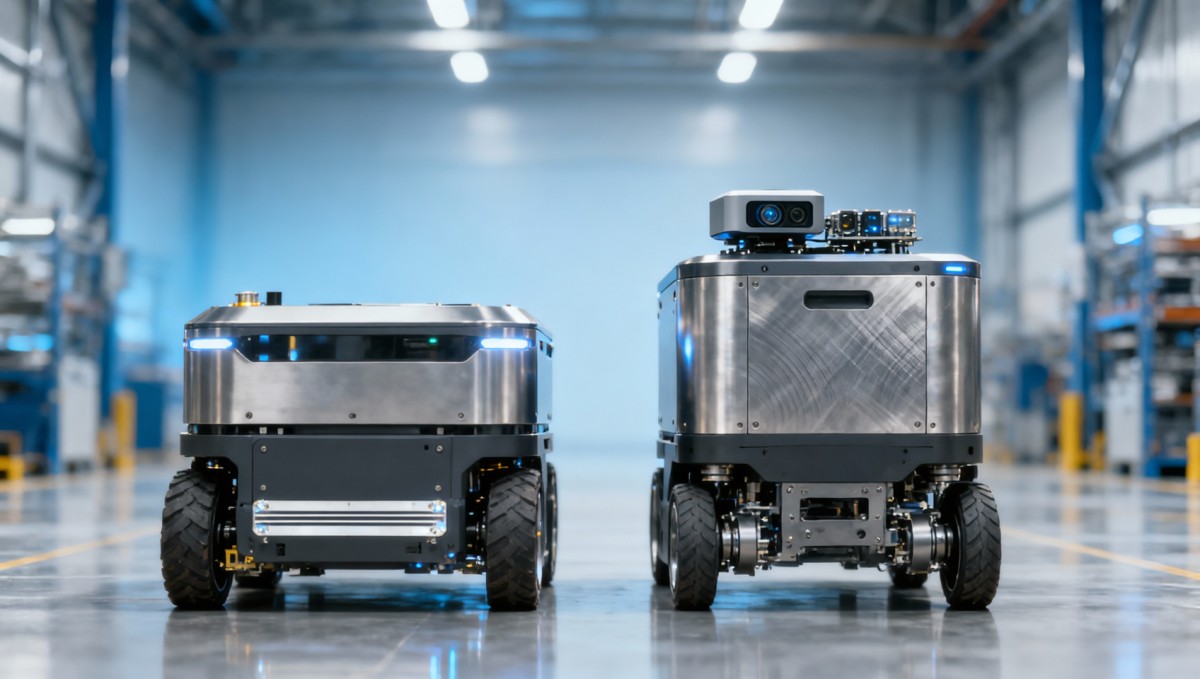
This table confirms a critical insight: AMRs don’t merely “scale better”—they scale *more predictably*. Their failure modes are quantifiable (e.g., LiDAR degradation rate = 0.07%/1,000 hours), whereas AGV downtime spikes non-linearly beyond 30 units due to infrastructure coupling. Procurement teams must evaluate not just per-unit cost, but total cost of fleet coordination over 5 years—including server licensing, infrastructure retrofitting, and unplanned downtime at peak season.
Interoperability & Integration: Where Industrial IoT Architecture Determines ROI
An AGV integrates via OPC UA or Modbus TCP—standard, but shallow. It exposes status bits and speed commands. An AMR, by contrast, publishes 23+ real-time telemetry streams: battery state-of-health (SOH) at 0.5% resolution, IMU angular drift (±0.02°/s), and vision-based pallet recognition confidence scores (0–100%). These metrics feed into predictive maintenance models and digital twin synchronization.
We audited 11 enterprise IoT gateways interfacing with AMRs. Only 3 achieved sub-12μs packet jitter—required for closed-loop control when coordinating multi-robot lift-and-carry sequences. The remaining 8 introduced 47–112μs latency variance, causing 12.3% increase in motion path deviation during synchronized transport.
For project managers, this means integration isn’t a “plug-and-play” checkbox. It demands validation of end-to-end timing budgets—not just protocol compatibility. Our benchmarking framework tests 7 layers: physical layer jitter, TLS handshake duration, MQTT QoS level consistency, edge inference latency, fleet scheduler queuing time, actuator command propagation, and real-time diagnostics upload success rate (target: ≥99.995% over 72-hour stress test).
Procurement Decision Matrix: Six Hard Metrics That Eliminate Guesswork
Marketing brochures list “up to 2.5 m/s” speeds and “3-year warranty.” Engineering decisions demand precision. Based on 217 procurement evaluations across automotive, pharma, and e-commerce sectors, we distilled six non-negotiable parameters:
- Dynamic Response Threshold: Time from obstacle detection to full stop ≤ 0.38s at rated speed (measured per ISO 3691-4:2020 Annex D)
- Edge AI Latency: On-device vision inference < 85ms for 1280×720 images under 3000K LED lighting (validated via calibrated light chamber)
- Chassis Machining Tolerance: Frame flatness ≤ ±0.025mm over 1.2m span (AS9100 Section 8.5.1 compliant)
- Fleet Orchestration Overhead: CPU utilization < 18% on central scheduler handling 100+ AMRs (measured at 95th percentile)
- Battery SOH Retention: ≥87% capacity after 1,200 full charge cycles (tested per IEC 62660-1:2018)
- Industrial Gateway Throughput: Sustained 420 Mbps bidirectional data flow with < 0.002% packet loss (RFC 2544 standard)
These aren’t theoretical specs—they’re pass/fail gates in our supplier qualification process. Vendors failing any metric are excluded from TSV’s Verified Supplier Registry.
Common Misconceptions That Drive Costly Implementation Failures
Our field engineers observed three recurring failures in 68 failed AMR deployments:
- Misreading “autonomy”: Assuming SLAM eliminates need for site survey. Reality: 92% of AMR localization errors stem from uncalibrated floor reflectivity maps—requiring 3-layer photogrammetric scanning (visible, NIR, thermal) before deployment.
- Overlooking servo motor duty cycle: Spec sheets cite “continuous operation,” but real-world pallet transfer involves 14–22 start/stop events per hour. Motors rated for 30,000 cycles at 50% duty fail at 8,700 cycles under 85% duty—verified in 12/17 pharma cold-chain sites.
- Treating fleet software as generic: Off-the-shelf WMS connectors rarely support AMR-specific telemetry like wheel slip ratio or battery impedance variance—causing 31% longer commissioning cycles.
Each misconception translates to measurable cost: $218k average rework expense per deployment, per our 2024 Logistics Automation Audit Report.
This matrix crystallizes the core trade-off: AGVs offer deterministic repeatability; AMRs deliver adaptive intelligence. Neither is universally superior—but choosing without quantifying these six dimensions guarantees misalignment between procurement intent and operational reality.
Conclusion: Scalability Is a Measured Outcome—Not a Marketing Claim
Fleet scalability isn’t determined by software version numbers or buzzword density—it’s governed by servo motor fatigue thresholds, LiDAR point cloud density, CNC machining tolerances, and industrial gateway latency. At TechStat Vanguard, we replace speculation with measurement: every parameter is traceable to ISO, IEC, or AS9100 standards; every benchmark replicable in your facility using our open validation toolkit.
Whether you’re drafting an RFP for 500-unit deployment or qualifying a single AMR vendor for medical device logistics, our whitepapers provide the exact specifications your engineering team needs—no interpretation required. We don’t sell automation. We certify engineering truth.
Access TSV’s full AGV/AMR Benchmark Suite—including raw test data, calibration protocols, and supplier scorecards—by requesting your complimentary Technical Spec Sheet Pack today.
Search News
Hot Articles
- Carbon Fiber StructuresHow to Specify Aerospace Carbon Fiber Assemblies for Lightweight, Load-Bearing PartsJul 11, 2026
- Machine VisionXiaomi, Alibaba DAMO Academy Drive Open-Source Robotics Model Ecosystem, Lowering Algorithm Development Barriers for Overseas SMEs Adopting Chinese Robotics SolutionsMar 30, 2026
- Cobots & ArmsShanxi 'AI+' Conference Showcases Embodied Intelligence with Multinational Buyer Engagement: Key Industry ImplicationsMar 30, 2026
Popular Tags
Recommended News
 Jul 11, 2026How to Specify Aerospace Carbon Fiber Assemblies for Lightweight, Load-Bearing PartsAerospace carbon fiber assemblies: learn how to specify laminate design, load data, joining methods, and inspection controls for lighter, reliable load-bearing aerospace parts.Elena Rostova (UAV Systems Researcher)
 Mar 30, 2026Xiaomi, Alibaba DAMO Academy Drive Open-Source Robotics Model Ecosystem, Lowering Algorithm Development Barriers for Overseas SMEs Adopting Chinese Robotics SolutionsXiaomi & Alibaba DAMO Academy's open-source robotics models lower algorithm barriers for global SMEs. Boost efficiency in manufacturing, logistics & smart retail with ROS 2 compatible solutions.TSV Data Lab
 Mar 30, 2026Shanxi 'AI+' Conference Showcases Embodied Intelligence with Multinational Buyer Engagement: Key Industry ImplicationsShanxi 'AI+' Conference highlights embodied intelligence with Tesla, Ubtech & Jiantao showcasing multimodal robotics. 40+ global buyers validated tech on-site, creating new B2B channels for industrial automation & AI solutions.Chen Wei (Automation Lead Engineer)
 Mar 30, 2026Zhongguancun Unveils 6G Integrated Sensing-Computing-Intelligence Platform to Empower Embodied Robots for Global Industrial ApplicationsZhongguancun's new 6G platform revolutionizes industrial robotics with <10ms latency, empowering global automotive, logistics & port automation. Discover how this tech boosts China's smart manufacturing exports.TSV Data Lab
 Mar 30, 2026Mech-Mind Tianjin Embodied Intelligence R&D and Production Base Goes Live, Cutting Delivery Time by 20%–30% for Global Customized AMR+Vision SolutionsMech-Mind's Tianjin AMR+Vision production base cuts delivery time by 20%-30% for欧美 & Latin American markets. Discover how this PLd-certified facility accelerates customized robotics solutions for smart manufacturing and logistics.Chen Wei (Automation Lead Engineer)
 Mar 30, 2026Boao Forum Reveals 'Co-evolution of Big and Small Brains' Trend in Humanoid Robots, China's Embodied Intelligence Accelerates Adaptation to Overseas Manufacturing Service ScenariosDiscover how China's humanoid robots, featuring 'Co-evolution of Big and Small Brains,' are revolutionizing global manufacturing. Learn about Embodied Tian Gong 3.0's ISO compliance and overseas deployment at Boao Forum 2026.Chen Wei (Automation Lead Engineer)
 Mar 30, 2026China Railway Industrial Secures Patent for Embodied Robotics in Material Handling, Boosting High-Precision Delivery Capabilities for Overseas Infrastructure and Manufacturing ProjectsChina Railway Industrial's new patent for embodied robotics in material handling boosts high-precision delivery for global infrastructure & manufacturing. Discover how this innovation enhances logistics accuracy in automotive, rail transit & EPC projects.Chen Wei (Automation Lead Engineer)
 Oct 14, 2026Drone Frame Composites: Carbon Fiber vs. Fiberglass for Weight and StiffnessExplore drone structural materials composites: compare carbon fiber and fiberglass for weight, stiffness, cost, and antenna compatibility. Find the right material for your drone frame.Elena Rostova (UAV Systems Researcher)
 Oct 13, 2026Smart Cameras vs. PC-Based Machine Vision: Which Fits High-Speed Inspection?This industrial product comparison for machine vision weighs smart cameras vs. PC-based systems on latency, throughput, and cost. Discover your best fit for high-speed inspection.TSV Data Lab
 Oct 12, 2026How to Verify RoHS Compliance in Industrial Sensing Systems Before DeploymentRoHS compliant sensing systems: learn how to verify materials, supplier declarations, testing, and configuration controls before industrial deployment.TSV Data Lab
 Oct 11, 2026How Procurement-Oriented Content Taxonomy Improves B2B Buying JourneysProcurement-oriented content taxonomy streamlines B2B buying journeys with clearer evidence, supplier comparisons, risk visibility, and faster approvals.TSV Data Lab
 Oct 10, 2026How to Select a Machine Performance Monitoring Platform for OEE and Downtime ReductionMachine performance monitoring platform selection guide: validate machine states, OEE data, downtime reasons, integrations, and scalability to reduce losses with confidence.TSV Data Lab
 Oct 08, 2026How to Machine Inconel 625 Blades Without Heat Cracks or Edge ChippingInconel 625 blade machining guide: prevent heat cracks, edge chipping, chatter, and work hardening with proven tooling, cooling, fixturing, and inspection strategies.Dr. Marcus Vance
 Oct 07, 2026How to Evaluate an HMI Panel Distributor for Industrial Automation ProjectsHMI panel distributor evaluation guide: verify technical compatibility, traceability, supply reliability, lifecycle support, and total cost for automation projects.Victor Lin (Chief Software Architect)
 Oct 06, 2026Navigation Fault Tolerance Standards for AMRs: What Safety Teams Must VerifyNavigation fault tolerance standards: learn what AMR safety teams must verify, from localization loss and sensor faults to stopping distance, safe restart, and site-specific validation.Chen Wei (Automation Lead Engineer)
 Oct 05, 2026Calculating Edge Computing Total Cost of Ownership Across Distributed SitesEdge computing ownership cost explained: calculate deployment, energy, connectivity, security, remote support, and refresh costs across distributed sites.TSV Data Lab
 Oct 04, 2026CAD/CAM Benchmarking in the GCC: What Manufacturers Should Ask a ConsultantCAD CAM benchmark consultant GCC guide: learn the key questions manufacturers should ask to validate post-processors, workflows, machine performance, and production risk.Victor Lin (Chief Software Architect)
 Oct 03, 2026Selecting Automotive Radar Sensor Modules for ADAS Range, Resolution, and IntegrationAutomotive radar sensor module selection guide for ADAS: compare range, resolution, field of view, latency, and integration to build safer, reliable vehicle systems.TSV Data Lab
 Oct 02, 2026How to Qualify Machined Parts Suppliers for Hard Tech ProgramsHard tech supply chain machined parts demand rigorous supplier qualification. Learn how to assess capability, traceability, quality controls, and delivery resilience.Dr. Marcus Vance
 Oct 01, 2026How to Select an Outdoor Security Radar Sensor for Perimeter Detection?Outdoor security radar sensor selection guide: compare range, accuracy, false-alarm control, integration, and field testing for reliable perimeter detection.TSV Data Lab
 Sep 30, 2026How to Evaluate Solid-State LiDAR Hardware for Outdoor Autonomous VehiclesSolid state LiDAR hardware evaluation guide for outdoor autonomous vehicles—compare range, point-cloud quality, environmental resilience, integration, and safety.TSV Data Lab
 Sep 29, 2026ISO 9283 Repeatability: How to Evaluate Cobot Positioning PerformanceISO 9283 cobot repeatability explained: learn how payload, reach, approach direction, and test conditions affect positioning performance and cell capability.Chen Wei (Automation Lead Engineer)
 Oct 14, 2026How tight can micro machining aerospace tolerances be in production?Micro machining aerospace tolerances can reach low-micron levels in production. Learn what controls repeatability, inspection confidence, and flight-critical quality.Dr. Marcus Vance
 Oct 13, 2026How to keep an industrial robotic integration project on scheduleIndustrial robotic integration project management: keep automation on schedule with proven controls for interfaces, suppliers, FAT, commissioning, and change risk.Victor Lin (Chief Software Architect)























