
AGV and AMR Fleet Software: When Dispatch Logic Breaks Down
Publication Date
author
When AGV and AMR fleet software starts making poor dispatch decisions, the problem is rarely just “traffic.” In most facilities, the real breakdown happens earlier: task priorities are misweighted, map assumptions drift from reality, charging logic becomes too rigid, and the system cannot recover gracefully from exceptions. The result is familiar to operators and managers alike—robots waiting at intersections, urgent jobs arriving late, charging queues forming at the wrong time, and expensive mobile assets spending too much of the shift idle.
For engineering teams, operators, procurement leaders, and decision-makers, the key question is not whether the robots have navigation capability. Modern AGV AMR obstacle avoidance systems and solid-state LiDAR for robotics navigation can perform well at the vehicle level. The harder question is whether the fleet layer can continuously make good system-level decisions under real plant conditions. This article explains why dispatch logic breaks down, what metrics actually reveal the root cause, and how to evaluate whether the fix is software tuning, workflow redesign, or a full fleet management platform change.
Why dispatch logic fails even when individual AGVs and AMRs are functioning correctly
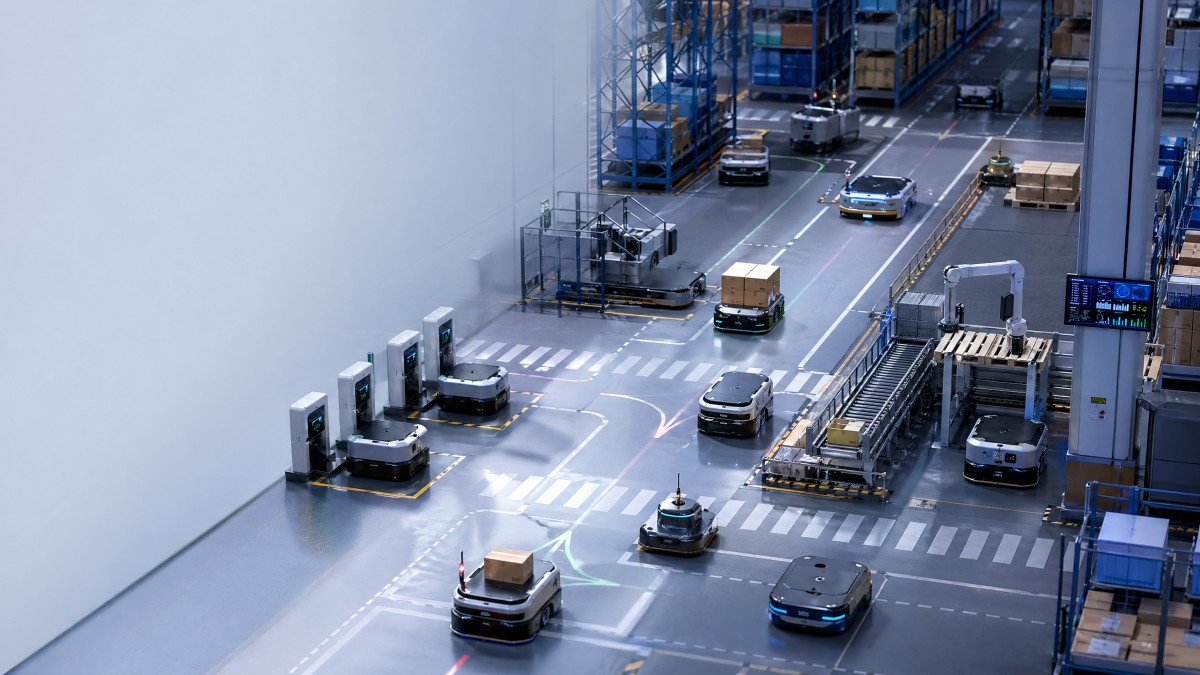
Many teams first suspect localization, sensors, or vehicle hardware when throughput drops. But in a large number of deployments, each robot is doing exactly what it was told to do. The failure sits in the orchestration layer: the fleet software is assigning the wrong task, at the wrong time, to the wrong vehicle, on the wrong route.
This is why a site can have acceptable robot navigation and still suffer poor operational performance. A vehicle may avoid obstacles perfectly yet still block a high-priority lane because the dispatch engine underestimated congestion. Another robot may reach a station on time but remain unproductive because the software did not account for downstream machine readiness or pallet availability.
In practice, dispatch breakdown usually appears in one or more of these forms:
- Priority inversion: low-value or routine moves consume vehicles while time-critical jobs wait.
- Route contention: too many robots are sent through the same corridor, elevator, docking point, or crossing.
- Battery mismanagement: vehicles are sent to charge too early, too late, or in clusters that create charging bottlenecks.
- Zone imbalance: one area has excess idle robots while another area experiences growing task queues.
- Exception paralysis: temporary obstructions, manual interventions, or workstation downtime trigger cascading rescheduling failures.
- Data lag: dispatch decisions rely on stale location, queue, or machine-state data.
The operational takeaway is simple: good robot behavior does not guarantee good fleet behavior. Fleet software must optimize globally, not just react locally.
What target readers usually need to know first: is this a software problem, a process problem, or a facility design problem?
This is the most important diagnostic question because many facilities waste months tuning parameters inside the fleet manager when the deeper issue is outside the software.
It is mainly a software problem when the site has stable workflows, reasonable aisle design, predictable demand windows, and healthy vehicles, but the fleet still produces poor task allocation, excessive empty travel, or recurring deadlocks. In these cases, dispatch rules, reservation logic, queue policies, and scheduler architecture deserve primary attention.
It is mainly a process problem when source tasks are released in bursts, workstation handoff times are inconsistent, manual operators override jobs frequently, or upstream systems publish incomplete statuses. If task generation itself is noisy, even strong fleet software will appear weak.
It is mainly a facility design problem when traffic bottlenecks are structural: single-lane chokepoints, insufficient buffer zones, poorly placed charging stations, mixed pedestrian-robot interference, or too few passing opportunities. No dispatch logic can fully compensate for a map that embeds unavoidable conflict.
For buyers and enterprise decision-makers, this distinction matters because it changes the investment path:
- Software problem: optimize fleet algorithms, integrations, and rules.
- Process problem: redesign release logic, workstation sequencing, and exception handling.
- Facility problem: modify layout, charging placement, crossing policy, or lane structure.
If these categories are not separated early, organizations often buy more robots when the real shortage is scheduling quality. That is one of the most expensive mistakes in mobile automation.
The hidden reasons AGV and AMR fleet management software breaks down under scale
Fleet logic often looks acceptable during pilot deployment and then degrades sharply during expansion. That is because scaling does not increase complexity linearly. It multiplies interactions.
Common root causes include:
1. Static rule sets in dynamic environments
Many dispatch engines rely on fixed assumptions about travel time, station dwell time, and job urgency. Real plants are not static. Shift changes, forklift interference, manual replenishment delays, and machine micro-stoppages alter optimal dispatch conditions throughout the day. If the logic cannot adapt, performance drifts.
2. Weak integration with MES, WMS, ERP, or line-control systems
If task creation and equipment status signals are delayed or incomplete, the fleet manager is effectively dispatching in partial darkness. A robot may be sent to pick material that is not ready, or a replenishment task may remain low priority even though a line is minutes away from starvation.
3. Poor traffic reservation and deadlock recovery logic
Some systems perform adequately in open layouts but struggle in constrained environments with shared lanes, elevators, doors, and intersections. Without strong reservation logic and fast conflict recovery, local congestion becomes system-wide delay.
4. Battery policy that ignores operational context
A simplistic threshold-based charging rule may send multiple robots to charge at once or remove key vehicles from busy zones at the wrong moment. Battery strategy should consider task urgency, queue depth, charger occupancy, and distance-to-next-critical-job.
5. KPI design that rewards the wrong behavior
If the team focuses only on robot utilization, the software may keep vehicles moving while increasing empty travel and reducing throughput quality. A busy fleet is not always an efficient fleet.
6. Overfitted pilot tuning
Pilot deployments are often tuned around one route family, one product mix, or one shift pattern. Once the system expands across more stations, more SKUs, or more exception types, the logic no longer generalizes.
Which metrics actually reveal dispatch logic quality
Teams that rely only on on-time delivery rate or robot uptime usually miss the deeper pattern. To understand whether fleet software is healthy, measure the system as a decision engine.
The most useful metrics include:
- Task assignment latency: time between task creation and vehicle commitment.
- Pickup delay by priority class: whether urgent tasks are truly receiving faster service.
- Empty travel ratio: percentage of vehicle movement without value-adding payload.
- Queue aging distribution: how long tasks remain unserved and whether tail delays are growing.
- Intersection dwell time: how long robots wait at crossings, doors, elevators, or merge points.
- Deadlock frequency and recovery time: a direct indicator of route coordination quality.
- Charge trip timing: whether vehicles leave production zones at operationally damaging moments.
- Zone service imbalance: over- and under-served areas across the facility.
- Exception resolution rate: how quickly the system recovers from blocked paths, canceled jobs, or workstation faults.
- Throughput per robot-hour: more useful than raw utilization for judging economic value.
For data-driven organizations, these metrics should be segmented by shift, zone, workflow, robot type, and task class. Average values alone are often misleading. A fleet may look stable on daily averages while suffering severe dispatch collapse in two predictable demand windows.
How engineers and operators can troubleshoot dispatch breakdown step by step
For site teams responsible for daily performance, troubleshooting should be structured. Random parameter changes tend to create temporary improvements while introducing new instability elsewhere.
Start with the symptom pattern, not the software menu
Ask where the failure appears first:
- Only during peaks?
- Only in one zone?
- Only when chargers are busy?
- Only when manual traffic increases?
- Only for one task type or one robot class?
Pattern-first diagnosis reduces guesswork.
Separate vehicle navigation problems from fleet allocation problems
If individual robots are localizing well and avoiding obstacles correctly, do not start with sensor replacement. Review task assignment logs, route reservations, and queue states first. A system-level error often masquerades as a vehicle-level issue.
Audit data freshness across connected systems
Compare timestamps between WMS/MES task generation, fleet ingestion, vehicle acknowledgment, and station completion. A few seconds of lag may be acceptable in low-density environments but harmful in tightly sequenced production flows.
Recreate high-congestion windows
Use historical logs to identify when queue aging, route contention, or charging conflicts spike. Replaying these windows often reveals whether the logic is making poor choices or simply reacting to impossible workload conditions.
Test charging rules as part of dispatch, not as a separate utility
Charging is often treated as background logic. It should be modeled as an integrated dispatch decision because it directly affects vehicle availability and congestion.
Review exception policy design
Temporary blockages, canceled orders, incomplete pickups, and inaccessible drop zones should not create long-lived scheduler confusion. If they do, the fleet software likely lacks resilient fallback logic.
What procurement teams and decision-makers should ask vendors before buying or replacing fleet software
If you are evaluating an AGV or AMR fleet platform, the right questions are less about interface polish and more about operational truth under stress.
Ask vendors to provide clear answers to these points:
- How does the dispatch engine prioritize urgent versus routine tasks? Request rule transparency, not vague claims about AI optimization.
- How is traffic managed in constrained spaces? Ask about path reservation, rerouting logic, and deadlock recovery time.
- How does the software behave when upstream data is delayed or incorrect? Robustness matters as much as speed.
- Can the system optimize mixed fleets? Many sites use different payload classes, speeds, and navigation profiles.
- How is battery charging orchestrated against workload and zone demand?
- What operational metrics are exposed natively? If meaningful diagnostics are hidden, troubleshooting will remain vendor-dependent.
- How does the software scale with task volume and map complexity? Request references from comparable environments.
- What simulation or digital twin capability exists before go-live changes?
- How are software updates validated for dispatch performance, not just system stability?
For enterprise leaders, the economic lens is straightforward: the wrong fleet software can force over-purchase of robots, increase buffer inventory, raise line-side risk, and lengthen supplier qualification cycles. The right software reduces not just robot downtime, but decision inefficiency.
When tuning is enough—and when the fleet management platform is the limiting factor
Not every dispatch problem requires software replacement. In many facilities, performance can improve substantially through reconfiguration, integration cleanup, map refinement, and workflow changes.
Tuning is usually enough when:
- Core KPIs are close to target but unstable during specific windows.
- Task priority rules are poorly configured.
- Charge thresholds are simplistic.
- Station state signals are incomplete or delayed.
- Congestion is concentrated in a few solvable locations.
The platform may be the constraint when:
- The software lacks transparent dispatch logic.
- Deadlock handling remains poor despite layout and rule optimization.
- Mixed-fleet support is weak or fragmented.
- Critical KPIs cannot be extracted reliably.
- Scaling from pilot to plant-wide deployment consistently degrades performance.
- Vendor support depends on manual intervention for recurring exceptions.
A practical decision rule is this: if the site has already normalized workflows, validated map design, improved integrations, and tuned operating policies—but throughput per robot-hour remains disappointing—the fleet platform itself deserves scrutiny.
How to restore reliable fleet performance with a data-first approach
Organizations that recover fleet performance fastest typically do three things well: they instrument the right metrics, isolate root causes without blame shifting, and test changes in a controlled way.
A strong recovery sequence looks like this:
- Establish baseline truth with task, traffic, and charging metrics by shift and zone.
- Classify failures into dispatch, workflow, layout, integration, and vehicle-level categories.
- Fix data quality first so the scheduler is not operating on stale or incomplete signals.
- Rework priority logic to reflect actual business criticality, not generic first-in-first-out behavior.
- Optimize chokepoints through route policy, buffers, and facility changes where needed.
- Integrate charging into fleet strategy rather than treating it as a simple threshold event.
- Replay and simulate peak conditions before broad rollout of rule changes.
- Review economics using throughput, labor impact, line risk reduction, and avoided robot purchases.
This approach aligns with how advanced manufacturing teams should evaluate automation systems: not by marketing claims, but by measurable decision quality under real operating stress.
Conclusion: the real issue is not whether the robots can move, but whether the fleet can think
When AGV and AMR fleet management software breaks down, the visible symptoms are congestion, delays, and underused assets. But the deeper issue is usually flawed orchestration logic, weak system integration, or operational assumptions that no longer match reality. Even excellent AGV AMR obstacle avoidance systems and high-performance solid-state LiDAR for robotics navigation cannot compensate for poor fleet-level decisions.
For operators and engineers, the priority is disciplined diagnosis through task, traffic, and charging data. For procurement teams, the priority is evaluating dispatch transparency, resilience, and scalability before purchase. For decision-makers, the central business question is whether the fleet software improves throughput and reliability enough to reduce hidden automation costs.
In short, if dispatch logic is failing, do not just ask whether the robots are advanced. Ask whether the system is making correct decisions, at the correct time, with correct data. That is the standard that determines whether a mobile robot fleet delivers real industrial value.
Search News
Hot Articles
- Carbon Fiber StructuresHow to Specify Aerospace Carbon Fiber Assemblies for Lightweight, Load-Bearing PartsJul 11, 2026
- Machine VisionXiaomi, Alibaba DAMO Academy Drive Open-Source Robotics Model Ecosystem, Lowering Algorithm Development Barriers for Overseas SMEs Adopting Chinese Robotics SolutionsMar 30, 2026
- Cobots & ArmsShanxi 'AI+' Conference Showcases Embodied Intelligence with Multinational Buyer Engagement: Key Industry ImplicationsMar 30, 2026
Popular Tags
Recommended News
 Jul 11, 2026How to Specify Aerospace Carbon Fiber Assemblies for Lightweight, Load-Bearing PartsAerospace carbon fiber assemblies: learn how to specify laminate design, load data, joining methods, and inspection controls for lighter, reliable load-bearing aerospace parts.Elena Rostova (UAV Systems Researcher)
 Mar 30, 2026Xiaomi, Alibaba DAMO Academy Drive Open-Source Robotics Model Ecosystem, Lowering Algorithm Development Barriers for Overseas SMEs Adopting Chinese Robotics SolutionsXiaomi & Alibaba DAMO Academy's open-source robotics models lower algorithm barriers for global SMEs. Boost efficiency in manufacturing, logistics & smart retail with ROS 2 compatible solutions.TSV Data Lab
 Mar 30, 2026Shanxi 'AI+' Conference Showcases Embodied Intelligence with Multinational Buyer Engagement: Key Industry ImplicationsShanxi 'AI+' Conference highlights embodied intelligence with Tesla, Ubtech & Jiantao showcasing multimodal robotics. 40+ global buyers validated tech on-site, creating new B2B channels for industrial automation & AI solutions.Chen Wei (Automation Lead Engineer)
 Mar 30, 2026Zhongguancun Unveils 6G Integrated Sensing-Computing-Intelligence Platform to Empower Embodied Robots for Global Industrial ApplicationsZhongguancun's new 6G platform revolutionizes industrial robotics with <10ms latency, empowering global automotive, logistics & port automation. Discover how this tech boosts China's smart manufacturing exports.TSV Data Lab
 Mar 30, 2026Mech-Mind Tianjin Embodied Intelligence R&D and Production Base Goes Live, Cutting Delivery Time by 20%–30% for Global Customized AMR+Vision SolutionsMech-Mind's Tianjin AMR+Vision production base cuts delivery time by 20%-30% for欧美 & Latin American markets. Discover how this PLd-certified facility accelerates customized robotics solutions for smart manufacturing and logistics.Chen Wei (Automation Lead Engineer)
 Mar 30, 2026Boao Forum Reveals 'Co-evolution of Big and Small Brains' Trend in Humanoid Robots, China's Embodied Intelligence Accelerates Adaptation to Overseas Manufacturing Service ScenariosDiscover how China's humanoid robots, featuring 'Co-evolution of Big and Small Brains,' are revolutionizing global manufacturing. Learn about Embodied Tian Gong 3.0's ISO compliance and overseas deployment at Boao Forum 2026.Chen Wei (Automation Lead Engineer)
 Mar 30, 2026China Railway Industrial Secures Patent for Embodied Robotics in Material Handling, Boosting High-Precision Delivery Capabilities for Overseas Infrastructure and Manufacturing ProjectsChina Railway Industrial's new patent for embodied robotics in material handling boosts high-precision delivery for global infrastructure & manufacturing. Discover how this innovation enhances logistics accuracy in automotive, rail transit & EPC projects.Chen Wei (Automation Lead Engineer)
 Oct 25, 2026Hesai Leads Global ADAS Main Lidar Shipments in Yole’s 2026 ReportHesai led global ADAS main lidar shipments with a 43% share in 2025, according to Yole’s 2026 report. Explore what this ranking reveals about its automotive market position.TSV Data Lab
 Oct 25, 2026Choosing an Aerospace Materials Manufacturer: Quality and Traceability ChecksChoosing an aerospace materials manufacturer? Learn how to verify certifications, test reports, and lot traceability to qualify suppliers confidently and reduce costly sourcing risks.Dr. Marcus Vance
 Oct 24, 2026Guotai Haitong: Global Entry-Level 3D Printer Shipments Rose 39% in Q1 2026Entry-level 3D printer shipments rose 39% in Q1 2026, Guotai Haitong reports. Explore how AI, multicolor printing and print farms are shaping market growth.Dr. Marcus Vance
 Oct 24, 2026Choosing an Industrial Vision Inspection Supplier: Acceptance Tests That MatterChoose an industrial vision inspection supplier with confidence. Discover acceptance tests for defect detection, false rejects, production speed, and reliable part rejection before you buy.TSV Data Lab
 Oct 23, 2026US Navy Raises Gecko Robotics Contract Ceiling to $300M for Robotic Fleet MaintenanceUS Navy raises Gecko Robotics’ contract ceiling to $300M for Pacific Fleet robotic inspections. Explore potential opportunities for maintenance suppliers and key procurement considerations.Chen Wei (Automation Lead Engineer)
 Oct 23, 2026Choosing Industrial Sensing Systems for Global Plants: Protocol CompatibilityCompare industrial sensing systems international buyers can trust. Explore protocol compatibility, reduce integration risks, and select proven configurations for reliable global plant deployments.TSV Data Lab
 Oct 22, 2026KUKA Showcases Physical AI and iiQKA.AI Vision at NVIDIA GTC BerlinExplore KUKA’s Physical AI showcase at NVIDIA GTC Berlin and discover how iiQKA.AI Vision aims to simplify robotic vision integration and improve 2D and 3D scene recognition.TSV Data Lab
 Oct 22, 2026Robotic Machining of Advanced Composites: What Tolerances Are Achievable?Explore advanced materials machining robotics: discover what drives achievable composite tolerances and how to validate accuracy before investing in your next machining system.Dr. Marcus Vance
 Oct 21, 2026China’s Industrial Robot Exports Near RMB 10 Billion in First Nine Months of 2026China’s industrial robot exports neared RMB 10 billion in January–September 2026, with value rising faster than volume. Explore the data and what it could mean for suppliers.Chen Wei (Automation Lead Engineer)
 Oct 21, 2026Low-Latency Industrial Data Processing: Pricing and Key Cost DriversExplore industrial data latency price drivers, from edge hardware to integration and support. Learn how to compare quotes, verify performance, and avoid unnecessary costs.TSV Data Lab
 Oct 20, 2026KUKA Launches iiQKA.AI Vision to Simplify Industrial Image ProcessingKUKA iiQKA.AI Vision simplifies industrial image processing with controller-based 2D and 3D vision. Explore drag-and-drop setup for vision-guided automation.TSV Data Lab
 Oct 20, 2026Smart Industrial Edge Devices: Key Criteria for Legacy PLC IntegrationChoose smart industrial edge devices for legacy PLC integration. Discover key criteria for compatibility, data quality, security, and reliable collection without disrupting control.TSV Data Lab
 Oct 19, 2026Choosing a Radar Sensor by Application: Range, Resolution, and Field of ViewSimplify radar sensor application based product selection. Compare range, resolution, and field of view to avoid blind spots and choose with confidence. Explore the guide.TSV Data Lab
 Oct 18, 2026Comparing Material Options for Procurement: Specs, Costs, and Supply RisksExplore procurement oriented technical content on material options, specs, costs, and supply risks. Compare alternatives to cut hidden expenses and make confident sourcing decisions.Dr. Marcus Vance
 Oct 17, 20265-Axis CNC Positioning Accuracy: How to Interpret ISO 230-2 Test ResultsAssess 5 axis CNC machining positioning accuracy with ISO 230-2. Learn to interpret repeatability, reversal error, and test conditions to compare suppliers and make confident acceptance decisions.Dr. Marcus Vance
 Oct 16, 2026Choosing a Rugged Edge AI Box Supplier: Thermal Tests and Lifecycle SupportChoose a rugged edge AI box supplier with proven thermal performance and reliable lifecycle support. Discover the tests and commitments to verify before you buy.TSV Data Lab
 Oct 15, 2026R&D Cost Reduction Services: How to Evaluate Fees, Savings, and ROIEvaluate R&D cost reduction services with confidence. Compare fees, verify savings, and calculate ROI without compromising performance. Discover how to choose a provider that delivers real value.Chen Wei (Automation Lead Engineer)























