Titanium CNC machining supplier selection gets harder with tight tolerances
Publication Date
author
As titanium CNC machining supplier selection grows tougher under tight tolerances, engineers and buyers can no longer rely on generic claims. From custom inconel parts manufacturer capabilities to iso13485 medical machining factory compliance and 5 axis cnc machining aerospace china benchmarks, every sourcing decision now depends on verified data, process stability, and measurable precision.
For R&D teams, operators, procurement managers, and executive decision-makers, the challenge is no longer finding a shop that can machine titanium. The real issue is identifying a supplier that can repeatedly hold tight tolerances across batches, geometries, and inspection cycles without driving lead time, scrap, and qualification costs out of control.
That shift matters because titanium parts are increasingly used in aerospace structures, UAV components, medical devices, energy systems, and high-load automation assemblies. In these applications, a dimensional drift of ±0.01 mm versus ±0.05 mm can change assembly fit, fatigue life, sealing performance, or downstream process yield.
At TechStat Vanguard, the sourcing lens is simple: strip away vague marketing language and focus on measurable engineering truth. When supplier selection gets harder, the answer is not more claims. It is better process evidence, clearer benchmarks, and more disciplined qualification criteria.
Why tight-tolerance titanium machining changes the supplier screening process
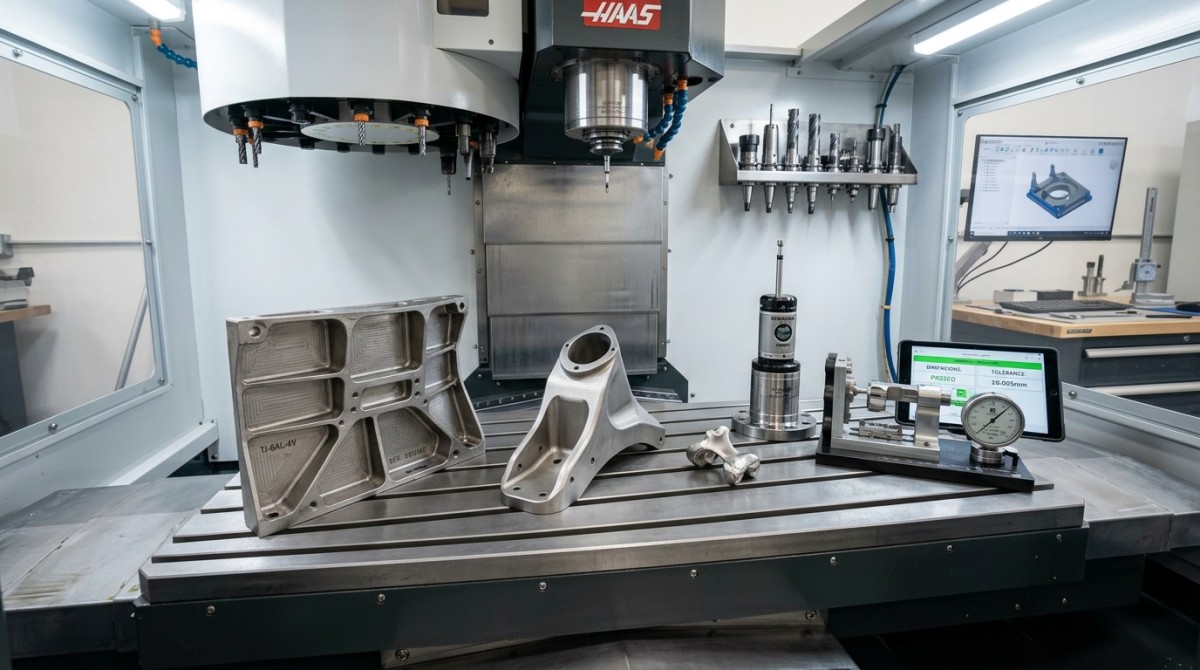
Titanium is not difficult only because it is strong. It is difficult because its low thermal conductivity, work-hardening behavior, and tool-load sensitivity amplify every weakness in a CNC process. A supplier that performs well on aluminum at ±0.05 mm may struggle when titanium parts require ±0.01 mm, flatness under 0.02 mm, or true position within 0.03 mm.
This is where many sourcing errors begin. Buyers often compare quotations based on unit price, quoted lead time, and a generic machine list. Yet for tight-tolerance titanium CNC machining, process variables such as spindle stability, fixturing rigidity, coolant strategy, in-process probing, and inspection repeatability directly influence actual delivery capability.
The difficulty increases further when parts combine deep pockets, thin walls, complex contours, and strict surface integrity requirements. A 5-axis setup may reduce repositioning errors, but it does not automatically guarantee stable results. What matters is whether the supplier can hold the tolerance window across 10, 50, or 500 pieces without excessive offset correction or rework.
In practical procurement terms, tight-tolerance projects should be treated as risk-managed engineering programs rather than commodity purchases. This is especially true when the same vendor is expected to support prototype runs in 7–15 days, pilot batches in 2–4 weeks, and validated production after first article approval.
What makes titanium sourcing more complex than standard CNC outsourcing
- Tool wear progresses faster, especially on high-strength grades and complex features.
- Heat concentration raises the risk of dimensional drift and compromised surface finish.
- Thin-wall parts can distort during clamping, roughing, or final finishing.
- Inspection strategy becomes as important as cutting strategy when tolerances drop below 0.02 mm.
The hidden cost of choosing on price alone
A quote that is 8% lower can become far more expensive if the supplier lacks process capability data, requires repeated engineering clarifications, or fails first article inspection. In high-value sectors, one failed batch can add 2–6 weeks to a launch schedule and trigger additional test, audit, and logistics costs that exceed the initial savings.
The technical checkpoints buyers should verify before approving a titanium CNC supplier
A reliable sourcing decision starts with a structured checklist. Instead of asking whether a supplier is “high quality,” ask whether it can demonstrate capability in specific process bands: tolerance control, material traceability, machine access, inspection depth, and corrective action speed. These are the variables that determine whether titanium machining performance is repeatable rather than accidental.
For teams comparing an aerospace-oriented vendor, an iso13485 medical machining factory, and a custom inconel parts manufacturer that also offers titanium work, cross-sector capability should not be assumed. Material familiarity helps, but certification scope, documentation discipline, and validation routines vary significantly by end-use market.
The table below outlines practical screening factors that engineering and procurement teams can use during RFQ review, supplier audit, and trial-order evaluation.
The main takeaway is that supplier approval should be evidence-based. If a shop cannot clearly explain how it controls thermal drift, tool life, fixture repeatability, and CMM verification, then tight-tolerance titanium work remains a sourcing gamble no matter how attractive the quotation looks.
Teams should also ask for one or two reference part categories rather than generic brochures. A titanium bracket with 3-axis milling is not a valid benchmark for a thin-wall impeller, orthopedic component, or aerospace housing requiring multi-axis positional control and controlled edge conditions.
Four qualification questions that reveal real capability
- What tolerance range is held on critical dimensions during regular production, not only on a single sample?
- Which inspection devices are used for first article, in-process checks, and final release?
- How does the supplier control deformation on thin walls below 1.5 mm or long unsupported features?
- What is the escalation path if Cpk trends down or a nonconformance appears during batch machining?
How certification, sector focus, and 5-axis capability affect supplier fit
Not every titanium CNC supplier serves the same risk profile. Aerospace, medical, robotics, and industrial equipment programs each prioritize different combinations of tolerance, validation, documentation, and change control. That is why 5 axis cnc machining aerospace china sourcing decisions should not be evaluated by machine count alone, and why an iso13485 medical machining factory may be a stronger fit for regulated surgical components than for non-critical industrial frames.
Aerospace-oriented suppliers typically emphasize first article documentation, material traceability, process route discipline, and feature integrity on complex geometries. Medical-focused suppliers often add stronger cleanliness controls, device-oriented recordkeeping, and tighter procedural consistency. A custom inconel parts manufacturer may bring expertise in heat-resistant alloys and difficult materials, but buyers should still verify titanium-specific process windows rather than assuming transferability.
The table below compares common supplier profiles seen in hard-tech procurement. It is not a ranking tool, but a fit-assessment framework for matching part risk with supplier capability.
A useful rule is to align supplier type with failure consequence. If part failure can affect flight safety, device reliability, or mission uptime, the qualification bar should rise accordingly. In those cases, documentation maturity and change-control discipline matter as much as spindle capability.
For procurement teams operating across regions, supplier location should also be evaluated through the lens of communication speed, engineering review quality, and sample-to-production transfer efficiency. A supplier that responds within 24 hours and returns DFM comments in 2 business days can materially shorten the qualification cycle.
Three fit criteria executives should review before vendor nomination
- Does the supplier’s certification scope match the commercial and regulatory risk of the part?
- Can engineering and quality teams communicate using measurable acceptance criteria rather than sales language?
- Is the vendor structured for prototype, pilot, and repeat production, or only for one of the three stages?
A practical sourcing workflow for reducing qualification risk and delivery surprises
The most effective way to select a titanium CNC machining supplier is to use a staged qualification model. This reduces surprises and allows engineering, quality, operations, and procurement to verify different risk points before the full purchase order is released. For most hard-tech organizations, a 4-step workflow is more reliable than jumping directly from RFQ to mass production.
Stage 1 is drawing and specification review. At this point, the supplier should comment on tolerance feasibility, datum strategy, surface finish targets such as Ra 0.8–1.6 µm, and any likely distortion zones. Stage 2 is sample or prototype machining, often in quantities of 1–10 pieces. Stage 3 is first article and batch validation, typically 10–50 pieces. Stage 4 is controlled production ramp with KPI tracking on yield, rework, and on-time delivery.
This process also gives operators and production teams a clearer path for process transfer. If setup sheets, tool offsets, fixture references, and inspection records are standardized early, production stability improves. If those records are weak, the same part may perform differently across shifts or repeat orders.
Below is a practical qualification workflow that many engineering-led sourcing teams can adapt without overcomplicating procurement.
Recommended 4-step qualification model
- Technical RFQ review: confirm tolerances, critical features, material grade, inspection method, and revision status.
- Trial build: machine a limited lot, usually 1–10 parts, to evaluate process realism versus quotation claims.
- FAI and process audit: verify dimensions, documentation flow, nonconformance response, and repeatability controls.
- Controlled release: ramp volume gradually, for example 20, 50, then 100 pieces, while monitoring scrap and delivery metrics.
Common mistakes during implementation
One common mistake is approving a supplier based on a single successful sample. Another is treating inspection reports as a final answer without reviewing how the process was controlled to achieve them. The third is failing to distinguish cosmetic dimensions from function-critical features, which causes unnecessary cost on some areas and insufficient control on others.
A better approach is to classify dimensions into at least 3 levels: critical-to-function, critical-to-assembly, and general tolerance. This helps both parties prioritize machine time, probing frequency, and final inspection effort where it matters most.
What buyers, engineers, and operators should ask during RFQ, audit, and ongoing supply reviews
Different stakeholders evaluate the same supplier from different angles. Engineers focus on geometry, tolerance chains, and manufacturability. Operators care about setup logic, handling consistency, and rework burden. Procurement teams compare cost, lead time, and communication efficiency. Executives look at risk concentration, scalability, and strategic reliability. A strong supplier must satisfy all four viewpoints.
For RFQ review, buyers should request more than a price and lead time. They should also ask for assumed datum strategy, critical feature control method, sample lot size, and inspection deliverables. During an audit, engineering teams should review how the shop handles tool replacement intervals, in-process verification frequency, and revision-controlled work instructions.
For ongoing supply management, teams should track a compact set of KPIs every month or quarter. Even 5 indicators can expose issues early: on-time delivery, first-pass yield, NCR rate, response time to technical queries, and dimensional stability on critical features. A supplier with 95% on-time delivery but unstable first-pass yield may still be a hidden risk for sensitive titanium parts.
The final objective is not just to buy titanium parts. It is to build a sourcing channel where engineering truth remains visible from quotation to shipment. That principle is central to TechStat Vanguard’s broader view of precision machining benchmarks: tolerances are operational facts, not marketing slogans.
FAQ: practical questions from real sourcing teams
How long does qualification usually take for a new titanium CNC supplier?
For a straightforward industrial component, initial qualification may take 2–4 weeks. For aerospace or medical parts requiring FAI, traceability review, and multiple approvals, 4–8 weeks is more realistic. Lead time depends on drawing maturity, material availability, and how quickly both parties close technical questions.
What tolerance level should trigger deeper supplier vetting?
As a practical threshold, any titanium part with repeated features at ±0.02 mm or tighter should trigger a deeper process review. The same applies to thin walls under 1.5 mm, true position requirements under 0.03 mm, and parts where surface damage or burrs can affect sealing, motion, or fatigue behavior.
Is 5-axis machining always necessary for titanium parts?
No. Many titanium parts can be produced on 3-axis or 4-axis platforms. However, 5-axis machining becomes valuable when it reduces re-clamping, improves tool access, controls angular features, or protects part accuracy on complex surfaces. The right question is not “Do you have 5-axis?” but “How does your process plan reduce error accumulation?”
What is the best way to compare two similar suppliers?
Use a weighted scorecard. Compare at least 6 factors: tolerance capability, inspection depth, documentation quality, communication speed, pilot-lot stability, and corrective action discipline. If the part is regulated or safety-related, give more weight to traceability and process control than to headline unit price.
Titanium CNC machining supplier selection becomes harder under tight tolerances because the difference between an acceptable vendor and a dependable one is rarely visible in a brochure. Buyers need proof of process control, sector-fit discipline, and measurable repeatability across prototype, pilot, and production stages.
For organizations sourcing complex titanium components, the most effective strategy is to qualify with data, compare with structured criteria, and align supplier type with application risk. If you need a clearer benchmark framework for evaluating machining partners, reducing supplier qualification cycles, or translating engineering requirements into sourcing decisions, contact TechStat Vanguard to get a data-driven assessment and explore more precision manufacturing solutions.
Search News
Hot Articles
- Carbon Fiber StructuresHow to Specify Aerospace Carbon Fiber Assemblies for Lightweight, Load-Bearing PartsJul 11, 2026
- Machine VisionXiaomi, Alibaba DAMO Academy Drive Open-Source Robotics Model Ecosystem, Lowering Algorithm Development Barriers for Overseas SMEs Adopting Chinese Robotics SolutionsMar 30, 2026
- Cobots & ArmsShanxi 'AI+' Conference Showcases Embodied Intelligence with Multinational Buyer Engagement: Key Industry ImplicationsMar 30, 2026
Popular Tags
Recommended News
 Jul 11, 2026How to Specify Aerospace Carbon Fiber Assemblies for Lightweight, Load-Bearing PartsAerospace carbon fiber assemblies: learn how to specify laminate design, load data, joining methods, and inspection controls for lighter, reliable load-bearing aerospace parts.Elena Rostova (UAV Systems Researcher)
 Mar 30, 2026Xiaomi, Alibaba DAMO Academy Drive Open-Source Robotics Model Ecosystem, Lowering Algorithm Development Barriers for Overseas SMEs Adopting Chinese Robotics SolutionsXiaomi & Alibaba DAMO Academy's open-source robotics models lower algorithm barriers for global SMEs. Boost efficiency in manufacturing, logistics & smart retail with ROS 2 compatible solutions.TSV Data Lab
 Mar 30, 2026Shanxi 'AI+' Conference Showcases Embodied Intelligence with Multinational Buyer Engagement: Key Industry ImplicationsShanxi 'AI+' Conference highlights embodied intelligence with Tesla, Ubtech & Jiantao showcasing multimodal robotics. 40+ global buyers validated tech on-site, creating new B2B channels for industrial automation & AI solutions.Chen Wei (Automation Lead Engineer)
 Mar 30, 2026Zhongguancun Unveils 6G Integrated Sensing-Computing-Intelligence Platform to Empower Embodied Robots for Global Industrial ApplicationsZhongguancun's new 6G platform revolutionizes industrial robotics with <10ms latency, empowering global automotive, logistics & port automation. Discover how this tech boosts China's smart manufacturing exports.TSV Data Lab
 Mar 30, 2026Mech-Mind Tianjin Embodied Intelligence R&D and Production Base Goes Live, Cutting Delivery Time by 20%–30% for Global Customized AMR+Vision SolutionsMech-Mind's Tianjin AMR+Vision production base cuts delivery time by 20%-30% for欧美 & Latin American markets. Discover how this PLd-certified facility accelerates customized robotics solutions for smart manufacturing and logistics.Chen Wei (Automation Lead Engineer)
 Mar 30, 2026Boao Forum Reveals 'Co-evolution of Big and Small Brains' Trend in Humanoid Robots, China's Embodied Intelligence Accelerates Adaptation to Overseas Manufacturing Service ScenariosDiscover how China's humanoid robots, featuring 'Co-evolution of Big and Small Brains,' are revolutionizing global manufacturing. Learn about Embodied Tian Gong 3.0's ISO compliance and overseas deployment at Boao Forum 2026.Chen Wei (Automation Lead Engineer)
 Mar 30, 2026China Railway Industrial Secures Patent for Embodied Robotics in Material Handling, Boosting High-Precision Delivery Capabilities for Overseas Infrastructure and Manufacturing ProjectsChina Railway Industrial's new patent for embodied robotics in material handling boosts high-precision delivery for global infrastructure & manufacturing. Discover how this innovation enhances logistics accuracy in automotive, rail transit & EPC projects.Chen Wei (Automation Lead Engineer)
 Oct 27, 2026GXO and Agility Robotics Expand Partnership to Accelerate US Humanoid Robot DeploymentGXO and Agility Robotics plan to expand US humanoid robot deployment with Digit 4 in early 2027. Explore warehouse automation plans, service terms and future Digit 5 upgrades.Chen Wei (Automation Lead Engineer)
 Oct 27, 2026Robotic Automation Costs: Budgeting for Equipment, Integration, and MaintenancePlan your robotics automation cost with confidence. Explore equipment, integration, and maintenance expenses, compare quotes, and build a realistic budget for better ROI.Chen Wei (Automation Lead Engineer)
 Oct 26, 2026AMAXiMAL Releases Open-Source TopMod 3D v3 With Claude AIExplore AMAXiMAL’s free, open-source TopMod 3D v3 with Claude AI assistance, topology-based modeling and plywood fabrication tools that connect complex designs to physical builds.Dr. Marcus Vance
 Oct 26, 2026Choosing a SCADA System Integrator Company: PLC Compatibility and Long-Term SupportChoose a scada system integrator company with proven PLC compatibility and reliable long-term support. Discover what to test, compare, and require before investing.Victor Lin (Chief Software Architect)
 Oct 25, 2026Hesai Leads Global ADAS Main Lidar Shipments in Yole’s 2026 ReportHesai led global ADAS main lidar shipments with a 43% share in 2025, according to Yole’s 2026 report. Explore what this ranking reveals about its automotive market position.TSV Data Lab
 Oct 25, 2026Choosing an Aerospace Materials Manufacturer: Quality and Traceability ChecksChoosing an aerospace materials manufacturer? Learn how to verify certifications, test reports, and lot traceability to qualify suppliers confidently and reduce costly sourcing risks.Dr. Marcus Vance
 Oct 24, 2026Guotai Haitong: Global Entry-Level 3D Printer Shipments Rose 39% in Q1 2026Entry-level 3D printer shipments rose 39% in Q1 2026, Guotai Haitong reports. Explore how AI, multicolor printing and print farms are shaping market growth.Dr. Marcus Vance
 Oct 24, 2026Choosing an Industrial Vision Inspection Supplier: Acceptance Tests That MatterChoose an industrial vision inspection supplier with confidence. Discover acceptance tests for defect detection, false rejects, production speed, and reliable part rejection before you buy.TSV Data Lab
 Oct 23, 2026US Navy Raises Gecko Robotics Contract Ceiling to $300M for Robotic Fleet MaintenanceUS Navy raises Gecko Robotics’ contract ceiling to $300M for Pacific Fleet robotic inspections. Explore potential opportunities for maintenance suppliers and key procurement considerations.Chen Wei (Automation Lead Engineer)
 Oct 23, 2026Choosing Industrial Sensing Systems for Global Plants: Protocol CompatibilityCompare industrial sensing systems international buyers can trust. Explore protocol compatibility, reduce integration risks, and select proven configurations for reliable global plant deployments.TSV Data Lab
 Oct 22, 2026KUKA Showcases Physical AI and iiQKA.AI Vision at NVIDIA GTC BerlinExplore KUKA’s Physical AI showcase at NVIDIA GTC Berlin and discover how iiQKA.AI Vision aims to simplify robotic vision integration and improve 2D and 3D scene recognition.TSV Data Lab
 Oct 22, 2026Robotic Machining of Advanced Composites: What Tolerances Are Achievable?Explore advanced materials machining robotics: discover what drives achievable composite tolerances and how to validate accuracy before investing in your next machining system.Dr. Marcus Vance
 Oct 21, 2026China’s Industrial Robot Exports Near RMB 10 Billion in First Nine Months of 2026China’s industrial robot exports neared RMB 10 billion in January–September 2026, with value rising faster than volume. Explore the data and what it could mean for suppliers.Chen Wei (Automation Lead Engineer)
 Oct 21, 2026Low-Latency Industrial Data Processing: Pricing and Key Cost DriversExplore industrial data latency price drivers, from edge hardware to integration and support. Learn how to compare quotes, verify performance, and avoid unnecessary costs.TSV Data Lab
 Oct 20, 2026KUKA Launches iiQKA.AI Vision to Simplify Industrial Image ProcessingKUKA iiQKA.AI Vision simplifies industrial image processing with controller-based 2D and 3D vision. Explore drag-and-drop setup for vision-guided automation.TSV Data Lab
 Oct 20, 2026Smart Industrial Edge Devices: Key Criteria for Legacy PLC IntegrationChoose smart industrial edge devices for legacy PLC integration. Discover key criteria for compatibility, data quality, security, and reliable collection without disrupting control.TSV Data Lab
 Oct 19, 2026Choosing a Radar Sensor by Application: Range, Resolution, and Field of ViewSimplify radar sensor application based product selection. Compare range, resolution, and field of view to avoid blind spots and choose with confidence. Explore the guide.TSV Data Lab