ISO 13485 medical machining factory claims sound similar. What should differ?
Publication Date
author
Many suppliers market themselves as an iso13485 medical machining factory, but similar claims should never imply equal capability. For engineers, buyers, and sourcing leaders comparing a custom inconel parts manufacturer, a titanium cnc machining supplier, or 5 axis cnc machining aerospace china providers, the real differentiators are traceable tolerances, material expertise, validation rigor, and data-backed process control.
In regulated machining, the certificate on a website is only the starting point. What matters in practice is whether a factory can repeatedly hold micron-level tolerances, manage material lots across multiple revisions, document inspection results at every stage, and communicate risk before nonconformance becomes scrap, delay, or field failure. That distinction is especially important for medical components, aerospace-adjacent parts, and complex prototypes made from titanium, stainless steel, PEEK, or nickel-based alloys.
For TSV’s audience, the question is not who claims compliance most loudly. The real question is what measurable capabilities should differ when two suppliers sound the same. Below is a practical framework to separate marketing language from engineering reality and to evaluate an iso13485 medical machining factory on evidence, process discipline, and supply-chain reliability.
Why Similar ISO 13485 Claims Often Hide Very Different Factories
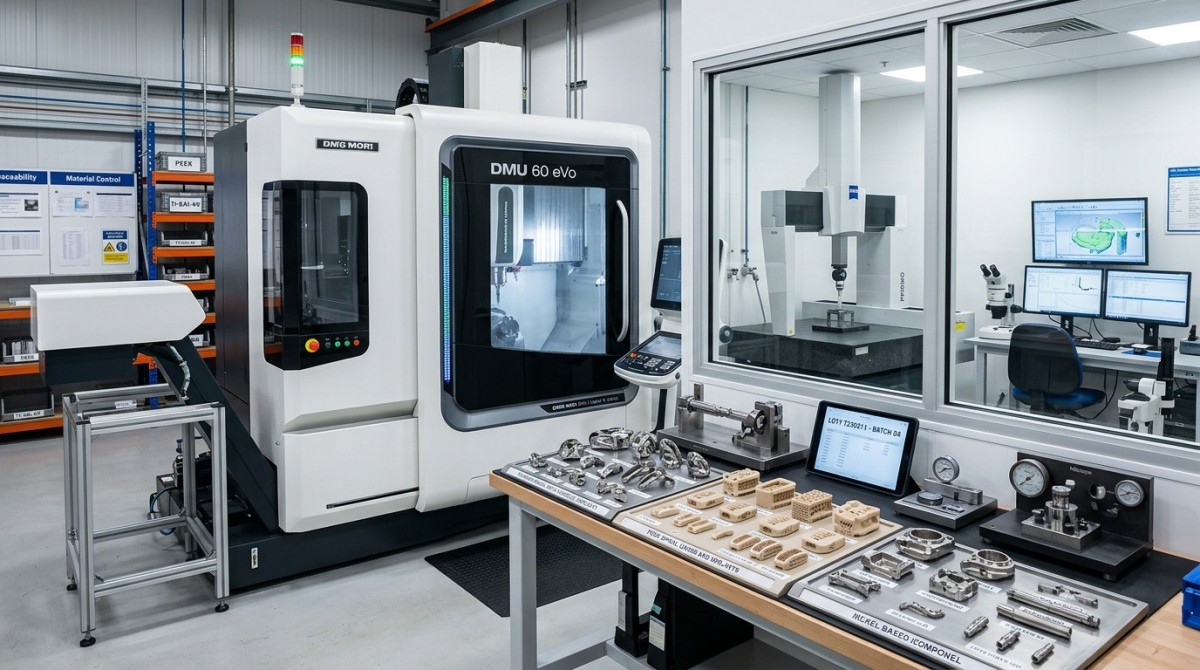
ISO 13485 is a quality management standard for medical devices and related services, but it does not automatically guarantee equal machining capability between suppliers. Two factories may both hold certification while operating with very different equipment age, process stability, inspection depth, engineering support, and change-control maturity. One may be optimized for simple turned parts in batches of 5,000 pieces, while another is built for low-volume, high-mix 5-axis milled implant instruments with revision-critical documentation.
This is where procurement teams often face information noise. A supplier may describe itself as a titanium cnc machining supplier or custom inconel parts manufacturer, yet omit the harder questions: What tolerance is held on a 120 mm feature after heat generation during roughing and finishing? What CpK target is used on critical dimensions? How often are probes, CMMs, and tool presetters calibrated? How fast can a nonconformance report be closed with corrective action?
In practice, meaningful differences show up in four areas: process validation, material control, inspection architecture, and engineering communication. A capable iso13485 medical machining factory should be able to explain not only what it machines, but how it prevents drift across 3 shifts, multiple fixtures, and repeated lots over 6 to 24 months.
Factories serving medical programs also differ in how they define “ready for production.” Some rely mainly on final inspection. Better-run operations use in-process controls, tool life limits, first article discipline, and revision-locked work instructions to reduce variation before the part reaches the CMM room. That difference affects lead time, scrap rate, and ultimately supplier trust.
Certification is a baseline, not a performance ranking
A certificate confirms a management framework, but buyers still need evidence of execution. In complex medical and aerospace-adjacent machining, execution includes fixture repeatability, thermal control, burr management, surface integrity, traceability of raw material heat numbers, and controlled handling of passivation or cleaning steps. These are not interchangeable capabilities.
What experienced buyers verify first
- Critical tolerance range actually held in production, such as ±0.005 mm to ±0.02 mm depending on geometry and material.
- Inspection sequence, including first article, in-process checks every 10 to 30 pieces, and final dimensional reporting.
- Material traceability from mill cert to finished lot, especially for titanium, 17-4 PH, 316L, PEEK, and Inconel.
- Change-control discipline for drawing revisions, tooling updates, and subcontracted finishing.
The table below highlights how similar marketing statements can conceal large operational differences.
The key takeaway is simple: the same headline claim can represent very different operational depth. Engineers and sourcing teams should score suppliers on measurable execution, not only on certification language.
What Should Differ: Tolerances, Materials, Validation, and Traceability
When comparing an iso13485 medical machining factory, buyers should expect clear differences in technical performance. The most visible one is tolerance control. A supplier for simple brackets may comfortably hold ±0.02 mm on stable geometries, while a stronger medical machining partner may repeatedly achieve ±0.005 mm to ±0.01 mm on critical mating features when supported by stable fixturing, controlled cutting parameters, and disciplined measurement strategy.
Material capability is another major separator. Titanium and Inconel are not marketing keywords; they are process challenges. Titanium often brings heat concentration, tool wear, and burr concerns. Inconel can create high cutting forces, work hardening, and longer cycle times. A custom inconel parts manufacturer with true expertise should explain spindle strategy, chip evacuation, tool-path planning, and surface integrity control rather than simply listing exotic alloys on a capability page.
Validation rigor should also differ. Medical buyers should look for first article inspection, process validation steps where appropriate, gage calibration control, and documented reaction plans when dimensions trend toward upper or lower limits. Even for prototypes, a strong supplier can define what is controlled at stage 1, what is locked at pilot stage 2, and what is validated before repeat production in stage 3.
Traceability is the fourth divider. On paper, most suppliers say they are traceable. In real operations, robust traceability means linking the purchase order, material certificate, machine route, operator record, inspection file, and any outsourced finishing step to the final lot. If a question arises 9 months later, the factory should be able to retrieve records without guesswork.
Capability signals that matter in supplier qualification
The following matrix helps buyers focus on the differences that influence yield, compliance, and total sourcing risk.
A supplier that answers these questions with process details, sample report formats, and realistic tolerance ranges is usually more mature than one relying on broad quality claims alone.
Three common misconceptions
- Certification means all product categories are equally mature. In reality, medical tooling, surgical components, housings, and implant-adjacent parts can require very different controls.
- 5-axis capability means difficult materials are automatically under control. It does not. Machine configuration, tooling library, CAM strategy, and thermal management all matter.
- Final inspection can compensate for unstable machining. It cannot. Inspection detects problems; it does not remove process variation already built into the part.
How Engineers and Buyers Should Audit a Supplier Beyond the Brochure
A practical supplier audit should be structured around evidence instead of general impressions. For engineers, the best starting point is a drawing-based technical review. Provide a part with 8 to 12 critical features, identify the top risk areas, and ask the supplier to comment on datums, fixturing, sequence, inspection access, and likely process bottlenecks. Strong suppliers will often flag concerns before quoting, which is usually a positive sign rather than a sales obstacle.
Procurement teams should also examine quoting quality. A reliable titanium cnc machining supplier or 5 axis cnc machining aerospace china partner typically provides revision confirmation, material specification alignment, finishing assumptions, inspection scope, and expected lead time bands such as 2 to 3 weeks for prototypes or 4 to 8 weeks for validated repeat orders. Vague quotations often predict later disputes.
On-site or remote audits should focus on process flow, not only cleanliness. Review how incoming material is labeled, how travelers move with parts, how nonconforming material is quarantined, and how operators know which revision is current. Ask to see calibration status, sample lot records, and an example of corrective action handling. A controlled factory can usually show these records within minutes, not days.
Communication quality is often undervalued. In regulated manufacturing, a 24-hour delay in clarifying a radius, thread standard, or deburring requirement can quickly extend lead time by 3 to 5 working days. The best suppliers combine machining skill with engineering communication discipline, especially when drawings are incomplete or application context is evolving.
A 6-point audit checklist
- Verify whether critical dimensions have process controls, not just final checks.
- Review sample documentation: material certs, inspection reports, lot linkage, and revision history.
- Assess difficult material experience with titanium, Inconel, hardened stainless, or engineering plastics.
- Confirm subcontractor control for passivation, anodizing, electropolishing, cleaning, or heat treatment.
- Check lead-time realism for prototype, pilot, and repeat production stages.
- Evaluate engineering response speed during quotation and DFM discussion within 24 to 48 hours.
Questions worth asking during technical review
Ask how the supplier manages thin-wall deflection below 1.5 mm, how it controls burrs on intersecting holes, what measurement method is used for complex freeform surfaces, and how tool wear thresholds are defined for longer runs. These questions reveal whether the shop thinks in terms of process physics or only in terms of machine availability.
If the part is for a medical device assembly, also ask about surface finish consistency, contamination prevention, and packaging discipline. A part can be dimensionally acceptable yet still create downstream assembly or cleaning issues if handling controls are weak.
Comparing Medical, Aerospace, and Specialty Alloy Machining Requirements
Many buyers compare suppliers across overlapping sectors. One factory may promote both iso13485 medical machining factory capability and 5 axis cnc machining aerospace china experience. That overlap can be useful, but only if the shop understands where requirements converge and where they diverge. Medical work emphasizes documentation, cleanliness, traceability, and change control. Aerospace-adjacent work often emphasizes structural integrity, dimensional consistency on complex geometries, and strict process discipline for approved routes.
Specialty alloys increase the separation further. A custom inconel parts manufacturer may be stronger in heat-resistant turbine-related geometries, while a medical-focused titanium cnc machining supplier may be stronger in surface integrity, passivation coordination, and small-batch revision responsiveness. Buyers should avoid assuming that one success automatically translates to all part families.
The most effective approach is to map supplier strength to part risk. A simple housing in 6061 aluminum may be transferable across industries. A complex 5-axis titanium instrument body with tight true position, cosmetic constraints, and lot-specific paperwork is not. Matching process maturity to part complexity reduces qualification cycles and improves first-pass yield.
Below is a practical comparison framework for sourcing teams working across regulated and high-performance machining categories.
This comparison shows why suppliers should be matched to specific part profiles rather than broad industry labels. Cross-sector capability is valuable only when supported by evidence relevant to the exact machining challenge.
When overlap is an advantage
A supplier with both medical and aerospace process discipline can be particularly strong for parts requiring 5-axis complexity, low defect tolerance, and robust traceability. However, the buyer should still verify which controls are internal and which depend on subcontractors, especially for surface treatment and specialty cleaning.
FAQ and Final Selection Guidance for Decision-Makers
For decision-makers, the right supplier choice is rarely about the lowest quote alone. It is about balancing compliance, manufacturability, communication speed, and total risk. A slightly higher unit price can be economically justified if it reduces rework loops, engineering clarification time, and qualification delays by 2 to 6 weeks.
The final selection should align the supplier’s actual process maturity with the program stage. Prototype teams may prioritize responsiveness and DFM depth. Pilot builds may prioritize documentation discipline and stable repeatability. Full production programs usually need both, plus evidence of sustained lot control over months rather than single successful runs.
Below are the most common questions buyers ask when narrowing an iso13485 medical machining factory shortlist.
How do I compare two ISO 13485 certified suppliers quickly?
Use a scorecard with 4 weighted categories: technical capability, documentation quality, communication speed, and delivery realism. For example, assign 35%, 25%, 20%, and 20% respectively. This prevents sourcing decisions from being driven by presentation style alone.
What lead times are normal for regulated precision machining?
Prototype lead times often fall in the 7 to 15 working day range for moderate complexity, while validated repeat orders may require 3 to 6 weeks depending on material availability, finishing, and documentation scope. Titanium and Inconel usually increase scheduling pressure because of tooling demands and longer cycle times.
What documents should I request before approval?
At minimum, request material certificates, sample dimensional reports, calibration evidence, nonconformance handling procedure, and a clear statement on revision control. For more complex programs, ask how subcontracted processes are monitored and how lot history is retained for 12 months, 24 months, or longer according to your internal requirement.
Final shortlist criteria
- Can the supplier explain process risk in plain engineering terms?
- Can it show controlled records, not just promise quality?
- Does its material expertise fit your actual part family?
- Can it support both immediate builds and long-term repeatability?
When suppliers sound similar, the real differences should appear in numbers, controls, and accountability. Tolerance capability, specialty alloy experience, validation discipline, and traceability depth are the factors that separate a merely certified shop from a dependable manufacturing partner.
If your team is benchmarking an iso13485 medical machining factory, evaluating a titanium cnc machining supplier, or screening a custom inconel parts manufacturer for regulated or high-risk applications, focus on evidence that reduces qualification uncertainty. To discuss machining benchmarks, supplier evaluation criteria, or a more tailored sourcing framework, contact TSV to get a data-driven assessment and explore more precision manufacturing solutions.
Search News
Hot Articles
- Carbon Fiber StructuresHow to Specify Aerospace Carbon Fiber Assemblies for Lightweight, Load-Bearing PartsJul 11, 2026
- Machine VisionXiaomi, Alibaba DAMO Academy Drive Open-Source Robotics Model Ecosystem, Lowering Algorithm Development Barriers for Overseas SMEs Adopting Chinese Robotics SolutionsMar 30, 2026
- Cobots & ArmsShanxi 'AI+' Conference Showcases Embodied Intelligence with Multinational Buyer Engagement: Key Industry ImplicationsMar 30, 2026
Popular Tags
Recommended News
 Jul 11, 2026How to Specify Aerospace Carbon Fiber Assemblies for Lightweight, Load-Bearing PartsAerospace carbon fiber assemblies: learn how to specify laminate design, load data, joining methods, and inspection controls for lighter, reliable load-bearing aerospace parts.Elena Rostova (UAV Systems Researcher)
 Mar 30, 2026Xiaomi, Alibaba DAMO Academy Drive Open-Source Robotics Model Ecosystem, Lowering Algorithm Development Barriers for Overseas SMEs Adopting Chinese Robotics SolutionsXiaomi & Alibaba DAMO Academy's open-source robotics models lower algorithm barriers for global SMEs. Boost efficiency in manufacturing, logistics & smart retail with ROS 2 compatible solutions.TSV Data Lab
 Mar 30, 2026Shanxi 'AI+' Conference Showcases Embodied Intelligence with Multinational Buyer Engagement: Key Industry ImplicationsShanxi 'AI+' Conference highlights embodied intelligence with Tesla, Ubtech & Jiantao showcasing multimodal robotics. 40+ global buyers validated tech on-site, creating new B2B channels for industrial automation & AI solutions.Chen Wei (Automation Lead Engineer)
 Mar 30, 2026Zhongguancun Unveils 6G Integrated Sensing-Computing-Intelligence Platform to Empower Embodied Robots for Global Industrial ApplicationsZhongguancun's new 6G platform revolutionizes industrial robotics with <10ms latency, empowering global automotive, logistics & port automation. Discover how this tech boosts China's smart manufacturing exports.TSV Data Lab
 Mar 30, 2026Mech-Mind Tianjin Embodied Intelligence R&D and Production Base Goes Live, Cutting Delivery Time by 20%–30% for Global Customized AMR+Vision SolutionsMech-Mind's Tianjin AMR+Vision production base cuts delivery time by 20%-30% for欧美 & Latin American markets. Discover how this PLd-certified facility accelerates customized robotics solutions for smart manufacturing and logistics.Chen Wei (Automation Lead Engineer)
 Mar 30, 2026Boao Forum Reveals 'Co-evolution of Big and Small Brains' Trend in Humanoid Robots, China's Embodied Intelligence Accelerates Adaptation to Overseas Manufacturing Service ScenariosDiscover how China's humanoid robots, featuring 'Co-evolution of Big and Small Brains,' are revolutionizing global manufacturing. Learn about Embodied Tian Gong 3.0's ISO compliance and overseas deployment at Boao Forum 2026.Chen Wei (Automation Lead Engineer)
 Mar 30, 2026China Railway Industrial Secures Patent for Embodied Robotics in Material Handling, Boosting High-Precision Delivery Capabilities for Overseas Infrastructure and Manufacturing ProjectsChina Railway Industrial's new patent for embodied robotics in material handling boosts high-precision delivery for global infrastructure & manufacturing. Discover how this innovation enhances logistics accuracy in automotive, rail transit & EPC projects.Chen Wei (Automation Lead Engineer)
 Oct 20, 2026KUKA Launches iiQKA.AI Vision to Simplify Industrial Image ProcessingKUKA iiQKA.AI Vision simplifies industrial image processing with controller-based 2D and 3D vision. Explore drag-and-drop setup for vision-guided automation.TSV Data Lab
 Oct 20, 2026Smart Industrial Edge Devices: Key Criteria for Legacy PLC IntegrationChoose smart industrial edge devices for legacy PLC integration. Discover key criteria for compatibility, data quality, security, and reliable collection without disrupting control.TSV Data Lab
 Oct 19, 2026Choosing a Radar Sensor by Application: Range, Resolution, and Field of ViewSimplify radar sensor application based product selection. Compare range, resolution, and field of view to avoid blind spots and choose with confidence. Explore the guide.TSV Data Lab
 Oct 18, 2026Comparing Material Options for Procurement: Specs, Costs, and Supply RisksExplore procurement oriented technical content on material options, specs, costs, and supply risks. Compare alternatives to cut hidden expenses and make confident sourcing decisions.Dr. Marcus Vance
 Oct 17, 20265-Axis CNC Positioning Accuracy: How to Interpret ISO 230-2 Test ResultsAssess 5 axis CNC machining positioning accuracy with ISO 230-2. Learn to interpret repeatability, reversal error, and test conditions to compare suppliers and make confident acceptance decisions.Dr. Marcus Vance
 Oct 16, 2026Choosing a Rugged Edge AI Box Supplier: Thermal Tests and Lifecycle SupportChoose a rugged edge AI box supplier with proven thermal performance and reliable lifecycle support. Discover the tests and commitments to verify before you buy.TSV Data Lab
 Oct 15, 2026R&D Cost Reduction Services: How to Evaluate Fees, Savings, and ROIEvaluate R&D cost reduction services with confidence. Compare fees, verify savings, and calculate ROI without compromising performance. Discover how to choose a provider that delivers real value.Chen Wei (Automation Lead Engineer)
 Oct 19, 2026How Do You Verify That Precision Machined Parts Meet Tolerances?Master precision machining tolerance verification with the right tools, datum setups, and acceptance rules. Learn how to validate parts confidently and reduce costly inspection errors.Dr. Marcus Vance
 Oct 18, 2026What Should an AS9100 Machining Supplier Checklist Include?Build an AS9100 machining supplier checklist that verifies capability, traceability, inspection, and outsourced processes. Discover what to check before approving your next aerospace supplier.Dr. Marcus Vance
 Oct 17, 2026How Should You Interpret Industrial Robot Repeatability Specs?Decode industrial robot repeatability specifications, understand ISO 9283 test conditions, and avoid costly selection mistakes. Learn how to verify performance for your process.Chen Wei (Automation Lead Engineer)
 Oct 16, 2026How Can You Fairly Compare MTBF Across Industrial Servo Motors?Make a fair industrial servo motor MTBF comparison with matched operating profiles, failure criteria, and confidence bounds. Discover how to assess reliability beyond advertised numbers.Chen Wei (Automation Lead Engineer)
 Oct 15, 2026How Should You Compare TechStat Vanguard 5-Axis CNC Tolerances?TechStat Vanguard 5-axis CNC tolerance comparison: learn how to verify part accuracy, assess inspection evidence, and choose suppliers that reliably meet your drawing requirements.Dr. Marcus Vance
 Oct 14, 2026Drone Frame Composites: Carbon Fiber vs. Fiberglass for Weight and StiffnessExplore drone structural materials composites: compare carbon fiber and fiberglass for weight, stiffness, cost, and antenna compatibility. Find the right material for your drone frame.Elena Rostova (UAV Systems Researcher)
 Oct 13, 2026Smart Cameras vs. PC-Based Machine Vision: Which Fits High-Speed Inspection?This industrial product comparison for machine vision weighs smart cameras vs. PC-based systems on latency, throughput, and cost. Discover your best fit for high-speed inspection.TSV Data Lab
 Oct 12, 2026How to Verify RoHS Compliance in Industrial Sensing Systems Before DeploymentRoHS compliant sensing systems: learn how to verify materials, supplier declarations, testing, and configuration controls before industrial deployment.TSV Data Lab
 Oct 11, 2026How Procurement-Oriented Content Taxonomy Improves B2B Buying JourneysProcurement-oriented content taxonomy streamlines B2B buying journeys with clearer evidence, supplier comparisons, risk visibility, and faster approvals.TSV Data Lab
 Oct 10, 2026How to Select a Machine Performance Monitoring Platform for OEE and Downtime ReductionMachine performance monitoring platform selection guide: validate machine states, OEE data, downtime reasons, integrations, and scalability to reduce losses with confidence.TSV Data Lab