Material Performance Analysis for Machining: Which Properties Matter Most in Tool Selection?
Publication Date
author
Material Performance Analysis for Machining: Which Properties Matter Most in Tool Selection?
In machining, tool life, surface finish, and process stability depend heavily on how a material behaves under real cutting conditions. This material performance analysis for machining highlights the properties that matter most in tool selection—from hardness and toughness to thermal conductivity and work hardening—helping operators and engineers make data-driven decisions that reduce wear, improve accuracy, and prevent costly trial-and-error on the shop floor.
Why material behavior changes tool selection
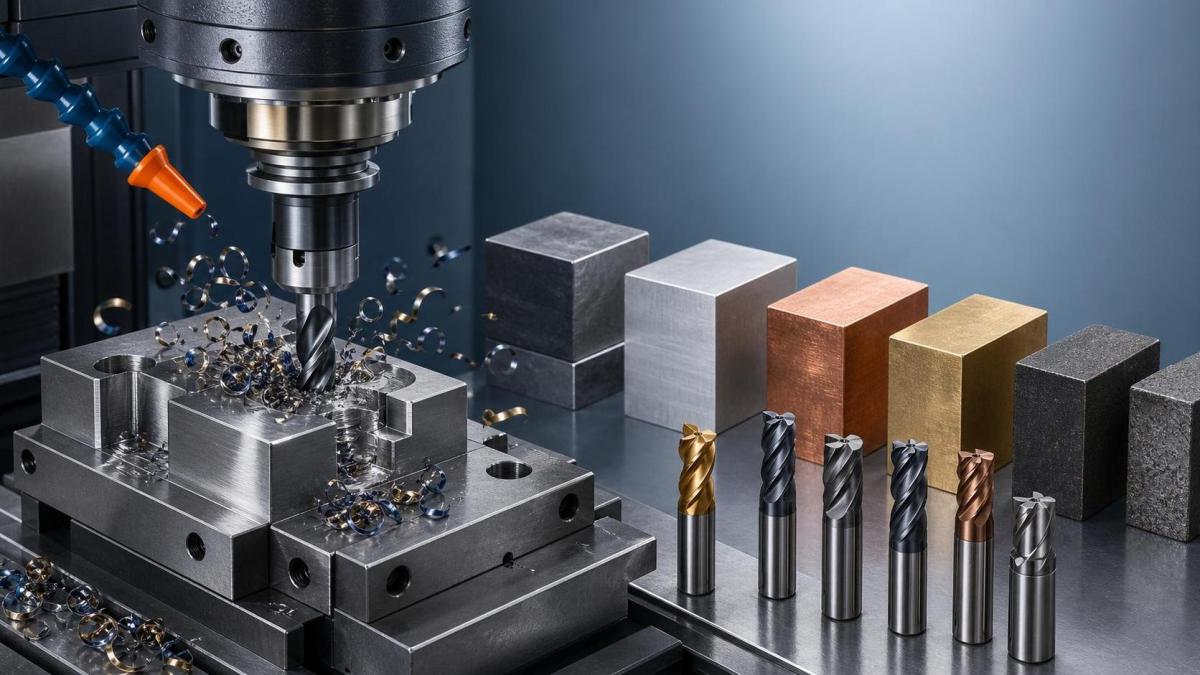
A tool that works well on one alloy can fail fast on another. That is why material performance analysis for machining starts with the workpiece, not the cutter.
The same spindle speed, feed rate, and insert grade can produce very different results depending on chip formation, heat flow, and built-up edge. In practice, the material sets the limits.
If you ignore those limits, you get chatter, broken edges, poor finish, and unstable cycle times. If you read them correctly, tool selection becomes much more predictable.
The properties that matter most
For material performance analysis for machining, a few properties consistently drive results more than the rest. These are the ones that should sit at the top of any selection checklist.
Hardness
Harder materials increase cutting force and accelerate flank wear. They often need wear-resistant tool materials, sharper edge preparation, and conservative cutting data. High hardness is a clear signal to prioritize tool toughness and coating quality.
Toughness
Tough materials can deform without cracking, but they also tend to push more load into the cutting edge. For interrupted cuts, roughing, or variable stock, toughness in the workpiece often means the tool must handle impact better, not just resist abrasion.
Thermal conductivity
Materials with low thermal conductivity trap heat at the cutting zone. That raises insert temperature, shortens tool life, and can distort parts. In this case, tool selection should favor heat-resistant grades and stable coolant strategy.
Work hardening tendency
Some materials get harder as you cut them. Austenitic stainless steels and certain nickel alloys are classic examples. Once the surface hardens, the next pass sees more resistance, so rubbing must be minimized and feed must stay positive.
Abrasiveness
Abrasive materials, especially cast irons, composites, and some powder metals, wear edges quickly. Here, material performance analysis for machining points toward hard coatings, wear-focused geometries, and inserts designed for edge retention.
How to match material data to tool choice
Good tool selection is not about choosing the strongest insert. It is about matching the failure mode to the material behavior.
If the workpiece is hard and abrasive, prioritize wear resistance. If it is tough and unstable, prioritize fracture resistance. If it holds heat, prioritize thermal stability. That logic is simple, but it prevents most bad choices.
- For hard materials: use stronger substrates and heat-resistant coatings.
- For tough materials: choose positive geometries and stable edge prep.
- For heat-sensitive parts: use coolant-friendly tools and lower thermal load.
- For abrasive alloys: shorten tool overhang and monitor wear more often.
This is also where trial runs become useful. Start with material performance analysis for machining, then validate with chip shape, tool wear pattern, and surface roughness after the first few parts.
Common material families and practical tool signals
Different material families send different signals on the machine. Reading those signals early helps you avoid overengineering the setup.
What operators should watch on the floor
Material performance analysis for machining is most useful when it shows up in daily decisions. The shop floor gives fast feedback if you know what to look for.
Watch chip color, chip shape, edge wear, and sound. Long strings may point to poor chip breaking. Blue chips can suggest excess heat. Sudden edge chipping usually means impact or vibration, not just bad tool quality.
Surface finish is another strong clue. If finish degrades before the insert looks worn, the material may be hardening, smearing, or generating unstable heat. That is the moment to adjust geometry, speed, or coolant delivery.
The most reliable teams treat every cut as a small data point. Over time, that turns material performance analysis for machining into a repeatable selection method instead of a one-time judgment call.
A simple selection framework
Before choosing a tool, ask four questions: Is the material hard? Does it work harden? Does it hold heat? Is it abrasive? Those answers usually narrow the field quickly.
Then check the process conditions. Interrupted or continuous cut, roughing or finishing, coolant or dry, rigid fixture or flexible setup. Material behavior and process conditions should be read together.
That combined view is the real value of material performance analysis for machining. It helps you choose tools that fit the part, the machine, and the risk level of the job.
Conclusion: make the material speak first
Tool selection gets easier when you stop starting with brand names and start with material behavior. Hardness, toughness, thermal conductivity, work hardening, and abrasiveness will tell you more than a catalog headline ever will.
Use material performance analysis for machining to compare options, validate the first run, and refine the setup with real wear data. That approach reduces scrap, improves finish, and gives operators a clearer path to stable production.
If you want better decisions on the shop floor, begin with the material, then choose the tool.
Search News
Hot Articles
- Carbon Fiber StructuresHow to Specify Aerospace Carbon Fiber Assemblies for Lightweight, Load-Bearing PartsJul 11, 2026
- Machine VisionXiaomi, Alibaba DAMO Academy Drive Open-Source Robotics Model Ecosystem, Lowering Algorithm Development Barriers for Overseas SMEs Adopting Chinese Robotics SolutionsMar 30, 2026
- Cobots & ArmsShanxi 'AI+' Conference Showcases Embodied Intelligence with Multinational Buyer Engagement: Key Industry ImplicationsMar 30, 2026
Popular Tags
Recommended News
 Jul 11, 2026How to Specify Aerospace Carbon Fiber Assemblies for Lightweight, Load-Bearing PartsAerospace carbon fiber assemblies: learn how to specify laminate design, load data, joining methods, and inspection controls for lighter, reliable load-bearing aerospace parts.Elena Rostova (UAV Systems Researcher)
 Mar 30, 2026Xiaomi, Alibaba DAMO Academy Drive Open-Source Robotics Model Ecosystem, Lowering Algorithm Development Barriers for Overseas SMEs Adopting Chinese Robotics SolutionsXiaomi & Alibaba DAMO Academy's open-source robotics models lower algorithm barriers for global SMEs. Boost efficiency in manufacturing, logistics & smart retail with ROS 2 compatible solutions.TSV Data Lab
 Mar 30, 2026Shanxi 'AI+' Conference Showcases Embodied Intelligence with Multinational Buyer Engagement: Key Industry ImplicationsShanxi 'AI+' Conference highlights embodied intelligence with Tesla, Ubtech & Jiantao showcasing multimodal robotics. 40+ global buyers validated tech on-site, creating new B2B channels for industrial automation & AI solutions.Chen Wei (Automation Lead Engineer)
 Mar 30, 2026Zhongguancun Unveils 6G Integrated Sensing-Computing-Intelligence Platform to Empower Embodied Robots for Global Industrial ApplicationsZhongguancun's new 6G platform revolutionizes industrial robotics with <10ms latency, empowering global automotive, logistics & port automation. Discover how this tech boosts China's smart manufacturing exports.TSV Data Lab
 Mar 30, 2026Mech-Mind Tianjin Embodied Intelligence R&D and Production Base Goes Live, Cutting Delivery Time by 20%–30% for Global Customized AMR+Vision SolutionsMech-Mind's Tianjin AMR+Vision production base cuts delivery time by 20%-30% for欧美 & Latin American markets. Discover how this PLd-certified facility accelerates customized robotics solutions for smart manufacturing and logistics.Chen Wei (Automation Lead Engineer)
 Mar 30, 2026Boao Forum Reveals 'Co-evolution of Big and Small Brains' Trend in Humanoid Robots, China's Embodied Intelligence Accelerates Adaptation to Overseas Manufacturing Service ScenariosDiscover how China's humanoid robots, featuring 'Co-evolution of Big and Small Brains,' are revolutionizing global manufacturing. Learn about Embodied Tian Gong 3.0's ISO compliance and overseas deployment at Boao Forum 2026.Chen Wei (Automation Lead Engineer)
 Mar 30, 2026China Railway Industrial Secures Patent for Embodied Robotics in Material Handling, Boosting High-Precision Delivery Capabilities for Overseas Infrastructure and Manufacturing ProjectsChina Railway Industrial's new patent for embodied robotics in material handling boosts high-precision delivery for global infrastructure & manufacturing. Discover how this innovation enhances logistics accuracy in automotive, rail transit & EPC projects.Chen Wei (Automation Lead Engineer)
 Sep 25, 2026How to Evaluate an Industrial Infrastructure Data Platform for Multi-Site OperationsIndustrial infrastructure data platform evaluation guide for multi-site operations: compare data quality, edge resilience, interoperability, governance, and scalable proof-of-value criteria.Victor Lin (Chief Software Architect)
 Sep 24, 2026How to Select Machine Vision Optics for Accurate Inspection at Different Working DistancesMachine vision optics selection guide for accurate inspection at every working distance. Compare FOV, pixel scale, DOF, distortion, lighting, and telecentric options.TSV Data Lab
 Sep 23, 2026How to Evaluate a Machine Vision System Integrator for High-Speed Inspection LinesChoose a machine vision system integrator with proven expertise in high-speed inspection, reliable reject timing, robust optics, and measurable acceptance criteria.TSV Data Lab
 Sep 25, 2026How a smart factory with Industrial IoT reduces production blind spotsDiscover how a smart factory with Industrial IoT turns real-time machine, quality, and workflow data into actionable insights that reduce production blind spots and delivery risks.Victor Lin (Chief Software Architect)
 Sep 24, 2026When does Industrial IoT make smart manufacturing easier to scale?Smart manufacturing Industrial IoT scales when trusted data, interoperable systems, and secure workflows turn connected assets into measurable gains.TSV Data Lab
 Sep 23, 2026What drives ultra-precision machining cost at 1-micron tolerance?Ultra precision machining cost per part at 1 micron tolerance depends on process, material, metrology, and yield. Learn how to compare quotes confidently.Dr. Marcus Vance
 Sep 22, 2026Drone Engine-T550CC Applications: Build the UAV Power System Around the MissionAn application guide for Drone Engine-T550CC integration, covering payload planning, airframe matching, cooling, fuel, vibration, test procedures, documentation, and service preparation.Elena Rostova (UAV Systems Researcher)
 Sep 22, 2026How to Evaluate Industrial Edge Computing Vendors for Factory DeploymentIndustrial edge computing vendor evaluation guide for factories: compare latency, protocol fit, reliability, security, and lifecycle support before deployment.TSV Data Lab
 Sep 21, 2026Drone Payload Integration: Matching Power, Data, and Center of Gravity for Reliable FlightsDrone payload integration made practical: balance power, data, center of gravity, and endurance to build safer, more reliable mission-ready flights.Elena Rostova (UAV Systems Researcher)
 Sep 20, 2026Autonomous Navigation Pricing: Cost Drivers and Budget Benchmarks for AMR ProjectsAutonomous navigation price explained: compare AMR cost drivers, software, sensors, integration, safety, and lifecycle budgets to build a scalable project plan.Chen Wei (Automation Lead Engineer)
 Sep 19, 2026How to Scope Automation Integration Services for Multi-System Factory ProjectsAutomation integration services: learn how to scope multi-system factory projects with clear workflows, interface contracts, safety boundaries, and acceptance criteria.Victor Lin (Chief Software Architect)
 Sep 18, 2026Selecting UAV Aerospace Structural Parts for Strength, Weight, and Fatigue LifeUAV aerospace structural parts guide: compare strength, weight, stiffness, fatigue life, joints, and traceability to select reliable flight-ready components.Elena Rostova (UAV Systems Researcher)
 Sep 17, 2026Selecting Commercial Drone Payloads for European Inspection ProjectsCommercial drone payloads Europe: learn how to select RGB, thermal and LiDAR systems for compliant, reliable inspection data and better project outcomes.Elena Rostova (UAV Systems Researcher)
 Sep 16, 2026Machining Tolerance Validation: How to Verify Critical Dimensions Before Production ReleaseMachining tolerance analysis validation: verify critical dimensions, measurement systems, process capability, and tolerance stacks before production release.Dr. Marcus Vance
 Sep 15, 2026AGV Tape Guidance vs Laser Navigation: Which Fits Your Warehouse Layout?AGV tape guidance comparison: discover how tape and laser navigation fit changing warehouse layouts, docking needs, floor conditions, maintenance, and route flexibility.Chen Wei (Automation Lead Engineer)
 Sep 14, 2026How Point Cloud Analytics Improves Asset Inspection Workflows Across GCC ProjectsPoint cloud analytics GCC helps project leaders improve asset inspections with accurate change detection, safer workflows, and faster maintenance decisions.TSV Data Lab
 Sep 13, 2026How Aerospace Manufacturers Can Build a Digital Thread From Design to Certified ProductionDigital manufacturing for aerospace: learn how to build a traceable digital thread from design through certified production, supplier control, and audit-ready compliance.Victor Lin (Chief Software Architect)