
Guitar Straps Wholesale: Materials, MOQ, Custom Branding, and Pricing
Publication Date
author
For distributors evaluating guitar straps wholesale opportunities, the right decision depends on more than style or catalog photos.
Materials, stitching durability, MOQ flexibility, custom branding options, and transparent pricing all affect resale margins, inventory risk, and long-term supplier reliability.
This guide applies a practical, data-driven sourcing lens to help compare strap specifications, understand cost drivers, and negotiate with manufacturers more confidently before committing to bulk orders.
What Does Guitar Straps Wholesale Really Include?
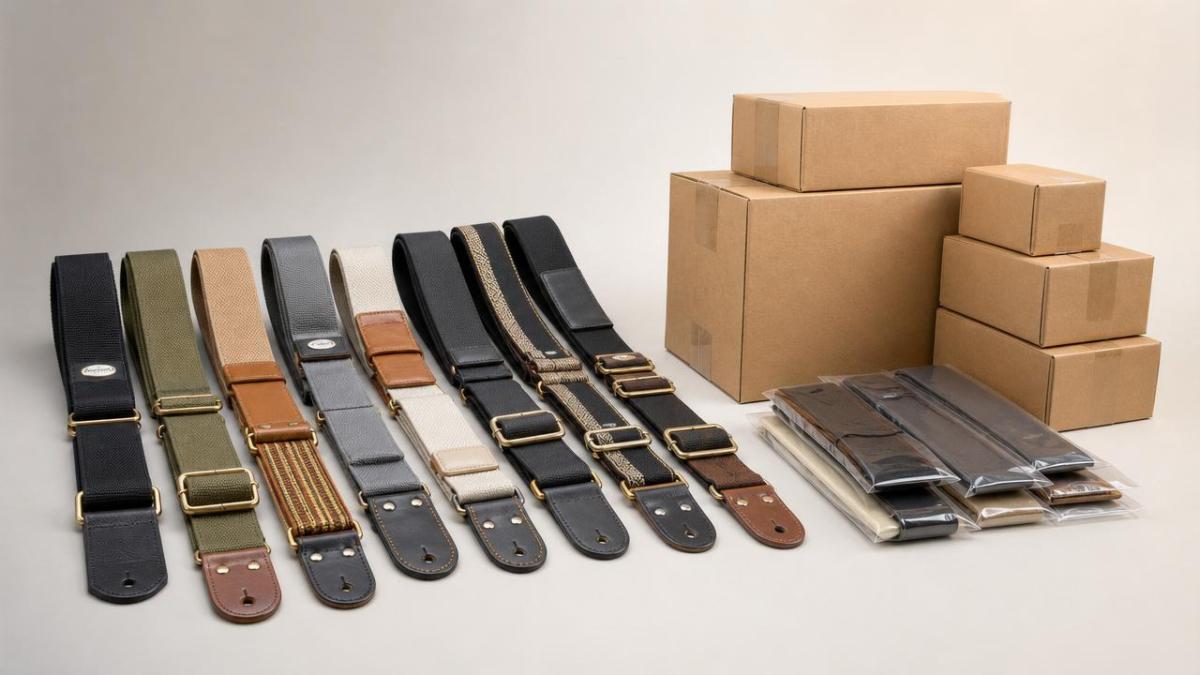
Guitar straps wholesale refers to bulk purchasing of straps for resale, brand programs, music stores, online channels, promotional kits, or instrument bundles.
A wholesale offer should include measurable product details, not only colors, patterns, and general promises about comfort.
Useful specifications include strap length, webbing thickness, end material, buckle type, stitch density, packaging format, and available branding methods.
For guitar straps wholesale, a clear quotation should separate unit price, mold fee, logo fee, packaging fee, freight, and sample charges.
This separation prevents hidden cost shifts when the final invoice is issued after samples or artwork confirmation.
Which specifications matter first?
- Length range for electric, acoustic, bass, and children’s guitars.
- Width, commonly 2 inches or 2.5 inches for comfort.
- End piece material, such as leather, PU, or reinforced synthetic.
- Adjustment hardware, including plastic slider, metal buckle, or tri-glide.
- Load-bearing test result under repeated tension.
A reliable guitar straps wholesale program converts these details into repeatable SKUs, stable quality checks, and predictable replenishment cycles.
Which Materials Are Best for Guitar Straps Wholesale?
Material choice drives comfort, appearance, durability, shipping weight, and price. It also shapes how the strap performs across different retail segments.
In guitar straps wholesale, common materials include polyester, nylon, cotton, jacquard fabric, genuine leather, PU leather, and neoprene.
Polyester and nylon: cost-efficient and scalable
Polyester is widely used because it supports vibrant printing, stable color, and controlled cost in bulk production.
Nylon usually feels smoother and slightly glossier. It can suit modern designs, beginner bundles, and high-volume guitar straps wholesale orders.
Both materials should be checked for edge softness, dye fastness, and resistance to fraying after repeated adjustment.
Cotton and jacquard: comfort and visual identity
Cotton straps offer a softer hand feel, especially for longer playing sessions and vintage-inspired collections.
Jacquard straps create woven patterns rather than surface printing. They usually cost more but provide stronger shelf appeal.
For guitar straps wholesale, jacquard can justify higher retail pricing when pattern detail and color consistency are controlled.
Leather, PU, and neoprene: premium or functional positioning
Genuine leather gives a premium appearance, but it requires closer inspection for thickness, grain consistency, odor, and edge finishing.
PU leather offers lower cost and broader styling flexibility. However, peeling resistance and climate stability must be tested.
Neoprene is useful for padded comfort straps. It is often selected for heavier instruments and ergonomic product lines.
How Should MOQ Be Evaluated Before Bulk Ordering?
MOQ is not only a quantity number. It reflects fabric purchasing, dyeing, printing setup, labor scheduling, and packaging preparation.
In guitar straps wholesale, standard ready designs may allow lower MOQ than fully customized straps with exclusive patterns.
A typical MOQ may range from 100 to 1,000 pieces per design, depending on material, logo method, and color complexity.
Why does MOQ vary by customization?
Printed polyester straps can be flexible when the base webbing is available in stock.
Jacquard weaving usually needs higher MOQ because the pattern is built directly into the fabric structure.
Leather straps may require MOQ based on hide utilization, cutting loss, and batch matching.
For guitar straps wholesale, MOQ should be evaluated together with sell-through speed, storage capacity, and SKU complexity.
How can inventory risk be reduced?
- Start with neutral colors before expanding into seasonal artwork.
- Use shared strap bodies with different hang tags or sleeves.
- Request mixed-color MOQ when fabric and hardware are common.
- Confirm reorder lead time before placing aggressive launch quantities.
A flexible guitar straps wholesale supplier should explain the operational reason behind MOQ instead of presenting it as a fixed rule.
What Custom Branding Options Are Practical?
Custom branding is valuable when it improves recognition, shelf presentation, or online product differentiation.
For guitar straps wholesale, branding can appear on the strap surface, leather ends, labels, buckles, packaging, or product inserts.
Common branding methods
- Screen printing for simple logos and economical bulk runs.
- Heat transfer for detailed graphics and small color gradients.
- Embroidery for textured branding on selected fabric straps.
- Embossing or debossing for leather and PU end pieces.
- Woven labels for consistent identity across multiple strap models.
Each branding method has different artwork limits. Thin lines, metallic effects, and tiny text may not reproduce cleanly.
In guitar straps wholesale, a pre-production sample should confirm logo position, color accuracy, durability, and packaging appearance.
What artwork files are usually needed?
Vector files such as AI, EPS, or SVG are preferred for logos. Pantone references help control color matching.
For full-surface designs, repeat pattern files should include scale, orientation, edge treatment, and approved color codes.
Clear artwork reduces sampling cycles and protects delivery schedules in guitar straps wholesale projects.
How Is Guitar Straps Wholesale Pricing Calculated?
Pricing depends on more than the visible strap. Material yield, labor time, branding process, inspection, packaging, and freight all matter.
A low unit price may become expensive if defect rate, late delivery, or poor packaging causes returns.
For guitar straps wholesale, the best comparison uses landed cost, not factory price alone.
What price range is realistic?
Entry polyester straps may sit at the lower end, especially with standard designs and simple packaging.
Printed custom straps are usually mid-range because artwork setup and quality control add cost.
Leather, jacquard, and padded straps usually cost more, but they can support stronger brand positioning.
In guitar straps wholesale, the cheapest offer should be tested carefully for stitching strength, end-piece durability, and color stability.
What Quality Checks Reduce Risk Before Shipment?
Quality control should be simple, measurable, and repeatable. Visual approval alone is not enough for guitar straps wholesale.
A useful inspection plan checks function, appearance, packaging, and carton labeling before final payment or dispatch.
Recommended inspection points
- Measure length, width, thickness, and adjustment range.
- Pull-test end pieces and stitching under defined force.
- Check buckle movement for slipping, cracking, or sharp edges.
- Compare bulk color against approved sample under consistent lighting.
- Review logo position, print adhesion, and barcode accuracy.
For guitar straps wholesale, even small defects can multiply quickly across cartons and harm customer confidence.
What documents should be requested?
Request a specification sheet, sample approval record, packing list, carton dimensions, and production photos.
If compliance claims are made, ask for relevant test reports rather than accepting general statements.
A disciplined document trail makes guitar straps wholesale easier to reorder, audit, and scale.
FAQ: Common Guitar Straps Wholesale Questions
How should suppliers be compared?
Compare suppliers using samples, specification accuracy, response speed, inspection discipline, and reorder consistency.
For guitar straps wholesale, a slightly higher price can be justified if fewer defects and faster replenishment protect margin.
What mistakes should be avoided?
Avoid approving bulk production from catalog photos alone. Physical samples reveal texture, stitching, weight, and real color.
Avoid unclear packaging instructions. Missing barcodes, weak hang cards, or wrong labels can disrupt sales channels.
Avoid comparing guitar straps wholesale prices without freight and defect allowance. Landed cost is the meaningful number.
Final Checklist for a Better Wholesale Decision
A strong guitar straps wholesale order begins with measurable requirements, approved samples, and a transparent quotation structure.
Before placing bulk orders, define material, length, branding, packaging, MOQ, inspection criteria, and shipping terms in writing.
Ask for a sample that matches final production, not a similar reference item from stock.
Review the total cost from factory to destination, including setup fees, cartons, freight, and possible quality losses.
The next practical step is to build a short specification sheet and request quotations from several qualified suppliers.
With disciplined comparison, guitar straps wholesale can become a scalable product category with controlled risk and sustainable margins.
Search News
Hot Articles
- Carbon Fiber StructuresHow to Specify Aerospace Carbon Fiber Assemblies for Lightweight, Load-Bearing PartsJul 11, 2026
- Machine VisionXiaomi, Alibaba DAMO Academy Drive Open-Source Robotics Model Ecosystem, Lowering Algorithm Development Barriers for Overseas SMEs Adopting Chinese Robotics SolutionsMar 30, 2026
- Cobots & ArmsShanxi 'AI+' Conference Showcases Embodied Intelligence with Multinational Buyer Engagement: Key Industry ImplicationsMar 30, 2026
Popular Tags
Recommended News
 Jul 11, 2026How to Specify Aerospace Carbon Fiber Assemblies for Lightweight, Load-Bearing PartsAerospace carbon fiber assemblies: learn how to specify laminate design, load data, joining methods, and inspection controls for lighter, reliable load-bearing aerospace parts.Elena Rostova (UAV Systems Researcher)
 Mar 30, 2026Xiaomi, Alibaba DAMO Academy Drive Open-Source Robotics Model Ecosystem, Lowering Algorithm Development Barriers for Overseas SMEs Adopting Chinese Robotics SolutionsXiaomi & Alibaba DAMO Academy's open-source robotics models lower algorithm barriers for global SMEs. Boost efficiency in manufacturing, logistics & smart retail with ROS 2 compatible solutions.TSV Data Lab
 Mar 30, 2026Shanxi 'AI+' Conference Showcases Embodied Intelligence with Multinational Buyer Engagement: Key Industry ImplicationsShanxi 'AI+' Conference highlights embodied intelligence with Tesla, Ubtech & Jiantao showcasing multimodal robotics. 40+ global buyers validated tech on-site, creating new B2B channels for industrial automation & AI solutions.Chen Wei (Automation Lead Engineer)
 Mar 30, 2026Zhongguancun Unveils 6G Integrated Sensing-Computing-Intelligence Platform to Empower Embodied Robots for Global Industrial ApplicationsZhongguancun's new 6G platform revolutionizes industrial robotics with <10ms latency, empowering global automotive, logistics & port automation. Discover how this tech boosts China's smart manufacturing exports.TSV Data Lab
 Mar 30, 2026Mech-Mind Tianjin Embodied Intelligence R&D and Production Base Goes Live, Cutting Delivery Time by 20%–30% for Global Customized AMR+Vision SolutionsMech-Mind's Tianjin AMR+Vision production base cuts delivery time by 20%-30% for欧美 & Latin American markets. Discover how this PLd-certified facility accelerates customized robotics solutions for smart manufacturing and logistics.Chen Wei (Automation Lead Engineer)
 Mar 30, 2026Boao Forum Reveals 'Co-evolution of Big and Small Brains' Trend in Humanoid Robots, China's Embodied Intelligence Accelerates Adaptation to Overseas Manufacturing Service ScenariosDiscover how China's humanoid robots, featuring 'Co-evolution of Big and Small Brains,' are revolutionizing global manufacturing. Learn about Embodied Tian Gong 3.0's ISO compliance and overseas deployment at Boao Forum 2026.Chen Wei (Automation Lead Engineer)
 Mar 30, 2026China Railway Industrial Secures Patent for Embodied Robotics in Material Handling, Boosting High-Precision Delivery Capabilities for Overseas Infrastructure and Manufacturing ProjectsChina Railway Industrial's new patent for embodied robotics in material handling boosts high-precision delivery for global infrastructure & manufacturing. Discover how this innovation enhances logistics accuracy in automotive, rail transit & EPC projects.Chen Wei (Automation Lead Engineer)
 Oct 17, 20265-Axis CNC Positioning Accuracy: How to Interpret ISO 230-2 Test ResultsAssess 5 axis CNC machining positioning accuracy with ISO 230-2. Learn to interpret repeatability, reversal error, and test conditions to compare suppliers and make confident acceptance decisions.Dr. Marcus Vance
 Oct 16, 2026Choosing a Rugged Edge AI Box Supplier: Thermal Tests and Lifecycle SupportChoose a rugged edge AI box supplier with proven thermal performance and reliable lifecycle support. Discover the tests and commitments to verify before you buy.TSV Data Lab
 Oct 15, 2026R&D Cost Reduction Services: How to Evaluate Fees, Savings, and ROIEvaluate R&D cost reduction services with confidence. Compare fees, verify savings, and calculate ROI without compromising performance. Discover how to choose a provider that delivers real value.Chen Wei (Automation Lead Engineer)
 Oct 16, 2026How Can You Fairly Compare MTBF Across Industrial Servo Motors?Make a fair industrial servo motor MTBF comparison with matched operating profiles, failure criteria, and confidence bounds. Discover how to assess reliability beyond advertised numbers.Chen Wei (Automation Lead Engineer)
 Oct 15, 2026How Should You Compare TechStat Vanguard 5-Axis CNC Tolerances?TechStat Vanguard 5-axis CNC tolerance comparison: learn how to verify part accuracy, assess inspection evidence, and choose suppliers that reliably meet your drawing requirements.Dr. Marcus Vance
 Oct 14, 2026Drone Frame Composites: Carbon Fiber vs. Fiberglass for Weight and StiffnessExplore drone structural materials composites: compare carbon fiber and fiberglass for weight, stiffness, cost, and antenna compatibility. Find the right material for your drone frame.Elena Rostova (UAV Systems Researcher)
 Oct 13, 2026Smart Cameras vs. PC-Based Machine Vision: Which Fits High-Speed Inspection?This industrial product comparison for machine vision weighs smart cameras vs. PC-based systems on latency, throughput, and cost. Discover your best fit for high-speed inspection.TSV Data Lab
 Oct 12, 2026How to Verify RoHS Compliance in Industrial Sensing Systems Before DeploymentRoHS compliant sensing systems: learn how to verify materials, supplier declarations, testing, and configuration controls before industrial deployment.TSV Data Lab
 Oct 11, 2026How Procurement-Oriented Content Taxonomy Improves B2B Buying JourneysProcurement-oriented content taxonomy streamlines B2B buying journeys with clearer evidence, supplier comparisons, risk visibility, and faster approvals.TSV Data Lab
 Oct 10, 2026How to Select a Machine Performance Monitoring Platform for OEE and Downtime ReductionMachine performance monitoring platform selection guide: validate machine states, OEE data, downtime reasons, integrations, and scalability to reduce losses with confidence.TSV Data Lab
 Oct 08, 2026How to Machine Inconel 625 Blades Without Heat Cracks or Edge ChippingInconel 625 blade machining guide: prevent heat cracks, edge chipping, chatter, and work hardening with proven tooling, cooling, fixturing, and inspection strategies.Dr. Marcus Vance
 Oct 07, 2026How to Evaluate an HMI Panel Distributor for Industrial Automation ProjectsHMI panel distributor evaluation guide: verify technical compatibility, traceability, supply reliability, lifecycle support, and total cost for automation projects.Victor Lin (Chief Software Architect)
 Oct 06, 2026Navigation Fault Tolerance Standards for AMRs: What Safety Teams Must VerifyNavigation fault tolerance standards: learn what AMR safety teams must verify, from localization loss and sensor faults to stopping distance, safe restart, and site-specific validation.Chen Wei (Automation Lead Engineer)
 Oct 05, 2026Calculating Edge Computing Total Cost of Ownership Across Distributed SitesEdge computing ownership cost explained: calculate deployment, energy, connectivity, security, remote support, and refresh costs across distributed sites.TSV Data Lab
 Oct 04, 2026CAD/CAM Benchmarking in the GCC: What Manufacturers Should Ask a ConsultantCAD CAM benchmark consultant GCC guide: learn the key questions manufacturers should ask to validate post-processors, workflows, machine performance, and production risk.Victor Lin (Chief Software Architect)
 Oct 03, 2026Selecting Automotive Radar Sensor Modules for ADAS Range, Resolution, and IntegrationAutomotive radar sensor module selection guide for ADAS: compare range, resolution, field of view, latency, and integration to build safer, reliable vehicle systems.TSV Data Lab
 Oct 02, 2026How to Qualify Machined Parts Suppliers for Hard Tech ProgramsHard tech supply chain machined parts demand rigorous supplier qualification. Learn how to assess capability, traceability, quality controls, and delivery resilience.Dr. Marcus Vance























