
EDM wire cutting service China and the risk of hidden rework
Publication Date
author
When evaluating an EDM wire cutting service China partner, the biggest cost is often not the quoted price but hidden rework caused by unstable micro machining tolerance limits and poor EDM surface integrity analysis. For engineers, buyers, and decision-makers, the real question is simple: can the supplier hold the required geometry consistently enough to avoid downstream fit issues, scrap, delays, and compliance risk? In many cases, the answer is not visible in the RFQ price sheet. It shows up later in assembly, inspection, fatigue performance, and supplier management time.
For most searchers, the core intent behind this topic is not merely to understand wire EDM in China. It is to assess supplier risk, identify where hidden rework comes from, and build a practical checklist for selecting a precision machining partner that can actually deliver repeatable results. This article focuses on that decision logic: where precision loss begins, how it propagates into manufacturing cost, and what verification data matter before you issue a PO.
Why hidden rework is the real cost risk in EDM wire cutting service China
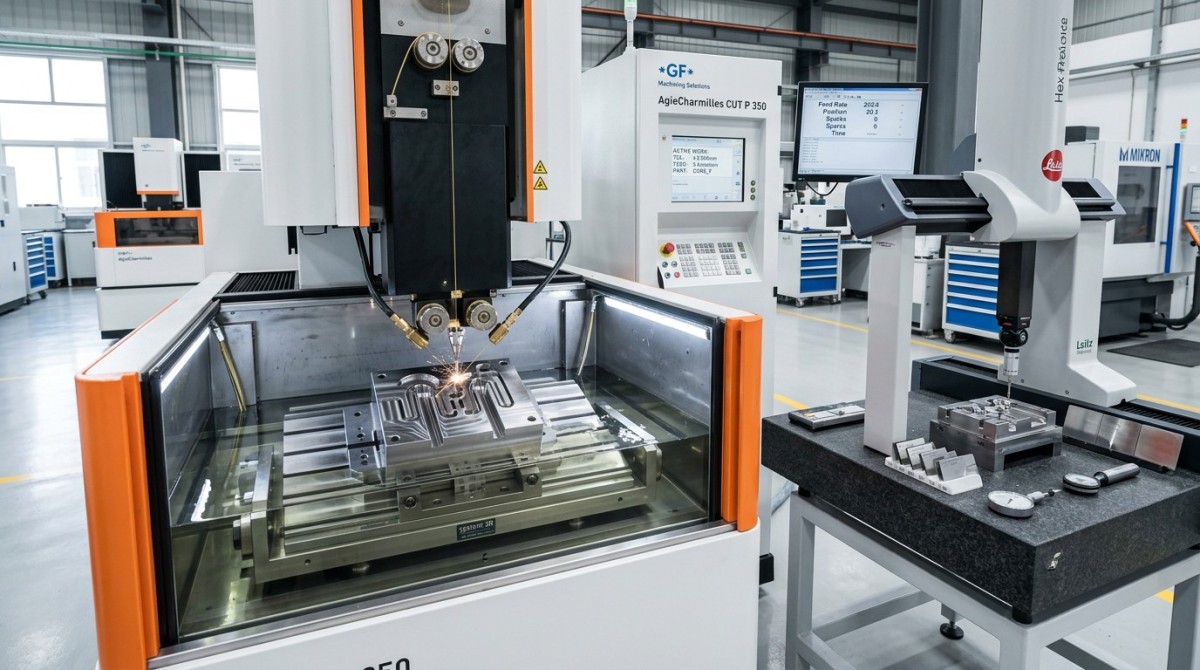
If you are sourcing an EDM wire cutting service China supplier, the headline unit price is only one part of the cost model. Hidden rework often comes from variation that stays within a vague “general tolerance” claim but fails in real production conditions. This is especially common in parts with tight slot width control, thin-wall features, fine corners, stacked profiles, or parts that serve as downstream locating, sealing, or mating features.
Hidden rework usually appears in five forms:
- Secondary fitting, lapping, polishing, or bench adjustment at assembly
- Extra inspection cycles due to dimensional instability between batches
- Unexpected scrap after heat treatment, coating, or final QA
- Delayed PPAP, FAI, or qualification because the process cannot repeat
- Field performance risk caused by poor surface integrity or recast layer issues
For procurement teams, this means the cheapest quote can become the most expensive source once engineering hours, line stoppage risk, and delivery instability are included. For engineers, the issue is more specific: wire EDM can achieve excellent accuracy, but only when machine condition, fixturing, wire path control, flushing, thermal stability, skim cut strategy, and inspection discipline are all managed properly. Without that process control, “precision” becomes a sample-based claim rather than a production capability.
Where precision loss actually begins: the upstream causes buyers often miss
Many sourcing decisions fail because evaluation starts too late, at the finished-part drawing review stage. In reality, precision loss often starts upstream, long before final measurement.
The most common root causes include:
1. Material condition is not stable
Residual stress, inconsistent hardness, poor flatness, or lot-to-lot variation can shift cut behavior. Even if the programmed path is correct, part movement during or after cutting can create geometry drift. This is a major issue in tool steel, hardened alloys, thin plates, and heat-treated materials.
2. The supplier quotes tolerance without proving process window
A supplier may accept a drawing tolerance because it is commercially attractive, but that does not mean the actual process capability supports repeatable production. The difference between “can make one acceptable sample” and “can hold stable production over multiple lots” is often where hidden rework is born.
3. Skim cut strategy is optimized for speed, not integrity
In wire EDM, rough cut plus skim cut planning directly affects dimensional control and surface quality. If the supplier reduces skim passes to improve throughput, you may see taper variation, edge condition issues, recast layer problems, or unstable corner geometry.
4. Flushing and thermal management are underestimated
Dielectric condition, flushing pressure, nozzle alignment, machine temperature stability, and workpiece heat behavior all influence accuracy. On micro features or high-aspect-ratio profiles, poor flushing can increase wire lag, spark instability, and local dimensional error.
5. Inspection only checks nominal dimensions, not process behavior
Some suppliers provide final dimensions but do not track drift across machine, operator, time, or batch. A part may pass incoming inspection and still create assembly problems because profile consistency, edge geometry, or surface integrity were not characterized deeply enough.
How hidden rework affects downstream assembly, quality, and business performance
For operators and assembly teams, hidden rework means parts that technically “measure okay” but do not behave well in production. A slot that is near the limit, a corner radius that is slightly inconsistent, or a cut surface with poor integrity may force unplanned manual correction. This slows takt time and introduces operator-dependent variability.
For quality teams, the impact spreads into traceability and compliance. If the part is used in aerospace, medical, automation, or sensor-related applications, unresolved EDM surface integrity analysis can become a serious problem. Recast layer, microcracks, heat-affected surface behavior, and burr-like edge conditions may influence fatigue life, sealing performance, coating adhesion, or post-process reliability.
For procurement leaders and business decision-makers, hidden rework creates three strategic costs:
- Total cost inflation: More inspection, more supplier communication, more internal handling
- Schedule risk: Repeat orders become unpredictable, qualification takes longer, launches slip
- Trust erosion: Engineering loses confidence in sourcing, and buyers lose leverage in future vendor consolidation
That is why mature organizations no longer evaluate an EDM wire cutting service China provider by quote and lead time alone. They evaluate whether the source can reduce uncertainty in the full manufacturing chain.
What data-backed checks should engineers and buyers request before placing an order
If your goal is to avoid hidden rework, ask for evidence that connects machine capability to production stability. The following checks are more useful than generic claims like “high precision” or “strict QC.”
Capability evidence for the actual feature type
Do not ask only for broad tolerance claims such as ±0.005 mm or ±0.002 mm. Ask for examples on parts similar to your geometry: thin ribs, narrow slots, fine internal corners, stacked contours, hardened material, or micro features. Capability is feature-dependent.
Process route details
Ask how many cuts are planned, what skim strategy is used, what material state is assumed, and whether stress relief or special fixturing is needed. A strong supplier can explain how process choices affect both tolerance and surface integrity.
Inspection method and sampling logic
Request more than a final dimensional report. Ask what is measured by CMM, vision system, optical comparator, pin gauge, roughness instrument, or metallographic analysis if relevant. Also ask how sampling is handled across first article, in-process inspection, and batch release.
Surface integrity data when function requires it
For high-value functional parts, EDM surface integrity analysis matters. Ask whether the supplier can evaluate recast layer thickness, microcrack risk, edge condition, and surface roughness after final skim cuts. If the application is sensitive to fatigue, sealing, electrical performance, or coating adhesion, this is not optional.
Batch consistency records
One good sample is not enough. Ask for evidence from multiple production runs. Batch-to-batch consistency tells you much more about hidden rework risk than a single showcase part.
Nonconformance handling and rework policy
A mature supplier should clearly define how dimensional drift, wire break issues, profile deviation, or post-process defects are contained. If the corrective action system is weak, small EDM variation can become recurring cost leakage.
How to evaluate micro machining tolerance limits without relying on marketing language
Many suppliers use broad precision language that sounds strong but is difficult to audit. A better approach is to convert claims into decision questions.
Ask these practical questions:
- What tolerance can you hold repeatedly on this exact material and thickness?
- What is the achieved Cp/Cpk or internal stability benchmark for similar parts?
- How does accuracy change at corners, small radii, tall aspect ratios, or thin sections?
- What is the effect of rough cut versus final skim cuts on final geometry?
- What inspection data can you share from at least three separate lots?
- What surface roughness and edge condition are typical after final cut?
- What failure modes most often trigger rework in similar jobs?
This approach helps both technical and commercial teams. Engineers gain confidence in process capability. Buyers gain a cleaner supplier comparison model. Managers gain better control over risk-adjusted total cost.
A practical supplier selection framework for reducing rework risk
To evaluate an EDM wire cutting service China partner with less guesswork, use a weighted framework instead of a price-first comparison.
1. Geometry fit
Has the supplier successfully cut similar part types, materials, and thickness ranges?
2. Tolerance realism
Are the quoted micro machining tolerance limits linked to actual production evidence, not just sales commitment?
3. Surface integrity control
Can the supplier explain and verify EDM surface integrity analysis when application risk demands it?
4. Inspection maturity
Does the supplier measure what matters functionally, not just what is easy to report?
5. Repeatability across batches
Can they show consistent output across time, operators, and lots?
6. Corrective action speed
When issues occur, can they isolate root cause quickly and communicate clearly?
7. Total cost logic
Will this supplier reduce internal troubleshooting, line delays, and engineering back-and-forth?
In many cases, the best supplier is not the one with the lowest nominal piece price. It is the one with the lowest probability of causing downstream disruption.
Final judgment: what smart buyers should conclude before choosing a supplier
If you are comparing EDM wire cutting service China options, the key insight is this: hidden rework is usually a process capability problem disguised as a pricing decision. Precision losses start upstream in material condition, machine control, cut strategy, flushing, and inspection discipline. They then show up later as fit issues, quality escapes, slower assembly, repeated communication, and avoidable cost.
The most reliable way to prevent this is to evaluate suppliers using evidence, not adjectives. Ask for tolerance capability on comparable features, review batch consistency, verify inspection depth, and request EDM surface integrity analysis when part function demands it. For organizations sourcing high-value precision parts, this approach shortens qualification cycles, lowers rework exposure, and improves trust between engineering, quality, and procurement.
In short, the real question is not whether a supplier can cut the shape. It is whether they can cut it consistently enough that your team never has to pay for the same mistake twice.
Search News
Hot Articles
- Carbon Fiber StructuresHow to Specify Aerospace Carbon Fiber Assemblies for Lightweight, Load-Bearing PartsJul 11, 2026
- Machine VisionXiaomi, Alibaba DAMO Academy Drive Open-Source Robotics Model Ecosystem, Lowering Algorithm Development Barriers for Overseas SMEs Adopting Chinese Robotics SolutionsMar 30, 2026
- Cobots & ArmsShanxi 'AI+' Conference Showcases Embodied Intelligence with Multinational Buyer Engagement: Key Industry ImplicationsMar 30, 2026
Popular Tags
Recommended News
 Jul 11, 2026How to Specify Aerospace Carbon Fiber Assemblies for Lightweight, Load-Bearing PartsAerospace carbon fiber assemblies: learn how to specify laminate design, load data, joining methods, and inspection controls for lighter, reliable load-bearing aerospace parts.Elena Rostova (UAV Systems Researcher)
 Mar 30, 2026Xiaomi, Alibaba DAMO Academy Drive Open-Source Robotics Model Ecosystem, Lowering Algorithm Development Barriers for Overseas SMEs Adopting Chinese Robotics SolutionsXiaomi & Alibaba DAMO Academy's open-source robotics models lower algorithm barriers for global SMEs. Boost efficiency in manufacturing, logistics & smart retail with ROS 2 compatible solutions.TSV Data Lab
 Mar 30, 2026Shanxi 'AI+' Conference Showcases Embodied Intelligence with Multinational Buyer Engagement: Key Industry ImplicationsShanxi 'AI+' Conference highlights embodied intelligence with Tesla, Ubtech & Jiantao showcasing multimodal robotics. 40+ global buyers validated tech on-site, creating new B2B channels for industrial automation & AI solutions.Chen Wei (Automation Lead Engineer)
 Mar 30, 2026Zhongguancun Unveils 6G Integrated Sensing-Computing-Intelligence Platform to Empower Embodied Robots for Global Industrial ApplicationsZhongguancun's new 6G platform revolutionizes industrial robotics with <10ms latency, empowering global automotive, logistics & port automation. Discover how this tech boosts China's smart manufacturing exports.TSV Data Lab
 Mar 30, 2026Mech-Mind Tianjin Embodied Intelligence R&D and Production Base Goes Live, Cutting Delivery Time by 20%–30% for Global Customized AMR+Vision SolutionsMech-Mind's Tianjin AMR+Vision production base cuts delivery time by 20%-30% for欧美 & Latin American markets. Discover how this PLd-certified facility accelerates customized robotics solutions for smart manufacturing and logistics.Chen Wei (Automation Lead Engineer)
 Mar 30, 2026Boao Forum Reveals 'Co-evolution of Big and Small Brains' Trend in Humanoid Robots, China's Embodied Intelligence Accelerates Adaptation to Overseas Manufacturing Service ScenariosDiscover how China's humanoid robots, featuring 'Co-evolution of Big and Small Brains,' are revolutionizing global manufacturing. Learn about Embodied Tian Gong 3.0's ISO compliance and overseas deployment at Boao Forum 2026.Chen Wei (Automation Lead Engineer)
 Mar 30, 2026China Railway Industrial Secures Patent for Embodied Robotics in Material Handling, Boosting High-Precision Delivery Capabilities for Overseas Infrastructure and Manufacturing ProjectsChina Railway Industrial's new patent for embodied robotics in material handling boosts high-precision delivery for global infrastructure & manufacturing. Discover how this innovation enhances logistics accuracy in automotive, rail transit & EPC projects.Chen Wei (Automation Lead Engineer)
 Oct 27, 2026GXO and Agility Robotics Expand Partnership to Accelerate US Humanoid Robot DeploymentGXO and Agility Robotics plan to expand US humanoid robot deployment with Digit 4 in early 2027. Explore warehouse automation plans, service terms and future Digit 5 upgrades.Chen Wei (Automation Lead Engineer)
 Oct 27, 2026Robotic Automation Costs: Budgeting for Equipment, Integration, and MaintenancePlan your robotics automation cost with confidence. Explore equipment, integration, and maintenance expenses, compare quotes, and build a realistic budget for better ROI.Chen Wei (Automation Lead Engineer)
 Oct 26, 2026AMAXiMAL Releases Open-Source TopMod 3D v3 With Claude AIExplore AMAXiMAL’s free, open-source TopMod 3D v3 with Claude AI assistance, topology-based modeling and plywood fabrication tools that connect complex designs to physical builds.Dr. Marcus Vance
 Oct 26, 2026Choosing a SCADA System Integrator Company: PLC Compatibility and Long-Term SupportChoose a scada system integrator company with proven PLC compatibility and reliable long-term support. Discover what to test, compare, and require before investing.Victor Lin (Chief Software Architect)
 Oct 25, 2026Hesai Leads Global ADAS Main Lidar Shipments in Yole’s 2026 ReportHesai led global ADAS main lidar shipments with a 43% share in 2025, according to Yole’s 2026 report. Explore what this ranking reveals about its automotive market position.TSV Data Lab
 Oct 25, 2026Choosing an Aerospace Materials Manufacturer: Quality and Traceability ChecksChoosing an aerospace materials manufacturer? Learn how to verify certifications, test reports, and lot traceability to qualify suppliers confidently and reduce costly sourcing risks.Dr. Marcus Vance
 Oct 24, 2026Guotai Haitong: Global Entry-Level 3D Printer Shipments Rose 39% in Q1 2026Entry-level 3D printer shipments rose 39% in Q1 2026, Guotai Haitong reports. Explore how AI, multicolor printing and print farms are shaping market growth.Dr. Marcus Vance
 Oct 24, 2026Choosing an Industrial Vision Inspection Supplier: Acceptance Tests That MatterChoose an industrial vision inspection supplier with confidence. Discover acceptance tests for defect detection, false rejects, production speed, and reliable part rejection before you buy.TSV Data Lab
 Oct 23, 2026US Navy Raises Gecko Robotics Contract Ceiling to $300M for Robotic Fleet MaintenanceUS Navy raises Gecko Robotics’ contract ceiling to $300M for Pacific Fleet robotic inspections. Explore potential opportunities for maintenance suppliers and key procurement considerations.Chen Wei (Automation Lead Engineer)
 Oct 23, 2026Choosing Industrial Sensing Systems for Global Plants: Protocol CompatibilityCompare industrial sensing systems international buyers can trust. Explore protocol compatibility, reduce integration risks, and select proven configurations for reliable global plant deployments.TSV Data Lab
 Oct 22, 2026KUKA Showcases Physical AI and iiQKA.AI Vision at NVIDIA GTC BerlinExplore KUKA’s Physical AI showcase at NVIDIA GTC Berlin and discover how iiQKA.AI Vision aims to simplify robotic vision integration and improve 2D and 3D scene recognition.TSV Data Lab
 Oct 22, 2026Robotic Machining of Advanced Composites: What Tolerances Are Achievable?Explore advanced materials machining robotics: discover what drives achievable composite tolerances and how to validate accuracy before investing in your next machining system.Dr. Marcus Vance
 Oct 21, 2026China’s Industrial Robot Exports Near RMB 10 Billion in First Nine Months of 2026China’s industrial robot exports neared RMB 10 billion in January–September 2026, with value rising faster than volume. Explore the data and what it could mean for suppliers.Chen Wei (Automation Lead Engineer)
 Oct 21, 2026Low-Latency Industrial Data Processing: Pricing and Key Cost DriversExplore industrial data latency price drivers, from edge hardware to integration and support. Learn how to compare quotes, verify performance, and avoid unnecessary costs.TSV Data Lab
 Oct 20, 2026KUKA Launches iiQKA.AI Vision to Simplify Industrial Image ProcessingKUKA iiQKA.AI Vision simplifies industrial image processing with controller-based 2D and 3D vision. Explore drag-and-drop setup for vision-guided automation.TSV Data Lab
 Oct 20, 2026Smart Industrial Edge Devices: Key Criteria for Legacy PLC IntegrationChoose smart industrial edge devices for legacy PLC integration. Discover key criteria for compatibility, data quality, security, and reliable collection without disrupting control.TSV Data Lab
 Oct 19, 2026Choosing a Radar Sensor by Application: Range, Resolution, and Field of ViewSimplify radar sensor application based product selection. Compare range, resolution, and field of view to avoid blind spots and choose with confidence. Explore the guide.TSV Data Lab























