
Aluminum 7075 vs 6061 strength for lightweight structural parts
Publication Date
author
When evaluating aluminum 7075 vs 6061 strength for lightweight structural parts, engineers and buyers need more than generic claims—they need measurable data on strength-to-weight ratio, machinability, fatigue behavior, and real production tolerance. This guide compares both alloys through an engineering-first lens, helping R&D teams, operators, procurement specialists, and decision-makers choose the right material for aerospace, UAV, and precision CNC applications.
In hard-tech sourcing, material selection is rarely a simple “stronger is better” decision. A bracket, frame, housing, arm, or fixture may need to survive cyclic loading, hold tight tolerances of ±0.01 mm to ±0.05 mm, resist corrosion in outdoor service, and still remain cost-efficient across batch sizes from 50 to 5,000 parts. That is where the aluminum 7075 vs 6061 debate becomes commercially important.
For advanced manufacturing teams, the real question is not which alloy wins on a single datasheet metric. The question is which alloy delivers the best engineering outcome when strength, weight, machining stability, finishing, lead time, and procurement risk are considered together. This article breaks down those trade-offs with practical benchmarks relevant to aerospace components, UAV structures, robotic fixtures, and precision machined assemblies.
Mechanical Strength Comparison: Where 7075 Clearly Leads and Where 6061 Stays Competitive
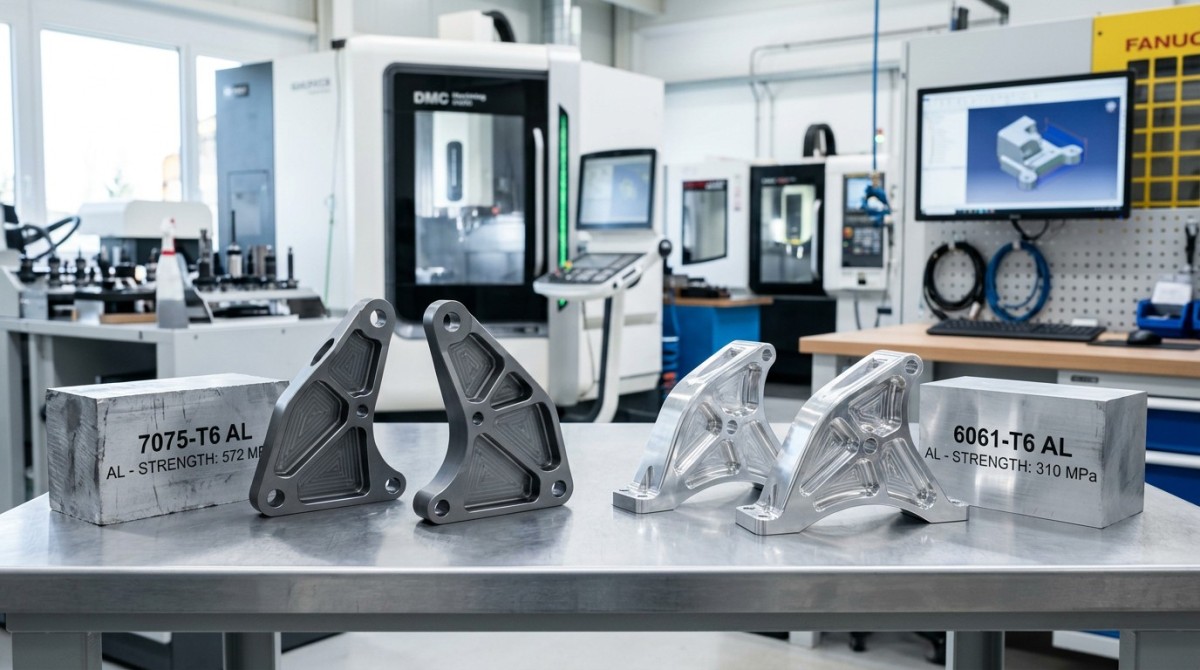
If the selection criterion is pure static strength, aluminum 7075 usually outperforms 6061 by a wide margin. In common tempers, 7075-T6 typically reaches ultimate tensile strength around 510–570 MPa and yield strength near 430–500 MPa. By comparison, 6061-T6 usually sits around 290–320 MPa ultimate tensile strength and about 240–280 MPa yield strength. That gap is why 7075 is often selected for high-load structural members where mass reduction is critical.
Density, however, is nearly the same. Both alloys are lightweight, with 6061 around 2.70 g/cm³ and 7075 around 2.81 g/cm³. In practice, the weight penalty of 7075 is small compared with its strength gain. This creates a meaningful advantage in strength-to-weight ratio, especially in UAV arms, aerospace fittings, and compact load-bearing assemblies where every 100 g saved can affect payload, battery life, or dynamic response.
That said, many structural parts are not loaded near the maximum capacity of the material. In medium-duty frames, machine guards, housings, and precision support brackets, 6061 can remain fully adequate. If actual working stress stays below 30%–40% of yield strength, the incremental cost and processing difficulty of 7075 may not produce enough system-level benefit to justify the switch.
Another point often missed in aluminum 7075 vs 6061 strength discussions is section optimization. Engineers can sometimes redesign a 6061 part by increasing wall thickness by 10%–20% and still achieve a competitive weight and lower total cost. In low to medium volume production, geometric optimization can be more economical than moving to a harder alloy with tighter machining controls.
Typical Mechanical Property Ranges
The table below summarizes commonly referenced engineering ranges for T6 temper material. Exact values vary by product form, heat treatment, and supplier quality documentation, so buyers should always align procurement specifications with mill cert requirements and part validation plans.
The key takeaway is straightforward: 7075 is the better answer when high tensile and yield margins dominate the design brief. 6061 remains a rational choice when loads are moderate, weight targets are achievable, and process flexibility matters as much as peak strength.
Machinability, Tolerance Control, and Shop-Floor Impact
For operators and CNC process engineers, material behavior at the machine matters as much as laboratory strength values. In many shops, 7075 is considered highly machinable and can produce clean chips and good surface finish under optimized cutting parameters. However, because it is harder and less forgiving than 6061, tool wear, heat generation, and edge condition need tighter control, especially on thin-wall features below 1.5 mm or long unsupported spans.
6061 is generally easier for broad production use. It offers stable machining, good availability in plate, bar, and extrusion form, and lower sensitivity during routine milling, drilling, and tapping. When parts require multiple secondary operations, fixture changes, or operator intervention, 6061 often reduces process variation. That can matter more than raw strength in mixed-production environments handling 20 to 30 part numbers per week.
Tolerance retention after machining is another practical factor in the aluminum 7075 vs 6061 strength decision. 7075 can be excellent for precision parts, but residual stress and stock quality must be managed carefully. On larger plates or asymmetrical cuts, stress release may affect flatness and positional accuracy. Shops working to ±0.02 mm on critical bores or to flatness below 0.05 mm across long surfaces should validate roughing and semi-finishing strategy before full production.
6061 tends to be more forgiving for general precision machining, custom fixtures, sensor mounts, automation brackets, and housings that need repeatable output without high scrap risk. For procurement teams comparing supplier quotations, this often translates to fewer process contingencies, easier sourcing, and shorter quoting cycles for medium-complexity geometries.
Production Considerations for Buyers and Operators
- For wall thickness under 2.0 mm, verify fixturing method, clamping pressure, and finishing pass strategy before approving 7075 for volume production.
- If the part includes welded joints, 6061 is usually preferred because 7075 is generally not selected for conventional welded structural applications.
- For cosmetic anodized surfaces, confirm finish expectations early. Both alloys can be anodized, but visual consistency may differ by alloy and batch.
- Where delivery speed matters, 6061 stock is often easier to source globally in standard dimensions, reducing procurement delay by several days to 2 weeks.
Common tolerance planning checkpoints
A practical supplier review should include at least 4 checkpoints: incoming material certification, stock stress condition, machining sequence, and final inspection method. For high-value structural parts, add 2 more: fixture repeatability study and sample-part dimensional trend review over the first 5 to 10 units. This is especially relevant when parts combine lightweight pocketing with critical datums.
Fatigue, Corrosion, and Environmental Suitability for Lightweight Structures
Static strength is only part of the engineering picture. Many lightweight structural parts in UAVs, robotic end-effectors, mobile equipment, and aerospace subassemblies experience repeated vibration, bending, or alternating loads. In these conditions, fatigue behavior becomes highly relevant. 7075 often delivers strong fatigue performance relative to its high strength, which is one reason it appears in demanding aerospace applications. Still, fatigue life depends heavily on notch geometry, surface finish, stress concentration, and load spectrum.
6061 may be less strong in absolute terms, but it can perform well in applications with smoother load paths and lower peak stress. If a part operates at 105 to 107 load cycles and the design avoids sharp transitions, 6061 can achieve reliable service life while simplifying corrosion management. This matters for outdoor systems, agricultural UAV subsystems, and sensor support structures exposed to moisture, dust, and temperature swings from -20°C to 60°C.
Corrosion resistance is one of the most important differentiators. 6061 generally offers better corrosion resistance than 7075 in many service environments, especially where humidity, salt exposure, or periodic chemical contact are involved. 7075 can require more careful surface protection such as anodizing, conversion coating, primer systems, or controlled sealing procedures, depending on the end-use environment and compliance needs.
For decision-makers, this means the aluminum 7075 vs 6061 strength comparison should never stop at load capacity. A part with 25% more theoretical strength margin can still become the wrong choice if surface treatment, inspection burden, and long-term field risk add too much cost or operational uncertainty.
Environmental and lifecycle comparison
The following matrix helps align alloy choice with operating conditions, maintenance expectations, and structural duty level in real manufacturing programs.
The pattern is clear: 7075 is optimized for structural efficiency under high stress, while 6061 offers a more balanced performance envelope for environments where corrosion, welding, and maintenance simplicity shape lifecycle value.
How to Choose by Application: Aerospace, UAV, Robotics, and Precision CNC Parts
Application context is the fastest way to make the aluminum 7075 vs 6061 strength decision practical. In aerospace brackets, wing-adjacent supports, high-load couplers, and UAV armatures, 7075 is often selected because it can reduce cross-section while preserving stiffness and load margin. This is especially attractive when system weight reduction of 5%–15% directly affects endurance, payload, or flight stability.
In robotics and automation, the answer is more mixed. A lightweight end-effector plate carrying a fast-moving payload may benefit from 7075 if acceleration loads are high and stiffness is critical for repeatability. But machine frames, guards, mounting blocks, and camera brackets often perform very well in 6061, especially where there is no need to design close to the material’s upper stress limits.
For precision CNC components used in instrumentation, inspection fixtures, semiconductor support parts, or sensor housings, 6061 frequently wins because it is easier to source, easier to machine consistently, and often easier to finish. If the part’s primary job is dimensional stability rather than extreme structural load, 6061 can offer the better total program result.
Procurement teams should also consider batch profile. For prototypes and low-volume pilots under 100 pieces, 6061 can reduce material availability issues and accelerate design iteration. For mature production programs with validated geometry and a clear strength bottleneck, 7075 becomes easier to justify because engineering risk is already reduced.
Quick selection guide by part type
- Choose 7075 for flight-critical or motion-critical parts where load margin and mass reduction are the top 2 priorities.
- Choose 6061 for welded assemblies, general structural supports, electronics housings, and parts exposed to more corrosive field conditions.
- Use a comparative prototype test when the part includes thin walls, high-cycle vibration, or cosmetic anodizing requirements.
- Request process capability discussion when tolerance is tighter than ±0.02 mm or when flatness below 0.05 mm is contract-critical.
Three frequent selection mistakes
First, selecting 7075 only because it is stronger, without calculating real operating stress. Second, selecting 6061 on price alone, then discovering late-stage stiffness or fatigue issues. Third, overlooking finishing and corrosion-control cost, which can shift total ownership cost by 8%–20% over the part lifecycle depending on service conditions and inspection intervals.
Procurement, Cost Control, and Supplier Qualification Strategy
From a sourcing perspective, aluminum 7075 vs 6061 strength is also a risk-management issue. Raw material cost for 7075 is usually higher than 6061, and supply flexibility can be narrower depending on region, stock form, and required certifications. For procurement managers handling multi-supplier RFQs, this can influence not just unit price, but also lead time stability, substitute availability, and scrap replacement speed.
A disciplined supplier qualification approach should connect material choice to manufacturing evidence. Instead of asking for generic “high quality” claims, buyers should request 5 concrete items: material certificate, heat treatment condition, machining tolerance capability, surface treatment process description, and inspection method. For critical structural parts, add first article inspection and dimensional trend data from pilot batches.
Lead time is another overlooked factor. Standard 6061 forms can often move through quoting and procurement faster, especially for prototype programs needing turnaround in 7–15 days. 7075 programs may require additional sourcing checks, process planning, or finishing verification, pushing full delivery into 2–4 weeks depending on geometry, post-processing, and inspection scope.
For enterprise decision-makers, the most reliable path is to compare total program economics rather than alloy price per kilogram. A part that is 12% more expensive in raw material may still reduce assembly mass, extend service life, or eliminate redesign. Conversely, a higher-strength alloy may create no measurable business value if the component never approaches the stress threshold that justifies it.
Supplier evaluation matrix for lightweight structural parts
The table below can be used by engineering, sourcing, and quality teams during RFQ review or vendor onboarding. It focuses on factors that materially affect part performance and delivery reliability.
In high-value programs, supplier transparency on these points often matters more than a narrow price delta. Better documentation, clearer capability boundaries, and earlier process alignment can prevent delays that cost far more than the alloy premium itself.
FAQ for engineering and procurement teams
Is 7075 always the better choice for lightweight structural parts?
No. 7075 is usually stronger, but that does not automatically make it better. If the part is lightly to moderately loaded, exposed to corrosive conditions, or needs welding, 6061 may offer better total value. The correct choice depends on actual stress, geometry, process route, and lifecycle environment.
How much stronger is 7075 than 6061 in practical terms?
In T6 condition, 7075 can provide roughly 60%–90% higher tensile strength and significantly higher yield strength than 6061. The exact benefit at part level depends on whether the design is strength-limited, stiffness-limited, or manufacturing-limited.
Which alloy is better for CNC machining suppliers serving aerospace or UAV projects?
Both can work well, but the best choice depends on the design brief. 7075 is common for high-strength aerospace and UAV parts. 6061 is often preferred for prototypes, housings, brackets, and components where corrosion resistance and process flexibility are more important than peak strength.
What should buyers request in the RFQ?
At minimum, request alloy and temper, tolerance targets, critical dimensions, surface finish requirement, inspection method, and intended environment. For structural parts, also request confirmation of material traceability, sample validation plan, and any fatigue or load-case assumptions used in the design.
For teams comparing aluminum 7075 vs 6061 strength for lightweight structural parts, the most reliable answer comes from matching material data to actual service conditions. 7075 is the stronger alloy and often the right choice for high-load, weight-sensitive applications in aerospace and UAV systems. 6061 remains highly competitive when corrosion resistance, weldability, machining flexibility, and supply efficiency carry equal or greater importance.
At TechStat Vanguard, we focus on engineering truth over marketing shorthand. If your team needs a more precise material selection framework, CNC feasibility review, or supplier benchmarking support for lightweight structural parts, contact us to discuss your specifications, compare process options, and obtain a data-driven recommendation for your next program.
Search News
Hot Articles
- Carbon Fiber StructuresHow to Specify Aerospace Carbon Fiber Assemblies for Lightweight, Load-Bearing PartsJul 11, 2026
- Machine VisionXiaomi, Alibaba DAMO Academy Drive Open-Source Robotics Model Ecosystem, Lowering Algorithm Development Barriers for Overseas SMEs Adopting Chinese Robotics SolutionsMar 30, 2026
- Cobots & ArmsShanxi 'AI+' Conference Showcases Embodied Intelligence with Multinational Buyer Engagement: Key Industry ImplicationsMar 30, 2026
Popular Tags
Recommended News
 Jul 11, 2026How to Specify Aerospace Carbon Fiber Assemblies for Lightweight, Load-Bearing PartsAerospace carbon fiber assemblies: learn how to specify laminate design, load data, joining methods, and inspection controls for lighter, reliable load-bearing aerospace parts.Elena Rostova (UAV Systems Researcher)
 Mar 30, 2026Xiaomi, Alibaba DAMO Academy Drive Open-Source Robotics Model Ecosystem, Lowering Algorithm Development Barriers for Overseas SMEs Adopting Chinese Robotics SolutionsXiaomi & Alibaba DAMO Academy's open-source robotics models lower algorithm barriers for global SMEs. Boost efficiency in manufacturing, logistics & smart retail with ROS 2 compatible solutions.TSV Data Lab
 Mar 30, 2026Shanxi 'AI+' Conference Showcases Embodied Intelligence with Multinational Buyer Engagement: Key Industry ImplicationsShanxi 'AI+' Conference highlights embodied intelligence with Tesla, Ubtech & Jiantao showcasing multimodal robotics. 40+ global buyers validated tech on-site, creating new B2B channels for industrial automation & AI solutions.Chen Wei (Automation Lead Engineer)
 Mar 30, 2026Zhongguancun Unveils 6G Integrated Sensing-Computing-Intelligence Platform to Empower Embodied Robots for Global Industrial ApplicationsZhongguancun's new 6G platform revolutionizes industrial robotics with <10ms latency, empowering global automotive, logistics & port automation. Discover how this tech boosts China's smart manufacturing exports.TSV Data Lab
 Mar 30, 2026Mech-Mind Tianjin Embodied Intelligence R&D and Production Base Goes Live, Cutting Delivery Time by 20%–30% for Global Customized AMR+Vision SolutionsMech-Mind's Tianjin AMR+Vision production base cuts delivery time by 20%-30% for欧美 & Latin American markets. Discover how this PLd-certified facility accelerates customized robotics solutions for smart manufacturing and logistics.Chen Wei (Automation Lead Engineer)
 Mar 30, 2026Boao Forum Reveals 'Co-evolution of Big and Small Brains' Trend in Humanoid Robots, China's Embodied Intelligence Accelerates Adaptation to Overseas Manufacturing Service ScenariosDiscover how China's humanoid robots, featuring 'Co-evolution of Big and Small Brains,' are revolutionizing global manufacturing. Learn about Embodied Tian Gong 3.0's ISO compliance and overseas deployment at Boao Forum 2026.Chen Wei (Automation Lead Engineer)
 Mar 30, 2026China Railway Industrial Secures Patent for Embodied Robotics in Material Handling, Boosting High-Precision Delivery Capabilities for Overseas Infrastructure and Manufacturing ProjectsChina Railway Industrial's new patent for embodied robotics in material handling boosts high-precision delivery for global infrastructure & manufacturing. Discover how this innovation enhances logistics accuracy in automotive, rail transit & EPC projects.Chen Wei (Automation Lead Engineer)
 Oct 27, 2026GXO and Agility Robotics Expand Partnership to Accelerate US Humanoid Robot DeploymentGXO and Agility Robotics plan to expand US humanoid robot deployment with Digit 4 in early 2027. Explore warehouse automation plans, service terms and future Digit 5 upgrades.Chen Wei (Automation Lead Engineer)
 Oct 27, 2026Robotic Automation Costs: Budgeting for Equipment, Integration, and MaintenancePlan your robotics automation cost with confidence. Explore equipment, integration, and maintenance expenses, compare quotes, and build a realistic budget for better ROI.Chen Wei (Automation Lead Engineer)
 Oct 26, 2026AMAXiMAL Releases Open-Source TopMod 3D v3 With Claude AIExplore AMAXiMAL’s free, open-source TopMod 3D v3 with Claude AI assistance, topology-based modeling and plywood fabrication tools that connect complex designs to physical builds.Dr. Marcus Vance
 Oct 26, 2026Choosing a SCADA System Integrator Company: PLC Compatibility and Long-Term SupportChoose a scada system integrator company with proven PLC compatibility and reliable long-term support. Discover what to test, compare, and require before investing.Victor Lin (Chief Software Architect)
 Oct 25, 2026Hesai Leads Global ADAS Main Lidar Shipments in Yole’s 2026 ReportHesai led global ADAS main lidar shipments with a 43% share in 2025, according to Yole’s 2026 report. Explore what this ranking reveals about its automotive market position.TSV Data Lab
 Oct 25, 2026Choosing an Aerospace Materials Manufacturer: Quality and Traceability ChecksChoosing an aerospace materials manufacturer? Learn how to verify certifications, test reports, and lot traceability to qualify suppliers confidently and reduce costly sourcing risks.Dr. Marcus Vance
 Oct 24, 2026Guotai Haitong: Global Entry-Level 3D Printer Shipments Rose 39% in Q1 2026Entry-level 3D printer shipments rose 39% in Q1 2026, Guotai Haitong reports. Explore how AI, multicolor printing and print farms are shaping market growth.Dr. Marcus Vance
 Oct 24, 2026Choosing an Industrial Vision Inspection Supplier: Acceptance Tests That MatterChoose an industrial vision inspection supplier with confidence. Discover acceptance tests for defect detection, false rejects, production speed, and reliable part rejection before you buy.TSV Data Lab
 Oct 23, 2026US Navy Raises Gecko Robotics Contract Ceiling to $300M for Robotic Fleet MaintenanceUS Navy raises Gecko Robotics’ contract ceiling to $300M for Pacific Fleet robotic inspections. Explore potential opportunities for maintenance suppliers and key procurement considerations.Chen Wei (Automation Lead Engineer)
 Oct 23, 2026Choosing Industrial Sensing Systems for Global Plants: Protocol CompatibilityCompare industrial sensing systems international buyers can trust. Explore protocol compatibility, reduce integration risks, and select proven configurations for reliable global plant deployments.TSV Data Lab
 Oct 22, 2026KUKA Showcases Physical AI and iiQKA.AI Vision at NVIDIA GTC BerlinExplore KUKA’s Physical AI showcase at NVIDIA GTC Berlin and discover how iiQKA.AI Vision aims to simplify robotic vision integration and improve 2D and 3D scene recognition.TSV Data Lab
 Oct 22, 2026Robotic Machining of Advanced Composites: What Tolerances Are Achievable?Explore advanced materials machining robotics: discover what drives achievable composite tolerances and how to validate accuracy before investing in your next machining system.Dr. Marcus Vance
 Oct 21, 2026China’s Industrial Robot Exports Near RMB 10 Billion in First Nine Months of 2026China’s industrial robot exports neared RMB 10 billion in January–September 2026, with value rising faster than volume. Explore the data and what it could mean for suppliers.Chen Wei (Automation Lead Engineer)
 Oct 21, 2026Low-Latency Industrial Data Processing: Pricing and Key Cost DriversExplore industrial data latency price drivers, from edge hardware to integration and support. Learn how to compare quotes, verify performance, and avoid unnecessary costs.TSV Data Lab
 Oct 20, 2026KUKA Launches iiQKA.AI Vision to Simplify Industrial Image ProcessingKUKA iiQKA.AI Vision simplifies industrial image processing with controller-based 2D and 3D vision. Explore drag-and-drop setup for vision-guided automation.TSV Data Lab
 Oct 20, 2026Smart Industrial Edge Devices: Key Criteria for Legacy PLC IntegrationChoose smart industrial edge devices for legacy PLC integration. Discover key criteria for compatibility, data quality, security, and reliable collection without disrupting control.TSV Data Lab
 Oct 19, 2026Choosing a Radar Sensor by Application: Range, Resolution, and Field of ViewSimplify radar sensor application based product selection. Compare range, resolution, and field of view to avoid blind spots and choose with confidence. Explore the guide.TSV Data Lab























