How to Use an AS9100 CNC Machining Tolerances Chart in Aerospace Quotes
Publication Date
author
For commercial aerospace buyers and technical evaluators, an AS9100 CNC machining tolerances chart is more than a reference—it is a practical tool for comparing supplier capability, quote accuracy, and compliance risk. This guide explains how to use an AS9100 CNC machining tolerances chart to assess machining feasibility, clarify hidden cost drivers, and make faster, data-based sourcing decisions.
When buyers search for an AS9100 CNC machining tolerances chart, they are usually not looking for a generic machining lesson. They want a faster way to judge whether a supplier’s quoted tolerances are realistic, whether the part can be manufactured without unnecessary cost, and whether the quoted process aligns with aerospace quality expectations. In short, the search intent is commercial and evaluative: reduce sourcing uncertainty before approving a supplier or releasing an RFQ.
For business evaluators, the chart becomes useful only when it helps answer practical questions. Can this supplier hold the required dimensions repeatedly? Are the tight tolerances on the drawing technically necessary or simply inherited from an old design? Will the quote increase sharply because of one or two critical features? And does AS9100 certification actually support the capability being claimed? These are the issues that directly affect award decisions, lead time, and supplier risk.
The most effective way to use the chart is not as a standalone pass/fail table, but as part of a structured quote review process. That means linking tolerances to material choice, feature geometry, machine type, inspection method, documentation burden, and production volume. Buyers who do this well typically shorten supplier comparison cycles and avoid the common mistake of treating all “tight tolerance” quotes as equal.
What an AS9100 CNC Machining Tolerances Chart Actually Tells a Buyer
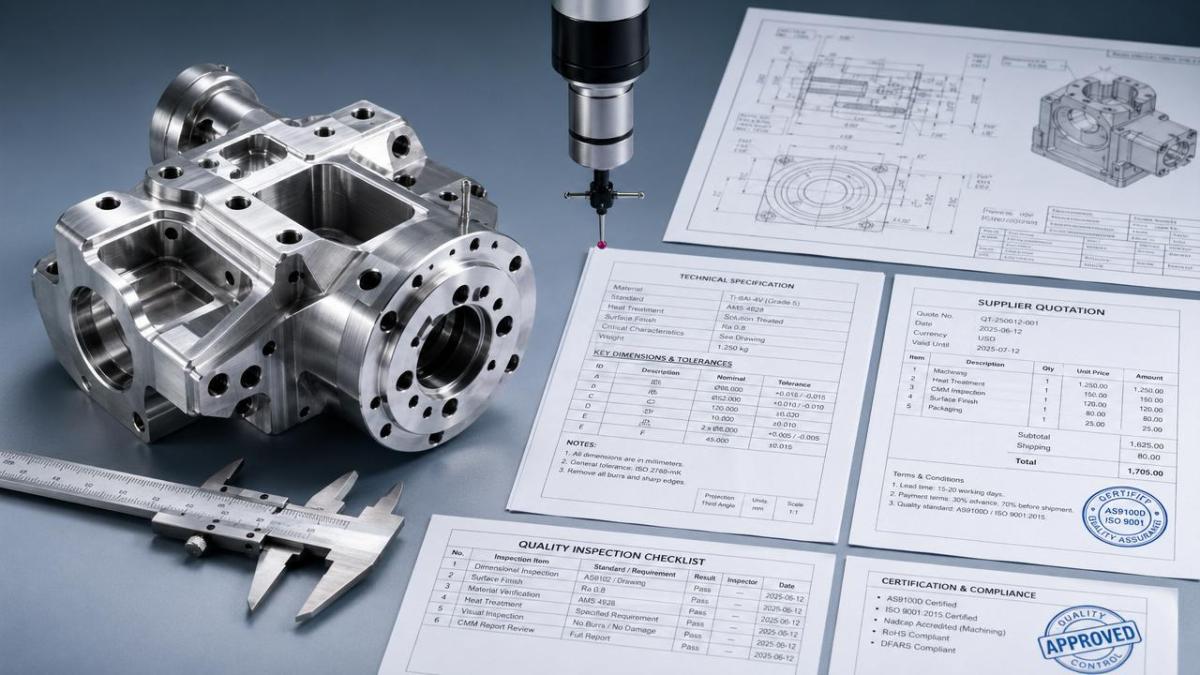
An AS9100 CNC machining tolerances chart generally provides a reference range for achievable dimensional tolerances under controlled aerospace manufacturing conditions. It helps buyers understand what is commonly feasible for milling, turning, holemaking, and complex multi-axis work on aerospace-grade materials. However, the chart should be read as a capability reference, not as an automatic guarantee for every geometry, material, or lot size.
This distinction matters because AS9100 is primarily a quality management standard for aerospace organizations. It confirms that a supplier follows documented processes, traceability, risk controls, corrective action systems, and quality discipline. It does not mean every AS9100-certified machine shop can hold the same tolerance on every feature. A chart may indicate a general capability window, but actual performance still depends on process maturity, tooling strategy, thermal control, fixture design, operator skill, and in-process inspection.
For procurement and supplier evaluation teams, the real value of the chart is as a benchmarking tool. It helps identify whether a supplier’s quoted tolerances seem conservative, aggressive, or unrealistic. If a supplier claims they can routinely hold ultra-tight tolerances across a complex aerospace part with minimal cost impact, the chart gives buyers a starting point for deeper questions. If another supplier prices the same part much higher, the chart helps reveal whether the premium is justified by actual process difficulty rather than vague quality claims.
What Commercial Aerospace Buyers Usually Need to Know First
Before reviewing individual line items in a quote, most buyers want an answer to a simpler question: is the tolerance package commercially reasonable? In many aerospace RFQs, drawings contain a mix of functional critical dimensions, legacy tolerances, and over-specified callouts added over time. A chart helps separate truly demanding features from dimensions that may be tightened on paper but do not materially affect function, fit, or certification outcomes.
That distinction has direct commercial value. A quote can rise sharply when a supplier assumes that every tight callout requires high-end tooling, slower feed rates, extra setups, 100% inspection, specialized gauging, or controlled-temperature measurement. If only a few dimensions actually drive mission performance or assembly success, buyers may have room to request tolerance rationalization before placing the order. This can reduce part cost without weakening compliance.
Business evaluators also care about comparability. Two suppliers may both state compliance with drawing requirements, but one may be planning a stable, repeatable process while another may be assuming manual intervention, rework, and elevated scrap risk. A tolerances chart does not expose all of that by itself, but it helps buyers ask better questions and challenge quotes that hide process instability behind broad quality language.
How to Read the Chart During RFQ and Quote Comparison
The best time to use an AS9100 CNC machining tolerances chart is during RFQ preparation and first-pass quote review. Start by mapping all drawing dimensions into practical categories: standard tolerances, close tolerances, critical tolerances, true position or GD&T-controlled features, surface finish requirements, and features tied to special inspection or first article reporting. The chart then helps estimate which features are likely to drive process complexity.
For example, a supplier may quote a competitive base price on a machined aerospace bracket, but the chart may suggest that several bores, datum relationships, or thin-wall features sit near the edge of normal process capability. That does not automatically mean the supplier is wrong. It means the buyer should verify how those features will be produced and measured. Will they use 5-axis machining in one setup? Will they rely on secondary finishing? Is there coordinate measuring machine verification for the critical relationship? Those questions are where commercial risk becomes visible.
Use the chart comparatively, not blindly. If one supplier prices a part much lower than others while the tolerance stack is demanding, check whether they have excluded first article inspection, process validation, special tooling, or full traceability from their initial quotation. The chart is helpful because it gives context to pricing spread. Wide quote variation often reflects not just labor rates, but radically different assumptions about how hard the tolerances will be to achieve repeatedly.
Which Tolerances Typically Drive Aerospace Quote Cost the Most
Not all tolerances affect price equally. From a sourcing perspective, the features that usually create the biggest cost increases are positional relationships, tight bore tolerances, thin-wall geometries, long unsupported features, tight flatness or perpendicularity requirements, and dimensions on difficult materials such as titanium, Inconel, or hardened stainless steel. A chart can help estimate whether these requirements fall within routine control or demand special process planning.
Material matters more than many non-technical buyers expect. A tolerance that is manageable on aluminum may become far more expensive on nickel alloys because of tool wear, heat generation, slower cutting speeds, and deformation risk. Likewise, a feature that appears simple in 2D may become difficult if it must be held after multiple operations or across a complex 5-axis geometry. When using the tolerances chart, always review the tolerance in relation to the material, feature access, and sequence of operations.
Inspection requirements are another hidden cost driver. A dimension that is tight enough to require CMM validation, custom fixturing, gage R&R discipline, or lot-by-lot traceability will often increase quote value beyond the pure machining time. For aerospace buyers, that is not necessarily a negative. In many cases, the higher quote reflects a more realistic compliance plan. The chart helps distinguish legitimate cost drivers from generic price inflation.
Why AS9100 Certification Alone Is Not Enough for Capability Validation
One of the most common sourcing mistakes is assuming that AS9100 certification equals universal machining competence. Certification is important and often non-negotiable in aerospace supply chains, but it is only one layer of evaluation. It tells you the supplier has a quality management framework aligned to aerospace expectations. It does not prove they can consistently hold the tolerances your specific part requires, on the material and geometry involved, at the quantity you need.
This is where the tolerances chart becomes useful in supplier qualification. If the drawing calls for dimensions near the limit of standard capability, buyers should request supporting evidence such as process capability data, sample inspection reports, first article examples, machine list details, thermal control practices, or recent work on similar parts. A serious supplier should be able to explain how the tolerance is achieved, not just confirm that it is “within our capability.”
For business evaluators, this approach improves decision quality without forcing them into deep manufacturing engineering. You do not need to become a machinist to ask the right questions. You only need a structured framework. The chart provides the reference point, and the supplier’s answers provide the confidence level. Together, they help verify whether the quote reflects real aerospace execution discipline.
A Practical Workflow for Using the Chart in Supplier Evaluation
A simple workflow can make the chart far more actionable. First, identify the top five to ten dimensions or GD&T requirements most likely to affect fit, flight safety, assembly reliability, or certification. Second, compare those features against a reasonable AS9100 CNC machining tolerances chart to determine whether they appear standard, moderately demanding, or highly demanding. Third, flag any feature that seems likely to require process explanation or inspection escalation.
Next, compare supplier quotations against those flagged features. Ask each supplier how they plan to hold the critical dimensions, whether multiple setups are required, what inspection methods are included, and which assumptions are built into the price. This reveals whether the quote is based on robust process planning or simply optimistic estimating. It also helps detect when low quotes are achieved by excluding quality burden that will later return as cost additions, delays, or non-conformance issues.
Finally, convert the findings into a commercial scorecard. Rather than evaluating only unit price and lead time, score suppliers on tolerance realism, inspection clarity, evidence of similar work, documentation completeness, and responsiveness to technical questions. This method aligns with TSV’s data-first philosophy: procurement confidence should be built on measurable process credibility, not marketing language or certification logos alone.
Red Flags the Chart Can Help You Catch Early
The chart is especially valuable for identifying quote risk before a purchase order is issued. One red flag is blanket acceptance of very tight tolerances without any note on process controls, inspection, or cost impact. In aerospace machining, difficult tolerances almost always have operational consequences. If the quote presents them as trivial, the supplier may be underestimating complexity or expecting to renegotiate later.
Another red flag is inconsistency between tolerance demands and production promises. For instance, if a supplier claims extremely fast lead times on a part with tight geometric relationships, difficult material, and full aerospace documentation, buyers should verify whether they are accounting for first article inspection, fixture preparation, and quality review cycles. The chart does not replace engineering judgment, but it helps flag when the commercial offer seems out of alignment with machining reality.
A third warning sign is vague language such as “machined to print” without specifics on critical features. Aerospace buyers should expect precision in both technical and commercial communication. If a supplier cannot identify which tolerances are most challenging or explain how they will verify them, that is often a stronger predictor of future problems than the quoted price itself.
How Buyers Can Use Tolerance Data to Negotiate Smarter
Used correctly, an AS9100 CNC machining tolerances chart is not just a screening tool; it is also a negotiation tool. If the chart indicates that most dimensions fall within routine capability but a few features drive disproportionate cost, buyers can discuss selective design-for-manufacturability improvements. In some cases, relaxing one non-critical tolerance, changing a corner condition, or modifying a datum strategy can reduce cost and lead time significantly without affecting function.
This is especially useful when procurement teams work with engineering, quality, and supplier development in parallel. The chart gives all parties a common reference point for discussing whether the RFQ reflects actual aerospace need or accumulated drawing conservatism. These conversations are often more productive when they are framed around process capability and risk reduction rather than price pressure alone.
Suppliers also respond better to data-backed questions than generic demands for discounts. If a buyer can point to specific tolerance categories and ask whether the cost increase is linked to setup count, inspection burden, or scrap exposure, the discussion becomes more transparent. Better transparency often leads to better commercial outcomes, whether through revised pricing, adjusted scope, or a clearer understanding of why the original quote is justified.
Final Takeaway for Commercial Evaluators
For aerospace sourcing teams, an AS9100 CNC machining tolerances chart is most valuable when it is treated as a commercial intelligence tool. It helps buyers identify which tolerances are routine, which ones are expensive, and which ones require stronger supplier proof. It also improves quote comparability by linking technical requirements to real manufacturing effort instead of relying on broad claims of quality.
The key takeaway is simple: do not use the chart to confirm that a supplier is certified. Use it to investigate whether the quoted capability, process plan, inspection burden, and price make sense together. In aerospace procurement, the real risk is rarely the existence of tight tolerances alone. The risk is approving a quote without understanding how those tolerances will be achieved consistently and documented credibly.
At a time when advanced manufacturing decisions are increasingly compressed by speed and complexity, buyers need tools that turn specifications into actionable insight. An AS9100 CNC machining tolerances chart does exactly that when used with discipline. It gives commercial evaluators a clearer way to judge feasibility, challenge ambiguity, and source with greater confidence in both performance and compliance.
Search News
Hot Articles
- Carbon Fiber StructuresHow to Specify Aerospace Carbon Fiber Assemblies for Lightweight, Load-Bearing PartsJul 11, 2026
- Machine VisionXiaomi, Alibaba DAMO Academy Drive Open-Source Robotics Model Ecosystem, Lowering Algorithm Development Barriers for Overseas SMEs Adopting Chinese Robotics SolutionsMar 30, 2026
- Cobots & ArmsShanxi 'AI+' Conference Showcases Embodied Intelligence with Multinational Buyer Engagement: Key Industry ImplicationsMar 30, 2026
Popular Tags
Recommended News
 Jul 11, 2026How to Specify Aerospace Carbon Fiber Assemblies for Lightweight, Load-Bearing PartsAerospace carbon fiber assemblies: learn how to specify laminate design, load data, joining methods, and inspection controls for lighter, reliable load-bearing aerospace parts.Elena Rostova (UAV Systems Researcher)
 Mar 30, 2026Xiaomi, Alibaba DAMO Academy Drive Open-Source Robotics Model Ecosystem, Lowering Algorithm Development Barriers for Overseas SMEs Adopting Chinese Robotics SolutionsXiaomi & Alibaba DAMO Academy's open-source robotics models lower algorithm barriers for global SMEs. Boost efficiency in manufacturing, logistics & smart retail with ROS 2 compatible solutions.TSV Data Lab
 Mar 30, 2026Shanxi 'AI+' Conference Showcases Embodied Intelligence with Multinational Buyer Engagement: Key Industry ImplicationsShanxi 'AI+' Conference highlights embodied intelligence with Tesla, Ubtech & Jiantao showcasing multimodal robotics. 40+ global buyers validated tech on-site, creating new B2B channels for industrial automation & AI solutions.Chen Wei (Automation Lead Engineer)
 Mar 30, 2026Zhongguancun Unveils 6G Integrated Sensing-Computing-Intelligence Platform to Empower Embodied Robots for Global Industrial ApplicationsZhongguancun's new 6G platform revolutionizes industrial robotics with <10ms latency, empowering global automotive, logistics & port automation. Discover how this tech boosts China's smart manufacturing exports.TSV Data Lab
 Mar 30, 2026Mech-Mind Tianjin Embodied Intelligence R&D and Production Base Goes Live, Cutting Delivery Time by 20%–30% for Global Customized AMR+Vision SolutionsMech-Mind's Tianjin AMR+Vision production base cuts delivery time by 20%-30% for欧美 & Latin American markets. Discover how this PLd-certified facility accelerates customized robotics solutions for smart manufacturing and logistics.Chen Wei (Automation Lead Engineer)
 Mar 30, 2026Boao Forum Reveals 'Co-evolution of Big and Small Brains' Trend in Humanoid Robots, China's Embodied Intelligence Accelerates Adaptation to Overseas Manufacturing Service ScenariosDiscover how China's humanoid robots, featuring 'Co-evolution of Big and Small Brains,' are revolutionizing global manufacturing. Learn about Embodied Tian Gong 3.0's ISO compliance and overseas deployment at Boao Forum 2026.Chen Wei (Automation Lead Engineer)
 Mar 30, 2026China Railway Industrial Secures Patent for Embodied Robotics in Material Handling, Boosting High-Precision Delivery Capabilities for Overseas Infrastructure and Manufacturing ProjectsChina Railway Industrial's new patent for embodied robotics in material handling boosts high-precision delivery for global infrastructure & manufacturing. Discover how this innovation enhances logistics accuracy in automotive, rail transit & EPC projects.Chen Wei (Automation Lead Engineer)
 Oct 28, 2026IDC: Global Quadruped Robot Shipments Rise 92.5% in H1 2026 as Volume and Value DivergeGlobal quadruped robot shipments rose 92.5% in H1 2026, according to IDC. Explore what diverging volume and value trends mean for industrial buyers and manufacturers.Chen Wei (Automation Lead Engineer)
 Oct 28, 2026Interpreting Industrial IoT Latency Data for Monitoring and Real-Time ControlInterpret industrial category latency data to assess jitter, deadline misses, and real-time readiness. Learn how to benchmark IIoT systems and choose monitoring and control solutions.TSV Data Lab
 Oct 27, 2026GXO and Agility Robotics Expand Partnership to Accelerate US Humanoid Robot DeploymentGXO and Agility Robotics plan to expand US humanoid robot deployment with Digit 4 in early 2027. Explore warehouse automation plans, service terms and future Digit 5 upgrades.Chen Wei (Automation Lead Engineer)
 Oct 27, 2026Robotic Automation Costs: Budgeting for Equipment, Integration, and MaintenancePlan your robotics automation cost with confidence. Explore equipment, integration, and maintenance expenses, compare quotes, and build a realistic budget for better ROI.Chen Wei (Automation Lead Engineer)
 Oct 26, 2026AMAXiMAL Releases Open-Source TopMod 3D v3 With Claude AIExplore AMAXiMAL’s free, open-source TopMod 3D v3 with Claude AI assistance, topology-based modeling and plywood fabrication tools that connect complex designs to physical builds.Dr. Marcus Vance
 Oct 26, 2026Choosing a SCADA System Integrator Company: PLC Compatibility and Long-Term SupportChoose a scada system integrator company with proven PLC compatibility and reliable long-term support. Discover what to test, compare, and require before investing.Victor Lin (Chief Software Architect)
 Oct 25, 2026Hesai Leads Global ADAS Main Lidar Shipments in Yole’s 2026 ReportHesai led global ADAS main lidar shipments with a 43% share in 2025, according to Yole’s 2026 report. Explore what this ranking reveals about its automotive market position.TSV Data Lab
 Oct 25, 2026Choosing an Aerospace Materials Manufacturer: Quality and Traceability ChecksChoosing an aerospace materials manufacturer? Learn how to verify certifications, test reports, and lot traceability to qualify suppliers confidently and reduce costly sourcing risks.Dr. Marcus Vance
 Oct 24, 2026Guotai Haitong: Global Entry-Level 3D Printer Shipments Rose 39% in Q1 2026Entry-level 3D printer shipments rose 39% in Q1 2026, Guotai Haitong reports. Explore how AI, multicolor printing and print farms are shaping market growth.Dr. Marcus Vance
 Oct 24, 2026Choosing an Industrial Vision Inspection Supplier: Acceptance Tests That MatterChoose an industrial vision inspection supplier with confidence. Discover acceptance tests for defect detection, false rejects, production speed, and reliable part rejection before you buy.TSV Data Lab
 Oct 23, 2026US Navy Raises Gecko Robotics Contract Ceiling to $300M for Robotic Fleet MaintenanceUS Navy raises Gecko Robotics’ contract ceiling to $300M for Pacific Fleet robotic inspections. Explore potential opportunities for maintenance suppliers and key procurement considerations.Chen Wei (Automation Lead Engineer)
 Oct 23, 2026Choosing Industrial Sensing Systems for Global Plants: Protocol CompatibilityCompare industrial sensing systems international buyers can trust. Explore protocol compatibility, reduce integration risks, and select proven configurations for reliable global plant deployments.TSV Data Lab
 Oct 22, 2026KUKA Showcases Physical AI and iiQKA.AI Vision at NVIDIA GTC BerlinExplore KUKA’s Physical AI showcase at NVIDIA GTC Berlin and discover how iiQKA.AI Vision aims to simplify robotic vision integration and improve 2D and 3D scene recognition.TSV Data Lab
 Oct 22, 2026Robotic Machining of Advanced Composites: What Tolerances Are Achievable?Explore advanced materials machining robotics: discover what drives achievable composite tolerances and how to validate accuracy before investing in your next machining system.Dr. Marcus Vance
 Oct 21, 2026China’s Industrial Robot Exports Near RMB 10 Billion in First Nine Months of 2026China’s industrial robot exports neared RMB 10 billion in January–September 2026, with value rising faster than volume. Explore the data and what it could mean for suppliers.Chen Wei (Automation Lead Engineer)
 Oct 21, 2026Low-Latency Industrial Data Processing: Pricing and Key Cost DriversExplore industrial data latency price drivers, from edge hardware to integration and support. Learn how to compare quotes, verify performance, and avoid unnecessary costs.TSV Data Lab
 Oct 20, 2026KUKA Launches iiQKA.AI Vision to Simplify Industrial Image ProcessingKUKA iiQKA.AI Vision simplifies industrial image processing with controller-based 2D and 3D vision. Explore drag-and-drop setup for vision-guided automation.TSV Data Lab