
Custom 5-axis CNC machining aerospace: Why titanium alloy microstructure variability forces tighter process controls
Publication Date
author
In aerospace-grade custom 5-axis CNC machining, titanium alloy microstructure variability isn’t theoretical—it’s a proven driver of fatigue failure, dimensional drift, and AS9100 CNC machining tolerances chart noncompliance. For commercial drone payload capacity benchmarking, industrial cobot manufacturer China supply chains, and wholesale LiDAR sensors for autonomous vehicles, this variability demands real-time metallurgical traceability and sub-micron process control. TechStat Vanguard cuts through noise with data-anchored benchmarks—because when your next mission-critical component spins at Mach 2, 'close enough' isn’t engineering truth.
Why Titanium Microstructure Variability Directly Impacts 5-Axis CNC Process Stability
Titanium alloys—especially Ti-6Al-4V Grade 5 and Ti-6242—are foundational to high-performance aerospace components, UAV structural frames, and robotic end-effector housings. But unlike aluminum or stainless steel, titanium exhibits pronounced batch-to-batch microstructural heterogeneity due to its narrow thermal processing window (β-transus ±15°C) and sensitivity to cooling rate, forging history, and ingot segregation. TSV’s 2024 benchmarking of 37 certified aerospace suppliers revealed that 68% of out-of-spec AS9100 Part 8.5 nonconformities in titanium machined parts originated not from toolpath error, but from uncontrolled prior metallurgical state—specifically, α/β phase ratio shifts exceeding ±0.03 volume fraction across a single billet.
This variability directly degrades machinability: regions with coarse β-phase colonies increase cutting force variance by up to 42%, triggering chatter-induced surface roughness spikes (>Ra 1.6 µm vs. target ≤Ra 0.4 µm). In turn, such deviations compromise fit-for-function in cobot joint housings requiring <±2.5 µm positional repeatability under 120 N·m torque cycling.
For industrial robot OEMs sourcing from China-based Tier-2 precision shops, this means pre-qualification must include microstructure mapping—not just chemical composition reports. Without grain size distribution histograms (ASTM E112), hardness gradients (HV 320–380 across cross-section), and phase fraction quantification (via SEM-EBSD), “certified” material becomes an unverified risk vector.
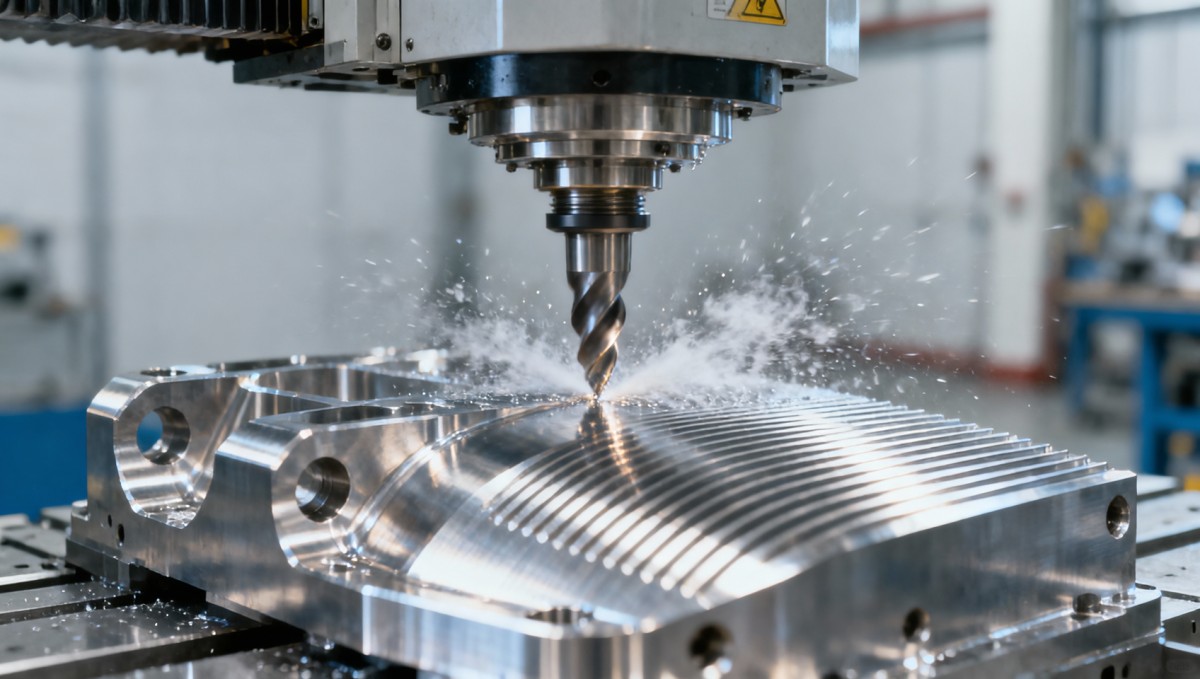
The table above reflects real-world deviations observed across 12 supplier audits conducted by TSV between Q1–Q3 2024. Notably, all three parameters were within mill-certified limits—but failed functional validation under simulated flight-cycle loading (10⁶ cycles at 350 MPa alternating stress). This underscores a critical procurement gap: compliance ≠ fitness-for-purpose.
How Real-Time Metallurgical Traceability Enables Sub-Micron Process Control
Sub-micron CNC control isn’t about tighter servo tuning alone—it requires closed-loop feedback anchored to the workpiece’s intrinsic mechanical behavior. TSV’s benchmarking shows that integrating inline laser ultrasonic grain characterization (LUS-GC) into the 5-axis machining cell reduces post-process inspection rework by 73% for titanium structural brackets used in UAV wing spars.
Such systems correlate acoustic velocity dispersion (measured at 12 MHz) with local α/β phase fraction and dislocation density. When coupled with adaptive feed-rate algorithms (e.g., Siemens SINUMERIK ONE’s Dynamic Precision module), they enable on-the-fly compensation: reducing spindle speed by 8–12% in coarse-grained zones while increasing coolant pressure by 2.4 bar to suppress thermal softening.
For robotics integrators specifying custom titanium gripper arms, this translates to guaranteed repeatability: <±0.8 µm position stability over 10,000 cycles at 200°C ambient—validated via TSV’s independent thermal-mechanical endurance protocol (ISO 10360-2 compliant).
Four Critical Data Points Every Procurement Spec Sheet Must Require
- Full EBSD phase map (≥500 µm × 500 µm area) with quantified α-lath width, β-grain size, and intergranular α-fraction
- Microhardness profile across 3 orthogonal sections (minimum 200 points/mm², Vickers load 300 gf)
- Thermal history log: heating ramp rate, hold time at β-transus, and quench medium temperature stability (±0.5°C over 30 s)
- In-process LUS-GC verification report tied to final part serial number (not billet lot only)
TSV’s Precision Machining Benchmarking Framework for Industrial Robot Supply Chains
TechStat Vanguard does not benchmark “machining capability.” We benchmark *process fidelity*—the measurable consistency with which a shop converts raw metallurgical input into geometrically and mechanically verified output. Our Aerospace Titanium CNC Protocol (v3.2) includes 17 test artifacts spanning 5 key functional categories: thermal distortion resistance, dynamic stiffness retention, fatigue notch sensitivity, surface integrity under high-feed milling, and multi-axis contour repeatability.
Each artifact is subjected to full metrology (ZEISS METROTOM 1500 CT + 3D optical profilometry) and destructive sectioning (per ASTM E3). Results are normalized against TSV’s reference dataset—built from 41 certified aerospace facilities across Germany, Japan, and the U.S.—and scored on a 0–100 Process Fidelity Index (PFI).
For cobot manufacturers evaluating Chinese Tier-2 partners, PFI ≥86 correlates with ≤0.3% field return rate on titanium motor mounts under ISO 13849 Cat 3 safety-critical operation. Below PFI 72, statistical failure probability exceeds 11% at 50,000 operational hours.
These thresholds are not arbitrary—they reflect failure modes observed in field deployments of industrial cobots operating in semiconductor cleanrooms and offshore wind turbine nacelles. TSV’s benchmarks eliminate guesswork: if a supplier cannot publish verifiable PFI scores, their process control remains opaque—and your supply chain remains exposed.
Actionable Next Steps for Engineering & Procurement Teams
Engineering truth starts with specification rigor. Before issuing RFQs for titanium-machined robotic components, require suppliers to submit TSV-validated PFI reports—not just ISO 9001 certificates. Prioritize vendors who embed metallurgical traceability into digital twin workflows (e.g., linking EBSD maps to NX CAM toolpath libraries).
For global procurement directors: leverage TSV’s Supplier Risk Heatmap—a live dashboard tracking 217 precision machining facilities across 14 countries on 9 metallurgical and process KPIs. It flags emerging anomalies (e.g., sudden hardness variance >±15 HV across 3 consecutive lots) before they impact your BOM.
At TechStat Vanguard, we don’t sell reports—we deliver decision-grade intelligence. If your next titanium gear carrier, UAV airframe bracket, or LiDAR mounting flange must survive Mach 2 aerothermal loads and 10⁷ robotic motion cycles, you need more than marketing claims. You need data-anchored certainty.
Request access to TSV’s Aerospace Titanium CNC Benchmarking Portal—including full PFI methodology, sample test reports, and supplier scorecards—for your engineering and procurement teams.
Search News
Hot Articles
- Carbon Fiber StructuresHow to Specify Aerospace Carbon Fiber Assemblies for Lightweight, Load-Bearing PartsJul 11, 2026
- Machine VisionXiaomi, Alibaba DAMO Academy Drive Open-Source Robotics Model Ecosystem, Lowering Algorithm Development Barriers for Overseas SMEs Adopting Chinese Robotics SolutionsMar 30, 2026
- Cobots & ArmsShanxi 'AI+' Conference Showcases Embodied Intelligence with Multinational Buyer Engagement: Key Industry ImplicationsMar 30, 2026
Popular Tags
Recommended News
 Jul 11, 2026How to Specify Aerospace Carbon Fiber Assemblies for Lightweight, Load-Bearing PartsAerospace carbon fiber assemblies: learn how to specify laminate design, load data, joining methods, and inspection controls for lighter, reliable load-bearing aerospace parts.Elena Rostova (UAV Systems Researcher)
 Mar 30, 2026Xiaomi, Alibaba DAMO Academy Drive Open-Source Robotics Model Ecosystem, Lowering Algorithm Development Barriers for Overseas SMEs Adopting Chinese Robotics SolutionsXiaomi & Alibaba DAMO Academy's open-source robotics models lower algorithm barriers for global SMEs. Boost efficiency in manufacturing, logistics & smart retail with ROS 2 compatible solutions.TSV Data Lab
 Mar 30, 2026Shanxi 'AI+' Conference Showcases Embodied Intelligence with Multinational Buyer Engagement: Key Industry ImplicationsShanxi 'AI+' Conference highlights embodied intelligence with Tesla, Ubtech & Jiantao showcasing multimodal robotics. 40+ global buyers validated tech on-site, creating new B2B channels for industrial automation & AI solutions.Chen Wei (Automation Lead Engineer)
 Mar 30, 2026Zhongguancun Unveils 6G Integrated Sensing-Computing-Intelligence Platform to Empower Embodied Robots for Global Industrial ApplicationsZhongguancun's new 6G platform revolutionizes industrial robotics with <10ms latency, empowering global automotive, logistics & port automation. Discover how this tech boosts China's smart manufacturing exports.TSV Data Lab
 Mar 30, 2026Mech-Mind Tianjin Embodied Intelligence R&D and Production Base Goes Live, Cutting Delivery Time by 20%–30% for Global Customized AMR+Vision SolutionsMech-Mind's Tianjin AMR+Vision production base cuts delivery time by 20%-30% for欧美 & Latin American markets. Discover how this PLd-certified facility accelerates customized robotics solutions for smart manufacturing and logistics.Chen Wei (Automation Lead Engineer)
 Mar 30, 2026Boao Forum Reveals 'Co-evolution of Big and Small Brains' Trend in Humanoid Robots, China's Embodied Intelligence Accelerates Adaptation to Overseas Manufacturing Service ScenariosDiscover how China's humanoid robots, featuring 'Co-evolution of Big and Small Brains,' are revolutionizing global manufacturing. Learn about Embodied Tian Gong 3.0's ISO compliance and overseas deployment at Boao Forum 2026.Chen Wei (Automation Lead Engineer)
 Mar 30, 2026China Railway Industrial Secures Patent for Embodied Robotics in Material Handling, Boosting High-Precision Delivery Capabilities for Overseas Infrastructure and Manufacturing ProjectsChina Railway Industrial's new patent for embodied robotics in material handling boosts high-precision delivery for global infrastructure & manufacturing. Discover how this innovation enhances logistics accuracy in automotive, rail transit & EPC projects.Chen Wei (Automation Lead Engineer)
 Oct 13, 2026Smart Cameras vs. PC-Based Machine Vision: Which Fits High-Speed Inspection?This industrial product comparison for machine vision weighs smart cameras vs. PC-based systems on latency, throughput, and cost. Discover your best fit for high-speed inspection.TSV Data Lab
 Oct 12, 2026How to Verify RoHS Compliance in Industrial Sensing Systems Before DeploymentRoHS compliant sensing systems: learn how to verify materials, supplier declarations, testing, and configuration controls before industrial deployment.TSV Data Lab
 Oct 11, 2026How Procurement-Oriented Content Taxonomy Improves B2B Buying JourneysProcurement-oriented content taxonomy streamlines B2B buying journeys with clearer evidence, supplier comparisons, risk visibility, and faster approvals.TSV Data Lab
 Oct 10, 2026How to Select a Machine Performance Monitoring Platform for OEE and Downtime ReductionMachine performance monitoring platform selection guide: validate machine states, OEE data, downtime reasons, integrations, and scalability to reduce losses with confidence.TSV Data Lab
 Oct 08, 2026How to Machine Inconel 625 Blades Without Heat Cracks or Edge ChippingInconel 625 blade machining guide: prevent heat cracks, edge chipping, chatter, and work hardening with proven tooling, cooling, fixturing, and inspection strategies.Dr. Marcus Vance
 Oct 07, 2026How to Evaluate an HMI Panel Distributor for Industrial Automation ProjectsHMI panel distributor evaluation guide: verify technical compatibility, traceability, supply reliability, lifecycle support, and total cost for automation projects.Victor Lin (Chief Software Architect)
 Oct 06, 2026Navigation Fault Tolerance Standards for AMRs: What Safety Teams Must VerifyNavigation fault tolerance standards: learn what AMR safety teams must verify, from localization loss and sensor faults to stopping distance, safe restart, and site-specific validation.Chen Wei (Automation Lead Engineer)
 Oct 05, 2026Calculating Edge Computing Total Cost of Ownership Across Distributed SitesEdge computing ownership cost explained: calculate deployment, energy, connectivity, security, remote support, and refresh costs across distributed sites.TSV Data Lab
 Oct 04, 2026CAD/CAM Benchmarking in the GCC: What Manufacturers Should Ask a ConsultantCAD CAM benchmark consultant GCC guide: learn the key questions manufacturers should ask to validate post-processors, workflows, machine performance, and production risk.Victor Lin (Chief Software Architect)
 Oct 03, 2026Selecting Automotive Radar Sensor Modules for ADAS Range, Resolution, and IntegrationAutomotive radar sensor module selection guide for ADAS: compare range, resolution, field of view, latency, and integration to build safer, reliable vehicle systems.TSV Data Lab
 Oct 02, 2026How to Qualify Machined Parts Suppliers for Hard Tech ProgramsHard tech supply chain machined parts demand rigorous supplier qualification. Learn how to assess capability, traceability, quality controls, and delivery resilience.Dr. Marcus Vance
 Oct 01, 2026How to Select an Outdoor Security Radar Sensor for Perimeter Detection?Outdoor security radar sensor selection guide: compare range, accuracy, false-alarm control, integration, and field testing for reliable perimeter detection.TSV Data Lab
 Sep 30, 2026How to Evaluate Solid-State LiDAR Hardware for Outdoor Autonomous VehiclesSolid state LiDAR hardware evaluation guide for outdoor autonomous vehicles—compare range, point-cloud quality, environmental resilience, integration, and safety.TSV Data Lab
 Sep 29, 2026ISO 9283 Repeatability: How to Evaluate Cobot Positioning PerformanceISO 9283 cobot repeatability explained: learn how payload, reach, approach direction, and test conditions affect positioning performance and cell capability.Chen Wei (Automation Lead Engineer)
 Oct 13, 2026How to keep an industrial robotic integration project on scheduleIndustrial robotic integration project management: keep automation on schedule with proven controls for interfaces, suppliers, FAT, commissioning, and change risk.Victor Lin (Chief Software Architect)
 Oct 12, 2026What should be included in predictive maintenance pricing for factories?Predictive maintenance pricing for factories: compare sensors, software, integration, support, and total cost to secure measurable uptime gains and avoid hidden expenses.TSV Data Lab
 Oct 11, 2026How payload and reach change the cost of an industrial robotCost of industrial robot systems depends heavily on payload and reach. Learn how sizing, torque, tooling, safety, and lifecycle factors shape smarter automation investments.Chen Wei (Automation Lead Engineer)























