
Aerospace Machining in Europe: Key Standards, Materials, and Supplier Evaluation Criteria
Publication Date
author
Aerospace Machining in Europe: Key Standards, Materials, and Supplier Evaluation Criteria
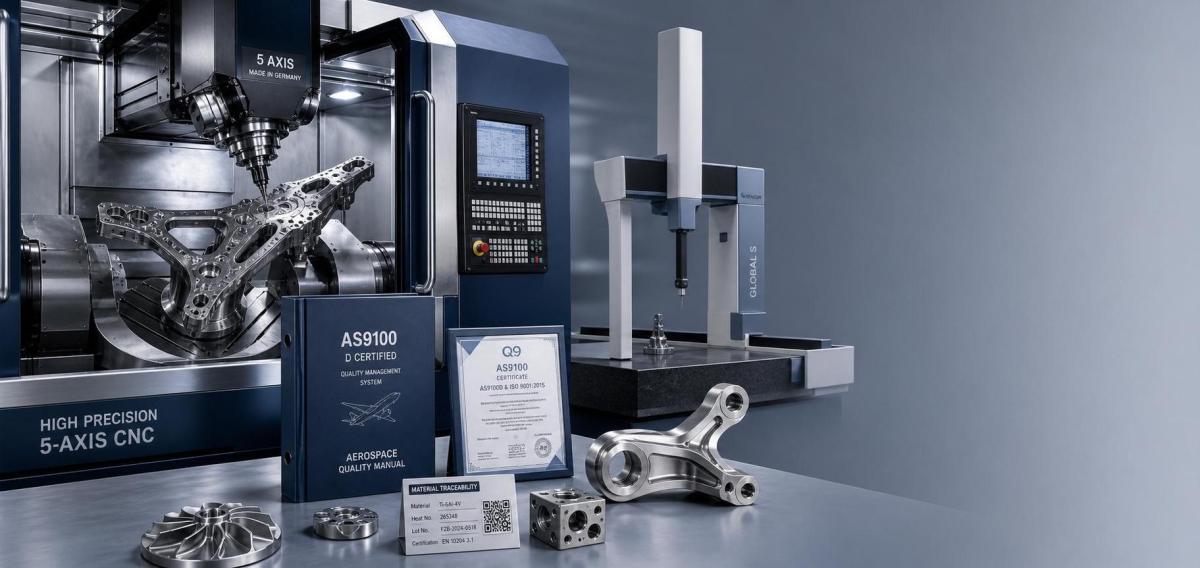
Aerospace machining in Europe demands more than broad supplier claims. It calls for verified standards, controlled materials, and measurable process capability.
For sourcing teams, the real issue is not finding a machine shop. It is finding one that can prove repeatable aerospace performance under audit pressure.
That is why aerospace machining in Europe is closely tied to certification depth, documentation quality, and production discipline.
In practice, supplier selection often breaks down around three questions. Which standards apply, which materials create the most risk, and how should capability be verified before award?
A clear answer to those questions helps reduce launch delays, nonconformance costs, and supplier onboarding cycles across a regulated aerospace supply chain.
Why Aerospace Machining in Europe Requires a Different Sourcing Lens
European aerospace programs operate inside a dense compliance environment. Requirements often combine global quality systems with customer-specific clauses and regional documentation expectations.
This means aerospace machining in Europe is rarely evaluated on price and lead time alone. Technical evidence matters earlier in the sourcing process.
More buyers now ask for process validation records, FAIR discipline, raw material traceability, and subcontractor control before releasing even low-volume packages.
A supplier may have advanced 5-axis capacity. That alone does not confirm stable performance on flight-critical geometries or difficult nickel-based alloys.
The stronger signal is consistency. Can the supplier hold tolerance over multiple batches, shifts, machines, and external audits?
The Standards That Matter Most
Any review of aerospace machining in Europe should start with standards. They define the baseline for quality systems, process control, inspection, and product release.
AS9100 as the Core Quality Gate
AS9100 remains the primary quality framework for aerospace machining suppliers. It extends ISO 9001 with aerospace-specific controls for risk, traceability, and configuration management.
A valid certificate is necessary, but it is not enough. The scope should explicitly cover machining activities, not generic manufacturing language.
EN Standards and Customer Flow-Downs
European aerospace contracts frequently reference EN standards for materials, testing, and documentation. Customer drawings may also include Airbus, Safran, Leonardo, or other OEM flow-down requirements.
This is where some sourcing projects stall. A capable shop may still struggle if it cannot interpret layered technical requirements correctly.
NADCAP for Special Processes
Machining rarely stands alone. Heat treatment, coating, NDT, and chemical processing often sit downstream, and these processes can determine final acceptance.
If a supplier outsources special processes, review NADCAP status and supplier control methods carefully. Weak subcontractor governance creates hidden risk.
FAIR and Inspection Discipline
AS9102 First Article Inspection is still a major checkpoint in aerospace machining in Europe. Mature suppliers prepare FAIR packages cleanly and respond quickly to drawing deltas.
Material Expertise Is Often the True Differentiator
When evaluating aerospace machining in Europe, material knowledge usually separates acceptable vendors from reliable long-term partners.
Aerospace parts may require titanium, Inconel, stainless grades, aluminum aerospace alloys, or high-performance engineering plastics. Each material changes the machining strategy.
Titanium can generate heat and tool wear quickly. Inconel pushes cycle time, tool life, and dimensional stability much harder than many suppliers first estimate.
Aluminum seems easier, but thin-wall aerospace structures still require strong fixture design and distortion control. Surface integrity also matters more than many RFQs indicate.
For this reason, ask for recent part families by material type, not just a broad capability statement. Evidence should match the alloy and geometry you plan to source.
- Raw material certificates with full heat traceability
- Experience with aerospace alloys under similar tolerance bands
- Tool wear management for difficult-to-machine materials
- Control plans for burrs, residual stress, and surface finish
- Defined response for material substitution restrictions
What to Check During Supplier Evaluation
A practical review model makes aerospace machining in Europe easier to compare across suppliers. It also reduces bias from polished sales presentations.
1. Process Capability
Look beyond machine lists. Ask how critical dimensions are controlled, how offsets are managed, and how capability data is recorded for repeat jobs.
2. Metrology Depth
CMM access matters, but so does measurement planning. The supplier should understand datum strategy, inspection frequency, and gauge calibration discipline.
3. Documentation Control
For aerospace machining in Europe, paperwork is part of the product. Missing revision control, incomplete certificates, or weak lot traceability can stop shipment.
4. Supply Chain Governance
Review approved vendors for raw material, plating, heat treatment, and NDT. A strong machining supplier still depends on disciplined upstream and downstream partners.
5. Change Management
Unexpected changes in tooling, routing, subcontractors, or inspection plans should trigger formal review. Informal changes are a serious warning sign.
A Simple Comparison Table for Shortlisting
The table below helps structure a sourcing review for aerospace machining in Europe. It keeps technical and commercial factors in the same decision frame.
Common Sourcing Risks in Aerospace Machining in Europe
Several recurring issues appear during supplier qualification. Most are avoidable if they are checked early.
- Certificates exist, but the scope does not match aerospace machining activities
- Material traceability stops at the distributor rather than the original mill
- Supplier experience is strong in general machining, but weak in flight hardware
- Quoted tolerances are accepted without a capability review
- Special process outsourcing is not controlled tightly enough
- Lead times ignore inspection bottlenecks and FAIR documentation work
From a decision standpoint, these risks usually cost more than a higher unit price from a better-qualified source.
How to Build a Better RFQ for Aerospace Machining in Europe
A better RFQ improves supplier selection before negotiations even begin. It also makes quote comparisons more meaningful.
- Specify applicable standards, including AS9100, AS9102, and any EN or customer flow-down requirements.
- State material grade, approved sources, and traceability expectations in exact terms.
- Mark critical characteristics and define inspection deliverables clearly.
- List special processes and whether in-house or approved subcontracting is required.
- Request examples of similar aerospace programs, not generic company profiles.
- Ask for risk notes with the quote. Strong suppliers usually identify issues early.
This approach fits the wider TSV view of engineering truth through data. Solid sourcing decisions depend on verifiable evidence, not broad marketing language.
Final Decision Criteria That Hold Up Under Audit
The best aerospace machining in Europe is not defined by one certificate or one impressive machine tool. It is defined by repeatability across the full manufacturing chain.
A strong supplier can show standards compliance, alloy-specific know-how, inspection discipline, and controlled subcontracting without hesitation.
For procurement decisions, the most dependable shortlist usually comes from suppliers that make technical risk visible early and back every claim with records.
That is the practical benchmark for aerospace machining in Europe today. Better data leads to better qualification, smoother launches, and fewer surprises after award.
Search News
Hot Articles
- Carbon Fiber StructuresHow to Specify Aerospace Carbon Fiber Assemblies for Lightweight, Load-Bearing PartsJul 11, 2026
- Machine VisionXiaomi, Alibaba DAMO Academy Drive Open-Source Robotics Model Ecosystem, Lowering Algorithm Development Barriers for Overseas SMEs Adopting Chinese Robotics SolutionsMar 30, 2026
- Cobots & ArmsShanxi 'AI+' Conference Showcases Embodied Intelligence with Multinational Buyer Engagement: Key Industry ImplicationsMar 30, 2026
Popular Tags
Recommended News
 Jul 11, 2026How to Specify Aerospace Carbon Fiber Assemblies for Lightweight, Load-Bearing PartsAerospace carbon fiber assemblies: learn how to specify laminate design, load data, joining methods, and inspection controls for lighter, reliable load-bearing aerospace parts.Elena Rostova (UAV Systems Researcher)
 Mar 30, 2026Xiaomi, Alibaba DAMO Academy Drive Open-Source Robotics Model Ecosystem, Lowering Algorithm Development Barriers for Overseas SMEs Adopting Chinese Robotics SolutionsXiaomi & Alibaba DAMO Academy's open-source robotics models lower algorithm barriers for global SMEs. Boost efficiency in manufacturing, logistics & smart retail with ROS 2 compatible solutions.TSV Data Lab
 Mar 30, 2026Shanxi 'AI+' Conference Showcases Embodied Intelligence with Multinational Buyer Engagement: Key Industry ImplicationsShanxi 'AI+' Conference highlights embodied intelligence with Tesla, Ubtech & Jiantao showcasing multimodal robotics. 40+ global buyers validated tech on-site, creating new B2B channels for industrial automation & AI solutions.Chen Wei (Automation Lead Engineer)
 Mar 30, 2026Zhongguancun Unveils 6G Integrated Sensing-Computing-Intelligence Platform to Empower Embodied Robots for Global Industrial ApplicationsZhongguancun's new 6G platform revolutionizes industrial robotics with <10ms latency, empowering global automotive, logistics & port automation. Discover how this tech boosts China's smart manufacturing exports.TSV Data Lab
 Mar 30, 2026Mech-Mind Tianjin Embodied Intelligence R&D and Production Base Goes Live, Cutting Delivery Time by 20%–30% for Global Customized AMR+Vision SolutionsMech-Mind's Tianjin AMR+Vision production base cuts delivery time by 20%-30% for欧美 & Latin American markets. Discover how this PLd-certified facility accelerates customized robotics solutions for smart manufacturing and logistics.Chen Wei (Automation Lead Engineer)
 Mar 30, 2026Boao Forum Reveals 'Co-evolution of Big and Small Brains' Trend in Humanoid Robots, China's Embodied Intelligence Accelerates Adaptation to Overseas Manufacturing Service ScenariosDiscover how China's humanoid robots, featuring 'Co-evolution of Big and Small Brains,' are revolutionizing global manufacturing. Learn about Embodied Tian Gong 3.0's ISO compliance and overseas deployment at Boao Forum 2026.Chen Wei (Automation Lead Engineer)
 Mar 30, 2026China Railway Industrial Secures Patent for Embodied Robotics in Material Handling, Boosting High-Precision Delivery Capabilities for Overseas Infrastructure and Manufacturing ProjectsChina Railway Industrial's new patent for embodied robotics in material handling boosts high-precision delivery for global infrastructure & manufacturing. Discover how this innovation enhances logistics accuracy in automotive, rail transit & EPC projects.Chen Wei (Automation Lead Engineer)
 Oct 14, 2026Drone Frame Composites: Carbon Fiber vs. Fiberglass for Weight and StiffnessExplore drone structural materials composites: compare carbon fiber and fiberglass for weight, stiffness, cost, and antenna compatibility. Find the right material for your drone frame.Elena Rostova (UAV Systems Researcher)
 Oct 13, 2026Smart Cameras vs. PC-Based Machine Vision: Which Fits High-Speed Inspection?This industrial product comparison for machine vision weighs smart cameras vs. PC-based systems on latency, throughput, and cost. Discover your best fit for high-speed inspection.TSV Data Lab
 Oct 12, 2026How to Verify RoHS Compliance in Industrial Sensing Systems Before DeploymentRoHS compliant sensing systems: learn how to verify materials, supplier declarations, testing, and configuration controls before industrial deployment.TSV Data Lab
 Oct 11, 2026How Procurement-Oriented Content Taxonomy Improves B2B Buying JourneysProcurement-oriented content taxonomy streamlines B2B buying journeys with clearer evidence, supplier comparisons, risk visibility, and faster approvals.TSV Data Lab
 Oct 10, 2026How to Select a Machine Performance Monitoring Platform for OEE and Downtime ReductionMachine performance monitoring platform selection guide: validate machine states, OEE data, downtime reasons, integrations, and scalability to reduce losses with confidence.TSV Data Lab
 Oct 08, 2026How to Machine Inconel 625 Blades Without Heat Cracks or Edge ChippingInconel 625 blade machining guide: prevent heat cracks, edge chipping, chatter, and work hardening with proven tooling, cooling, fixturing, and inspection strategies.Dr. Marcus Vance
 Oct 07, 2026How to Evaluate an HMI Panel Distributor for Industrial Automation ProjectsHMI panel distributor evaluation guide: verify technical compatibility, traceability, supply reliability, lifecycle support, and total cost for automation projects.Victor Lin (Chief Software Architect)
 Oct 06, 2026Navigation Fault Tolerance Standards for AMRs: What Safety Teams Must VerifyNavigation fault tolerance standards: learn what AMR safety teams must verify, from localization loss and sensor faults to stopping distance, safe restart, and site-specific validation.Chen Wei (Automation Lead Engineer)
 Oct 05, 2026Calculating Edge Computing Total Cost of Ownership Across Distributed SitesEdge computing ownership cost explained: calculate deployment, energy, connectivity, security, remote support, and refresh costs across distributed sites.TSV Data Lab
 Oct 04, 2026CAD/CAM Benchmarking in the GCC: What Manufacturers Should Ask a ConsultantCAD CAM benchmark consultant GCC guide: learn the key questions manufacturers should ask to validate post-processors, workflows, machine performance, and production risk.Victor Lin (Chief Software Architect)
 Oct 03, 2026Selecting Automotive Radar Sensor Modules for ADAS Range, Resolution, and IntegrationAutomotive radar sensor module selection guide for ADAS: compare range, resolution, field of view, latency, and integration to build safer, reliable vehicle systems.TSV Data Lab
 Oct 02, 2026How to Qualify Machined Parts Suppliers for Hard Tech ProgramsHard tech supply chain machined parts demand rigorous supplier qualification. Learn how to assess capability, traceability, quality controls, and delivery resilience.Dr. Marcus Vance
 Oct 01, 2026How to Select an Outdoor Security Radar Sensor for Perimeter Detection?Outdoor security radar sensor selection guide: compare range, accuracy, false-alarm control, integration, and field testing for reliable perimeter detection.TSV Data Lab
 Sep 30, 2026How to Evaluate Solid-State LiDAR Hardware for Outdoor Autonomous VehiclesSolid state LiDAR hardware evaluation guide for outdoor autonomous vehicles—compare range, point-cloud quality, environmental resilience, integration, and safety.TSV Data Lab
 Sep 29, 2026ISO 9283 Repeatability: How to Evaluate Cobot Positioning PerformanceISO 9283 cobot repeatability explained: learn how payload, reach, approach direction, and test conditions affect positioning performance and cell capability.Chen Wei (Automation Lead Engineer)
 Oct 14, 2026How tight can micro machining aerospace tolerances be in production?Micro machining aerospace tolerances can reach low-micron levels in production. Learn what controls repeatability, inspection confidence, and flight-critical quality.Dr. Marcus Vance
 Oct 13, 2026How to keep an industrial robotic integration project on scheduleIndustrial robotic integration project management: keep automation on schedule with proven controls for interfaces, suppliers, FAT, commissioning, and change risk.Victor Lin (Chief Software Architect)























