CODESYS runtime latency test results that actually matter
Publication Date
author
For technical evaluators, a codesys runtime latency test is only useful when the data reflects real deployment risk, not lab-friendly averages. This article focuses on the latency results that actually affect control stability, edge responsiveness, and procurement decisions, helping you separate meaningful engineering signals from benchmark noise and judge whether a CODESYS runtime can meet demanding industrial workloads.
What does a codesys runtime latency test really measure?
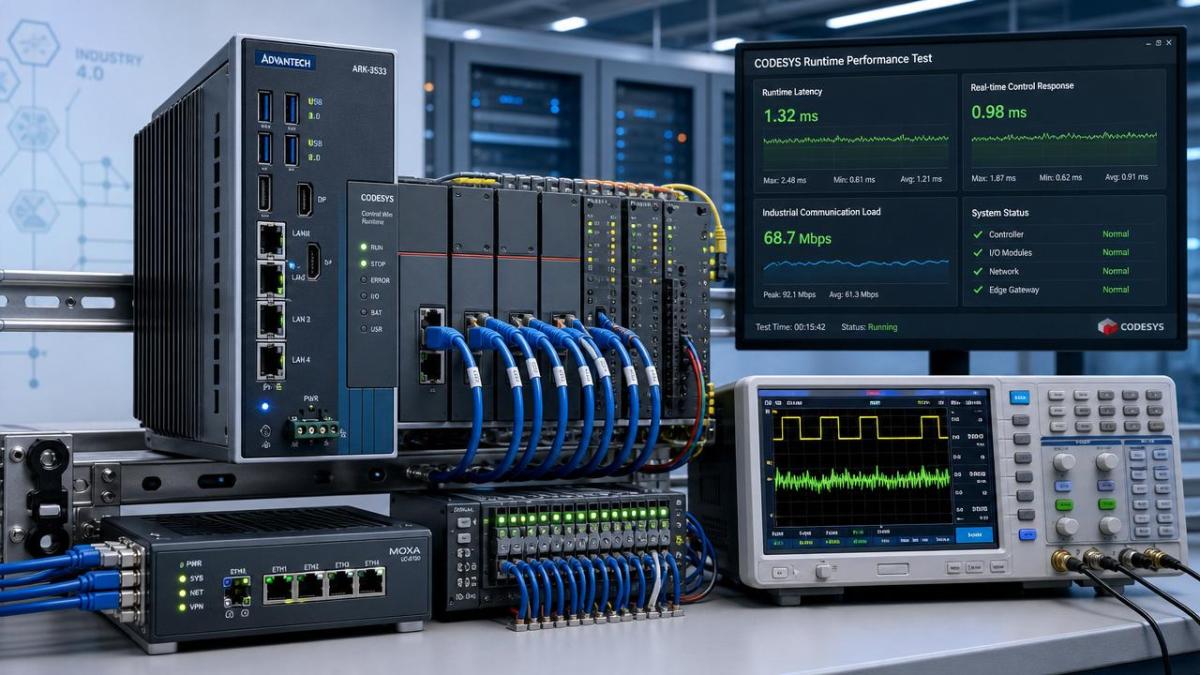
In industrial control, latency is not a single number. A useful codesys runtime latency test examines how long the runtime takes to execute scheduled tasks, react to input changes, exchange field data, and recover under CPU, memory, and network pressure. For evaluators comparing PLC soft runtime platforms, the meaningful question is not “What is the average scan time?” but “How bad does latency become when the system is loaded in the way our plant, machine, or vehicle will actually load it?”
That distinction matters because averages hide control risk. A runtime that reports a neat average of 2 ms may still produce 20 ms spikes during visualization refresh, data logging, protocol conversion, or edge analytics. In robotics, motion coordination may drift. In UAV ground systems, telemetry handling may queue. In machine vision cells, trigger alignment may slip. In distributed automation, such spikes become procurement problems, commissioning delays, and warranty disputes.
At TechStat Vanguard, the priority is always engineering truth rather than vendor-friendly presentation. For a codesys runtime latency test to support a serious decision, it should identify deterministic behavior, worst-case jitter, task preemption behavior, overload thresholds, and the conditions under which response time degrades from acceptable to operationally unsafe.
- Task cycle latency: actual delay between scheduled task release and execution start.
- Jitter: variance around the target cycle time, especially under mixed workloads.
- I/O reaction delay: time from physical or simulated input change to logic response.
- Communication latency coupling: effect of OPC UA, Modbus TCP, EtherCAT gateways, or MQTT traffic on control tasks.
- Overload behavior: whether latency grows gradually, abruptly, or unpredictably once CPU headroom disappears.
Which latency results actually matter in real deployment?
Technical evaluators often receive benchmark summaries that emphasize best-case timing. That is rarely enough for procurement approval. What matters is whether the runtime preserves timing integrity across realistic scenarios such as HMI activity, historian writes, fieldbus traffic bursts, or edge inferencing workloads. The table below shows which codesys runtime latency test outputs deserve the most attention during supplier screening.
A strong codesys runtime latency test therefore prioritizes distribution, tails, and operating context. For most evaluators, the 99th percentile and worst observed events are more decision-relevant than a polished average. This is especially true in advanced manufacturing, edge control, and mixed-protocol environments where timing pressure is not constant.
Why average latency can mislead procurement teams
Average latency is attractive because it is easy to market and easy to compare. Yet it fails to capture the operational cost of intermittent failure. A machine can run for hours with nominal timing and still lose batches, trigger nuisance faults, or produce synchronization drift because rare spikes occur during the wrong state transition. Evaluators who sign off using only mean cycle time often discover that the practical issue was not throughput, but timing integrity during edge cases.
Common causes of hidden latency spikes
- Shared CPU contention between control logic, visualization, database writes, and protocol stacks.
- Operating system background activity when the runtime is deployed on non-dedicated industrial PCs.
- Burst traffic from supervisory systems polling tags faster than the architecture was sized to handle.
- I/O driver overhead and gateway translation when multiple buses coexist in one node.
- Memory pressure, logging bursts, or poorly prioritized tasks in the application design.
This is why TSV-style evaluation insists on context-rich evidence. Parameters do not lie, but incomplete parameters do mislead. A purchasing team comparing platforms for robotics, packaging, process skids, autonomous support equipment, or sensor fusion gateways should ask for load-state behavior, not just baseline numbers.
How to structure a meaningful codesys runtime latency test
A practical test plan should mirror the workload profile of the target system. The goal is not to make the runtime fail theatrically. The goal is to understand when timing margins become narrow enough to threaten stability, product quality, or compliance obligations. For technical evaluators, that means defining task classes, load sources, measurement windows, and pass or review thresholds before the test starts.
- Map the control architecture: cyclic tasks, event tasks, communication services, logging, HMI, analytics, and redundancy functions.
- Define deployment hardware clearly: CPU class, core count, memory, storage type, industrial OS, and virtualization status.
- Test at multiple load levels, such as idle, normal, heavy, and overload, instead of a single “typical” state.
- Capture percentile latency, peak jitter, missed cycles, and recovery time after bursts or interruptions.
- Repeat long enough to expose drift, not just startup behavior or short demo windows.
The following parameter guide can help translate a codesys runtime latency test into procurement language. It does not prescribe one universal threshold, because tolerable latency depends on the application. It does, however, define the signals that should drive a technical acceptance discussion.
When suppliers cannot provide this level of structure, evaluators should treat claimed latency performance as incomplete evidence. Lack of test transparency often creates more downstream cost than a slightly higher but honestly characterized latency profile.
Which scenarios are most sensitive to CODESYS runtime latency?
Not every industrial workload needs the same timing discipline. A codesys runtime latency test matters most where response consistency directly affects physical behavior, closed-loop stability, or synchronized data value. This includes more than classic PLC cells. In modern hard-tech systems, software runtimes now sit closer to robotics, edge AI, sensor fusion, remote diagnostics, and autonomous support functions.
High-impact application categories
- Robotics and automation cells where deterministic timing affects path consistency, station handoff, and cycle repeatability.
- AGV and AMR support infrastructure where gateway control and traffic coordination depend on low-latency state exchange.
- Industrial IoT edge nodes that combine control with protocol aggregation, local analytics, and cloud forwarding.
- UAV ground or payload subsystems where telemetry synchronization and actuator command timing must remain predictable.
- Precision machining and process skids where recipe execution and alarm handling need stable scan behavior across long shifts.
In each of these cases, a single latency figure is insufficient. Evaluators should compare control criticality, communication load, and future feature expansion. A platform acceptable for a pump skid may not be acceptable for a machine with tightly coordinated subassemblies or deterministic event timing requirements.
How should technical evaluators compare suppliers and platforms?
Comparing runtimes is difficult because the software layer, operating environment, fieldbus design, and application structure all influence results. The right comparison method is therefore not brand rhetoric but normalized test logic. Below is a practical comparison framework for a codesys runtime latency test during RFQ, pilot, or design freeze stages.
This comparison approach helps procurement teams align engineering evidence with commercial risk. It also supports supplier traceability, because benchmark claims can be tied back to disclosed setup conditions rather than broad promises.
What standards, compliance, and documentation should support the test?
A codesys runtime latency test usually sits inside a broader qualification process. Depending on the sector, evaluators may need documentation that supports machine safety assessments, cybersecurity review, software validation, or regulated manufacturing controls. While no single standard defines every acceptable latency threshold, disciplined documentation helps prove that performance claims are relevant to the intended use.
- Document software version, runtime configuration, operating system build, and hardware revision used in testing.
- Record network topology, fieldbus update rates, task priorities, and logging policies that affect timing.
- Where applicable, align test evidence with machine risk assessment and functional design verification records.
- If the system will operate in aerospace-adjacent, medical-adjacent, or high-traceability environments, retain change-control discipline for benchmark repeatability.
For evaluators in cross-border sourcing programs, this documentation discipline is often as important as the latency number itself. It shortens supplier qualification cycles and makes engineering discussions evidence-driven rather than argumentative.
Common misconceptions about codesys runtime latency test results
Several recurring misunderstandings distort buying decisions. They usually appear when teams inherit marketing summaries instead of raw engineering context.
Misconception 1: lower average latency always means a better runtime
Not necessarily. A slightly slower but highly stable runtime can outperform a faster-looking setup with poor jitter behavior. Control quality depends on consistency, not just speed.
Misconception 2: lab results transfer directly to the field
Only if hardware, services, I/O behavior, and communication load remain comparable. In actual deployments, extra functions frequently consume the timing margin that benchmarks never disclosed.
Misconception 3: communication latency and runtime latency can be assessed separately
In many architectures they interact. Protocol load, tag polling, and gateway translation can change task timing enough to alter control behavior. Isolation is useful for diagnosis, but integrated testing is essential for acceptance.
FAQ: what do technical evaluators ask most often?
How do I know whether a codesys runtime latency test is realistic?
Check whether the test includes your intended task structure, communication pattern, hardware class, and run duration. If the supplier cannot explain workload composition, percentile behavior, and overload response, the result is probably too abstract for procurement approval.
Which metric should I prioritize first?
Start with worst-case and 99th percentile timing under realistic load, then review input-to-logic response and missed cycle behavior. Those indicators usually expose practical deployment risk faster than average scan time alone.
Is a codesys runtime latency test only important for high-speed motion systems?
No. It also matters in distributed process control, alarm handling, edge gateway control, coordinated machine sequencing, and any system where delayed logic can create quality drift, nuisance stops, or synchronization faults.
What should be included in an RFQ or evaluation checklist?
Request hardware details, software version, task map, test duration, load conditions, percentile and peak latency data, communication profile, and explanation of mitigation options if timing limits are approached. This converts the codesys runtime latency test from a sales artifact into a technical decision tool.
Why choose us for data-driven runtime evaluation?
TechStat Vanguard approaches control benchmarking the way advanced manufacturing teams actually need it: by stripping away ambiguous claims and focusing on parameter-level evidence. If you are assessing a codesys runtime latency test for automation, edge control, UAV support systems, sensor gateways, or precision equipment integration, we help translate raw timing data into deployment risk, supplier comparability, and specification language.
You can contact us for specific evaluation support including parameter confirmation, test methodology review, supplier comparison logic, hardware headroom analysis, delivery-risk screening, customization scope discussion, compliance documentation alignment, and quotation-stage technical clarification. For teams facing tight timelines or uncertain vendor claims, that means fewer trial-and-error loops and faster movement from benchmark noise to engineering truth.
Search News
Hot Articles
- Carbon Fiber StructuresHow to Specify Aerospace Carbon Fiber Assemblies for Lightweight, Load-Bearing PartsJul 11, 2026
- Machine VisionXiaomi, Alibaba DAMO Academy Drive Open-Source Robotics Model Ecosystem, Lowering Algorithm Development Barriers for Overseas SMEs Adopting Chinese Robotics SolutionsMar 30, 2026
- Cobots & ArmsShanxi 'AI+' Conference Showcases Embodied Intelligence with Multinational Buyer Engagement: Key Industry ImplicationsMar 30, 2026
Popular Tags
Recommended News
 Jul 11, 2026How to Specify Aerospace Carbon Fiber Assemblies for Lightweight, Load-Bearing PartsAerospace carbon fiber assemblies: learn how to specify laminate design, load data, joining methods, and inspection controls for lighter, reliable load-bearing aerospace parts.Elena Rostova (UAV Systems Researcher)
 Mar 30, 2026Xiaomi, Alibaba DAMO Academy Drive Open-Source Robotics Model Ecosystem, Lowering Algorithm Development Barriers for Overseas SMEs Adopting Chinese Robotics SolutionsXiaomi & Alibaba DAMO Academy's open-source robotics models lower algorithm barriers for global SMEs. Boost efficiency in manufacturing, logistics & smart retail with ROS 2 compatible solutions.TSV Data Lab
 Mar 30, 2026Shanxi 'AI+' Conference Showcases Embodied Intelligence with Multinational Buyer Engagement: Key Industry ImplicationsShanxi 'AI+' Conference highlights embodied intelligence with Tesla, Ubtech & Jiantao showcasing multimodal robotics. 40+ global buyers validated tech on-site, creating new B2B channels for industrial automation & AI solutions.Chen Wei (Automation Lead Engineer)
 Mar 30, 2026Zhongguancun Unveils 6G Integrated Sensing-Computing-Intelligence Platform to Empower Embodied Robots for Global Industrial ApplicationsZhongguancun's new 6G platform revolutionizes industrial robotics with <10ms latency, empowering global automotive, logistics & port automation. Discover how this tech boosts China's smart manufacturing exports.TSV Data Lab
 Mar 30, 2026Mech-Mind Tianjin Embodied Intelligence R&D and Production Base Goes Live, Cutting Delivery Time by 20%–30% for Global Customized AMR+Vision SolutionsMech-Mind's Tianjin AMR+Vision production base cuts delivery time by 20%-30% for欧美 & Latin American markets. Discover how this PLd-certified facility accelerates customized robotics solutions for smart manufacturing and logistics.Chen Wei (Automation Lead Engineer)
 Mar 30, 2026Boao Forum Reveals 'Co-evolution of Big and Small Brains' Trend in Humanoid Robots, China's Embodied Intelligence Accelerates Adaptation to Overseas Manufacturing Service ScenariosDiscover how China's humanoid robots, featuring 'Co-evolution of Big and Small Brains,' are revolutionizing global manufacturing. Learn about Embodied Tian Gong 3.0's ISO compliance and overseas deployment at Boao Forum 2026.Chen Wei (Automation Lead Engineer)
 Mar 30, 2026China Railway Industrial Secures Patent for Embodied Robotics in Material Handling, Boosting High-Precision Delivery Capabilities for Overseas Infrastructure and Manufacturing ProjectsChina Railway Industrial's new patent for embodied robotics in material handling boosts high-precision delivery for global infrastructure & manufacturing. Discover how this innovation enhances logistics accuracy in automotive, rail transit & EPC projects.Chen Wei (Automation Lead Engineer)
 Sep 29, 2026ISO 9283 Repeatability: How to Evaluate Cobot Positioning PerformanceISO 9283 cobot repeatability explained: learn how payload, reach, approach direction, and test conditions affect positioning performance and cell capability.Chen Wei (Automation Lead Engineer)
 Sep 28, 2026Spindle Runout Measurement in Germany: DIN Standards, Methods, and Acceptance LimitsSpindle runout measurement Germany: explore DIN standards, proven methods, acceptance limits, and audit-ready practices for reliable machining quality.Dr. Marcus Vance
 Sep 27, 2026How to Select Wall-Mount Edge Devices for Space-Constrained Factory NetworksWall mount edge devices for space-constrained factories: evaluate workload, thermal design, power resilience, cable access, and network reliability for smarter deployments.TSV Data Lab
 Sep 26, 2026Machining Tolerance Analysis: How to Set Limits That Meet Function and Cost TargetsMachining tolerance analysis: learn how to set functional limits, control tolerance stacks, reduce inspection risk, and balance precision with production cost.Dr. Marcus Vance
 Sep 25, 2026How to Evaluate an Industrial Infrastructure Data Platform for Multi-Site OperationsIndustrial infrastructure data platform evaluation guide for multi-site operations: compare data quality, edge resilience, interoperability, governance, and scalable proof-of-value criteria.Victor Lin (Chief Software Architect)
 Sep 24, 2026How to Select Machine Vision Optics for Accurate Inspection at Different Working DistancesMachine vision optics selection guide for accurate inspection at every working distance. Compare FOV, pixel scale, DOF, distortion, lighting, and telecentric options.TSV Data Lab
 Sep 23, 2026How to Evaluate a Machine Vision System Integrator for High-Speed Inspection LinesChoose a machine vision system integrator with proven expertise in high-speed inspection, reliable reject timing, robust optics, and measurable acceptance criteria.TSV Data Lab
 Sep 28, 2026When is a SCADA API the right choice for connecting plant systems?SCADA API guide: learn when governed plant data integration improves traceability, security, and scalability—without compromising real-time control.Victor Lin (Chief Software Architect)
 Sep 27, 2026How SCADA data integration improves traceability across production linesSCADA data integration connects production-line data to improve traceability, accelerate quality investigations, and strengthen safety decisions.Victor Lin (Chief Software Architect)
 Sep 26, 2026What to define before starting SCADA integration planningSCADA integration planning starts with clear scope, control boundaries, data models, cybersecurity, and testing. Discover the definitions that reduce risk and costly rework.Victor Lin (Chief Software Architect)
 Sep 25, 2026How a smart factory with Industrial IoT reduces production blind spotsDiscover how a smart factory with Industrial IoT turns real-time machine, quality, and workflow data into actionable insights that reduce production blind spots and delivery risks.Victor Lin (Chief Software Architect)
 Sep 24, 2026When does Industrial IoT make smart manufacturing easier to scale?Smart manufacturing Industrial IoT scales when trusted data, interoperable systems, and secure workflows turn connected assets into measurable gains.TSV Data Lab
 Sep 23, 2026What drives ultra-precision machining cost at 1-micron tolerance?Ultra precision machining cost per part at 1 micron tolerance depends on process, material, metrology, and yield. Learn how to compare quotes confidently.Dr. Marcus Vance
 Sep 22, 2026Drone Engine-T550CC Applications: Build the UAV Power System Around the MissionAn application guide for Drone Engine-T550CC integration, covering payload planning, airframe matching, cooling, fuel, vibration, test procedures, documentation, and service preparation.Elena Rostova (UAV Systems Researcher)
 Sep 22, 2026How to Evaluate Industrial Edge Computing Vendors for Factory DeploymentIndustrial edge computing vendor evaluation guide for factories: compare latency, protocol fit, reliability, security, and lifecycle support before deployment.TSV Data Lab
 Sep 21, 2026Drone Payload Integration: Matching Power, Data, and Center of Gravity for Reliable FlightsDrone payload integration made practical: balance power, data, center of gravity, and endurance to build safer, more reliable mission-ready flights.Elena Rostova (UAV Systems Researcher)
 Sep 20, 2026Autonomous Navigation Pricing: Cost Drivers and Budget Benchmarks for AMR ProjectsAutonomous navigation price explained: compare AMR cost drivers, software, sensors, integration, safety, and lifecycle budgets to build a scalable project plan.Chen Wei (Automation Lead Engineer)