
Office Partitions Wholesale: How to Compare Materials, Lead Times, and MOQs
Publication Date
author
Why does office partitions wholesale require more than a simple price comparison?
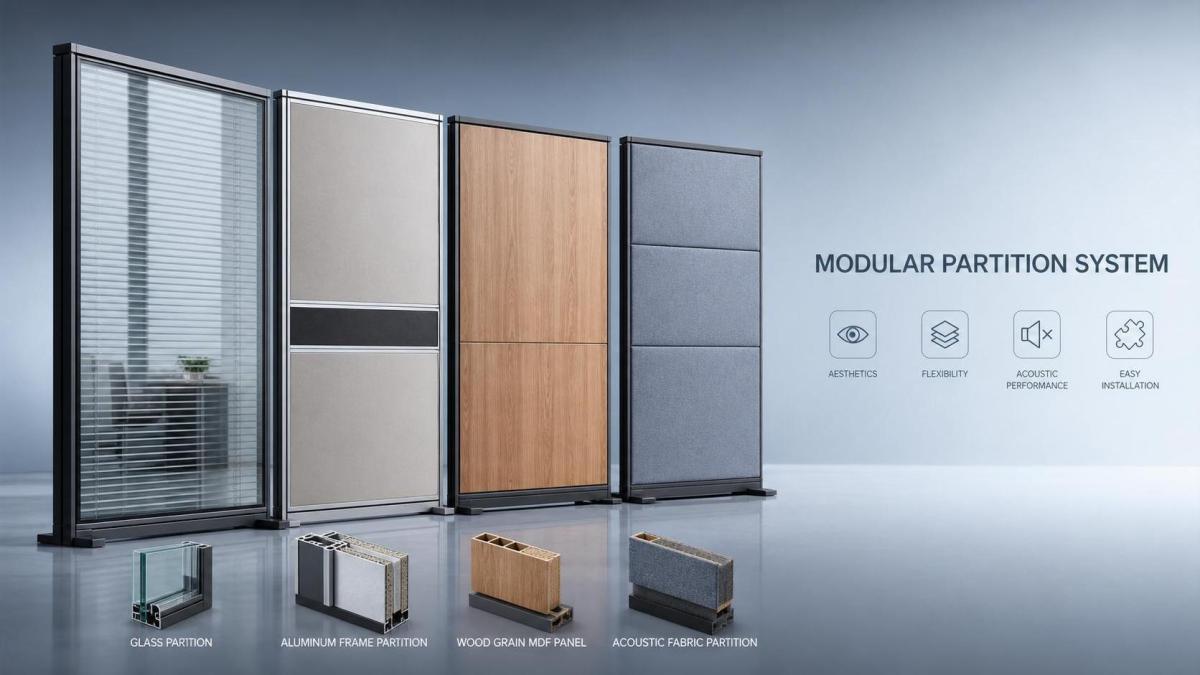
In office partitions wholesale, the visible unit price is only one layer of the decision.
The larger cost sits in rework, damaged panels, delayed fit-out schedules, and poor acoustic results after installation.
That is why experienced sourcing teams compare technical and commercial variables together, not in isolation.
For most projects, the real questions are practical.
Will the partition system meet the workplace layout?
Can the supplier hold tolerances across repeated batches?
Will the lead time support the construction sequence without idle labor?
Can the MOQ fit phased rollouts instead of forcing excess inventory?
TechStat Vanguard often frames procurement questions through measurable evidence.
That mindset matters here as much as in hard-tech sourcing.
Parameters do not lie.
Even in commercial interiors, specifications, tolerances, and process discipline usually predict supplier reliability better than polished brochures.
Which materials are actually worth comparing in office partitions wholesale?
Most office partitions wholesale options fall into a few common material families.
The right choice depends on acoustic targets, visual style, durability, and installation method.
Glass partitions are often selected for transparency and daylight flow.
However, buyers should verify tempered or laminated glass type, thickness, frame compatibility, and sound insulation data.
Aluminum-framed systems remain common because they balance rigidity, modularity, and manageable transport weight.
What matters is profile thickness, finish consistency, and connection strength at corners and joints.
Melamine, laminate, or MDF panel partitions usually compete on cost.
They can work well for private rooms or budget-sensitive fit-outs.
The tradeoff is moisture sensitivity, edge wear, and a shorter visual life in high-traffic spaces.
Fabric-wrapped acoustic panels are useful where speech privacy matters more than visual openness.
In practice, these systems need closer review of core density, NRC or STC data, and fabric abrasion resistance.
A quick comparison helps separate appearance from performance.
A lower-cost panel may still be the better choice if replacement cycles are short.
But for multi-site deployment, consistency often outweighs small unit savings.
How should lead times be evaluated when schedules keep changing?
Published lead times in office partitions wholesale are often optimistic.
A quote may show four weeks, while actual delivery depends on drawings, finish approvals, hardware availability, and container consolidation.
A more useful approach is to split lead time into stages.
- Shop drawing confirmation and revision cycle
- Raw material preparation
- Production and finishing
- Quality inspection and packing
- International shipping or domestic delivery
This breakdown exposes where the real schedule risk sits.
For custom office partitions wholesale orders, finish approval delays are especially common.
Powder-coat color, glass film, and panel texture can each add extra days.
It also helps to ask whether the supplier stocks standard profiles.
Stocked systems usually reduce volatility more than simply choosing the cheapest vendor.
In data-driven sourcing, schedule promises should be tested against production capacity, not just sales language.
Requesting recent on-time delivery records for similar orders is a practical filter.
Are MOQs negotiable, or do they usually hide other cost issues?
MOQ in office partitions wholesale is rarely arbitrary.
It usually reflects setup cost, material purchasing thresholds, packaging efficiency, or export handling economics.
That said, MOQ is often more flexible than first quotes suggest.
The key is understanding what drives it.
If the MOQ comes from custom extrusion or special glass dimensions, negotiation space may be limited.
If it comes from mixed-model handling or color complexity, standardizing specifications can lower the threshold.
A common mistake is forcing a low MOQ while ignoring total landed cost.
Smaller batches may raise unit price, freight cost, and spare-part mismatch risk.
More efficient office partitions wholesale programs often use one of three tactics.
- Bundle several rooms or sites into one standard specification set
- Use phased deliveries under a single production agreement
- Lock core components, while varying only surface finishes
These methods reduce waste without creating avoidable inventory pressure.
What specifications should be verified before comparing wholesale quotes?
This is where many office partitions wholesale evaluations go off track.
Quotes may look comparable, but the underlying specification set is often uneven.
Before judging price, confirm that each supplier is quoting the same technical basis.
The shortlist below catches most hidden differences.
TSV’s broader philosophy is relevant here.
Remove vague claims and force every supplier response back to measurable values.
That simple discipline improves quote quality fast.
Where do buyers usually make mistakes in office partitions wholesale?
One common error is overvaluing visual samples.
A neat mockup does not confirm production repeatability across a full project batch.
Another is ignoring packaging and site handling.
Fragile glass, corner damage, and missing hardware often erase the benefit of a lower quote.
There is also a tendency to compare office partitions wholesale offers without clarifying installation scope.
Some prices exclude anchors, sealants, doors, or adjustment accessories.
The cost gap then appears smaller than it really is.
More careful sourcing usually includes these checks.
- Ask for a bill of materials tied to drawings
- Confirm whether test reports are current and relevant
- Review spare-part availability for future expansion
- Check tolerance control for modular alignment
- Request references from similar completed layouts
In short, the safest office partitions wholesale decision usually comes from specification discipline rather than aggressive bargaining alone.
So how do you move from quote collection to a reliable decision?
A workable decision path starts with defining the non-negotiables.
That typically includes layout constraints, acoustic needs, compliance standards, finish expectations, and target delivery windows.
Then compare office partitions wholesale offers against the same scorecard.
Do not let one supplier win on price while another is carrying more complete scope.
A practical scorecard often weighs material performance, lead time reliability, MOQ fit, documentation quality, and after-sales support.
This is also where a TSV-style evidence filter helps.
If a claim cannot be linked to a specification, a test report, or a process record, it should carry less weight.
For the next step, build a comparison sheet before sending RFQs.
List exact materials, tolerances, hardware scope, certifications, packaging requirements, lead time milestones, and acceptable MOQ ranges.
That one document reduces noise, speeds quote alignment, and makes office partitions wholesale decisions far easier to defend internally.
Search News
Hot Articles
- Carbon Fiber StructuresHow to Specify Aerospace Carbon Fiber Assemblies for Lightweight, Load-Bearing PartsJul 11, 2026
- Machine VisionXiaomi, Alibaba DAMO Academy Drive Open-Source Robotics Model Ecosystem, Lowering Algorithm Development Barriers for Overseas SMEs Adopting Chinese Robotics SolutionsMar 30, 2026
- Cobots & ArmsShanxi 'AI+' Conference Showcases Embodied Intelligence with Multinational Buyer Engagement: Key Industry ImplicationsMar 30, 2026
Popular Tags
Recommended News
 Jul 11, 2026How to Specify Aerospace Carbon Fiber Assemblies for Lightweight, Load-Bearing PartsAerospace carbon fiber assemblies: learn how to specify laminate design, load data, joining methods, and inspection controls for lighter, reliable load-bearing aerospace parts.Elena Rostova (UAV Systems Researcher)
 Mar 30, 2026Xiaomi, Alibaba DAMO Academy Drive Open-Source Robotics Model Ecosystem, Lowering Algorithm Development Barriers for Overseas SMEs Adopting Chinese Robotics SolutionsXiaomi & Alibaba DAMO Academy's open-source robotics models lower algorithm barriers for global SMEs. Boost efficiency in manufacturing, logistics & smart retail with ROS 2 compatible solutions.TSV Data Lab
 Mar 30, 2026Shanxi 'AI+' Conference Showcases Embodied Intelligence with Multinational Buyer Engagement: Key Industry ImplicationsShanxi 'AI+' Conference highlights embodied intelligence with Tesla, Ubtech & Jiantao showcasing multimodal robotics. 40+ global buyers validated tech on-site, creating new B2B channels for industrial automation & AI solutions.Chen Wei (Automation Lead Engineer)
 Mar 30, 2026Zhongguancun Unveils 6G Integrated Sensing-Computing-Intelligence Platform to Empower Embodied Robots for Global Industrial ApplicationsZhongguancun's new 6G platform revolutionizes industrial robotics with <10ms latency, empowering global automotive, logistics & port automation. Discover how this tech boosts China's smart manufacturing exports.TSV Data Lab
 Mar 30, 2026Mech-Mind Tianjin Embodied Intelligence R&D and Production Base Goes Live, Cutting Delivery Time by 20%–30% for Global Customized AMR+Vision SolutionsMech-Mind's Tianjin AMR+Vision production base cuts delivery time by 20%-30% for欧美 & Latin American markets. Discover how this PLd-certified facility accelerates customized robotics solutions for smart manufacturing and logistics.Chen Wei (Automation Lead Engineer)
 Mar 30, 2026Boao Forum Reveals 'Co-evolution of Big and Small Brains' Trend in Humanoid Robots, China's Embodied Intelligence Accelerates Adaptation to Overseas Manufacturing Service ScenariosDiscover how China's humanoid robots, featuring 'Co-evolution of Big and Small Brains,' are revolutionizing global manufacturing. Learn about Embodied Tian Gong 3.0's ISO compliance and overseas deployment at Boao Forum 2026.Chen Wei (Automation Lead Engineer)
 Mar 30, 2026China Railway Industrial Secures Patent for Embodied Robotics in Material Handling, Boosting High-Precision Delivery Capabilities for Overseas Infrastructure and Manufacturing ProjectsChina Railway Industrial's new patent for embodied robotics in material handling boosts high-precision delivery for global infrastructure & manufacturing. Discover how this innovation enhances logistics accuracy in automotive, rail transit & EPC projects.Chen Wei (Automation Lead Engineer)
 Oct 15, 2026R&D Cost Reduction Services: How to Evaluate Fees, Savings, and ROIEvaluate R&D cost reduction services with confidence. Compare fees, verify savings, and calculate ROI without compromising performance. Discover how to choose a provider that delivers real value.Chen Wei (Automation Lead Engineer)
 Oct 15, 2026How Should You Compare TechStat Vanguard 5-Axis CNC Tolerances?TechStat Vanguard 5-axis CNC tolerance comparison: learn how to verify part accuracy, assess inspection evidence, and choose suppliers that reliably meet your drawing requirements.Dr. Marcus Vance
 Oct 14, 2026Drone Frame Composites: Carbon Fiber vs. Fiberglass for Weight and StiffnessExplore drone structural materials composites: compare carbon fiber and fiberglass for weight, stiffness, cost, and antenna compatibility. Find the right material for your drone frame.Elena Rostova (UAV Systems Researcher)
 Oct 13, 2026Smart Cameras vs. PC-Based Machine Vision: Which Fits High-Speed Inspection?This industrial product comparison for machine vision weighs smart cameras vs. PC-based systems on latency, throughput, and cost. Discover your best fit for high-speed inspection.TSV Data Lab
 Oct 12, 2026How to Verify RoHS Compliance in Industrial Sensing Systems Before DeploymentRoHS compliant sensing systems: learn how to verify materials, supplier declarations, testing, and configuration controls before industrial deployment.TSV Data Lab
 Oct 11, 2026How Procurement-Oriented Content Taxonomy Improves B2B Buying JourneysProcurement-oriented content taxonomy streamlines B2B buying journeys with clearer evidence, supplier comparisons, risk visibility, and faster approvals.TSV Data Lab
 Oct 10, 2026How to Select a Machine Performance Monitoring Platform for OEE and Downtime ReductionMachine performance monitoring platform selection guide: validate machine states, OEE data, downtime reasons, integrations, and scalability to reduce losses with confidence.TSV Data Lab
 Oct 08, 2026How to Machine Inconel 625 Blades Without Heat Cracks or Edge ChippingInconel 625 blade machining guide: prevent heat cracks, edge chipping, chatter, and work hardening with proven tooling, cooling, fixturing, and inspection strategies.Dr. Marcus Vance
 Oct 07, 2026How to Evaluate an HMI Panel Distributor for Industrial Automation ProjectsHMI panel distributor evaluation guide: verify technical compatibility, traceability, supply reliability, lifecycle support, and total cost for automation projects.Victor Lin (Chief Software Architect)
 Oct 06, 2026Navigation Fault Tolerance Standards for AMRs: What Safety Teams Must VerifyNavigation fault tolerance standards: learn what AMR safety teams must verify, from localization loss and sensor faults to stopping distance, safe restart, and site-specific validation.Chen Wei (Automation Lead Engineer)
 Oct 05, 2026Calculating Edge Computing Total Cost of Ownership Across Distributed SitesEdge computing ownership cost explained: calculate deployment, energy, connectivity, security, remote support, and refresh costs across distributed sites.TSV Data Lab
 Oct 04, 2026CAD/CAM Benchmarking in the GCC: What Manufacturers Should Ask a ConsultantCAD CAM benchmark consultant GCC guide: learn the key questions manufacturers should ask to validate post-processors, workflows, machine performance, and production risk.Victor Lin (Chief Software Architect)
 Oct 03, 2026Selecting Automotive Radar Sensor Modules for ADAS Range, Resolution, and IntegrationAutomotive radar sensor module selection guide for ADAS: compare range, resolution, field of view, latency, and integration to build safer, reliable vehicle systems.TSV Data Lab
 Oct 02, 2026How to Qualify Machined Parts Suppliers for Hard Tech ProgramsHard tech supply chain machined parts demand rigorous supplier qualification. Learn how to assess capability, traceability, quality controls, and delivery resilience.Dr. Marcus Vance
 Oct 01, 2026How to Select an Outdoor Security Radar Sensor for Perimeter Detection?Outdoor security radar sensor selection guide: compare range, accuracy, false-alarm control, integration, and field testing for reliable perimeter detection.TSV Data Lab
 Sep 30, 2026How to Evaluate Solid-State LiDAR Hardware for Outdoor Autonomous VehiclesSolid state LiDAR hardware evaluation guide for outdoor autonomous vehicles—compare range, point-cloud quality, environmental resilience, integration, and safety.TSV Data Lab
 Sep 29, 2026ISO 9283 Repeatability: How to Evaluate Cobot Positioning PerformanceISO 9283 cobot repeatability explained: learn how payload, reach, approach direction, and test conditions affect positioning performance and cell capability.Chen Wei (Automation Lead Engineer)























