Why Aerospace Machining Whitepapers Often Skip the Hard Numbers
Publication Date
author
An aerospace machining whitepaper download is supposed to reduce uncertainty. For business evaluators, that means helping teams compare suppliers on capability, risk, and fit—not just giving them polished claims about “advanced machining” or “aerospace-grade quality.” In practice, many whitepapers stop short of the numbers that matter most: tolerance distributions, Cp/Cpk data, scrap rates, fatigue thresholds, first-pass yield, material traceability depth, and process stability across batches.
The reason is not always simple evasion, but the pattern is real. Some suppliers fear exposing weak capability. Some need to protect customer confidentiality or proprietary process knowledge. Others are writing for lead generation, not technical due diligence. The result is the same: procurement, sourcing, and technical review teams are left with documents that sound credible but do little to support a high-stakes supplier decision.
For commercial teams, program managers, and business evaluators involved in aerospace sourcing, this creates a practical problem. A report without hard numbers cannot answer the real question: can this supplier repeatedly deliver the required part geometry, material performance, and documentation quality at production scale? That gap increases qualification time, raises audit burden, and often pushes buyers into costly follow-up requests that the whitepaper should have addressed from the start.
This article explains why so many reports leave out the hard data, what risks that creates, and how to judge whether an aerospace machining whitepaper download is truly useful. The goal is not to criticize whitepapers as a format. It is to help decision-makers separate engineering evidence from marketing collateral and use the right signals when assessing machining partners.
What business evaluators are really looking for in an aerospace machining whitepaper
The search intent behind an aerospace machining whitepaper download is usually transactional and evaluative, not purely educational. Readers are rarely looking for a generic overview of CNC machining. They want a document that helps them shortlist suppliers, frame a technical conversation, or support internal justification for further qualification.
That means the most valuable whitepapers are the ones that answer supplier-comparison questions directly. Can the manufacturer hold the tolerances our program needs? On which materials? At what part complexity? With what demonstrated consistency over time? Under what quality system controls? And with what evidence that the process can scale beyond prototype work?
For a business evaluator, the whitepaper does not need to reveal every proprietary process parameter. But it does need enough quantified detail to reduce ambiguity. A decision-maker should be able to infer whether the supplier’s claims are backed by disciplined manufacturing capability, statistical control, and aerospace-ready documentation.
In other words, the reader is not buying theory. They are looking for a lower-risk path to supplier qualification. If the whitepaper cannot support that objective, it may still serve branding purposes, but it has limited procurement value.
Why the hard numbers are often missing
The first reason is simple: many whitepapers are marketing assets first and technical assets second. Their job is to attract inquiries from a broad audience, so they stay high-level by design. Marketing teams often prefer universally positive language over detailed data that could invite scrutiny, raise objections, or reveal that capability varies by material, geometry, or lot size.
A second reason is capability asymmetry. Some suppliers can machine impressive one-off demonstrator parts, but their repeatability under production conditions is less robust. Publishing a single best-case tolerance or a clean laboratory result is easier than publishing process capability across multiple runs, operators, machines, and inspection cycles. When the data is mixed, omission becomes tempting.
Third, aerospace manufacturing involves real confidentiality constraints. Suppliers serving defense, space, or commercial aerospace OEMs may be restricted from disclosing part-specific dimensions, customer names, performance outcomes, or inspection protocols. That is legitimate. The problem is that some vendors use confidentiality as a blanket reason to avoid sharing even generalized, anonymized capability evidence.
Fourth, hard numbers can expose context dependence. A claimed ±0.0005 in tolerance might be achievable on a small titanium feature under tightly controlled conditions, but not on a larger structural component with thermal distortion risk. Once numbers are published, serious buyers will ask about machine platform, fixture strategy, batch size, gauge R&R, inspection environment, and revision stability. Not every supplier is prepared for that conversation.
There is also a strategic issue. Some companies prefer to gate meaningful data until an NDA is signed or a live opportunity is qualified. From their perspective, detailed benchmarks are commercial leverage. From the buyer’s perspective, however, this delays evaluation and makes early-stage comparison less efficient.
Finally, some whitepapers are written by people who do not know which metrics matter to procurement and engineering stakeholders. They focus on machine count, facility size, broad certifications, and generic “quality commitment” statements. Those points may have value, but without quantified process evidence they do not resolve decision risk.
What risks missing data creates in procurement and supplier qualification
When hard numbers are missing, buyers are forced to fill the gaps with assumptions. That can distort supplier scoring. A polished report may create the appearance of technical maturity even when the underlying production controls are average. Conversely, a highly capable but less polished supplier may be overlooked because its evidence is not presented clearly.
The biggest risk is underestimating execution variance. Aerospace machining is not judged only by whether a supplier can make a conforming part once. It is judged by whether they can do it repeatedly, document it correctly, and manage changes without degrading quality. Without statistical indicators, buyers may confuse anecdotal success with stable capability.
There is also a timeline risk. If the whitepaper lacks useful data, sourcing teams must request additional documents, schedule more technical calls, and expand on-site audit scope. That lengthens qualification cycles and increases internal labor. For organizations managing multiple RFQs or urgent program deadlines, this friction has a real cost.
Commercial risk follows closely behind. Weak early-stage evidence can lead to poor supplier selection, expensive first-article failures, delayed PPAP or FAIR completion, higher incoming inspection burden, and greater exposure to nonconformance management. Even when problems are eventually corrected, the cost of recovery often exceeds the cost of better upfront evaluation.
Another hidden risk is misalignment between commercial promise and engineering reality. Sales teams may present a supplier as a fit for demanding aerospace work, while actual process performance is best suited for less critical components, looser tolerances, or lower-volume jobs. A vague whitepaper can mask that mismatch until late in the buying process.
Which numbers actually make a whitepaper valuable
Not all metrics carry equal decision value. Business evaluators do not need a flood of raw data with no interpretation. They need a focused set of indicators that connect manufacturing capability to procurement risk. The best whitepapers present numbers that are specific enough to verify competence and structured enough to support comparison.
One of the most useful categories is tolerance capability. Rather than claiming “tight tolerances,” a credible report should indicate achievable ranges by material class, feature type, and part size. Better still, it should note whether these ranges reflect prototype, low-volume production, or sustained batch runs.
Process capability statistics matter because they show repeatability, not just possibility. Cp and Cpk data, where appropriate, can help evaluators understand whether the supplier is consistently centered within specification limits or merely touching them under ideal conditions. If statistical capability is not provided, the report should at least explain how consistency is monitored and maintained.
Material-related data is also essential. Aerospace machining often involves titanium, Inconel, aluminum alloys, stainless steels, and specialty materials with very different machinability profiles. A useful whitepaper should indicate which materials the supplier regularly processes, what wall-thickness or geometric constraints apply, and how material behavior affects cycle stability, tool wear, and dimensional control.
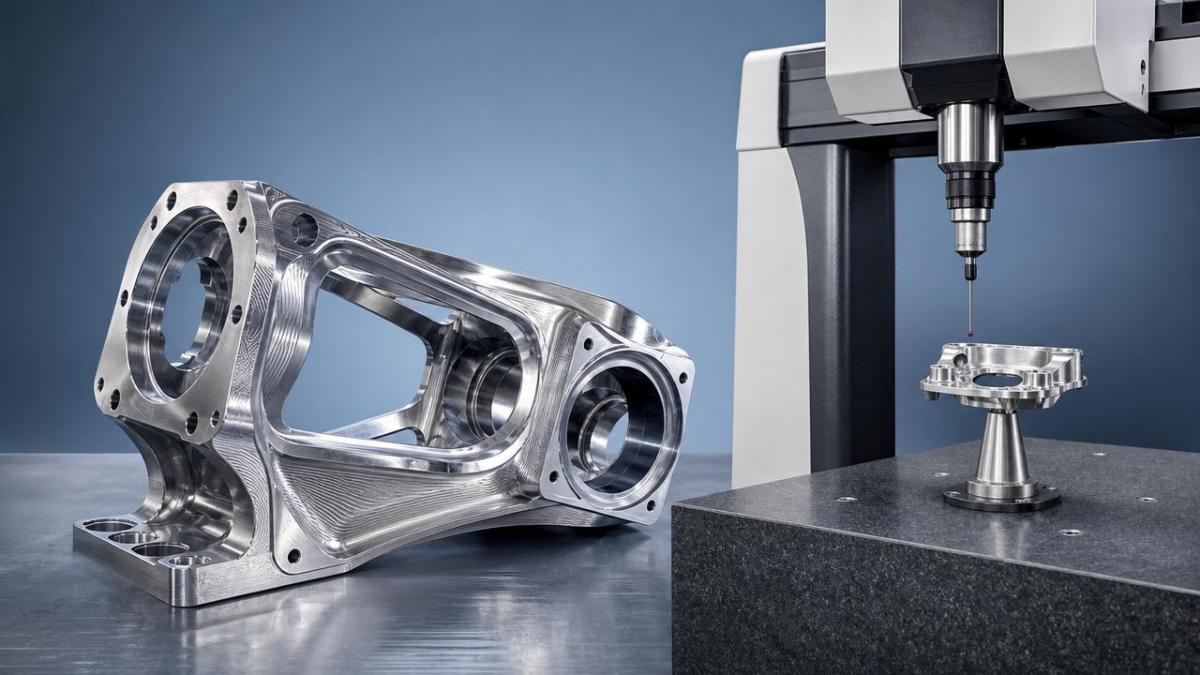
Inspection and traceability metrics are another core area. Does the supplier specify CMM capability, in-process inspection frequency, gauge control practices, calibration standards, lot traceability, and document retention discipline? Aerospace buyers need evidence that quality is measured systematically, not assumed.
Lead-time and yield data can be surprisingly valuable as well. A whitepaper that discusses first-pass yield, rework frequency, on-time delivery performance for comparable work, and bottlenecks in multi-axis machining gives buyers a much clearer view of operational maturity than a generic promise of “fast turnaround.”
Finally, fatigue, surface integrity, and post-machining performance data can be highly relevant for structural or mission-critical components. Even when part-specific data cannot be disclosed, generalized results on residual stress control, deburring consistency, surface finish distribution, or performance after heat treatment add real substance.
How to tell whether a whitepaper is engineering evidence or polished promotion
A strong whitepaper usually reveals its seriousness within the first few pages. It defines scope clearly, identifies the application context, and explains what the presented data does and does not represent. It avoids sweeping claims that treat all aerospace parts as equivalent and instead distinguishes by geometry, material, tolerance class, and production stage.
Look closely at language patterns. Phrases like “best-in-class,” “world-class precision,” or “unmatched quality” are not automatically disqualifying, but they should be accompanied by measurable proof. If superlatives dominate while metrics remain absent, the document is likely designed to persuade emotionally rather than reduce technical uncertainty.
Methodology transparency is another strong signal. Reliable reports explain how samples were selected, how measurements were taken, how many runs were included, and whether results reflect standard production conditions or controlled demonstration trials. Without methodology, a number is just a claim with decimals attached.
Credible whitepapers also acknowledge limitations. They may state that certain tolerance ranges depend on fixture strategy, thermal control, or feature accessibility. That kind of specificity builds trust because it reflects real manufacturing constraints. Overly smooth documents that imply universal capability across all aerospace scenarios should be treated carefully.
Pay attention to whether the report helps you ask better questions. A good aerospace machining whitepaper download should not end the qualification process, but it should sharpen it. If the document leaves your team with clearer audit points, more targeted RFQ requirements, and a better sense of where risk may sit, it is doing real work.
What business evaluators should ask after downloading a whitepaper
Even a strong whitepaper is only the start of due diligence. After reading it, business evaluators should move quickly to gap-testing. Ask whether the published metrics reflect current production capability or a historical snapshot. Clarify whether the cited results are from prototype cells, dedicated aerospace lines, or mixed-use machine capacity.
It is also important to ask how capability changes by part family. A supplier may be excellent at small, complex titanium components but less consistent on larger thin-wall aluminum structures. Whitepapers often compress these distinctions, so follow-up questions should restore them.
Request evidence of control discipline, not just end results. Ask about tool-life management, machine qualification intervals, fixture repeatability, nonconformance containment, operator training, and change control. These factors often explain whether published outcomes are durable or fragile.
For commercial assessment, ask what the supplier can support at the pace your program needs. A technically capable shop may still be a poor fit if scheduling flexibility, documentation responsiveness, or quality communication are weak. Numbers matter, but the operating model behind those numbers matters too.
If the whitepaper is vague, use that as data. Evasive answers, inconsistent definitions, or refusal to provide anonymized benchmarking under reasonable confidentiality terms often indicate that the document was never intended to support serious comparison. That does not automatically disqualify the supplier, but it should lower confidence until stronger evidence appears.
What a better aerospace machining whitepaper should look like
The most useful documents respect both confidentiality and buyer intelligence. They do not need to expose customer IP, but they should include normalized benchmarks, representative capability bands, and clearly defined process conditions. They should connect machine capability to actual part outcomes rather than relying on equipment lists alone.
For business evaluators, the ideal report is structured around decision criteria. It shows where the supplier performs strongly, where constraints apply, and what proof exists for repeatability, documentation rigor, and production readiness. It translates technical performance into qualification relevance.
That is especially important in aerospace, where the cost of ambiguity is high. A supplier that publishes fewer claims but better data is often more valuable than one that offers a glossy package full of certifications, brand language, and undefined precision statements. In high-consequence manufacturing, credibility is built by measured evidence, not by tone.
From an SEO perspective, many readers searching for an aerospace machining whitepaper download are not just looking for a file. They are looking for a filter. They want to know whether the content they download will genuinely reduce decision risk. The right answer is simple: only if it contains enough hard engineering context to support comparison, challenge assumptions, and guide next-step qualification.
Conclusion: download the whitepaper, but evaluate the evidence
Aerospace machining whitepapers often skip the hard numbers because of marketing priorities, capability gaps, confidentiality concerns, or weak understanding of what buyers actually need. But for business evaluators, those omissions are not minor. They directly affect supplier comparison quality, qualification speed, and procurement risk.
The practical takeaway is clear. Do not judge a whitepaper by how technical it sounds. Judge it by whether it provides quantified, contextualized evidence about repeatability, materials, inspection discipline, and production reality. A useful aerospace machining whitepaper download should help your team ask fewer vague questions and make better-informed decisions faster.
In aerospace sourcing, polished language is cheap. Trustworthy numbers are not. The suppliers worth deeper consideration are usually the ones willing to show enough data to prove that their process is not just impressive in theory, but dependable in execution.
Search News
Hot Articles
- Carbon Fiber StructuresHow to Specify Aerospace Carbon Fiber Assemblies for Lightweight, Load-Bearing PartsJul 11, 2026
- Machine VisionXiaomi, Alibaba DAMO Academy Drive Open-Source Robotics Model Ecosystem, Lowering Algorithm Development Barriers for Overseas SMEs Adopting Chinese Robotics SolutionsMar 30, 2026
- Cobots & ArmsShanxi 'AI+' Conference Showcases Embodied Intelligence with Multinational Buyer Engagement: Key Industry ImplicationsMar 30, 2026
Popular Tags
Recommended News
 Jul 11, 2026How to Specify Aerospace Carbon Fiber Assemblies for Lightweight, Load-Bearing PartsAerospace carbon fiber assemblies: learn how to specify laminate design, load data, joining methods, and inspection controls for lighter, reliable load-bearing aerospace parts.Elena Rostova (UAV Systems Researcher)
 Mar 30, 2026Xiaomi, Alibaba DAMO Academy Drive Open-Source Robotics Model Ecosystem, Lowering Algorithm Development Barriers for Overseas SMEs Adopting Chinese Robotics SolutionsXiaomi & Alibaba DAMO Academy's open-source robotics models lower algorithm barriers for global SMEs. Boost efficiency in manufacturing, logistics & smart retail with ROS 2 compatible solutions.TSV Data Lab
 Mar 30, 2026Shanxi 'AI+' Conference Showcases Embodied Intelligence with Multinational Buyer Engagement: Key Industry ImplicationsShanxi 'AI+' Conference highlights embodied intelligence with Tesla, Ubtech & Jiantao showcasing multimodal robotics. 40+ global buyers validated tech on-site, creating new B2B channels for industrial automation & AI solutions.Chen Wei (Automation Lead Engineer)
 Mar 30, 2026Zhongguancun Unveils 6G Integrated Sensing-Computing-Intelligence Platform to Empower Embodied Robots for Global Industrial ApplicationsZhongguancun's new 6G platform revolutionizes industrial robotics with <10ms latency, empowering global automotive, logistics & port automation. Discover how this tech boosts China's smart manufacturing exports.TSV Data Lab
 Mar 30, 2026Mech-Mind Tianjin Embodied Intelligence R&D and Production Base Goes Live, Cutting Delivery Time by 20%–30% for Global Customized AMR+Vision SolutionsMech-Mind's Tianjin AMR+Vision production base cuts delivery time by 20%-30% for欧美 & Latin American markets. Discover how this PLd-certified facility accelerates customized robotics solutions for smart manufacturing and logistics.Chen Wei (Automation Lead Engineer)
 Mar 30, 2026Boao Forum Reveals 'Co-evolution of Big and Small Brains' Trend in Humanoid Robots, China's Embodied Intelligence Accelerates Adaptation to Overseas Manufacturing Service ScenariosDiscover how China's humanoid robots, featuring 'Co-evolution of Big and Small Brains,' are revolutionizing global manufacturing. Learn about Embodied Tian Gong 3.0's ISO compliance and overseas deployment at Boao Forum 2026.Chen Wei (Automation Lead Engineer)
 Mar 30, 2026China Railway Industrial Secures Patent for Embodied Robotics in Material Handling, Boosting High-Precision Delivery Capabilities for Overseas Infrastructure and Manufacturing ProjectsChina Railway Industrial's new patent for embodied robotics in material handling boosts high-precision delivery for global infrastructure & manufacturing. Discover how this innovation enhances logistics accuracy in automotive, rail transit & EPC projects.Chen Wei (Automation Lead Engineer)
 Sep 28, 2026Spindle Runout Measurement in Germany: DIN Standards, Methods, and Acceptance LimitsSpindle runout measurement Germany: explore DIN standards, proven methods, acceptance limits, and audit-ready practices for reliable machining quality.Dr. Marcus Vance
 Sep 27, 2026How to Select Wall-Mount Edge Devices for Space-Constrained Factory NetworksWall mount edge devices for space-constrained factories: evaluate workload, thermal design, power resilience, cable access, and network reliability for smarter deployments.TSV Data Lab
 Sep 26, 2026Machining Tolerance Analysis: How to Set Limits That Meet Function and Cost TargetsMachining tolerance analysis: learn how to set functional limits, control tolerance stacks, reduce inspection risk, and balance precision with production cost.Dr. Marcus Vance
 Sep 25, 2026How to Evaluate an Industrial Infrastructure Data Platform for Multi-Site OperationsIndustrial infrastructure data platform evaluation guide for multi-site operations: compare data quality, edge resilience, interoperability, governance, and scalable proof-of-value criteria.Victor Lin (Chief Software Architect)
 Sep 24, 2026How to Select Machine Vision Optics for Accurate Inspection at Different Working DistancesMachine vision optics selection guide for accurate inspection at every working distance. Compare FOV, pixel scale, DOF, distortion, lighting, and telecentric options.TSV Data Lab
 Sep 23, 2026How to Evaluate a Machine Vision System Integrator for High-Speed Inspection LinesChoose a machine vision system integrator with proven expertise in high-speed inspection, reliable reject timing, robust optics, and measurable acceptance criteria.TSV Data Lab
 Sep 28, 2026When is a SCADA API the right choice for connecting plant systems?SCADA API guide: learn when governed plant data integration improves traceability, security, and scalability—without compromising real-time control.Victor Lin (Chief Software Architect)
 Sep 27, 2026How SCADA data integration improves traceability across production linesSCADA data integration connects production-line data to improve traceability, accelerate quality investigations, and strengthen safety decisions.Victor Lin (Chief Software Architect)
 Sep 26, 2026What to define before starting SCADA integration planningSCADA integration planning starts with clear scope, control boundaries, data models, cybersecurity, and testing. Discover the definitions that reduce risk and costly rework.Victor Lin (Chief Software Architect)
 Sep 25, 2026How a smart factory with Industrial IoT reduces production blind spotsDiscover how a smart factory with Industrial IoT turns real-time machine, quality, and workflow data into actionable insights that reduce production blind spots and delivery risks.Victor Lin (Chief Software Architect)
 Sep 24, 2026When does Industrial IoT make smart manufacturing easier to scale?Smart manufacturing Industrial IoT scales when trusted data, interoperable systems, and secure workflows turn connected assets into measurable gains.TSV Data Lab
 Sep 23, 2026What drives ultra-precision machining cost at 1-micron tolerance?Ultra precision machining cost per part at 1 micron tolerance depends on process, material, metrology, and yield. Learn how to compare quotes confidently.Dr. Marcus Vance
 Sep 22, 2026Drone Engine-T550CC Applications: Build the UAV Power System Around the MissionAn application guide for Drone Engine-T550CC integration, covering payload planning, airframe matching, cooling, fuel, vibration, test procedures, documentation, and service preparation.Elena Rostova (UAV Systems Researcher)
 Sep 22, 2026How to Evaluate Industrial Edge Computing Vendors for Factory DeploymentIndustrial edge computing vendor evaluation guide for factories: compare latency, protocol fit, reliability, security, and lifecycle support before deployment.TSV Data Lab
 Sep 21, 2026Drone Payload Integration: Matching Power, Data, and Center of Gravity for Reliable FlightsDrone payload integration made practical: balance power, data, center of gravity, and endurance to build safer, more reliable mission-ready flights.Elena Rostova (UAV Systems Researcher)
 Sep 20, 2026Autonomous Navigation Pricing: Cost Drivers and Budget Benchmarks for AMR ProjectsAutonomous navigation price explained: compare AMR cost drivers, software, sensors, integration, safety, and lifecycle budgets to build a scalable project plan.Chen Wei (Automation Lead Engineer)
 Sep 19, 2026How to Scope Automation Integration Services for Multi-System Factory ProjectsAutomation integration services: learn how to scope multi-system factory projects with clear workflows, interface contracts, safety boundaries, and acceptance criteria.Victor Lin (Chief Software Architect)