
UAV thermal inspection of solar panels is not just about image quality
Publication Date
author
In UAV thermal inspection of solar panels, sharp imagery alone does not guarantee actionable results. What determines inspection value is the full engineering chain—from sensor calibration and drone photogrammetry software integration to flight stability, emissivity interpretation, and data traceability inside a UAV fleet management system. For engineers, operators, buyers, and decision-makers, real performance comes from measurable accuracy, repeatability, and workflow integration, not visual appeal.
When people search for solutions around UAV thermal inspection of solar panels, the real question is usually not “Which camera produces the best-looking image?” It is “Which inspection workflow can reliably detect faults, reduce false positives, support maintenance decisions, and scale across sites?” That distinction matters. In utility-scale and commercial solar operations, a visually impressive thermal map is only useful if it leads to correct diagnosis, consistent reporting, and traceable maintenance action.
What actually determines the value of UAV thermal inspection for solar panels?
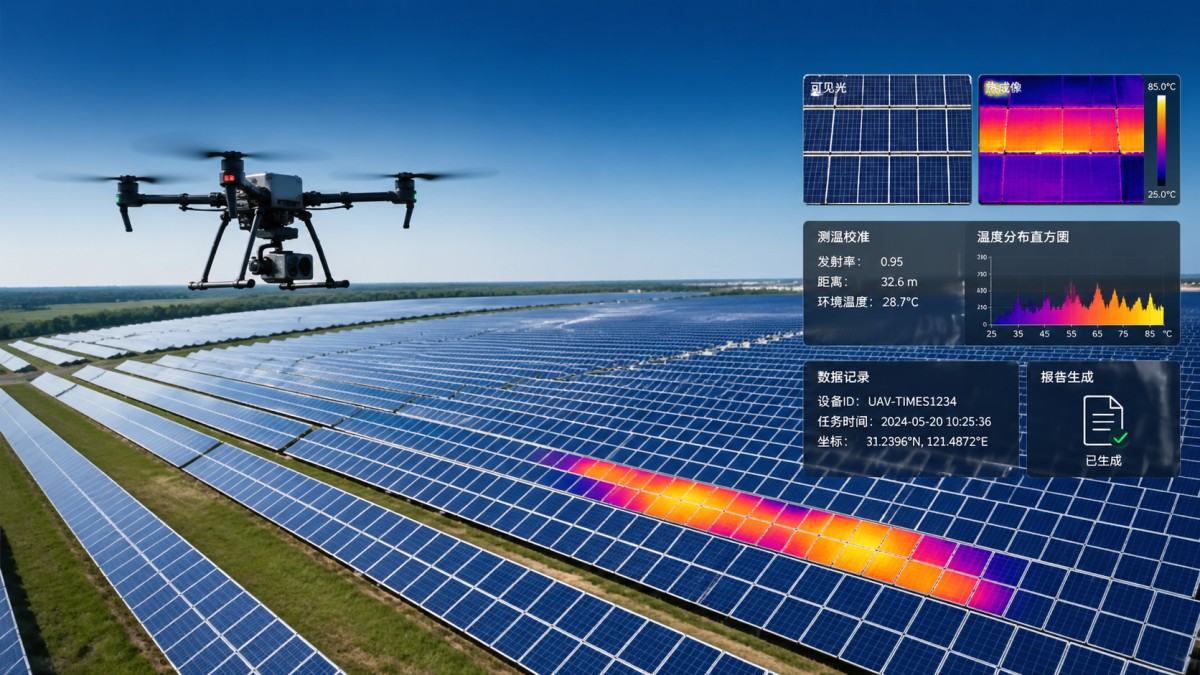
The short answer is this: inspection value comes from measurement integrity, not image aesthetics. A thermal image can look sharp while still being operationally weak if the temperature data is poorly calibrated, the flight path is inconsistent, or the analysis cannot distinguish a true module fault from an environmental artifact.
For target readers across operations, procurement, and management, the most important evaluation criteria usually include:
- Detection reliability: Can the system consistently identify hot spots, string issues, bypass diode failures, cracked cells, or connector problems?
- Repeatability: If the same site is inspected next week or by another team, will the results be comparable?
- Operational efficiency: How much area can be covered per flight, per team, and per day?
- Diagnostic usefulness: Does the report support maintenance prioritization, warranty claims, and asset management decisions?
- Data traceability: Can findings be tied to panel location, historical inspections, and work-order systems?
That is why professionals increasingly evaluate UAV thermal inspection systems as an integrated inspection stack: drone platform, thermal payload, visible sensor, positioning accuracy, mission planning, environmental controls, processing software, and reporting workflow.
Why image quality alone can mislead engineers, operators, and buyers
In marketing materials, image sharpness is easy to showcase. In real-world field operations, it is only one small part of the decision. A crisp thermal image does not automatically mean correct temperature measurement or correct fault interpretation.
Several factors can produce attractive but misleading outputs:
- Improper radiometric calibration: If the sensor does not maintain stable calibration, apparent hot spots may not reflect actual thermal anomalies.
- Environmental interference: Solar irradiance, wind speed, ambient temperature, cloud transitions, and panel reflectivity can distort readings.
- Incorrect emissivity assumptions: Solar panel materials and viewing angles affect apparent surface temperature.
- Flight instability: Changes in altitude, speed, or camera angle reduce consistency across image sets.
- Poor georeferencing: If anomalies are not accurately mapped to exact modules or strings, maintenance teams lose time validating findings manually.
For procurement teams, this means that buying a “high-resolution thermal camera” is not the same as buying a dependable inspection solution. For enterprise decision-makers, it means ROI depends less on headline sensor specs and more on defect-detection accuracy across an entire operating workflow.
What engineers and operators should evaluate in a real inspection workflow
If the goal is actionable inspection data, the workflow should be assessed from mission planning to report generation.
1. Sensor calibration and radiometric integrity
A thermal payload should support stable radiometric performance under field conditions, not just laboratory conditions. Engineers should ask whether the system provides consistent temperature measurements across different flights, sites, and ambient conditions. Calibration drift, thermal stabilization time, and the method used for temperature normalization all affect final data quality.
2. Flight consistency and platform stability
Reliable detection requires controlled altitude, overlap, camera angle, and airspeed. Even a capable sensor underperforms on an unstable platform. In solar inspections, repeatable mission execution is essential because maintenance teams often compare anomaly development over time.
3. Drone photogrammetry software integration
Thermal inspection is more useful when thermal data is aligned with visible imagery, orthomosaics, and geospatial references. Good drone photogrammetry software integration helps operators convert thermal captures into panel-level maps rather than isolated images. This reduces ambiguity and improves maintenance response.
4. Anomaly classification logic
Not all hot spots are equal. Some indicate urgent safety or performance concerns, while others may reflect temporary operational variation. The software and analysis workflow should help distinguish likely failure modes such as:
- Cell mismatch
- Bypass diode malfunction
- Junction box heating
- Soiling-related thermal variation
- Connector or cable issues
Operators need workflows that move beyond raw image review toward structured classification and severity ranking.
5. Reporting structure and maintenance linkage
A useful report should identify location, anomaly type, confidence level, image evidence, and recommended next action. If it cannot feed maintenance planning or asset documentation, the inspection loses value quickly.
What procurement teams should ask before selecting a UAV thermal inspection solution
Buyers often compare airframes, cameras, and pricing, but a stronger procurement process asks whether the vendor or system can support a dependable inspection program over time.
Key questions include:
- Is the thermal sensor radiometric, and how is calibration validated?
- What is the realistic defect detection rate in field conditions, not demo conditions?
- How does the system handle geolocation accuracy at module level?
- Can the workflow integrate with existing GIS, CMMS, or asset management systems?
- What training is required for operators to produce repeatable results?
- How much post-processing effort is needed per megawatt inspected?
- Does the vendor support fleet-scale deployment through a UAV fleet management system?
For enterprise buyers, the best solution is often not the one with the most aggressive specification sheet. It is the one with the clearest evidence of repeatability, workflow compatibility, and scalable data management.
How decision-makers should think about ROI, risk, and scaling across solar assets
For business leaders, the core issue is not simply technical preference. It is whether UAV thermal inspection improves asset performance and reduces decision latency at acceptable cost.
Well-executed UAV thermal inspection of solar panels can create business value in several ways:
- Earlier fault detection: Identifying thermal anomalies before they become larger production losses.
- Reduced manual inspection burden: Covering large sites faster than ground-based methods.
- Improved maintenance prioritization: Directing field teams toward the most critical faults first.
- Better documentation: Supporting warranty, insurance, compliance, and contractor accountability.
- Trend analysis over time: Tracking degradation patterns across modules, strings, and sites.
However, ROI deteriorates when organizations underestimate workflow complexity. Common failure points include inconsistent operator training, lack of standard weather windows, fragmented file handling, and weak integration between inspection and maintenance teams. In practice, a mediocre sensor inside a disciplined inspection system often delivers more value than a premium sensor inside a fragmented workflow.
Common reasons thermal inspections fail to produce actionable solar O&M insights
Many organizations adopt drone thermal surveys expecting immediate diagnostic clarity, then become disappointed by noisy or inconclusive results. Usually, the problem is not the concept of UAV inspection itself. It is weak process control.
Typical causes of failure include:
- Flying at unsuitable irradiance levels
- Inconsistent mission parameters between inspection cycles
- Relying on unstructured visual interpretation
- Using thermal maps without precise module identification
- Ignoring the effect of angle, reflection, and emissivity on apparent temperature
- Separating thermal findings from maintenance execution systems
This is why mature teams treat thermal inspection as an engineering discipline rather than a camera exercise. Standard operating procedures, environmental thresholds, data validation, and historical comparison all matter.
What a high-value UAV thermal inspection program should look like
A strong program combines hardware capability with inspection governance. In most cases, the most effective model includes:
- A radiometric thermal sensor with verified field performance
- Stable flight execution with repeatable mission templates
- Integrated visible and thermal capture for context
- Accurate georeferencing and panel-level mapping
- Software that supports analysis, classification, and reporting
- Centralized data handling through a UAV fleet management system
- Clear linkage from anomaly detection to maintenance action
For technical teams, this structure improves confidence in findings. For procurement teams, it creates better vendor comparison criteria. For decision-makers, it turns drone inspection from a promising tool into a measurable asset-management capability.
Conclusion: in solar thermal drone inspection, trustworthy data beats impressive images
UAV thermal inspection of solar panels is not just about image quality. Sharp images may help with visualization, but they do not by themselves ensure detection accuracy, repeatability, or maintenance value. The real differentiators are calibration, flight control, environmental discipline, interpretation logic, software integration, and data traceability.
For operators, the takeaway is to focus on process consistency. For buyers, it is to evaluate the full inspection workflow, not just the camera. For enterprise leaders, it is to judge solutions by operational outcomes: fewer false positives, faster maintenance decisions, and scalable inspection intelligence across assets.
In other words, the best solar inspection program is not the one that looks most impressive on screen. It is the one that produces reliable engineering truth in the field.
Search News
Hot Articles
- Carbon Fiber StructuresHow to Specify Aerospace Carbon Fiber Assemblies for Lightweight, Load-Bearing PartsJul 11, 2026
- Machine VisionXiaomi, Alibaba DAMO Academy Drive Open-Source Robotics Model Ecosystem, Lowering Algorithm Development Barriers for Overseas SMEs Adopting Chinese Robotics SolutionsMar 30, 2026
- Cobots & ArmsShanxi 'AI+' Conference Showcases Embodied Intelligence with Multinational Buyer Engagement: Key Industry ImplicationsMar 30, 2026
Popular Tags
Recommended News
 Jul 11, 2026How to Specify Aerospace Carbon Fiber Assemblies for Lightweight, Load-Bearing PartsAerospace carbon fiber assemblies: learn how to specify laminate design, load data, joining methods, and inspection controls for lighter, reliable load-bearing aerospace parts.Elena Rostova (UAV Systems Researcher)
 Mar 30, 2026Xiaomi, Alibaba DAMO Academy Drive Open-Source Robotics Model Ecosystem, Lowering Algorithm Development Barriers for Overseas SMEs Adopting Chinese Robotics SolutionsXiaomi & Alibaba DAMO Academy's open-source robotics models lower algorithm barriers for global SMEs. Boost efficiency in manufacturing, logistics & smart retail with ROS 2 compatible solutions.TSV Data Lab
 Mar 30, 2026Shanxi 'AI+' Conference Showcases Embodied Intelligence with Multinational Buyer Engagement: Key Industry ImplicationsShanxi 'AI+' Conference highlights embodied intelligence with Tesla, Ubtech & Jiantao showcasing multimodal robotics. 40+ global buyers validated tech on-site, creating new B2B channels for industrial automation & AI solutions.Chen Wei (Automation Lead Engineer)
 Mar 30, 2026Zhongguancun Unveils 6G Integrated Sensing-Computing-Intelligence Platform to Empower Embodied Robots for Global Industrial ApplicationsZhongguancun's new 6G platform revolutionizes industrial robotics with <10ms latency, empowering global automotive, logistics & port automation. Discover how this tech boosts China's smart manufacturing exports.TSV Data Lab
 Mar 30, 2026Mech-Mind Tianjin Embodied Intelligence R&D and Production Base Goes Live, Cutting Delivery Time by 20%–30% for Global Customized AMR+Vision SolutionsMech-Mind's Tianjin AMR+Vision production base cuts delivery time by 20%-30% for欧美 & Latin American markets. Discover how this PLd-certified facility accelerates customized robotics solutions for smart manufacturing and logistics.Chen Wei (Automation Lead Engineer)
 Mar 30, 2026Boao Forum Reveals 'Co-evolution of Big and Small Brains' Trend in Humanoid Robots, China's Embodied Intelligence Accelerates Adaptation to Overseas Manufacturing Service ScenariosDiscover how China's humanoid robots, featuring 'Co-evolution of Big and Small Brains,' are revolutionizing global manufacturing. Learn about Embodied Tian Gong 3.0's ISO compliance and overseas deployment at Boao Forum 2026.Chen Wei (Automation Lead Engineer)
 Mar 30, 2026China Railway Industrial Secures Patent for Embodied Robotics in Material Handling, Boosting High-Precision Delivery Capabilities for Overseas Infrastructure and Manufacturing ProjectsChina Railway Industrial's new patent for embodied robotics in material handling boosts high-precision delivery for global infrastructure & manufacturing. Discover how this innovation enhances logistics accuracy in automotive, rail transit & EPC projects.Chen Wei (Automation Lead Engineer)
 Oct 25, 2026Hesai Leads Global ADAS Main Lidar Shipments in Yole’s 2026 ReportHesai led global ADAS main lidar shipments with a 43% share in 2025, according to Yole’s 2026 report. Explore what this ranking reveals about its automotive market position.TSV Data Lab
 Oct 25, 2026Choosing an Aerospace Materials Manufacturer: Quality and Traceability ChecksChoosing an aerospace materials manufacturer? Learn how to verify certifications, test reports, and lot traceability to qualify suppliers confidently and reduce costly sourcing risks.Dr. Marcus Vance
 Oct 24, 2026Guotai Haitong: Global Entry-Level 3D Printer Shipments Rose 39% in Q1 2026Entry-level 3D printer shipments rose 39% in Q1 2026, Guotai Haitong reports. Explore how AI, multicolor printing and print farms are shaping market growth.Dr. Marcus Vance
 Oct 24, 2026Choosing an Industrial Vision Inspection Supplier: Acceptance Tests That MatterChoose an industrial vision inspection supplier with confidence. Discover acceptance tests for defect detection, false rejects, production speed, and reliable part rejection before you buy.TSV Data Lab
 Oct 23, 2026US Navy Raises Gecko Robotics Contract Ceiling to $300M for Robotic Fleet MaintenanceUS Navy raises Gecko Robotics’ contract ceiling to $300M for Pacific Fleet robotic inspections. Explore potential opportunities for maintenance suppliers and key procurement considerations.Chen Wei (Automation Lead Engineer)
 Oct 23, 2026Choosing Industrial Sensing Systems for Global Plants: Protocol CompatibilityCompare industrial sensing systems international buyers can trust. Explore protocol compatibility, reduce integration risks, and select proven configurations for reliable global plant deployments.TSV Data Lab
 Oct 22, 2026KUKA Showcases Physical AI and iiQKA.AI Vision at NVIDIA GTC BerlinExplore KUKA’s Physical AI showcase at NVIDIA GTC Berlin and discover how iiQKA.AI Vision aims to simplify robotic vision integration and improve 2D and 3D scene recognition.TSV Data Lab
 Oct 22, 2026Robotic Machining of Advanced Composites: What Tolerances Are Achievable?Explore advanced materials machining robotics: discover what drives achievable composite tolerances and how to validate accuracy before investing in your next machining system.Dr. Marcus Vance
 Oct 21, 2026China’s Industrial Robot Exports Near RMB 10 Billion in First Nine Months of 2026China’s industrial robot exports neared RMB 10 billion in January–September 2026, with value rising faster than volume. Explore the data and what it could mean for suppliers.Chen Wei (Automation Lead Engineer)
 Oct 21, 2026Low-Latency Industrial Data Processing: Pricing and Key Cost DriversExplore industrial data latency price drivers, from edge hardware to integration and support. Learn how to compare quotes, verify performance, and avoid unnecessary costs.TSV Data Lab
 Oct 20, 2026KUKA Launches iiQKA.AI Vision to Simplify Industrial Image ProcessingKUKA iiQKA.AI Vision simplifies industrial image processing with controller-based 2D and 3D vision. Explore drag-and-drop setup for vision-guided automation.TSV Data Lab
 Oct 20, 2026Smart Industrial Edge Devices: Key Criteria for Legacy PLC IntegrationChoose smart industrial edge devices for legacy PLC integration. Discover key criteria for compatibility, data quality, security, and reliable collection without disrupting control.TSV Data Lab
 Oct 19, 2026Choosing a Radar Sensor by Application: Range, Resolution, and Field of ViewSimplify radar sensor application based product selection. Compare range, resolution, and field of view to avoid blind spots and choose with confidence. Explore the guide.TSV Data Lab
 Oct 18, 2026Comparing Material Options for Procurement: Specs, Costs, and Supply RisksExplore procurement oriented technical content on material options, specs, costs, and supply risks. Compare alternatives to cut hidden expenses and make confident sourcing decisions.Dr. Marcus Vance
 Oct 17, 20265-Axis CNC Positioning Accuracy: How to Interpret ISO 230-2 Test ResultsAssess 5 axis CNC machining positioning accuracy with ISO 230-2. Learn to interpret repeatability, reversal error, and test conditions to compare suppliers and make confident acceptance decisions.Dr. Marcus Vance
 Oct 16, 2026Choosing a Rugged Edge AI Box Supplier: Thermal Tests and Lifecycle SupportChoose a rugged edge AI box supplier with proven thermal performance and reliable lifecycle support. Discover the tests and commitments to verify before you buy.TSV Data Lab
 Oct 15, 2026R&D Cost Reduction Services: How to Evaluate Fees, Savings, and ROIEvaluate R&D cost reduction services with confidence. Compare fees, verify savings, and calculate ROI without compromising performance. Discover how to choose a provider that delivers real value.Chen Wei (Automation Lead Engineer)























