UAV Component Supplier Qualification: What to Verify Before RFQ and Vendor Approval
Publication Date
author
What should procurement verify before sending an RFQ for UAV components?
Start with the items that can break a sourcing decision later: drawing control, material traceability, process capability, certification scope, inspection records, and delivery discipline. That is the real foundation of supplier qualification for UAV components. A polished capability deck does not tell you whether a machined arm, flight-control housing, connector assembly, or carbon fiber bracket can be built repeatedly to the same standard across batches.
Before the RFQ goes out, make sure your own package is strong enough to qualify the supplier fairly. Include the latest revision level, critical tolerances, special process requirements, inspection points, packaging expectations, and any environmental or reliability conditions that matter in service. If the RFQ is vague, weak suppliers can still look competitive on price, and the cost shows up later in scrap, delays, rework, and engineering time.
Is ISO 9001 enough, or do UAV buyers need more?
ISO 9001 is a baseline, not a conclusion. It shows that a supplier has a quality management system, but it does not prove that the supplier is suitable for aviation-grade or mission-critical UAV parts. What matters is whether the certification scope actually covers the work you want them to do.
For example, a supplier may hold ISO 9001 for general machining, while your program needs tight-tolerance aluminum housings, bonded composites, cable assemblies, or outsourced surface treatment with full traceability. Those are not the same risk level. Buyers should ask for the certificate, the scope statement, and the list of key in-house and outsourced processes. If the most critical steps sit outside the certified scope, the certificate carries much less weight.
When the component is safety-relevant or likely to face customer or regulatory scrutiny, procurement should also look for evidence of aerospace-style controls: revision management, nonconformance handling, lot segregation, calibration discipline, and documented first article practices. Those controls usually matter more than the logo on the certificate.
Which documents actually matter during vendor approval?
Ask for documents that help you judge execution risk, not just marketing claims. A useful approval file usually includes:
- Quality certificate and scope
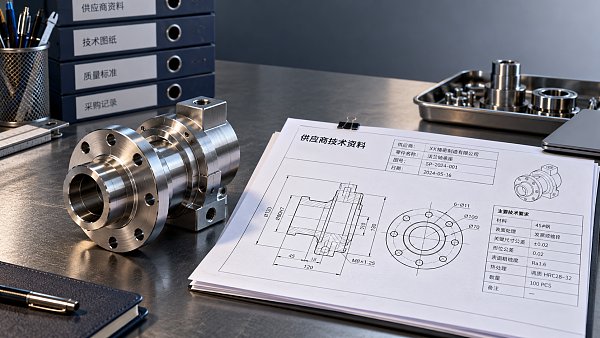
- Sample inspection report tied to a drawing revision
- Material certificate format and lot traceability method
- Calibration control records for critical measuring equipment
- List of special processes and whether they are in-house or subcontracted
- Nonconformance and corrective action workflow
- Lead time history or on-time delivery data, if available in a credible format
- Change control procedure for materials, tooling, process route, and sub-suppliers
What you are looking for is internal consistency. If the supplier says they offer full traceability but cannot show how lot numbers connect material, process, inspection, and shipment, that is a red flag. If they claim tight tolerance capability but provide only generic inspection templates without measured values, treat the capability claim as unproven.

How do you check traceability without turning qualification into a paperwork exercise?
Keep it practical. Pick one part family and walk backward from a shipped unit. Can the supplier link that unit to the drawing revision, raw material heat or batch, production traveler, inspection record, and any outside process such as anodizing, bonding, or heat treatment? If that chain breaks, traceability is only partial.
This matters because UAV failures are often investigated at the part and lot level. A supplier that cannot isolate affected batches forces broader containment, more re-inspection, and more inventory exposure. Procurement feels that as cost, not just quality pain. Good traceability reduces the size of a problem when something goes wrong.
What is the most overlooked risk in UAV component sourcing?
Special processes. Buyers often focus on the machine shop or assembly house and miss the outsourced steps that create the highest hidden risk. Surface finishing, adhesive bonding, composite layup, potting, heat treatment, and wire harness termination can all affect fatigue life, corrosion behavior, conductivity, fit, or long-term reliability.
A supplier should be able to tell you which processes are controlled internally, which are outsourced, how subcontractors are approved, and how finished parts are accepted back into the main quality system. If the answer is vague, assume schedule and consistency risk are higher than quoted.
How should buyers evaluate process capability before awarding production volume?
Do not jump from a clean sample to a full release. Ask whether the supplier has a controlled first article process and whether they can identify critical-to-function features on the drawing. For UAV parts, those features may include flatness on mounting surfaces, hole position, connector alignment, wall thickness, laminate consistency, torque retention, or weight limits.
Then look at how they prove repeatability. You do not always need a complex statistical package at the RFQ stage, but you do need some evidence that the process is stable and measured with suitable equipment. A supplier who cannot explain their control plan will often compensate by over-inspecting parts, which raises cost and still does not fix an unstable process.
What should be in the RFQ if you want comparable quotes?
Comparable pricing starts with comparable assumptions. A strong RFQ package should define:
- Drawing revision and 3D model status
- Material grade and approved substitutions policy
- Required certifications or records at shipment
- Inspection level and first article expectations
- Annual volume, batch size, and forecast stability
- Packaging, labeling, and traceability requirements
- Target Incoterms, destination, and delivery window
Without that structure, one quote may include incoming material certs and serialized labels, while another assumes bare parts in bulk packaging. The cheaper quote can become the expensive one very quickly.
Is the lowest quote ever a good sign?
Sometimes it is simply efficient manufacturing. Often it signals a mismatch in scope. The first question is not, “Why are they cheap?” It is, “What are they excluding?” For supplier qualification for UAV components, low pricing often comes from one of four gaps: weaker inspection coverage, non-equivalent materials, subcontracted processes with little control, or unrealistic lead times.
A useful procurement move is to normalize quotes line by line. Ask each bidder to break out tooling, first article cost, recurring unit price, outside processes, and documentation requirements. That exposes whether one supplier priced the actual requirement and another priced a simplified version of it.
What delivery risks should be checked before adding a vendor to the approved list?
Lead time risk is not only about capacity. It also comes from material sourcing, fixture readiness, dependence on one outside processor, and weak change control. Ask what their longest-pole item is for your component. If they cannot answer clearly, their planning may not be mature enough for production work.
Procurement should also check whether the supplier can handle:
- Schedule changes without losing revision control
- Split shipments for urgent builds
- Controlled handling of nonconforming stock
- Buffer inventory or raw material reservation for long-lead parts
Those points matter more than a claimed standard lead time on a sales slide.
How much technical depth does procurement need during qualification?
Enough to challenge risk, not enough to replace engineering. Procurement does not need to re-design the part, but it should be able to test whether the supplier understands what drives function and cost. If a vendor cannot explain which dimensions are critical, which process step drives scrap, or which material issue could delay supply, that is useful information.
In practice, the best qualification reviews happen when procurement and engineering use the same checklist but ask different questions. Engineering checks technical fit. Procurement checks whether that fit can be delivered consistently, contractually, and at the expected total cost.
What are the most common mistakes when approving a UAV component supplier?
A few patterns show up again and again:
Most of these are avoidable if approval is tied to evidence from one real part family, not just broad corporate claims.
When should a buyer reject, pause, or conditionally approve a supplier?
Reject when the supplier cannot support basic traceability, cannot match the drawing and process requirements, or shows repeated inconsistency between what they say and what their records prove. Pause when the gap may be fixable, such as incomplete inspection reporting, unclear subcontractor control, or weak change notification practice.
Conditional approval works when the risk is narrow and controlled. For example, you may approve for prototype quantities only, with mandatory first article submission, stricter incoming inspection, or restricted process scope. That keeps the program moving without treating an unproven supplier as fully production-ready.
What is the best practical rule for supplier qualification for UAV components?
Approve the supplier you can audit through records, not the one that sounds most confident in meetings. If procurement can trace one shipped part back through material, process, inspection, and change control, and the quote still holds up after scope normalization, that supplier is usually worth serious consideration. Run that discipline before the RFQ, and vendor approval gets faster, cleaner, and much less expensive to correct later.
Search News
Hot Articles
- Carbon Fiber StructuresHow to Specify Aerospace Carbon Fiber Assemblies for Lightweight, Load-Bearing PartsJul 11, 2026
- Machine VisionXiaomi, Alibaba DAMO Academy Drive Open-Source Robotics Model Ecosystem, Lowering Algorithm Development Barriers for Overseas SMEs Adopting Chinese Robotics SolutionsMar 30, 2026
- Cobots & ArmsShanxi 'AI+' Conference Showcases Embodied Intelligence with Multinational Buyer Engagement: Key Industry ImplicationsMar 30, 2026
Popular Tags
Recommended News
 Jul 11, 2026How to Specify Aerospace Carbon Fiber Assemblies for Lightweight, Load-Bearing PartsAerospace carbon fiber assemblies: learn how to specify laminate design, load data, joining methods, and inspection controls for lighter, reliable load-bearing aerospace parts.Elena Rostova (UAV Systems Researcher)
 Mar 30, 2026Xiaomi, Alibaba DAMO Academy Drive Open-Source Robotics Model Ecosystem, Lowering Algorithm Development Barriers for Overseas SMEs Adopting Chinese Robotics SolutionsXiaomi & Alibaba DAMO Academy's open-source robotics models lower algorithm barriers for global SMEs. Boost efficiency in manufacturing, logistics & smart retail with ROS 2 compatible solutions.TSV Data Lab
 Mar 30, 2026Shanxi 'AI+' Conference Showcases Embodied Intelligence with Multinational Buyer Engagement: Key Industry ImplicationsShanxi 'AI+' Conference highlights embodied intelligence with Tesla, Ubtech & Jiantao showcasing multimodal robotics. 40+ global buyers validated tech on-site, creating new B2B channels for industrial automation & AI solutions.Chen Wei (Automation Lead Engineer)
 Mar 30, 2026Zhongguancun Unveils 6G Integrated Sensing-Computing-Intelligence Platform to Empower Embodied Robots for Global Industrial ApplicationsZhongguancun's new 6G platform revolutionizes industrial robotics with <10ms latency, empowering global automotive, logistics & port automation. Discover how this tech boosts China's smart manufacturing exports.TSV Data Lab
 Mar 30, 2026Mech-Mind Tianjin Embodied Intelligence R&D and Production Base Goes Live, Cutting Delivery Time by 20%–30% for Global Customized AMR+Vision SolutionsMech-Mind's Tianjin AMR+Vision production base cuts delivery time by 20%-30% for欧美 & Latin American markets. Discover how this PLd-certified facility accelerates customized robotics solutions for smart manufacturing and logistics.Chen Wei (Automation Lead Engineer)
 Mar 30, 2026Boao Forum Reveals 'Co-evolution of Big and Small Brains' Trend in Humanoid Robots, China's Embodied Intelligence Accelerates Adaptation to Overseas Manufacturing Service ScenariosDiscover how China's humanoid robots, featuring 'Co-evolution of Big and Small Brains,' are revolutionizing global manufacturing. Learn about Embodied Tian Gong 3.0's ISO compliance and overseas deployment at Boao Forum 2026.Chen Wei (Automation Lead Engineer)
 Mar 30, 2026China Railway Industrial Secures Patent for Embodied Robotics in Material Handling, Boosting High-Precision Delivery Capabilities for Overseas Infrastructure and Manufacturing ProjectsChina Railway Industrial's new patent for embodied robotics in material handling boosts high-precision delivery for global infrastructure & manufacturing. Discover how this innovation enhances logistics accuracy in automotive, rail transit & EPC projects.Chen Wei (Automation Lead Engineer)
 Oct 30, 2026Choosing a Procurement Content Provider: Data Quality and CoverageChoose a procurement content provider with confidence. Learn how to assess data quality, supplier coverage, traceability, and verification before you buy.Chen Wei (Automation Lead Engineer)
 Oct 29, 2026Shanghai Plan Targets 8,000 Humanoid Robots in Factories by 2028Shanghai's humanoid robot plan targets 8,000 factory deployments by 2028. Explore what it means for smart manufacturing and robot suppliers.Chen Wei (Automation Lead Engineer)
 Oct 29, 2026Aerospace Aluminum Alloy Strength: 2024-T3 vs. 7075-T6 ComparedCompare aerospace aluminum alloy strength in 2024-T3 vs. 7075-T6. Explore fatigue, corrosion, and weight trade-offs to choose the right alloy for your design.Dr. Marcus Vance
 Oct 28, 2026IDC: Global Quadruped Robot Shipments Rise 92.5% in H1 2026 as Volume and Value DivergeGlobal quadruped robot shipments rose 92.5% in H1 2026, according to IDC. Explore what diverging volume and value trends mean for industrial buyers and manufacturers.Chen Wei (Automation Lead Engineer)
 Oct 28, 2026Interpreting Industrial IoT Latency Data for Monitoring and Real-Time ControlInterpret industrial category latency data to assess jitter, deadline misses, and real-time readiness. Learn how to benchmark IIoT systems and choose monitoring and control solutions.TSV Data Lab
 Oct 27, 2026GXO and Agility Robotics Expand Partnership to Accelerate US Humanoid Robot DeploymentGXO and Agility Robotics plan to expand US humanoid robot deployment with Digit 4 in early 2027. Explore warehouse automation plans, service terms and future Digit 5 upgrades.Chen Wei (Automation Lead Engineer)
 Oct 27, 2026Robotic Automation Costs: Budgeting for Equipment, Integration, and MaintenancePlan your robotics automation cost with confidence. Explore equipment, integration, and maintenance expenses, compare quotes, and build a realistic budget for better ROI.Chen Wei (Automation Lead Engineer)
 Oct 26, 2026AMAXiMAL Releases Open-Source TopMod 3D v3 With Claude AIExplore AMAXiMAL’s free, open-source TopMod 3D v3 with Claude AI assistance, topology-based modeling and plywood fabrication tools that connect complex designs to physical builds.Dr. Marcus Vance
 Oct 26, 2026Choosing a SCADA System Integrator Company: PLC Compatibility and Long-Term SupportChoose a scada system integrator company with proven PLC compatibility and reliable long-term support. Discover what to test, compare, and require before investing.Victor Lin (Chief Software Architect)
 Oct 25, 2026Hesai Leads Global ADAS Main Lidar Shipments in Yole’s 2026 ReportHesai led global ADAS main lidar shipments with a 43% share in 2025, according to Yole’s 2026 report. Explore what this ranking reveals about its automotive market position.TSV Data Lab
 Oct 25, 2026Choosing an Aerospace Materials Manufacturer: Quality and Traceability ChecksChoosing an aerospace materials manufacturer? Learn how to verify certifications, test reports, and lot traceability to qualify suppliers confidently and reduce costly sourcing risks.Dr. Marcus Vance
 Oct 24, 2026Guotai Haitong: Global Entry-Level 3D Printer Shipments Rose 39% in Q1 2026Entry-level 3D printer shipments rose 39% in Q1 2026, Guotai Haitong reports. Explore how AI, multicolor printing and print farms are shaping market growth.Dr. Marcus Vance
 Oct 24, 2026Choosing an Industrial Vision Inspection Supplier: Acceptance Tests That MatterChoose an industrial vision inspection supplier with confidence. Discover acceptance tests for defect detection, false rejects, production speed, and reliable part rejection before you buy.TSV Data Lab
 Oct 23, 2026US Navy Raises Gecko Robotics Contract Ceiling to $300M for Robotic Fleet MaintenanceUS Navy raises Gecko Robotics’ contract ceiling to $300M for Pacific Fleet robotic inspections. Explore potential opportunities for maintenance suppliers and key procurement considerations.Chen Wei (Automation Lead Engineer)
 Oct 23, 2026Choosing Industrial Sensing Systems for Global Plants: Protocol CompatibilityCompare industrial sensing systems international buyers can trust. Explore protocol compatibility, reduce integration risks, and select proven configurations for reliable global plant deployments.TSV Data Lab
 Oct 22, 2026KUKA Showcases Physical AI and iiQKA.AI Vision at NVIDIA GTC BerlinExplore KUKA’s Physical AI showcase at NVIDIA GTC Berlin and discover how iiQKA.AI Vision aims to simplify robotic vision integration and improve 2D and 3D scene recognition.TSV Data Lab
 Oct 22, 2026Robotic Machining of Advanced Composites: What Tolerances Are Achievable?Explore advanced materials machining robotics: discover what drives achievable composite tolerances and how to validate accuracy before investing in your next machining system.Dr. Marcus Vance