
Heavy Lift UAV for Construction: What Payload, Flight Time, and Permits Matter Most?
Publication Date
author
A heavy lift uav for construction is no longer judged by advertised lifting power alone. On active sites, the practical questions are narrower and more important: how stable the payload remains during real maneuvers, how much usable flight time survives wind, dust, and repeated cycles, and whether permits will slow deployment before work even begins.
That shift matters because construction teams are asking UAV platforms to do more than aerial imaging. Material delivery, cable pulling, façade inspection, temporary sensor placement, and rapid logistics support now place aircraft inside tighter engineering, safety, and compliance boundaries.
From the TSV perspective, this is where procurement discipline becomes essential. Marketing language hides too much. A useful evaluation starts with measurable thresholds, site constraints, and mission-specific operating margins.
Why construction demand is changing UAV selection
Construction sites create a harder operating environment than many commercial drone demonstrations suggest. Loads are rarely ideal, launch zones are imperfect, and nearby structures disturb airflow and satellite reception.
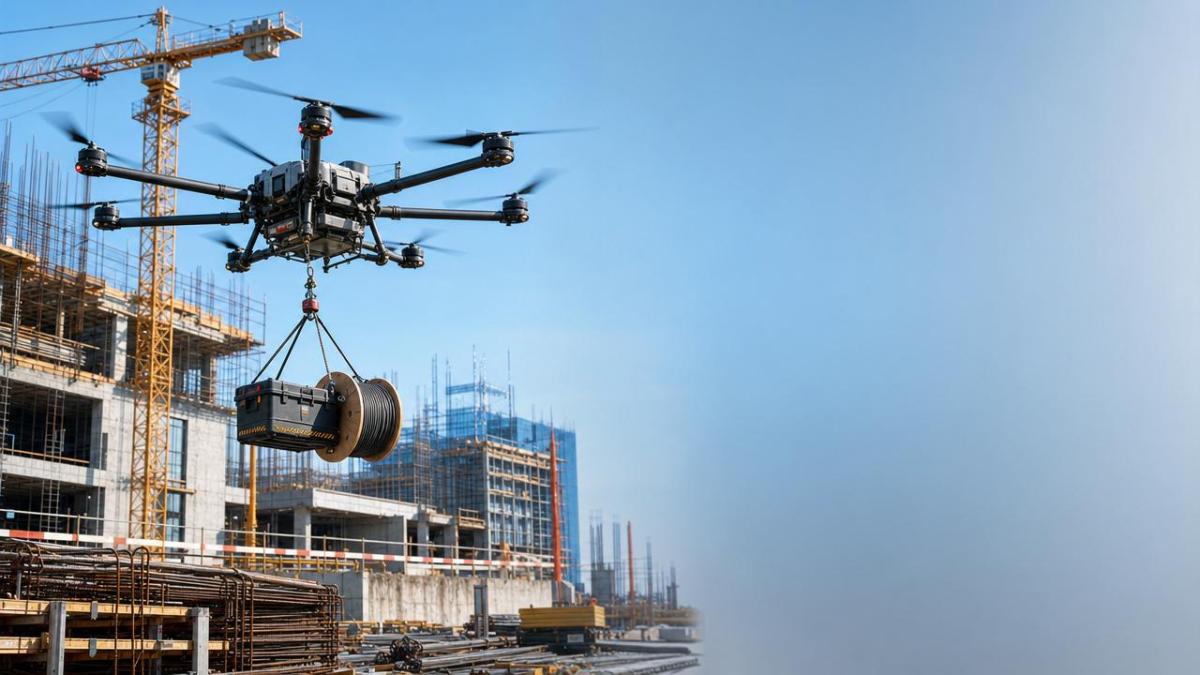
A heavy lift uav for construction often works near cranes, scaffolding, rebar, unfinished concrete, and temporary power systems. Each factor changes how safely the aircraft can hover, translate, and land under load.
This is also why the topic sits across a broader industrial landscape. It connects aerospace reliability, automation planning, site logistics, and risk management. The platform is airborne, but the decision is operational.
Payload is more than a maximum number
The first specification everyone sees is payload capacity. It matters, but the raw number is incomplete without context. The better question is what payload can be carried repeatedly, with stability, at the required altitude and safety reserve.
For a heavy lift uav for construction, payload assessment should include the mass itself, the center of gravity, the shape of the load, and how the load behaves in motion. A compact tool case and a suspended coil do not create the same flight condition.
What usually changes the real payload limit
- Ambient temperature, which affects battery efficiency and motor thermal margin.
- Elevation, which reduces air density and available lift.
- Wind gusts around building edges and open structural frames.
- Attachment method, including winch systems, hooks, or rigid mounts.
- Mission repetition, because peak payload on one test flight differs from daily field duty.
A credible specification sheet should separate maximum payload from recommended operational payload. TSV-style analysis always treats that distinction as critical, because design margins determine whether a platform is useful or merely impressive on paper.
Flight time must be measured as usable time
Published endurance figures often reflect ideal conditions: no wind, balanced payload, fresh batteries, and a simple flight profile. A heavy lift uav for construction almost never operates in that environment.
Usable flight time is what remains after takeoff, positioning, task execution, return, reserve power, and contingency margin. That is the only endurance number that supports scheduling.
Why endurance collapses faster on site
Hovering with a suspended load draws power differently from forward transit. Repeated micro-corrections in turbulent air add further drain. Battery aging then reduces consistency across shifts.
In practice, a platform advertised at 35 minutes may deliver far less in productive construction work. That does not make the aircraft poor. It means the endurance claim must be translated into mission reality.
Permits often decide the true deployment speed
Many projects focus on airframe performance first and regulatory feasibility later. That order creates delays. For a heavy lift uav for construction, permits and operating approvals can be the real gating factor.
Requirements vary by jurisdiction, but the pattern is consistent. Heavier aircraft, operations near people, work in dense urban zones, and flights beyond standard visual conditions usually trigger more review.
Permit questions worth clarifying early
- Aircraft weight class and whether the payload changes regulatory treatment.
- Minimum standoff distances from workers, roads, and occupied structures.
- Rules for operations near airports, helipads, or controlled airspace.
- Pilot licensing, observer requirements, and site-specific safety documentation.
- Insurance thresholds and incident reporting obligations.
A capable aircraft loses value if the approval cycle exceeds the project window. That is why permit readiness should be evaluated alongside payload and endurance, not after vendor selection.
Where a heavy lift uav for construction creates value
The strongest use cases are not generic. They appear where access is difficult, lifting volumes are moderate, response time matters, or ground movement introduces more disruption than an aerial route.
Examples include carrying tools to upper elevations, moving lines across obstacles, supporting inspections after storms, placing lightweight sensors, and delivering urgent repair items across large sites.
In these cases, a heavy lift uav for construction can reduce idle time around scaffolding access, crane scheduling conflicts, or temporary route closures. The savings often come from coordination efficiency rather than labor replacement alone.
How to compare platforms without relying on hype
A disciplined comparison framework is more reliable than broad vendor claims. TSV’s underlying principle applies directly here: parameters matter most when they are tied to repeatable operating conditions.
A practical review framework
- Define the actual load profile, including dimensions, attachment, and center-of-gravity behavior.
- Translate published endurance into mission endurance with reserve power included.
- Check propulsion redundancy, fail-safe landing logic, and flight controller stability under interference.
- Review maintenance intervals, battery replacement planning, and spare parts lead times.
- Map permit complexity before finalizing the operating concept.
This approach helps separate a technically compatible heavy lift uav for construction from one that only matches the headline requirement. The difference becomes obvious when schedules are tight and safety tolerances are narrow.
A better next step than chasing the highest payload
The best decision usually starts with a mission matrix, not a catalog. List the load types, lift heights, cycle frequency, wind exposure, launch constraints, and approval needs for each anticipated task.
Then compare candidate systems against those conditions using operational payload, usable flight time, and permit fit as the primary filters. That sequence produces a more realistic shortlist and reduces trial-and-error costs.
For anyone assessing a heavy lift uav for construction, the most valuable question is simple: which platform still performs safely and predictably after the marketing layer is removed? That is where sound deployment decisions begin.
Search News
Hot Articles
- Carbon Fiber StructuresHow to Specify Aerospace Carbon Fiber Assemblies for Lightweight, Load-Bearing PartsJul 11, 2026
- Machine VisionXiaomi, Alibaba DAMO Academy Drive Open-Source Robotics Model Ecosystem, Lowering Algorithm Development Barriers for Overseas SMEs Adopting Chinese Robotics SolutionsMar 30, 2026
- Cobots & ArmsShanxi 'AI+' Conference Showcases Embodied Intelligence with Multinational Buyer Engagement: Key Industry ImplicationsMar 30, 2026
Popular Tags
Recommended News
 Jul 11, 2026How to Specify Aerospace Carbon Fiber Assemblies for Lightweight, Load-Bearing PartsAerospace carbon fiber assemblies: learn how to specify laminate design, load data, joining methods, and inspection controls for lighter, reliable load-bearing aerospace parts.Elena Rostova (UAV Systems Researcher)
 Mar 30, 2026Xiaomi, Alibaba DAMO Academy Drive Open-Source Robotics Model Ecosystem, Lowering Algorithm Development Barriers for Overseas SMEs Adopting Chinese Robotics SolutionsXiaomi & Alibaba DAMO Academy's open-source robotics models lower algorithm barriers for global SMEs. Boost efficiency in manufacturing, logistics & smart retail with ROS 2 compatible solutions.TSV Data Lab
 Mar 30, 2026Shanxi 'AI+' Conference Showcases Embodied Intelligence with Multinational Buyer Engagement: Key Industry ImplicationsShanxi 'AI+' Conference highlights embodied intelligence with Tesla, Ubtech & Jiantao showcasing multimodal robotics. 40+ global buyers validated tech on-site, creating new B2B channels for industrial automation & AI solutions.Chen Wei (Automation Lead Engineer)
 Mar 30, 2026Zhongguancun Unveils 6G Integrated Sensing-Computing-Intelligence Platform to Empower Embodied Robots for Global Industrial ApplicationsZhongguancun's new 6G platform revolutionizes industrial robotics with <10ms latency, empowering global automotive, logistics & port automation. Discover how this tech boosts China's smart manufacturing exports.TSV Data Lab
 Mar 30, 2026Mech-Mind Tianjin Embodied Intelligence R&D and Production Base Goes Live, Cutting Delivery Time by 20%–30% for Global Customized AMR+Vision SolutionsMech-Mind's Tianjin AMR+Vision production base cuts delivery time by 20%-30% for欧美 & Latin American markets. Discover how this PLd-certified facility accelerates customized robotics solutions for smart manufacturing and logistics.Chen Wei (Automation Lead Engineer)
 Mar 30, 2026Boao Forum Reveals 'Co-evolution of Big and Small Brains' Trend in Humanoid Robots, China's Embodied Intelligence Accelerates Adaptation to Overseas Manufacturing Service ScenariosDiscover how China's humanoid robots, featuring 'Co-evolution of Big and Small Brains,' are revolutionizing global manufacturing. Learn about Embodied Tian Gong 3.0's ISO compliance and overseas deployment at Boao Forum 2026.Chen Wei (Automation Lead Engineer)
 Mar 30, 2026China Railway Industrial Secures Patent for Embodied Robotics in Material Handling, Boosting High-Precision Delivery Capabilities for Overseas Infrastructure and Manufacturing ProjectsChina Railway Industrial's new patent for embodied robotics in material handling boosts high-precision delivery for global infrastructure & manufacturing. Discover how this innovation enhances logistics accuracy in automotive, rail transit & EPC projects.Chen Wei (Automation Lead Engineer)
 Oct 25, 2026Hesai Leads Global ADAS Main Lidar Shipments in Yole’s 2026 ReportHesai led global ADAS main lidar shipments with a 43% share in 2025, according to Yole’s 2026 report. Explore what this ranking reveals about its automotive market position.TSV Data Lab
 Oct 25, 2026Choosing an Aerospace Materials Manufacturer: Quality and Traceability ChecksChoosing an aerospace materials manufacturer? Learn how to verify certifications, test reports, and lot traceability to qualify suppliers confidently and reduce costly sourcing risks.Dr. Marcus Vance
 Oct 24, 2026Guotai Haitong: Global Entry-Level 3D Printer Shipments Rose 39% in Q1 2026Entry-level 3D printer shipments rose 39% in Q1 2026, Guotai Haitong reports. Explore how AI, multicolor printing and print farms are shaping market growth.Dr. Marcus Vance
 Oct 24, 2026Choosing an Industrial Vision Inspection Supplier: Acceptance Tests That MatterChoose an industrial vision inspection supplier with confidence. Discover acceptance tests for defect detection, false rejects, production speed, and reliable part rejection before you buy.TSV Data Lab
 Oct 23, 2026US Navy Raises Gecko Robotics Contract Ceiling to $300M for Robotic Fleet MaintenanceUS Navy raises Gecko Robotics’ contract ceiling to $300M for Pacific Fleet robotic inspections. Explore potential opportunities for maintenance suppliers and key procurement considerations.Chen Wei (Automation Lead Engineer)
 Oct 23, 2026Choosing Industrial Sensing Systems for Global Plants: Protocol CompatibilityCompare industrial sensing systems international buyers can trust. Explore protocol compatibility, reduce integration risks, and select proven configurations for reliable global plant deployments.TSV Data Lab
 Oct 22, 2026KUKA Showcases Physical AI and iiQKA.AI Vision at NVIDIA GTC BerlinExplore KUKA’s Physical AI showcase at NVIDIA GTC Berlin and discover how iiQKA.AI Vision aims to simplify robotic vision integration and improve 2D and 3D scene recognition.TSV Data Lab
 Oct 22, 2026Robotic Machining of Advanced Composites: What Tolerances Are Achievable?Explore advanced materials machining robotics: discover what drives achievable composite tolerances and how to validate accuracy before investing in your next machining system.Dr. Marcus Vance
 Oct 21, 2026China’s Industrial Robot Exports Near RMB 10 Billion in First Nine Months of 2026China’s industrial robot exports neared RMB 10 billion in January–September 2026, with value rising faster than volume. Explore the data and what it could mean for suppliers.Chen Wei (Automation Lead Engineer)
 Oct 21, 2026Low-Latency Industrial Data Processing: Pricing and Key Cost DriversExplore industrial data latency price drivers, from edge hardware to integration and support. Learn how to compare quotes, verify performance, and avoid unnecessary costs.TSV Data Lab
 Oct 20, 2026KUKA Launches iiQKA.AI Vision to Simplify Industrial Image ProcessingKUKA iiQKA.AI Vision simplifies industrial image processing with controller-based 2D and 3D vision. Explore drag-and-drop setup for vision-guided automation.TSV Data Lab
 Oct 20, 2026Smart Industrial Edge Devices: Key Criteria for Legacy PLC IntegrationChoose smart industrial edge devices for legacy PLC integration. Discover key criteria for compatibility, data quality, security, and reliable collection without disrupting control.TSV Data Lab
 Oct 19, 2026Choosing a Radar Sensor by Application: Range, Resolution, and Field of ViewSimplify radar sensor application based product selection. Compare range, resolution, and field of view to avoid blind spots and choose with confidence. Explore the guide.TSV Data Lab
 Oct 18, 2026Comparing Material Options for Procurement: Specs, Costs, and Supply RisksExplore procurement oriented technical content on material options, specs, costs, and supply risks. Compare alternatives to cut hidden expenses and make confident sourcing decisions.Dr. Marcus Vance
 Oct 17, 20265-Axis CNC Positioning Accuracy: How to Interpret ISO 230-2 Test ResultsAssess 5 axis CNC machining positioning accuracy with ISO 230-2. Learn to interpret repeatability, reversal error, and test conditions to compare suppliers and make confident acceptance decisions.Dr. Marcus Vance
 Oct 16, 2026Choosing a Rugged Edge AI Box Supplier: Thermal Tests and Lifecycle SupportChoose a rugged edge AI box supplier with proven thermal performance and reliable lifecycle support. Discover the tests and commitments to verify before you buy.TSV Data Lab
 Oct 15, 2026R&D Cost Reduction Services: How to Evaluate Fees, Savings, and ROIEvaluate R&D cost reduction services with confidence. Compare fees, verify savings, and calculate ROI without compromising performance. Discover how to choose a provider that delivers real value.Chen Wei (Automation Lead Engineer)























