
How to Judge Carbon Fiber Drone Frame Quality
Publication Date
author
For engineers, operators, buyers, and decision-makers, judging a carbon fiber drone frame means looking past claims and into measurable performance. Whether sourcing carbon fiber drone frame wholesale, evaluating a carbon fiber tube for aerospace, or comparing a commercial drone manufacturer China partner, the real indicators are fiber grade, layup consistency, resin quality, machining precision, and verified strength-to-weight data.
In UAV procurement and product development, the frame is not just a shell. It is the structural backbone that determines payload stability, crash resistance, vibration behavior, and long-term flight reliability. A low-cost frame with poor laminate quality can pass a visual inspection yet fail after 50 to 100 aggressive flight cycles, while a well-engineered frame can maintain dimensional stability and structural integrity over far longer service intervals.
For B2B buyers and technical teams, the challenge is separating marketing language from engineering reality. TechStat Vanguard approaches this topic from a data-first perspective: what can be inspected, what should be tested, which tolerances matter, and how procurement teams can compare suppliers using objective criteria rather than vague quality claims.
Why Carbon Fiber Drone Frame Quality Matters in Real Applications
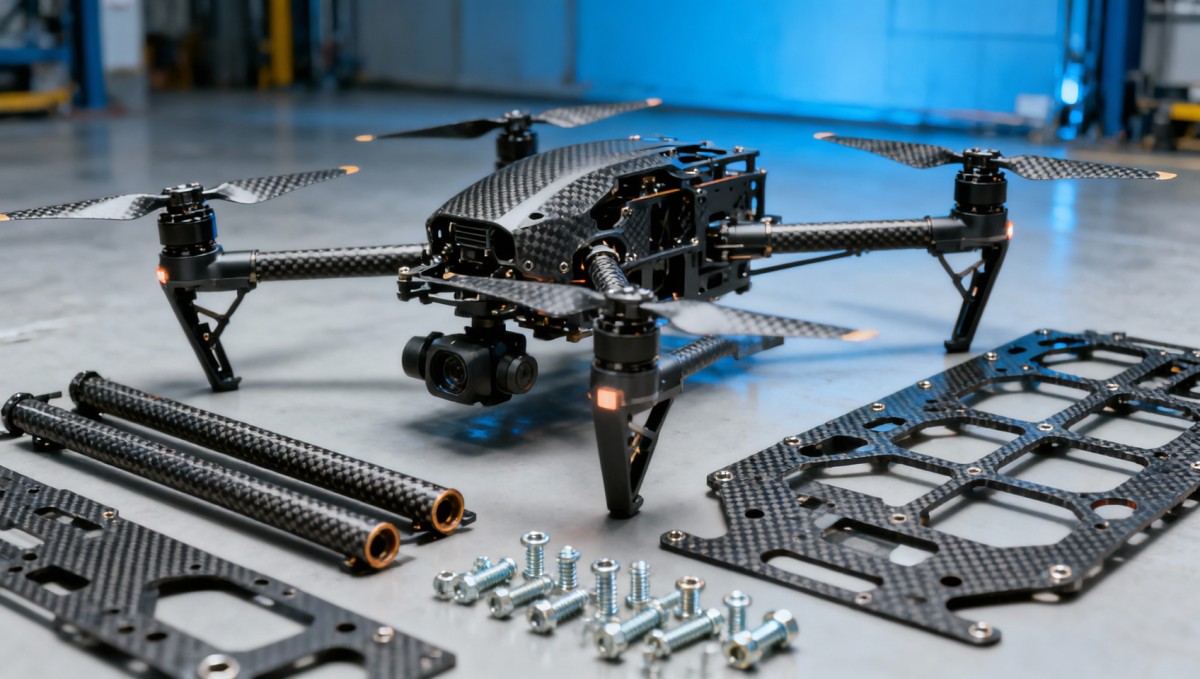
Frame quality directly affects mission success in mapping, inspection, agriculture, logistics, and industrial UAV operations. In a lightweight quadcopter, even a 20 to 40 gram variance in frame mass can influence endurance, center of gravity, and motor efficiency. In heavier commercial platforms, poor stiffness can introduce resonance that degrades IMU accuracy, gimbal performance, and image sharpness.
For operators, the practical consequence is reduced consistency. A frame with irregular arm stiffness may track normally in calm weather but drift under crosswinds or oscillate during rapid pitch changes. For procurement teams, inconsistent quality across production batches increases maintenance cost, spare part inventory complexity, and supplier qualification risk.
The issue is especially important when sourcing from multiple regions or evaluating a commercial drone manufacturer China ecosystem partner. Price differences of 10% to 25% between suppliers often come from differences in raw fiber grade, prepreg control, resin systems, CNC finishing discipline, and inspection depth. Those differences may not be obvious in product photos, but they become very visible in fatigue life and assembly precision.
In aerospace-adjacent and industrial environments, buyers should think of the frame as a structural system, not a cosmetic component. The arms, center plates, tube joints, motor mounts, and fastener interfaces must work as one load path. If one section has weak bonding or fiber discontinuity, the entire drone may experience early failure even when the nominal material is advertised as high-grade carbon fiber.
Typical operational risks linked to poor frame quality
- Micro-cracks around motor mounting holes after repeated vibration, often visible after 30 to 80 flight hours.
- Arm twist under payload load, causing flight controller compensation and lower positional stability.
- Delamination at plate edges due to poor curing, low resin uniformity, or weak hole finishing.
- Dimensional mismatch of ±0.5 mm to ±1.0 mm, leading to assembly stress and poor alignment.
Where quality matters most by use case
A racing drone may prioritize low mass and torsional stiffness, while a mapping UAV needs repeatable geometry and vibration damping for cleaner survey data. Agricultural platforms need better chemical resistance and impact tolerance, especially when exposed to fertilizer mist, moisture, and frequent transport handling. Industrial inspection drones need better fastener retention and arm stiffness because they often carry heavier sensors and fly in more demanding wind environments.
The takeaway is simple: quality must be judged against the mission profile. A frame that is acceptable for hobby use may be unsuitable for commercial uptime targets, repetitive field deployment, or regulated aerospace-adjacent projects. Buyers should always connect structural quality to payload class, duty cycle, and environmental exposure.
Material and Laminate Indicators That Reveal Real Quality
The first step in judging a carbon fiber drone frame is understanding what the supplier actually means by “carbon fiber.” Not all carbon laminates are equal. Fiber modulus, tow count, resin type, fiber-to-resin ratio, and layup orientation all affect stiffness, impact response, and final weight. A frame made from low-cost woven sheet may look clean on the surface but behave very differently from a properly engineered quasi-isotropic laminate.
For a carbon fiber tube for aerospace or UAV structural use, buyers should ask whether the tube is roll-wrapped, pultruded, or filament wound. Each process has tradeoffs. Roll-wrapped tubes often offer better torsional performance and tailored layups. Pultruded tubes can be cost-effective but may have less optimized multi-directional strength. The right answer depends on arm length, motor thrust, and joint design.
Layup consistency is often more important than raw fiber marketing language. A balanced layup may include 0°, 90°, and ±45° orientations to manage axial load, torsion, and local impact stress. If too much emphasis is placed on one direction, the part may test well in one static load mode yet underperform under real flight vibration and multi-axis dynamic loading.
Resin quality also matters. Poor curing or low-grade resin can create voids, edge fraying, brittle drilling response, and lower interlaminar strength. In practical terms, this means damage can begin at bolt holes or arm clamps long before the main laminate reaches its expected load capacity. Even a 1% to 3% void content can influence fatigue durability when the drone sees frequent takeoff and landing cycles.
What to verify in the material specification
- Declared laminate thickness and tolerance, for example 3.0 mm ±0.15 mm for main plates.
- Fiber orientation design, especially whether ±45° layers are used for torsional stability.
- Resin system type and curing approach, such as autoclave, hot press, or compression molding.
- Surface finish method, including whether cosmetic weave hides a lower-structure core.
- Tube process route for arm structures and whether wall thickness is consistent across batches.
When suppliers cannot provide even basic material details, that is a procurement warning sign. A credible supplier may not disclose every proprietary process detail, but they should be able to explain laminate architecture, tolerance control, and inspection methods in technical language rather than pure sales phrasing.
Visual clues that often indicate laminate problems
Uneven weave alignment, cloudy resin zones, frayed cut edges, pinholes, and inconsistent gloss can indicate weak process control. These issues do not automatically mean a part will fail, but they justify deeper verification. In high-volume carbon fiber drone frame wholesale sourcing, visual inconsistency across 20 to 50 pieces in the same batch is often a reliable early indicator of wider variability in mass, thickness, or drilled-hole accuracy.
For buyers, this table provides a practical filter: do not ask only what fiber is used; ask how the laminate behaves, how consistently it is produced, and whether the supplier can show repeatable process control over at least 3 consecutive batches.
Machining Precision, Assembly Fit, and Structural Testing
Even high-grade carbon composite can underperform if machining quality is poor. CNC cutting, drilling, chamfering, edge sealing, and insert handling all influence how the frame behaves in service. In drone assembly, hole position error greater than ±0.20 mm can create preload distortion when arms, center plates, and motor mounts are tightened together. That distortion may not be obvious on the bench, but it can reduce fatigue life significantly.
Well-made frames show consistent countersink depth, clean hole walls, and smooth edge treatment with minimal fiber breakout. Poorly machined frames often generate stress risers at corners and holes. Those areas then become the first points of cracking, especially on platforms that experience high motor vibration or repeated landing shock.
For procurement teams, structural testing is where supplier claims should be validated. At minimum, request static load results, fatigue or cyclic loading information, and dimensional inspection records. If the drone will carry expensive sensors, a simple visual sample approval is not enough. A purchasing decision should include evidence that the frame can survive the real operational load envelope with an appropriate safety margin.
A useful engineering benchmark is not a single “maximum load” figure. Instead, teams should review a 4-part validation set: mass consistency, hole position tolerance, stiffness under defined load, and fatigue response over repeated cycles. For example, an arm may pass a one-time 25 kg static test but still degrade unacceptably after 10,000 vibration cycles if the laminate edge around the clamp zone is weak.
Recommended inspection checklist before supplier approval
- Measure frame mass across at least 10 samples and compare variance. A spread under 2% is generally easier to control in production.
- Check key hole positions, arm lengths, and plate flatness using calipers, gauge pins, or a CMM where available.
- Inspect edge quality under magnification for breakout, delamination, and resin-rich or resin-starved zones.
- Run a basic assembly torque test to confirm no cracking appears at standard fastener torque levels.
- Review test conditions, not just results, including load direction, fixture method, and cycle count.
Why test methodology matters
A supplier may show strong numbers without clarifying setup details. Was the frame clamped in a way that reduced bending? Was the test done on a bare plate instead of the assembled structure? Was failure defined as catastrophic breakage or as stiffness loss above a certain threshold? These details change how useful the data is for real purchasing decisions.
For teams working with TSV-style engineering benchmarking principles, the best practice is to compare suppliers using identical load cases and acceptance criteria. That creates a clear technical baseline and reduces the risk of sourcing based on inconsistent presentations or selective reporting.
How to Compare Suppliers for Wholesale and OEM Procurement
Choosing a supplier for carbon fiber drone frame wholesale is not only about unit price. It is about production repeatability, document transparency, engineering responsiveness, and the ability to support batch-level consistency. For OEM and commercial programs, the real cost of a frame includes incoming inspection time, rework, field failure rate, and replacement logistics.
When comparing a commercial drone manufacturer China partner or an independent frame supplier, buyers should assess both manufacturing capability and communication quality. A technically mature supplier can answer questions about layup direction, hole tolerance, tube wall uniformity, and recommended torque values within 24 to 72 hours. Slow or vague responses often indicate that engineering depth is limited or that manufacturing is heavily subcontracted.
MOQ, sample lead time, and quality documentation are also critical. In many projects, a reasonable sample cycle is 7 to 21 days depending on machining complexity, while batch lead time may run 3 to 6 weeks. Extremely short promises are not always a positive sign if they come without clear process control, inspection routing, or material traceability.
From a strategic sourcing perspective, the best supplier is often the one that can support specification alignment early. That includes confirming the drawing revision, defining cosmetic versus structural acceptance, and agreeing on 5 to 8 key control dimensions before mass production. This reduces friction during first article inspection and shortens the supplier qualification cycle.
Supplier comparison framework
The following matrix helps procurement teams compare offers beyond headline pricing. It is particularly useful when quotes appear close in cost but differ widely in hidden risk.
The main conclusion is that a reliable supplier reduces engineering uncertainty. Procurement should favor partners who can support specification drafting, testing alignment, and batch-level accountability, not just one-time shipment execution.
Practical questions to ask before placing a bulk order
- What are the 3 to 5 key dimensions controlled on every batch?
- How is hole breakout or delamination screened during inspection?
- Can you share typical mass variation across 10 pieces from one lot?
- What changes between prototype and mass production process routes?
- If a tube or plate fails inspection, what containment and replacement process exists?
Common Mistakes, Field Checks, and a Better Buying Decision Process
One common mistake is judging quality by surface finish alone. A glossy twill weave may look premium, but appearance does not guarantee proper layup, hole accuracy, or fatigue resistance. Another mistake is focusing only on ultimate strength. Drones fail in service more often from repeated vibration, small impacts, joint loosening, and local crack growth than from one-time overload events.
A second mistake is ignoring the complete assembly system. Even a good carbon frame can perform poorly if clamp design is too aggressive, inserts are misaligned, or torque guidance is missing. The frame should be evaluated together with fasteners, spacers, motor mounts, landing gear interfaces, and payload brackets. In many UAV platforms, system fit matters as much as raw laminate quality.
Teams can reduce risk with a simple 3-stage buying process: document review, sample verification, and pilot batch validation. During document review, confirm material description, tolerance targets, and inspection items. During sample verification, inspect 3 to 10 pieces for weight, geometry, and visual consistency. During pilot batch validation, build and fly test units under realistic payload and vibration conditions for at least several duty cycles rather than relying on bench review only.
For users and operators in the field, there are also basic checks that can reveal hidden issues early. After initial flights, inspect bolt holes, arm roots, landing gear joints, and payload mounting areas. If white edge marks, crack lines, or local softness appear after 10 to 20 flights, the frame or assembly method should be reviewed before scaling deployment.
Fast field-check routine after receiving a new frame batch
- Weigh each frame or arm set and flag any unit outside the expected tolerance band.
- Dry-fit the structure before final torque to confirm hole alignment and plate flatness.
- Tap-test suspect areas for changes in sound that may indicate voids or local delamination.
- Run a short vibration and hover test before payload integration.
- Document all nonconformities by lot number to support supplier feedback and traceability.
FAQ: What buyers and engineering teams ask most often
How do I know whether a frame is suitable for commercial rather than hobby use?
Look for documented tolerance control, repeatable batch quality, and evidence of static plus cyclic testing. Commercial suitability is less about marketing category and more about whether the frame can maintain performance under repeated operation, transport, and maintenance over dozens or hundreds of missions.
What is more important: lighter weight or higher stiffness?
Neither metric should be isolated. The best frame delivers the required stiffness at the lowest reasonable mass. A part that is 8% lighter but significantly less rigid may reduce flight quality, especially for mapping or heavy-payload inspection drones.
How long should supplier qualification take?
For a new supplier, a practical timeline is often 2 to 6 weeks depending on sample complexity, testing depth, and drawing maturity. Rushing this process may create much larger downstream costs in rework, field failures, or delayed program launch.
Can a lower-cost frame still be acceptable?
Yes, if the duty cycle is light and the supplier can demonstrate stable quality for the intended use. The right decision is not always the most expensive frame. It is the frame with the best fit between structural performance, consistency, and lifecycle cost for the actual mission profile.
Judging carbon fiber drone frame quality requires a disciplined view of materials, machining, testing, and supplier capability. The most reliable decisions come from measurable data: thickness tolerance, mass variance, hole accuracy, fatigue behavior, and batch consistency. For engineers, operators, buyers, and business leaders, these indicators reduce sourcing risk and improve long-term UAV performance.
If your team is evaluating carbon fiber drone frame wholesale options, comparing a carbon fiber tube for aerospace application, or screening a commercial drone manufacturer China partner, a structured technical review will save time and avoid costly qualification mistakes. To discuss specification benchmarks, inspection priorities, or supplier evaluation criteria, contact us to explore a more data-driven sourcing approach and get a tailored solution for your UAV program.
Search News
Hot Articles
- Carbon Fiber StructuresHow to Specify Aerospace Carbon Fiber Assemblies for Lightweight, Load-Bearing PartsJul 11, 2026
- Machine VisionXiaomi, Alibaba DAMO Academy Drive Open-Source Robotics Model Ecosystem, Lowering Algorithm Development Barriers for Overseas SMEs Adopting Chinese Robotics SolutionsMar 30, 2026
- Cobots & ArmsShanxi 'AI+' Conference Showcases Embodied Intelligence with Multinational Buyer Engagement: Key Industry ImplicationsMar 30, 2026
Popular Tags
Recommended News
 Jul 11, 2026How to Specify Aerospace Carbon Fiber Assemblies for Lightweight, Load-Bearing PartsAerospace carbon fiber assemblies: learn how to specify laminate design, load data, joining methods, and inspection controls for lighter, reliable load-bearing aerospace parts.Elena Rostova (UAV Systems Researcher)
 Mar 30, 2026Xiaomi, Alibaba DAMO Academy Drive Open-Source Robotics Model Ecosystem, Lowering Algorithm Development Barriers for Overseas SMEs Adopting Chinese Robotics SolutionsXiaomi & Alibaba DAMO Academy's open-source robotics models lower algorithm barriers for global SMEs. Boost efficiency in manufacturing, logistics & smart retail with ROS 2 compatible solutions.TSV Data Lab
 Mar 30, 2026Shanxi 'AI+' Conference Showcases Embodied Intelligence with Multinational Buyer Engagement: Key Industry ImplicationsShanxi 'AI+' Conference highlights embodied intelligence with Tesla, Ubtech & Jiantao showcasing multimodal robotics. 40+ global buyers validated tech on-site, creating new B2B channels for industrial automation & AI solutions.Chen Wei (Automation Lead Engineer)
 Mar 30, 2026Zhongguancun Unveils 6G Integrated Sensing-Computing-Intelligence Platform to Empower Embodied Robots for Global Industrial ApplicationsZhongguancun's new 6G platform revolutionizes industrial robotics with <10ms latency, empowering global automotive, logistics & port automation. Discover how this tech boosts China's smart manufacturing exports.TSV Data Lab
 Mar 30, 2026Mech-Mind Tianjin Embodied Intelligence R&D and Production Base Goes Live, Cutting Delivery Time by 20%–30% for Global Customized AMR+Vision SolutionsMech-Mind's Tianjin AMR+Vision production base cuts delivery time by 20%-30% for欧美 & Latin American markets. Discover how this PLd-certified facility accelerates customized robotics solutions for smart manufacturing and logistics.Chen Wei (Automation Lead Engineer)
 Mar 30, 2026Boao Forum Reveals 'Co-evolution of Big and Small Brains' Trend in Humanoid Robots, China's Embodied Intelligence Accelerates Adaptation to Overseas Manufacturing Service ScenariosDiscover how China's humanoid robots, featuring 'Co-evolution of Big and Small Brains,' are revolutionizing global manufacturing. Learn about Embodied Tian Gong 3.0's ISO compliance and overseas deployment at Boao Forum 2026.Chen Wei (Automation Lead Engineer)
 Mar 30, 2026China Railway Industrial Secures Patent for Embodied Robotics in Material Handling, Boosting High-Precision Delivery Capabilities for Overseas Infrastructure and Manufacturing ProjectsChina Railway Industrial's new patent for embodied robotics in material handling boosts high-precision delivery for global infrastructure & manufacturing. Discover how this innovation enhances logistics accuracy in automotive, rail transit & EPC projects.Chen Wei (Automation Lead Engineer)
 Oct 17, 20265-Axis CNC Positioning Accuracy: How to Interpret ISO 230-2 Test ResultsAssess 5 axis CNC machining positioning accuracy with ISO 230-2. Learn to interpret repeatability, reversal error, and test conditions to compare suppliers and make confident acceptance decisions.Dr. Marcus Vance
 Oct 16, 2026Choosing a Rugged Edge AI Box Supplier: Thermal Tests and Lifecycle SupportChoose a rugged edge AI box supplier with proven thermal performance and reliable lifecycle support. Discover the tests and commitments to verify before you buy.TSV Data Lab
 Oct 15, 2026R&D Cost Reduction Services: How to Evaluate Fees, Savings, and ROIEvaluate R&D cost reduction services with confidence. Compare fees, verify savings, and calculate ROI without compromising performance. Discover how to choose a provider that delivers real value.Chen Wei (Automation Lead Engineer)
 Oct 16, 2026How Can You Fairly Compare MTBF Across Industrial Servo Motors?Make a fair industrial servo motor MTBF comparison with matched operating profiles, failure criteria, and confidence bounds. Discover how to assess reliability beyond advertised numbers.Chen Wei (Automation Lead Engineer)
 Oct 15, 2026How Should You Compare TechStat Vanguard 5-Axis CNC Tolerances?TechStat Vanguard 5-axis CNC tolerance comparison: learn how to verify part accuracy, assess inspection evidence, and choose suppliers that reliably meet your drawing requirements.Dr. Marcus Vance
 Oct 14, 2026Drone Frame Composites: Carbon Fiber vs. Fiberglass for Weight and StiffnessExplore drone structural materials composites: compare carbon fiber and fiberglass for weight, stiffness, cost, and antenna compatibility. Find the right material for your drone frame.Elena Rostova (UAV Systems Researcher)
 Oct 13, 2026Smart Cameras vs. PC-Based Machine Vision: Which Fits High-Speed Inspection?This industrial product comparison for machine vision weighs smart cameras vs. PC-based systems on latency, throughput, and cost. Discover your best fit for high-speed inspection.TSV Data Lab
 Oct 12, 2026How to Verify RoHS Compliance in Industrial Sensing Systems Before DeploymentRoHS compliant sensing systems: learn how to verify materials, supplier declarations, testing, and configuration controls before industrial deployment.TSV Data Lab
 Oct 11, 2026How Procurement-Oriented Content Taxonomy Improves B2B Buying JourneysProcurement-oriented content taxonomy streamlines B2B buying journeys with clearer evidence, supplier comparisons, risk visibility, and faster approvals.TSV Data Lab
 Oct 10, 2026How to Select a Machine Performance Monitoring Platform for OEE and Downtime ReductionMachine performance monitoring platform selection guide: validate machine states, OEE data, downtime reasons, integrations, and scalability to reduce losses with confidence.TSV Data Lab
 Oct 08, 2026How to Machine Inconel 625 Blades Without Heat Cracks or Edge ChippingInconel 625 blade machining guide: prevent heat cracks, edge chipping, chatter, and work hardening with proven tooling, cooling, fixturing, and inspection strategies.Dr. Marcus Vance
 Oct 07, 2026How to Evaluate an HMI Panel Distributor for Industrial Automation ProjectsHMI panel distributor evaluation guide: verify technical compatibility, traceability, supply reliability, lifecycle support, and total cost for automation projects.Victor Lin (Chief Software Architect)
 Oct 06, 2026Navigation Fault Tolerance Standards for AMRs: What Safety Teams Must VerifyNavigation fault tolerance standards: learn what AMR safety teams must verify, from localization loss and sensor faults to stopping distance, safe restart, and site-specific validation.Chen Wei (Automation Lead Engineer)
 Oct 05, 2026Calculating Edge Computing Total Cost of Ownership Across Distributed SitesEdge computing ownership cost explained: calculate deployment, energy, connectivity, security, remote support, and refresh costs across distributed sites.TSV Data Lab
 Oct 04, 2026CAD/CAM Benchmarking in the GCC: What Manufacturers Should Ask a ConsultantCAD CAM benchmark consultant GCC guide: learn the key questions manufacturers should ask to validate post-processors, workflows, machine performance, and production risk.Victor Lin (Chief Software Architect)
 Oct 03, 2026Selecting Automotive Radar Sensor Modules for ADAS Range, Resolution, and IntegrationAutomotive radar sensor module selection guide for ADAS: compare range, resolution, field of view, latency, and integration to build safer, reliable vehicle systems.TSV Data Lab
 Oct 02, 2026How to Qualify Machined Parts Suppliers for Hard Tech ProgramsHard tech supply chain machined parts demand rigorous supplier qualification. Learn how to assess capability, traceability, quality controls, and delivery resilience.Dr. Marcus Vance























