Common Failures in Robotic Arms for Injection Molding and How to Prevent Them
Publication Date
author
A robotic arm for injection molding can dramatically improve cycle consistency, but even small failures in sensors, end-of-arm tooling, servo systems, or programming can trigger downtime, scrap, and safety risks. For after-sales maintenance teams, understanding the most common fault patterns and their root causes is essential to faster troubleshooting and longer service life. This guide outlines practical prevention strategies that reduce unplanned stops and protect stable production.
Why Failure Prevention Is Becoming More Important in Today’s Injection Molding Cells
The maintenance environment around every robotic arm for injection molding is changing. In many plants, molding cycles are faster, resin grades are more specialized, lot traceability requirements are tighter, and labor pressure is pushing more unmanned or lightly staffed shifts. As a result, failures that once caused a minor interruption now create broader production consequences, including cavity imbalance, part handling defects, packaging delays, and missed customer delivery windows.
This shift matters for after-sales service teams because maintenance is no longer judged only by repair speed. It is judged by how well teams can predict recurring faults, reduce repeat callouts, and support long-term equipment reliability. In a modern molding cell, the robotic arm, injection molding machine, gripper, safety devices, and peripheral equipment behave as one interdependent system. A small issue in one node can quickly appear somewhere else.
The strongest trend signal is simple: preventive maintenance now delivers more value than reactive repair. Facilities increasingly expect service teams to diagnose patterns, not just replace parts. That means understanding not only what fails on a robotic arm for injection molding, but why those failures are becoming more common under current production conditions.
What is changing on the shop floor
- Higher cycle frequency increases wear on linear guides, belts, vacuum circuits, and EOAT components.
- More mold changeovers raise the risk of setup errors, mis-taught positions, and cable strain.
- Integrated automation creates more communication dependencies between robots, IMM controllers, conveyors, and vision systems.
- Demand for stable unattended operation makes small sensor faults more costly than before.
Trend comparison table
The Most Common Failures in a Robotic Arm for Injection Molding
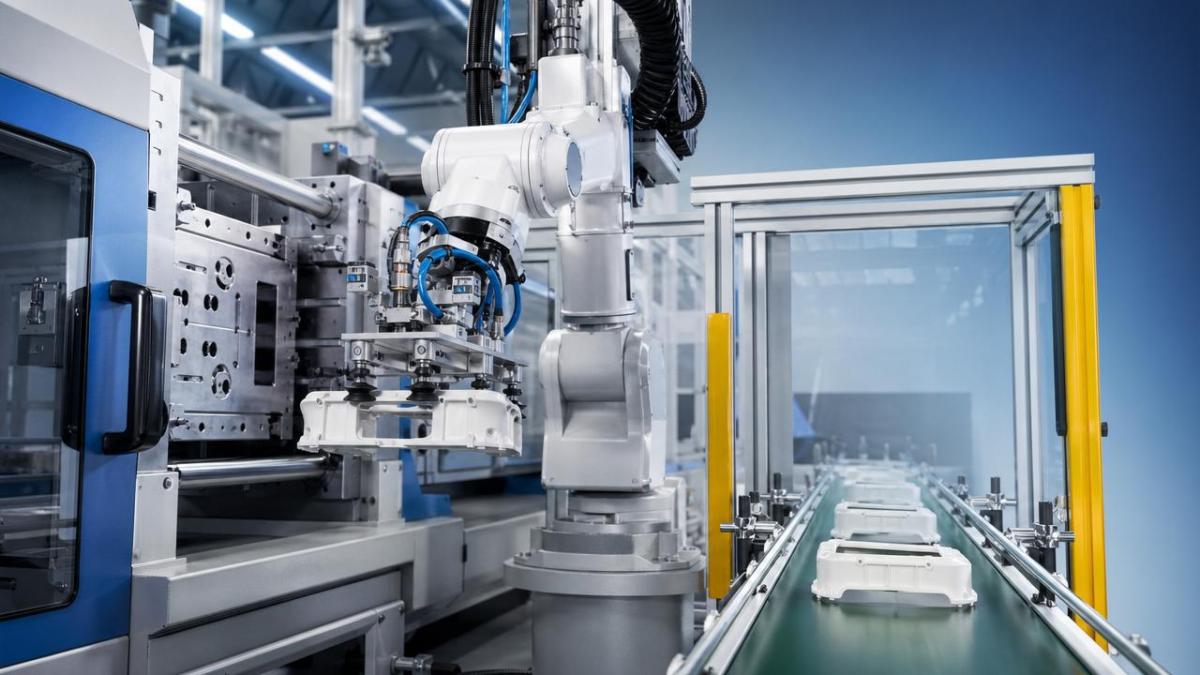
Although fault symptoms vary by brand and cell layout, several failure families repeatedly appear in field service. The most frequent issues usually involve sensing accuracy, gripping reliability, servo motion quality, wiring integrity, air or vacuum stability, and software logic. These are not isolated technical details; they are the main sources of downtime in high-volume molding operations.
For after-sales maintenance personnel, categorizing failures correctly is the fastest route to shorter troubleshooting time. A dropped part may look like a gripper issue but originate from inconsistent vacuum generation, poor tubing routing, delayed valve response, or an incorrect release sequence in the program. Likewise, unstable positioning may point to servo tuning, mechanical looseness, or reference drift.
The table below summarizes the fault patterns that appear most often in a robotic arm for injection molding and the practical consequences they create on the line.
High-frequency fault patterns
A key field observation
Many failures are mixed failures. A robotic arm for injection molding may report an electrical alarm, while the true trigger is mechanical drag or poor air quality. This is why service teams should avoid replacing parts too quickly without confirming the root cause chain.
What Is Driving These Failures More Frequently
The rise in recurring faults is not random. It is being driven by a combination of production intensification, broader automation integration, and higher quality expectations. In practical terms, robots are being asked to run longer, handle more product variants, and coordinate with more devices while maintaining near-zero interruption. That operating profile exposes weaknesses that may have stayed hidden in less demanding environments.
Another important factor is maintenance timing. In some plants, service intervals are still based on calendar schedules rather than actual cycle counts, motion intensity, contamination level, or part geometry changes. For a robotic arm for injection molding, this can lead to overused consumables in one line and unnecessary part replacement in another. Preventive maintenance becomes more effective when tied to operating reality.
There is also a knowledge transition issue. As automation systems become more integrated, technicians need a wider troubleshooting range. They must understand motion control, pneumatics, sensor logic, communication handshakes, and mold-side process timing. Failures appear more frequent when the diagnostic model is too narrow.
Main driving factors behind failure growth
- Shorter cycle times increase cumulative wear and heat load.
- Frequent SKU or mold changes create setup inconsistency.
- Dust, resin fines, oil mist, and temperature variation reduce sensor reliability.
- Complex cell communication introduces more synchronization failure points.
- Delayed replacement of vacuum cups, seals, belts, and connectors amplifies secondary damage.
Why root-cause analysis must evolve
The practical lesson for after-sales teams is clear: a robotic arm for injection molding should be diagnosed in context. A robot that stops at mold open position may not have a robot problem first. It may be waiting on machine-ready status, safety gate confirmation, or a delayed downstream discharge signal. Trend-aware maintenance starts by mapping dependencies before touching hardware.
This broader diagnostic method aligns with TSV’s engineering-first view. Parameters matter because they reveal where failure margins are shrinking: cycle time, vacuum level, axis current, stop count, sensor response delay, and repeatability deviation. When those signals drift, failure prevention becomes measurable rather than subjective.
How These Failures Affect Maintenance Teams, Production, and Quality Control
The impact of robotic failure is no longer limited to repair hours. A single unstable robotic arm for injection molding can disrupt product quality data, mold protection routines, packaging flow, and customer confidence. For maintenance teams, this means the service role is becoming more strategic. Fast recovery still matters, but repeat-failure elimination matters more.
For production supervisors, robot instability directly affects OEE, cycle adherence, and staffing efficiency. For quality teams, handling variation can leave marks, deform thin-wall parts, or create inconsistent cooling intervals before downstream inspection. For procurement and management, repeated field failures raise spare part urgency and lifecycle cost concerns.
Understanding these layered effects helps after-sales personnel prioritize service actions. Not every fault has the same business impact, and not every preventive action offers the same return.
Impact by stakeholder
A shift in service expectations
Plants increasingly expect service providers to deliver maintenance intelligence, not only repairs. For a robotic arm for injection molding, that means documenting failure recurrence, analyzing wear trends, recommending PM intervals by application, and advising on improvements in EOAT design, cable routing, and alarm handling logic.
Prevention Strategies That Match Current Operating Trends
The most effective prevention plan combines routine inspection, data-based replacement timing, and smarter troubleshooting discipline. For after-sales maintenance teams, the goal is to prevent predictable failures before they stop production, while also building a service record that reveals weak points in each robotic arm for injection molding application.
A practical starting point is to classify components into three risk groups: wear items, signal-critical items, and collision-sensitive items. Wear items include vacuum cups, seals, guide elements, belts, and tubing. Signal-critical items include sensors, connectors, and communication interfaces. Collision-sensitive items include EOAT alignment points, mechanical stoppers, and taught positions near mold surfaces.
Prevention also becomes stronger when maintenance and operations share the same checklist language. If operators can report “late release,” “pickup drift,” or “home signal flicker” consistently, service teams can identify patterns earlier and reduce unnecessary downtime.
Recommended preventive actions
- Inspect sensor faces, brackets, and target positions at fixed cycle-count intervals, not only during breakdowns.
- Check EOAT fasteners, suction cups, gripper pads, and alignment after every mold change or product changeover.
- Trend servo load, axis temperature, and positioning deviation to catch drag or tuning problems early.
- Inspect cable chains for bending stress, insulation wear, and loose connectors in repeated travel zones.
- Verify air quality, regulator stability, vacuum generation, and response time under actual production conditions.
- Back up robot programs and confirm handshake logic after software edits, control updates, or cell modifications.
What a stronger PM routine should include
Mechanical checks
Listen for abnormal noise, check for looseness, verify travel smoothness, and measure critical repeatability points. On a robotic arm for injection molding, mechanical play often appears before a major alarm does.
Electrical and control checks
Review I/O response, inspect grounding condition, confirm stable power quality, and test alarm history against real events. Intermittent electrical faults should be recorded with time, axis position, and machine state to isolate patterns.
Pneumatic and vacuum checks
Measure vacuum hold performance, leak rate, and valve switching consistency. Many part-drop incidents come from gradual degradation rather than sudden failure.
How After-Sales Teams Should Judge the Next Service Priorities
Looking ahead, the service priority for any robotic arm for injection molding should move toward condition-based maintenance, clearer failure documentation, and application-specific prevention standards. Not every molding cell needs the same service interval. A high-speed packaging part line, a technical resin application, and a cosmetic part cell create very different wear patterns and fault risks.
The next useful question is not simply “What broke?” but “What changed before it broke?” That includes mold replacement, cycle time adjustment, resin switch, EOAT modification, compressed air quality drift, controller update, or operator retraining gaps. These change signals often explain why a failure appears suddenly on a previously stable line.
For organizations that want fewer emergency interventions, the best path is to standardize inspection points, document recurring alarms in a comparable format, and rank failures by production impact. That turns maintenance from a reactive cost center into an engineering feedback loop.
Questions worth confirming on every service visit
- Has the robotic arm for injection molding experienced a recent cycle time or mold change?
- Are there alarm patterns linked to a specific axis position, shift, or product type?
- Do wear parts fail by time, by cycle count, or after setup changes?
- Is the problem local to the robot, or triggered by machine, safety, or downstream equipment signals?
- Which preventive action would eliminate recurrence rather than only restore operation?
In today’s production environment, preventing common robot failures is not only about protecting one machine. It is about protecting the stability of the entire molding cell. If your team wants to judge how these trends affect your own service model, focus first on three areas: recurring fault categories, component life under real cycle conditions, and the quality of cross-system diagnostics. Those answers usually show where the biggest reliability gains can be made next.
Search News
Hot Articles
- Carbon Fiber StructuresHow to Specify Aerospace Carbon Fiber Assemblies for Lightweight, Load-Bearing PartsJul 11, 2026
- Machine VisionXiaomi, Alibaba DAMO Academy Drive Open-Source Robotics Model Ecosystem, Lowering Algorithm Development Barriers for Overseas SMEs Adopting Chinese Robotics SolutionsMar 30, 2026
- Cobots & ArmsShanxi 'AI+' Conference Showcases Embodied Intelligence with Multinational Buyer Engagement: Key Industry ImplicationsMar 30, 2026
Popular Tags
Recommended News
 Jul 11, 2026How to Specify Aerospace Carbon Fiber Assemblies for Lightweight, Load-Bearing PartsAerospace carbon fiber assemblies: learn how to specify laminate design, load data, joining methods, and inspection controls for lighter, reliable load-bearing aerospace parts.Elena Rostova (UAV Systems Researcher)
 Mar 30, 2026Xiaomi, Alibaba DAMO Academy Drive Open-Source Robotics Model Ecosystem, Lowering Algorithm Development Barriers for Overseas SMEs Adopting Chinese Robotics SolutionsXiaomi & Alibaba DAMO Academy's open-source robotics models lower algorithm barriers for global SMEs. Boost efficiency in manufacturing, logistics & smart retail with ROS 2 compatible solutions.TSV Data Lab
 Mar 30, 2026Shanxi 'AI+' Conference Showcases Embodied Intelligence with Multinational Buyer Engagement: Key Industry ImplicationsShanxi 'AI+' Conference highlights embodied intelligence with Tesla, Ubtech & Jiantao showcasing multimodal robotics. 40+ global buyers validated tech on-site, creating new B2B channels for industrial automation & AI solutions.Chen Wei (Automation Lead Engineer)
 Mar 30, 2026Zhongguancun Unveils 6G Integrated Sensing-Computing-Intelligence Platform to Empower Embodied Robots for Global Industrial ApplicationsZhongguancun's new 6G platform revolutionizes industrial robotics with <10ms latency, empowering global automotive, logistics & port automation. Discover how this tech boosts China's smart manufacturing exports.TSV Data Lab
 Mar 30, 2026Mech-Mind Tianjin Embodied Intelligence R&D and Production Base Goes Live, Cutting Delivery Time by 20%–30% for Global Customized AMR+Vision SolutionsMech-Mind's Tianjin AMR+Vision production base cuts delivery time by 20%-30% for欧美 & Latin American markets. Discover how this PLd-certified facility accelerates customized robotics solutions for smart manufacturing and logistics.Chen Wei (Automation Lead Engineer)
 Mar 30, 2026Boao Forum Reveals 'Co-evolution of Big and Small Brains' Trend in Humanoid Robots, China's Embodied Intelligence Accelerates Adaptation to Overseas Manufacturing Service ScenariosDiscover how China's humanoid robots, featuring 'Co-evolution of Big and Small Brains,' are revolutionizing global manufacturing. Learn about Embodied Tian Gong 3.0's ISO compliance and overseas deployment at Boao Forum 2026.Chen Wei (Automation Lead Engineer)
 Mar 30, 2026China Railway Industrial Secures Patent for Embodied Robotics in Material Handling, Boosting High-Precision Delivery Capabilities for Overseas Infrastructure and Manufacturing ProjectsChina Railway Industrial's new patent for embodied robotics in material handling boosts high-precision delivery for global infrastructure & manufacturing. Discover how this innovation enhances logistics accuracy in automotive, rail transit & EPC projects.Chen Wei (Automation Lead Engineer)
 Oct 28, 2026IDC: Global Quadruped Robot Shipments Rise 92.5% in H1 2026 as Volume and Value DivergeGlobal quadruped robot shipments rose 92.5% in H1 2026, according to IDC. Explore what diverging volume and value trends mean for industrial buyers and manufacturers.Chen Wei (Automation Lead Engineer)
 Oct 28, 2026Interpreting Industrial IoT Latency Data for Monitoring and Real-Time ControlInterpret industrial category latency data to assess jitter, deadline misses, and real-time readiness. Learn how to benchmark IIoT systems and choose monitoring and control solutions.TSV Data Lab
 Oct 27, 2026GXO and Agility Robotics Expand Partnership to Accelerate US Humanoid Robot DeploymentGXO and Agility Robotics plan to expand US humanoid robot deployment with Digit 4 in early 2027. Explore warehouse automation plans, service terms and future Digit 5 upgrades.Chen Wei (Automation Lead Engineer)
 Oct 27, 2026Robotic Automation Costs: Budgeting for Equipment, Integration, and MaintenancePlan your robotics automation cost with confidence. Explore equipment, integration, and maintenance expenses, compare quotes, and build a realistic budget for better ROI.Chen Wei (Automation Lead Engineer)
 Oct 26, 2026AMAXiMAL Releases Open-Source TopMod 3D v3 With Claude AIExplore AMAXiMAL’s free, open-source TopMod 3D v3 with Claude AI assistance, topology-based modeling and plywood fabrication tools that connect complex designs to physical builds.Dr. Marcus Vance
 Oct 26, 2026Choosing a SCADA System Integrator Company: PLC Compatibility and Long-Term SupportChoose a scada system integrator company with proven PLC compatibility and reliable long-term support. Discover what to test, compare, and require before investing.Victor Lin (Chief Software Architect)
 Oct 25, 2026Hesai Leads Global ADAS Main Lidar Shipments in Yole’s 2026 ReportHesai led global ADAS main lidar shipments with a 43% share in 2025, according to Yole’s 2026 report. Explore what this ranking reveals about its automotive market position.TSV Data Lab
 Oct 25, 2026Choosing an Aerospace Materials Manufacturer: Quality and Traceability ChecksChoosing an aerospace materials manufacturer? Learn how to verify certifications, test reports, and lot traceability to qualify suppliers confidently and reduce costly sourcing risks.Dr. Marcus Vance
 Oct 24, 2026Guotai Haitong: Global Entry-Level 3D Printer Shipments Rose 39% in Q1 2026Entry-level 3D printer shipments rose 39% in Q1 2026, Guotai Haitong reports. Explore how AI, multicolor printing and print farms are shaping market growth.Dr. Marcus Vance
 Oct 24, 2026Choosing an Industrial Vision Inspection Supplier: Acceptance Tests That MatterChoose an industrial vision inspection supplier with confidence. Discover acceptance tests for defect detection, false rejects, production speed, and reliable part rejection before you buy.TSV Data Lab
 Oct 23, 2026US Navy Raises Gecko Robotics Contract Ceiling to $300M for Robotic Fleet MaintenanceUS Navy raises Gecko Robotics’ contract ceiling to $300M for Pacific Fleet robotic inspections. Explore potential opportunities for maintenance suppliers and key procurement considerations.Chen Wei (Automation Lead Engineer)
 Oct 23, 2026Choosing Industrial Sensing Systems for Global Plants: Protocol CompatibilityCompare industrial sensing systems international buyers can trust. Explore protocol compatibility, reduce integration risks, and select proven configurations for reliable global plant deployments.TSV Data Lab
 Oct 22, 2026KUKA Showcases Physical AI and iiQKA.AI Vision at NVIDIA GTC BerlinExplore KUKA’s Physical AI showcase at NVIDIA GTC Berlin and discover how iiQKA.AI Vision aims to simplify robotic vision integration and improve 2D and 3D scene recognition.TSV Data Lab
 Oct 22, 2026Robotic Machining of Advanced Composites: What Tolerances Are Achievable?Explore advanced materials machining robotics: discover what drives achievable composite tolerances and how to validate accuracy before investing in your next machining system.Dr. Marcus Vance
 Oct 21, 2026China’s Industrial Robot Exports Near RMB 10 Billion in First Nine Months of 2026China’s industrial robot exports neared RMB 10 billion in January–September 2026, with value rising faster than volume. Explore the data and what it could mean for suppliers.Chen Wei (Automation Lead Engineer)
 Oct 21, 2026Low-Latency Industrial Data Processing: Pricing and Key Cost DriversExplore industrial data latency price drivers, from edge hardware to integration and support. Learn how to compare quotes, verify performance, and avoid unnecessary costs.TSV Data Lab
 Oct 20, 2026KUKA Launches iiQKA.AI Vision to Simplify Industrial Image ProcessingKUKA iiQKA.AI Vision simplifies industrial image processing with controller-based 2D and 3D vision. Explore drag-and-drop setup for vision-guided automation.TSV Data Lab