What Makes a Reliable AGV Chassis Supplier for Custom Mobile Robots
Publication Date
author
Choosing the right agv chassis supplier is less about finding a company with a polished catalog and more about verifying whether its platform can survive real engineering constraints. For technical evaluators, the core search intent behind this topic is clear: identify the practical criteria that distinguish a reliable supplier from a marketing-heavy vendor, reduce integration risk, and shorten supplier qualification time for custom mobile robot projects.
The target reader usually cares about four questions above all else: Can the chassis carry the real payload with adequate dynamic stability? Will the motion control, communication interfaces, and power architecture integrate cleanly with our sensors and upper-level software? Is the supplier transparent enough to provide test data, tolerance information, and failure boundaries? And can the platform remain supportable across prototyping, validation, and scaled deployment?
This article focuses on those decision points. Instead of repeating generic claims about quality or innovation, it examines the engineering signals that matter: drivetrain design, structural margins, localization compatibility, electrical interface openness, reliability validation, manufacturability, and supplier responsiveness. For teams evaluating a custom mobile robot base, these are the factors that turn a chassis from a purchase item into a dependable subsystem.
Why reliability in an AGV chassis supplier is really an engineering risk question
When engineers search for an agv chassis supplier, they are usually not looking for a commodity platform. They are looking for a risk-controlled foundation for a robot that may eventually operate in factories, warehouses, labs, hospitals, or inspection environments. In that context, “reliable” means more than low failure rate. It means predictable behavior under load, repeatable motion, stable interfaces, and a supplier that does not hide technical limits.
A custom mobile robot project often fails long before deployment because the chassis selection process focused too much on headline specifications and too little on system compatibility. A nominal payload rating, for example, says very little unless it is tied to acceleration profile, center-of-gravity limits, floor condition assumptions, and braking performance. A credible supplier can explain these dependencies in detail and document how they were tested.
For technical evaluators, the best mindset is to treat the chassis supplier as an engineering partner whose outputs will affect navigation quality, battery life, safety envelope, maintenance burden, and future design flexibility. A reliable supplier reduces uncertainty. An unreliable one pushes hidden system costs downstream, where they become expensive integration delays and field failures.
Can the chassis actually support your payload, dynamics, and center-of-gravity requirements?
Payload is usually the first specification buyers compare, but technical evaluators know static payload numbers can be misleading. A chassis rated for 500 kg on paper may behave very differently when the real robot includes a mast, manipulator, battery pack, vision suite, and an uneven center of gravity. The right question is not just “What is the maximum load?” but “Under what motion profile, floor condition, and load geometry is that capacity valid?”
A reliable supplier should provide dynamic load information, not just static rating. Ask for acceleration and deceleration limits at full load, slope tolerance, wheel-ground traction assumptions, anti-tip considerations, and recommended center-of-mass envelope. If your mobile robot will carry elevated payloads or off-axis equipment, the supplier should be able to model or at least discuss yaw stability, roll sensitivity, and emergency stop behavior.
Structural design details matter as much as headline capacity. Evaluate frame material selection, weld quality or machining consistency, mounting flatness, torsional stiffness, and protection against long-term fatigue. If the supplier cannot explain where structural margins exist, or if they only offer broad claims like “heavy duty” without technical backup, that is an early warning sign. Reliable AGV chassis platforms are engineered with known load paths, not just oversized metal.
How strong is the motion control and drivetrain architecture behind the platform?
The chassis is not only a mechanical base; it is the motion foundation of the entire robot. A supplier may offer an attractive frame, but if the motor sizing, reducer selection, wheel configuration, and controller tuning are weak, your navigation performance will suffer. For custom robots, that means poor path tracking, overshoot during docking, unstable low-speed behavior, or inconsistent turning under variable payload.
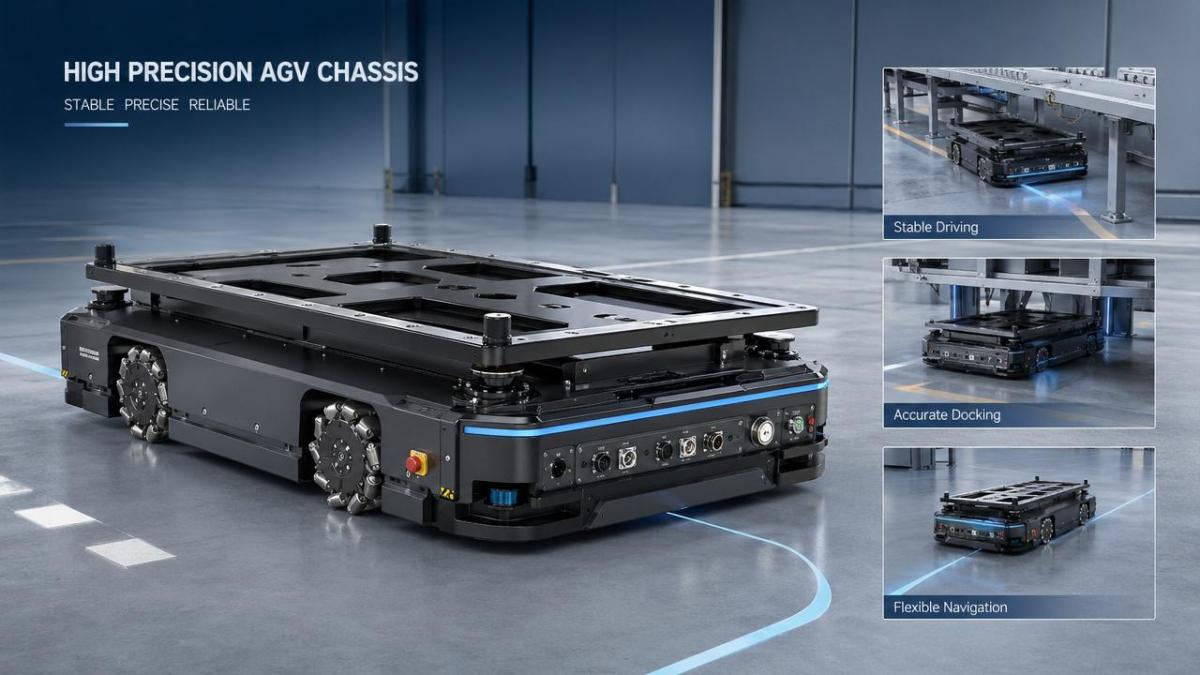
Technical evaluators should review drive topology carefully. Differential drive, omnidirectional drive, Ackermann steering, and Mecanum-based layouts all involve tradeoffs in traction, control complexity, floor sensitivity, and navigation precision. A reliable supplier should not simply list available configurations; they should help justify which architecture fits your use case, whether that is narrow-aisle logistics, precision docking, indoor service robotics, or mixed-environment transport.
Motor and controller transparency is another marker of supplier quality. Request information on servo or BLDC motor ratings, encoder resolution, current limits, thermal protection logic, reducer backlash, closed-loop control frequency, and low-speed smoothness. If the supplier has performed endurance tests or published MTBF-related component data, even better. Stable motion comes from well-matched electromechanical design, not from software compensation alone.
Does the supplier make sensor, controller, and software integration easier or harder?
For a custom mobile robot, integration effort often determines the true cost of the chassis. A technically credible supplier should make it straightforward to connect LiDAR, cameras, IMUs, safety scanners, PLCs, edge computers, and upper-level autonomy stacks. That starts with open and well-documented interfaces. CAN bus, EtherCAT, RS485, Ethernet, digital I/O, emergency stop circuits, and power distribution details should be clearly defined rather than explained only after purchase.
Mounting and packaging flexibility are equally important. Ask whether the chassis supports modular sensor brackets, standardized top-plate mounting patterns, accessible cable routing, and protected zones for sensitive electronics. A platform that looks compact in a brochure may become difficult to use if battery access, controller placement, thermal airflow, or service access are poorly thought out. Mechanical integration is often where hidden engineering time gets lost.
Software interoperability is another key filter. If your team uses ROS, proprietary fleet software, custom navigation stacks, or industrial automation frameworks, the supplier should explain how odometry, motor control, diagnostics, and fault reporting can be interfaced. Reliable suppliers do not claim universal compatibility without specifics. They provide message definitions, API or protocol documentation, and realistic guidance on what their system supports out of the box versus what requires custom development.
What validation evidence should a trustworthy AGV chassis supplier be able to show?
One of the clearest ways to separate a real engineering supplier from a noise-driven vendor is to ask for evidence. Not just certificates, but test logic. A dependable supplier should be able to share at least some validation data related to endurance, thermal behavior, repeated docking accuracy, load cycling, braking distance, battery runtime, wheel wear, and environmental suitability. The exact depth of disclosure varies, but the presence of structured testing is non-negotiable.
For example, if the chassis is intended for industrial use, ask how it performs after long-cycle operation under rated load. What happens to motor temperature, gearbox noise, and localization repeatability over time? How does the platform behave when crossing minor floor joints or when operating near the limits of battery discharge? Good suppliers know these answers because they have measured them. Weak suppliers respond with generic confidence statements.
Also evaluate certification and quality systems in context. Compliance with relevant standards, ESD practices, EMC awareness, and documented inspection processes all add credibility, but they should not be treated as substitutes for application-specific validation. A reliable supplier understands that a custom mobile robot program needs both formal quality discipline and practical field-oriented test evidence.
How do you assess long-term support, customization capability, and supply continuity?
Even if the initial prototype works, supplier reliability is still unproven until support quality has been tested. For technical evaluators, a major concern is whether the chassis supplier can sustain revisions, parts replacement, firmware updates, and production consistency. A one-off platform with weak revision control may create serious downstream problems once your robot enters pilot deployment or commercial scaling.
Ask how customization is handled. Can the supplier modify dimensions, wheelbase, suspension strategy, battery compartment, or interface layout without destabilizing the design? Do they manage engineering changes with version control and updated documentation? Can they support low-volume prototyping first and then transition to repeatable batch production? A reliable agv chassis supplier treats customization as a controlled engineering process, not an ad hoc fabrication service.
Supply chain continuity also matters. Review key component sourcing risk, lead times for motors and reducers, replacement part availability, and second-source strategy where applicable. For long-lifecycle robotics programs, obsolescence planning is important. Technical teams should not only ask whether the chassis is available today, but whether it will remain supportable during future maintenance cycles, design updates, and regional deployment expansion.
Practical red flags that technical evaluators should not ignore
Several warning signs appear repeatedly when supplier evaluation goes wrong. The first is specification vagueness. If a vendor quotes payload, speed, or runtime without test conditions, the data is incomplete. Another red flag is interface ambiguity. If communication protocols, safety wiring, or top-level control responsibilities are unclear, your integration risk is already high. Hidden complexity usually shows up later as schedule slippage.
A second red flag is overreliance on visuals instead of engineering documents. Attractive renders and polished websites do not substitute for drawings, tolerance information, wiring diagrams, and validated performance curves. Technical evaluators should expect a serious supplier to discuss constraints openly, including what the chassis does not handle well. Honest boundaries are a sign of maturity, not weakness.
The third red flag is poor responsiveness during technical inquiry. If pre-sales engineering communication is slow, inconsistent, or unable to answer detailed questions, post-sales support is unlikely to improve. In mobile robotics, project success often depends on fast clarification cycles between software, electrical, and mechanical teams. Supplier communication quality is therefore not a soft factor; it is part of technical reliability.
A practical evaluation framework for choosing the right supplier
A useful way to compare candidates is to build a weighted evaluation matrix around your real robot requirements. Start with payload and center-of-gravity fit, then score drive performance, control interface openness, mounting flexibility, environmental suitability, validation evidence, customization capacity, and lifecycle support. This prevents teams from being distracted by one strong selling point while missing broader system risk.
It is also wise to request a technical review meeting rather than only exchanging brochures. In that meeting, ask the supplier to walk through a specific deployment scenario: your payload mass, target speed, turning radius, duty cycle, floor condition, charging method, and sensor stack. Their ability to respond with structured engineering logic will reveal much more than a static product page ever can.
Where budget and schedule allow, prototype evaluation is the most effective filter. Test docking repeatability, odometry stability, acceleration smoothness, emergency stop response, thermal behavior, and service accessibility under representative load. A reliable agv chassis supplier will usually welcome this stage because it converts assumptions into measurable fit. For technical teams, measured fit is ultimately the only defensible basis for supplier selection.
Conclusion: reliability comes from transparency, testability, and system fit
A reliable AGV chassis supplier is not defined by branding language or an extensive product list. It is defined by engineering transparency, realistic specifications, proven motion performance, integration readiness, and the ability to support your robot beyond the first shipment. For technical evaluators, the most valuable suppliers are those who can clearly explain limits, provide evidence, and adapt their platform without losing control of quality.
If you are selecting a chassis for a custom mobile robot, focus on the issues that most strongly affect deployment success: dynamic payload behavior, drivetrain quality, interface openness, validation discipline, and lifecycle support. These factors do more to reduce technical risk than any brochure-level claim about innovation or premium quality.
In short, the right agv chassis supplier helps your team build a robot that works not only in demos, but in sustained operation. That is the standard that matters. In hard-tech procurement, reliability is earned through data, documentation, and repeatable engineering performance.
Search News
Hot Articles
- Carbon Fiber StructuresHow to Specify Aerospace Carbon Fiber Assemblies for Lightweight, Load-Bearing PartsJul 11, 2026
- Machine VisionXiaomi, Alibaba DAMO Academy Drive Open-Source Robotics Model Ecosystem, Lowering Algorithm Development Barriers for Overseas SMEs Adopting Chinese Robotics SolutionsMar 30, 2026
- Cobots & ArmsShanxi 'AI+' Conference Showcases Embodied Intelligence with Multinational Buyer Engagement: Key Industry ImplicationsMar 30, 2026
Popular Tags
Recommended News
 Jul 11, 2026How to Specify Aerospace Carbon Fiber Assemblies for Lightweight, Load-Bearing PartsAerospace carbon fiber assemblies: learn how to specify laminate design, load data, joining methods, and inspection controls for lighter, reliable load-bearing aerospace parts.Elena Rostova (UAV Systems Researcher)
 Mar 30, 2026Xiaomi, Alibaba DAMO Academy Drive Open-Source Robotics Model Ecosystem, Lowering Algorithm Development Barriers for Overseas SMEs Adopting Chinese Robotics SolutionsXiaomi & Alibaba DAMO Academy's open-source robotics models lower algorithm barriers for global SMEs. Boost efficiency in manufacturing, logistics & smart retail with ROS 2 compatible solutions.TSV Data Lab
 Mar 30, 2026Shanxi 'AI+' Conference Showcases Embodied Intelligence with Multinational Buyer Engagement: Key Industry ImplicationsShanxi 'AI+' Conference highlights embodied intelligence with Tesla, Ubtech & Jiantao showcasing multimodal robotics. 40+ global buyers validated tech on-site, creating new B2B channels for industrial automation & AI solutions.Chen Wei (Automation Lead Engineer)
 Mar 30, 2026Zhongguancun Unveils 6G Integrated Sensing-Computing-Intelligence Platform to Empower Embodied Robots for Global Industrial ApplicationsZhongguancun's new 6G platform revolutionizes industrial robotics with <10ms latency, empowering global automotive, logistics & port automation. Discover how this tech boosts China's smart manufacturing exports.TSV Data Lab
 Mar 30, 2026Mech-Mind Tianjin Embodied Intelligence R&D and Production Base Goes Live, Cutting Delivery Time by 20%–30% for Global Customized AMR+Vision SolutionsMech-Mind's Tianjin AMR+Vision production base cuts delivery time by 20%-30% for欧美 & Latin American markets. Discover how this PLd-certified facility accelerates customized robotics solutions for smart manufacturing and logistics.Chen Wei (Automation Lead Engineer)
 Mar 30, 2026Boao Forum Reveals 'Co-evolution of Big and Small Brains' Trend in Humanoid Robots, China's Embodied Intelligence Accelerates Adaptation to Overseas Manufacturing Service ScenariosDiscover how China's humanoid robots, featuring 'Co-evolution of Big and Small Brains,' are revolutionizing global manufacturing. Learn about Embodied Tian Gong 3.0's ISO compliance and overseas deployment at Boao Forum 2026.Chen Wei (Automation Lead Engineer)
 Mar 30, 2026China Railway Industrial Secures Patent for Embodied Robotics in Material Handling, Boosting High-Precision Delivery Capabilities for Overseas Infrastructure and Manufacturing ProjectsChina Railway Industrial's new patent for embodied robotics in material handling boosts high-precision delivery for global infrastructure & manufacturing. Discover how this innovation enhances logistics accuracy in automotive, rail transit & EPC projects.Chen Wei (Automation Lead Engineer)
 Oct 29, 2026Aerospace Aluminum Alloy Strength: 2024-T3 vs. 7075-T6 ComparedCompare aerospace aluminum alloy strength in 2024-T3 vs. 7075-T6. Explore fatigue, corrosion, and weight trade-offs to choose the right alloy for your design.Dr. Marcus Vance
 Oct 28, 2026IDC: Global Quadruped Robot Shipments Rise 92.5% in H1 2026 as Volume and Value DivergeGlobal quadruped robot shipments rose 92.5% in H1 2026, according to IDC. Explore what diverging volume and value trends mean for industrial buyers and manufacturers.Chen Wei (Automation Lead Engineer)
 Oct 28, 2026Interpreting Industrial IoT Latency Data for Monitoring and Real-Time ControlInterpret industrial category latency data to assess jitter, deadline misses, and real-time readiness. Learn how to benchmark IIoT systems and choose monitoring and control solutions.TSV Data Lab
 Oct 27, 2026GXO and Agility Robotics Expand Partnership to Accelerate US Humanoid Robot DeploymentGXO and Agility Robotics plan to expand US humanoid robot deployment with Digit 4 in early 2027. Explore warehouse automation plans, service terms and future Digit 5 upgrades.Chen Wei (Automation Lead Engineer)
 Oct 27, 2026Robotic Automation Costs: Budgeting for Equipment, Integration, and MaintenancePlan your robotics automation cost with confidence. Explore equipment, integration, and maintenance expenses, compare quotes, and build a realistic budget for better ROI.Chen Wei (Automation Lead Engineer)
 Oct 26, 2026AMAXiMAL Releases Open-Source TopMod 3D v3 With Claude AIExplore AMAXiMAL’s free, open-source TopMod 3D v3 with Claude AI assistance, topology-based modeling and plywood fabrication tools that connect complex designs to physical builds.Dr. Marcus Vance
 Oct 26, 2026Choosing a SCADA System Integrator Company: PLC Compatibility and Long-Term SupportChoose a scada system integrator company with proven PLC compatibility and reliable long-term support. Discover what to test, compare, and require before investing.Victor Lin (Chief Software Architect)
 Oct 25, 2026Hesai Leads Global ADAS Main Lidar Shipments in Yole’s 2026 ReportHesai led global ADAS main lidar shipments with a 43% share in 2025, according to Yole’s 2026 report. Explore what this ranking reveals about its automotive market position.TSV Data Lab
 Oct 25, 2026Choosing an Aerospace Materials Manufacturer: Quality and Traceability ChecksChoosing an aerospace materials manufacturer? Learn how to verify certifications, test reports, and lot traceability to qualify suppliers confidently and reduce costly sourcing risks.Dr. Marcus Vance
 Oct 24, 2026Guotai Haitong: Global Entry-Level 3D Printer Shipments Rose 39% in Q1 2026Entry-level 3D printer shipments rose 39% in Q1 2026, Guotai Haitong reports. Explore how AI, multicolor printing and print farms are shaping market growth.Dr. Marcus Vance
 Oct 24, 2026Choosing an Industrial Vision Inspection Supplier: Acceptance Tests That MatterChoose an industrial vision inspection supplier with confidence. Discover acceptance tests for defect detection, false rejects, production speed, and reliable part rejection before you buy.TSV Data Lab
 Oct 23, 2026US Navy Raises Gecko Robotics Contract Ceiling to $300M for Robotic Fleet MaintenanceUS Navy raises Gecko Robotics’ contract ceiling to $300M for Pacific Fleet robotic inspections. Explore potential opportunities for maintenance suppliers and key procurement considerations.Chen Wei (Automation Lead Engineer)
 Oct 23, 2026Choosing Industrial Sensing Systems for Global Plants: Protocol CompatibilityCompare industrial sensing systems international buyers can trust. Explore protocol compatibility, reduce integration risks, and select proven configurations for reliable global plant deployments.TSV Data Lab
 Oct 22, 2026KUKA Showcases Physical AI and iiQKA.AI Vision at NVIDIA GTC BerlinExplore KUKA’s Physical AI showcase at NVIDIA GTC Berlin and discover how iiQKA.AI Vision aims to simplify robotic vision integration and improve 2D and 3D scene recognition.TSV Data Lab
 Oct 22, 2026Robotic Machining of Advanced Composites: What Tolerances Are Achievable?Explore advanced materials machining robotics: discover what drives achievable composite tolerances and how to validate accuracy before investing in your next machining system.Dr. Marcus Vance
 Oct 21, 2026China’s Industrial Robot Exports Near RMB 10 Billion in First Nine Months of 2026China’s industrial robot exports neared RMB 10 billion in January–September 2026, with value rising faster than volume. Explore the data and what it could mean for suppliers.Chen Wei (Automation Lead Engineer)
 Oct 21, 2026Low-Latency Industrial Data Processing: Pricing and Key Cost DriversExplore industrial data latency price drivers, from edge hardware to integration and support. Learn how to compare quotes, verify performance, and avoid unnecessary costs.TSV Data Lab