How to Evaluate a Mecanum Wheel AGV Factory Beyond Unit Price
Publication Date
author
Choosing a mecanum wheel AGV factory on unit price alone can hide deeper risks in navigation accuracy, payload stability, lifecycle cost, and supplier traceability. For business evaluators making high-stakes sourcing decisions, the real question is whether a factory can deliver verifiable engineering data, consistent production quality, and long-term operational value. This guide explains how to assess a mecanum wheel AGV factory with the rigor that serious procurement demands.
Why the Evaluation Standard for a Mecanum Wheel AGV Factory Is Changing
The sourcing environment for AGV systems has changed sharply in recent years. Buyers are no longer evaluating a mecanum wheel AGV factory only as a metal-and-motor assembler. They are evaluating a system supplier whose output affects warehouse flexibility, production continuity, data integration, safety compliance, and future automation scalability. That shift has raised the standard for procurement review.
Several market signals explain this change. First, applications for omnidirectional AGVs have expanded from simple line feeding into dense manufacturing cells, electronics handling, medical logistics, and mixed-material transport. Second, navigation expectations have moved beyond basic route following toward stable performance in dynamic environments. Third, procurement teams now face pressure to justify total cost of ownership rather than just initial purchase price.
As a result, the best business evaluators ask a more strategic question: can the mecanum wheel AGV factory prove repeatable engineering capability under real operating conditions? Factories that cannot provide this evidence often compete on price, but hidden costs emerge later in commissioning delays, wheel wear, unstable motion control, spare parts gaps, or software support limitations.
Key trend signals affecting supplier assessment
A practical shift in buyer mindset
This trend matters because a mecanum wheel AGV factory sits at the intersection of mechanics, controls, software, and quality management. Unit price may indicate a negotiation outcome, but it does not reveal whether the supplier controls assembly tolerances, validates wheel friction behavior, or maintains firmware revision discipline. Those factors increasingly determine business value.
The Real Cost Drivers Buyers Often Miss Beyond the Quotation
A low quotation can be attractive, especially in competitive capex cycles, but the structure of AGV cost has shifted. In many projects, the visible purchase price is only one layer. The less visible layers include commissioning effort, route adaptation, maintenance intervals, battery replacement, wheel consumption, downtime during fault recovery, and software upgrade dependency.
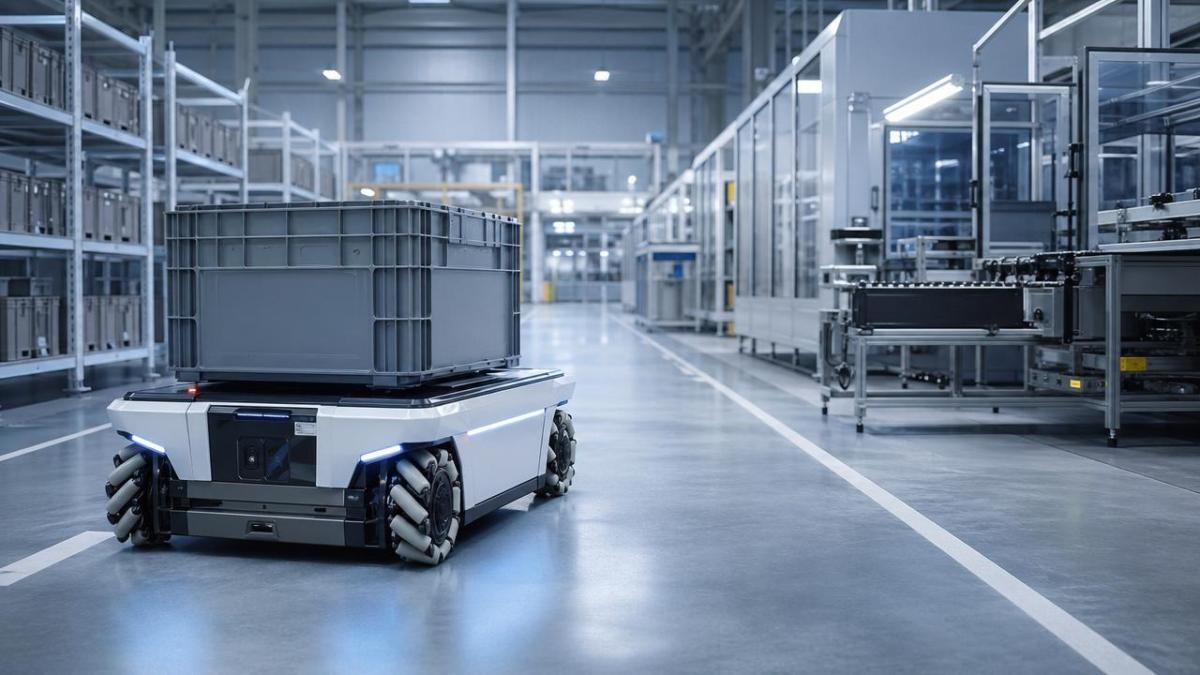
For a mecanum wheel AGV factory, wheel architecture is especially important. Mecanum systems deliver exceptional maneuverability, but they also demand stronger design discipline in wheel quality, load distribution, floor compatibility, and control tuning. If those areas are weak, buyers may face vibration, drift, inconsistent stopping, or accelerated wear that quickly erodes any upfront savings.
Business evaluators should therefore map cost drivers across the full operating life. A supplier that looks expensive on day one may be cheaper by year three if its spare parts are standardized, diagnostics are better, software is maintainable, and field support is faster.
- Wheel and roller replacement frequency
- Battery cycle life and charging strategy
- Controller stability under continuous operation
- Navigation recalibration effort after layout changes
- Spare part lead time and firmware version control
- On-site response time and remote diagnostics capability
This broader view aligns with how advanced procurement teams now evaluate automation vendors. They are not just buying a vehicle; they are buying operational continuity. That is why any serious review of a mecanum wheel AGV factory should include cost-to-operate and cost-to-recover metrics, not only cost-to-purchase.
Engineering Evidence Is Becoming the Main Differentiator
As automation deployments become more complex, engineering evidence matters more than sales language. A qualified mecanum wheel AGV factory should be able to show how it validates payload stability, turning performance, localization accuracy, obstacle response, braking distance, and reliability under defined duty cycles. If the supplier cannot explain its test methods, buyers should treat claims cautiously.
This is where many evaluations become too shallow. Buyers often compare rated load, speed, and battery capacity, but those headline numbers can hide important conditions. Was payload tested during straight travel or omnidirectional movement? Was speed measured unloaded or under sustained transport? Was navigation accuracy measured on a smooth lab floor or in a reflective industrial environment?
A strong mecanum wheel AGV factory will document boundaries, tolerances, and test setups. That level of transparency indicates maturity. It also helps procurement teams compare suppliers on consistent terms instead of marketing vocabulary.
What engineering data should be requested
- Payload test data across forward, lateral, and diagonal movement
- Positioning accuracy and repeatability under practical floor conditions
- Wheel durability data, including roller wear and replacement intervals
- MTBF or equivalent reliability evidence for core drive and control components
- Battery safety, cycle life, and charging management records
- Software interface documents for MES, WMS, PLC, or fleet systems
What to look for inside the factory review
During an audit, look beyond the showroom vehicle. Review incoming inspection rules for motors, reducers, sensors, and wheels. Ask how torque calibration is controlled on assembly lines. Check whether serial numbers connect to component batches. Ask how design changes are released and how software versions are locked before shipment. These are not administrative details; they are evidence of whether the mecanum wheel AGV factory can deliver consistency at scale.
How Industry Changes Affect Different Evaluation Stakeholders
The consequences of choosing the wrong supplier are no longer limited to procurement. Because AGVs now influence production rhythm, inventory movement, and digital coordination, evaluation criteria affect several internal stakeholders. That is another reason business evaluators should build a multidimensional assessment model when comparing each mecanum wheel AGV factory.
Engineering teams typically prioritize navigation robustness, control stability, and integration flexibility. Operations leaders focus on uptime, route efficiency, and recovery from exceptions. Finance teams want predictable maintenance and defensible lifecycle economics. Compliance or EHS personnel pay attention to safety logic, emergency behavior, and documentation discipline. A factory that looks acceptable to one group may fail another group’s real requirements.
The current trend is clear: cross-functional sourcing has become the norm. Therefore, supplier assessment should reflect shared ownership rather than a single department’s checklist.
Stakeholder impact table
When evaluation teams align these perspectives early, they reduce the chance of selecting a mecanum wheel AGV factory that wins the RFQ but struggles in deployment. This is especially important in facilities where floor conditions, load types, and traffic density make omnidirectional AGV performance more sensitive to engineering detail.
What a Strong Mecanum Wheel AGV Factory Should Demonstrate in 2025 and Beyond
The next phase of AGV competition will likely center on proof, adaptability, and supportability. Buyers should expect more than an attractive specification sheet. A future-ready mecanum wheel AGV factory should show signs of disciplined manufacturing, modular product architecture, and evidence-based service capabilities. These strengths help customers adapt when layouts change, throughput increases, or software environments evolve.
Another important direction is compatibility with broader automation ecosystems. Factories that design vehicles as isolated machines may struggle as customers demand fleet coordination, traceability, and plant-level visibility. Business evaluators should therefore test whether the supplier can support integration discussions, not merely hardware delivery.
Service maturity is also becoming a differentiator. In a tighter labor market, many end users lack deep in-house AGV troubleshooting capability. A reliable mecanum wheel AGV factory should provide documentation, training paths, remote diagnostic support, and clear spare parts planning. This reduces operational uncertainty after installation.
Future-oriented evaluation checklist
- Can the factory explain its roadmap for controller, sensor, and software updates?
- Are mechanical modules standardized for easier maintenance and replacement?
- Does the supplier maintain traceable records from component sourcing to shipment?
- Can it support pilot testing in application conditions similar to yours?
- Does it provide measurable service commitments instead of general promises?
A warning about over-optimized quotations
If a quotation looks unusually low, evaluators should check which capabilities were removed to hit that price. Sometimes the tradeoff is in wheel quality, battery grade, sensor redundancy, software openness, or post-sales staffing. In trend terms, this matters because the market increasingly rewards dependable operation, not minimal entry cost.
A Smarter Decision Framework for Business Evaluators
To evaluate a mecanum wheel AGV factory effectively, procurement teams should move from price comparison to weighted decision analysis. This does not mean ignoring cost. It means placing price inside a broader framework that reflects engineering risk, operational impact, and supplier resilience. The goal is a sourcing decision that remains defensible six months after deployment, not just on the day the contract is signed.
A practical approach is to separate evaluation into three layers: technical proof, manufacturing control, and service continuity. Technical proof confirms whether the AGV can do the job. Manufacturing control confirms whether every delivered unit will perform consistently. Service continuity confirms whether the supplier can support the equipment throughout its useful life. A weakness in any one layer can undermine the whole project.
For organizations operating in fast-moving industrial environments, this framework also supports trend-aware decision making. It captures the reality that automation assets now need to be adaptable, data-capable, and supportable over time.
Recommended decision framework
In final review meetings, ask not only whether the mecanum wheel AGV factory is affordable, but whether it is measurable, controllable, and supportable. Those three questions are increasingly better predictors of long-term value than unit price alone. If your business wants to judge how these trends affect a specific sourcing project, focus next on floor conditions, duty cycle, integration needs, wheel wear assumptions, and the factory’s ability to prove its claims with engineering data.
Search News
Hot Articles
- Carbon Fiber StructuresHow to Specify Aerospace Carbon Fiber Assemblies for Lightweight, Load-Bearing PartsJul 11, 2026
- Machine VisionXiaomi, Alibaba DAMO Academy Drive Open-Source Robotics Model Ecosystem, Lowering Algorithm Development Barriers for Overseas SMEs Adopting Chinese Robotics SolutionsMar 30, 2026
- Cobots & ArmsShanxi 'AI+' Conference Showcases Embodied Intelligence with Multinational Buyer Engagement: Key Industry ImplicationsMar 30, 2026
Popular Tags
Recommended News
 Jul 11, 2026How to Specify Aerospace Carbon Fiber Assemblies for Lightweight, Load-Bearing PartsAerospace carbon fiber assemblies: learn how to specify laminate design, load data, joining methods, and inspection controls for lighter, reliable load-bearing aerospace parts.Elena Rostova (UAV Systems Researcher)
 Mar 30, 2026Xiaomi, Alibaba DAMO Academy Drive Open-Source Robotics Model Ecosystem, Lowering Algorithm Development Barriers for Overseas SMEs Adopting Chinese Robotics SolutionsXiaomi & Alibaba DAMO Academy's open-source robotics models lower algorithm barriers for global SMEs. Boost efficiency in manufacturing, logistics & smart retail with ROS 2 compatible solutions.TSV Data Lab
 Mar 30, 2026Shanxi 'AI+' Conference Showcases Embodied Intelligence with Multinational Buyer Engagement: Key Industry ImplicationsShanxi 'AI+' Conference highlights embodied intelligence with Tesla, Ubtech & Jiantao showcasing multimodal robotics. 40+ global buyers validated tech on-site, creating new B2B channels for industrial automation & AI solutions.Chen Wei (Automation Lead Engineer)
 Mar 30, 2026Zhongguancun Unveils 6G Integrated Sensing-Computing-Intelligence Platform to Empower Embodied Robots for Global Industrial ApplicationsZhongguancun's new 6G platform revolutionizes industrial robotics with <10ms latency, empowering global automotive, logistics & port automation. Discover how this tech boosts China's smart manufacturing exports.TSV Data Lab
 Mar 30, 2026Mech-Mind Tianjin Embodied Intelligence R&D and Production Base Goes Live, Cutting Delivery Time by 20%–30% for Global Customized AMR+Vision SolutionsMech-Mind's Tianjin AMR+Vision production base cuts delivery time by 20%-30% for欧美 & Latin American markets. Discover how this PLd-certified facility accelerates customized robotics solutions for smart manufacturing and logistics.Chen Wei (Automation Lead Engineer)
 Mar 30, 2026Boao Forum Reveals 'Co-evolution of Big and Small Brains' Trend in Humanoid Robots, China's Embodied Intelligence Accelerates Adaptation to Overseas Manufacturing Service ScenariosDiscover how China's humanoid robots, featuring 'Co-evolution of Big and Small Brains,' are revolutionizing global manufacturing. Learn about Embodied Tian Gong 3.0's ISO compliance and overseas deployment at Boao Forum 2026.Chen Wei (Automation Lead Engineer)
 Mar 30, 2026China Railway Industrial Secures Patent for Embodied Robotics in Material Handling, Boosting High-Precision Delivery Capabilities for Overseas Infrastructure and Manufacturing ProjectsChina Railway Industrial's new patent for embodied robotics in material handling boosts high-precision delivery for global infrastructure & manufacturing. Discover how this innovation enhances logistics accuracy in automotive, rail transit & EPC projects.Chen Wei (Automation Lead Engineer)
 Oct 29, 2026Aerospace Aluminum Alloy Strength: 2024-T3 vs. 7075-T6 ComparedCompare aerospace aluminum alloy strength in 2024-T3 vs. 7075-T6. Explore fatigue, corrosion, and weight trade-offs to choose the right alloy for your design.Dr. Marcus Vance
 Oct 28, 2026IDC: Global Quadruped Robot Shipments Rise 92.5% in H1 2026 as Volume and Value DivergeGlobal quadruped robot shipments rose 92.5% in H1 2026, according to IDC. Explore what diverging volume and value trends mean for industrial buyers and manufacturers.Chen Wei (Automation Lead Engineer)
 Oct 28, 2026Interpreting Industrial IoT Latency Data for Monitoring and Real-Time ControlInterpret industrial category latency data to assess jitter, deadline misses, and real-time readiness. Learn how to benchmark IIoT systems and choose monitoring and control solutions.TSV Data Lab
 Oct 27, 2026GXO and Agility Robotics Expand Partnership to Accelerate US Humanoid Robot DeploymentGXO and Agility Robotics plan to expand US humanoid robot deployment with Digit 4 in early 2027. Explore warehouse automation plans, service terms and future Digit 5 upgrades.Chen Wei (Automation Lead Engineer)
 Oct 27, 2026Robotic Automation Costs: Budgeting for Equipment, Integration, and MaintenancePlan your robotics automation cost with confidence. Explore equipment, integration, and maintenance expenses, compare quotes, and build a realistic budget for better ROI.Chen Wei (Automation Lead Engineer)
 Oct 26, 2026AMAXiMAL Releases Open-Source TopMod 3D v3 With Claude AIExplore AMAXiMAL’s free, open-source TopMod 3D v3 with Claude AI assistance, topology-based modeling and plywood fabrication tools that connect complex designs to physical builds.Dr. Marcus Vance
 Oct 26, 2026Choosing a SCADA System Integrator Company: PLC Compatibility and Long-Term SupportChoose a scada system integrator company with proven PLC compatibility and reliable long-term support. Discover what to test, compare, and require before investing.Victor Lin (Chief Software Architect)
 Oct 25, 2026Hesai Leads Global ADAS Main Lidar Shipments in Yole’s 2026 ReportHesai led global ADAS main lidar shipments with a 43% share in 2025, according to Yole’s 2026 report. Explore what this ranking reveals about its automotive market position.TSV Data Lab
 Oct 25, 2026Choosing an Aerospace Materials Manufacturer: Quality and Traceability ChecksChoosing an aerospace materials manufacturer? Learn how to verify certifications, test reports, and lot traceability to qualify suppliers confidently and reduce costly sourcing risks.Dr. Marcus Vance
 Oct 24, 2026Guotai Haitong: Global Entry-Level 3D Printer Shipments Rose 39% in Q1 2026Entry-level 3D printer shipments rose 39% in Q1 2026, Guotai Haitong reports. Explore how AI, multicolor printing and print farms are shaping market growth.Dr. Marcus Vance
 Oct 24, 2026Choosing an Industrial Vision Inspection Supplier: Acceptance Tests That MatterChoose an industrial vision inspection supplier with confidence. Discover acceptance tests for defect detection, false rejects, production speed, and reliable part rejection before you buy.TSV Data Lab
 Oct 23, 2026US Navy Raises Gecko Robotics Contract Ceiling to $300M for Robotic Fleet MaintenanceUS Navy raises Gecko Robotics’ contract ceiling to $300M for Pacific Fleet robotic inspections. Explore potential opportunities for maintenance suppliers and key procurement considerations.Chen Wei (Automation Lead Engineer)
 Oct 23, 2026Choosing Industrial Sensing Systems for Global Plants: Protocol CompatibilityCompare industrial sensing systems international buyers can trust. Explore protocol compatibility, reduce integration risks, and select proven configurations for reliable global plant deployments.TSV Data Lab
 Oct 22, 2026KUKA Showcases Physical AI and iiQKA.AI Vision at NVIDIA GTC BerlinExplore KUKA’s Physical AI showcase at NVIDIA GTC Berlin and discover how iiQKA.AI Vision aims to simplify robotic vision integration and improve 2D and 3D scene recognition.TSV Data Lab
 Oct 22, 2026Robotic Machining of Advanced Composites: What Tolerances Are Achievable?Explore advanced materials machining robotics: discover what drives achievable composite tolerances and how to validate accuracy before investing in your next machining system.Dr. Marcus Vance
 Oct 21, 2026China’s Industrial Robot Exports Near RMB 10 Billion in First Nine Months of 2026China’s industrial robot exports neared RMB 10 billion in January–September 2026, with value rising faster than volume. Explore the data and what it could mean for suppliers.Chen Wei (Automation Lead Engineer)
 Oct 21, 2026Low-Latency Industrial Data Processing: Pricing and Key Cost DriversExplore industrial data latency price drivers, from edge hardware to integration and support. Learn how to compare quotes, verify performance, and avoid unnecessary costs.TSV Data Lab