
Custom Aerospace Structural Parts: Cost Drivers
Publication Date
author
For buyers, engineers, and decision-makers evaluating custom aerospace structural parts, cost is shaped by far more than material price alone. From carbon fiber tube for aerospace selection and tolerance control to supplier capability, certification, and production scale, every variable affects total value. This guide breaks down the real cost drivers behind precision aerospace components while helping you compare manufacturing options with clearer technical and commercial judgment.
In aerospace programs, a part that looks simple on a drawing can become expensive because of inspection intensity, traceability demands, multi-axis machining time, or low-volume production constraints. A bracket, rib, fitting, or composite tube may carry strict structural, thermal, and fatigue requirements that reshape both process planning and commercial terms.
That is why serious sourcing cannot rely on headline unit price alone. The better question is how material choice, geometry, tolerances, certification, and supplier process maturity interact to determine total delivered value over a 6-month, 12-month, or multi-year program lifecycle.
Material Selection and Structural Performance Requirements
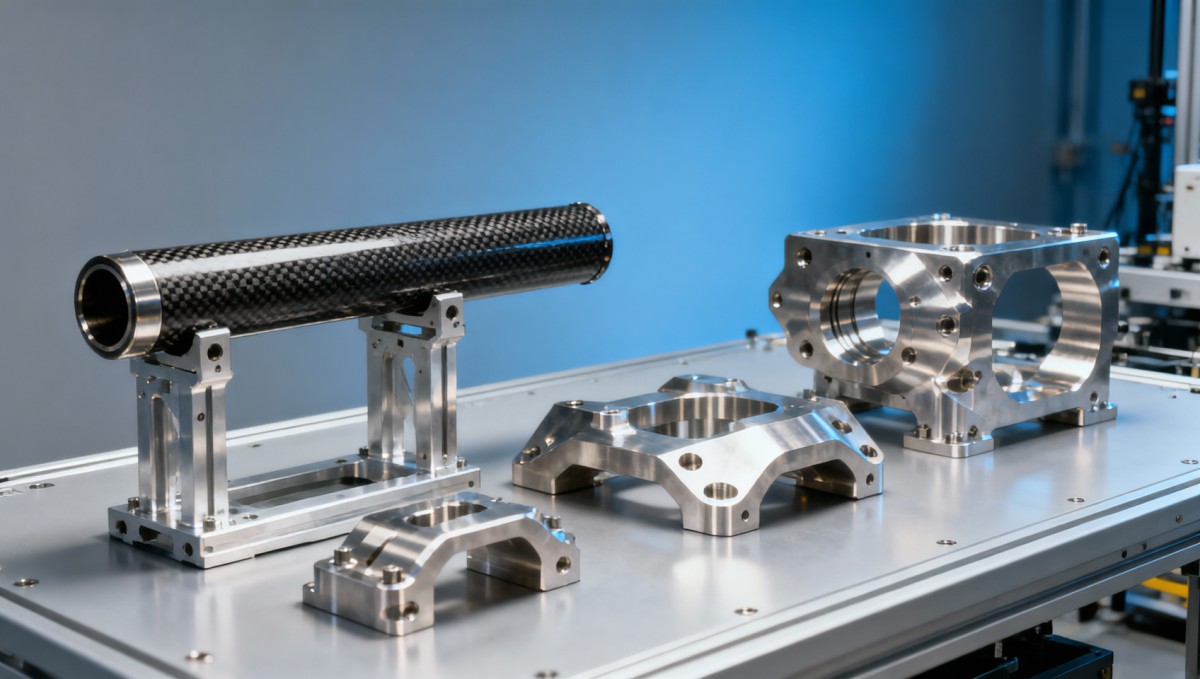
Material is usually the first visible cost driver, but in aerospace structural parts it is rarely the only one. Aluminum alloys, titanium, stainless steel, Inconel-class heat-resistant alloys, and composite systems such as carbon fiber tube for aerospace all carry very different raw stock costs, machining behavior, scrap rates, and inspection demands.
For example, aerospace aluminum may support lower machining cost and shorter cycle time, while titanium often increases tool wear, spindle hours, and process risk. Composite parts can reduce mass by 20% to 50% in the right application, but their cost may rise because of layup complexity, bonding validation, curing control, and destructive test coupons.
Engineers should also separate raw material price from structural value. A lower-cost metal that forces a heavier design may increase downstream fuel, payload, or system integration penalties. In UAV and commercial aerospace structures, a favorable strength-to-weight ratio can justify a higher per-kilogram material cost if the design saves 5% to 15% system mass.
Why composite and specialty alloy choices change pricing
When a buyer specifies a carbon fiber tube for aerospace, pricing depends on fiber grade, resin system, wall thickness, layup schedule, dimensional stability, and whether the component needs autoclave processing or a lower-cost out-of-autoclave route. A tube with a 1.5 mm wall and moderate straightness control is a different commercial product from a tube requiring tight concentricity and validated fatigue performance.
Metals behave similarly. A simple 3-axis aluminum part can be produced quickly, while a titanium fitting with thin walls, deep pockets, and low distortion tolerance may require slower feeds, additional stress-relief steps, and multiple in-process checks. The same nominal size can therefore produce a 2x to 4x difference in manufacturing effort.
The table below shows how common material families affect typical cost contributors in custom aerospace structural parts.
The key takeaway is that material choice should be evaluated against structural function, not just raw price. A supplier that can explain buy-to-fly ratio, scrap exposure, and inspection implications is usually more valuable than one quoting only by kilogram or by piece.
Geometry, Tolerances, and Manufacturing Complexity
Once material is defined, geometry becomes the next major cost lever. Complex pockets, thin walls, blended radii, internal channels, and tight mating features can increase setup count, fixturing effort, and machine time. A part requiring 1 setup may be economical; the same part redesigned into 3 or 4 setups may carry a sharp price increase.
Tolerance is especially important. A general tolerance of ±0.10 mm is very different from a critical bearing interface held at ±0.01 mm or a composite tube with strict straightness and concentricity requirements. Tighter tolerances usually add slower machining passes, more metrology time, and a higher risk of scrap during final inspection.
Surface finish and edge condition also matter. Aerospace structural parts may need Ra values below 1.6 µm on selected interfaces, controlled deburring for fastener holes, or burr-free edges to prevent crack initiation. These details are not cosmetic; they directly affect labor content and quality assurance cost.
Common design features that raise cost
- Deep cavities with thin remaining walls, which increase vibration risk and often require reduced cutting parameters.
- High hole count patterns, especially when position tolerance and countersink consistency must be tightly controlled.
- Closed or hard-to-reach internal areas that demand special tooling, custom fixturing, or non-contact measurement methods.
- Composite-metal hybrid joints that introduce adhesive bonding, insert installation, or galvanic isolation steps.
Tolerance strategy should match functional criticality
A frequent procurement mistake is applying tight tolerances across an entire drawing when only 10% to 20% of the features are functionally critical. This approach inflates machining and inspection cost without improving performance. A better drawing distinguishes datum-related interfaces, safety-critical dimensions, and non-critical cosmetic features.
In many programs, cost can be reduced by reserving the tightest controls for load paths, alignment points, and sealing or bearing surfaces. If a supplier can review the print and suggest realistic GD&T rationalization, that supplier may lower risk more effectively than one offering the lowest initial quote.
The following table highlights how common design variables affect custom aerospace structural parts pricing.
In short, geometry and tolerance decisions can outweigh raw material in many quotes. Early design-for-manufacture review often prevents 15% to 30% cost escalation that would otherwise appear later as scrap, rework, or delayed approval.
Certification, Traceability, and Quality Assurance Costs
In aerospace, the cost of proving a part can be as important as the cost of making it. Buyers often underestimate how much documentation, inspection planning, and traceability add to a custom structural component. Material certs, batch traceability, first article inspection, process records, and non-destructive testing can represent a meaningful share of project cost.
A supplier working under aerospace quality systems such as AS9100-aligned processes typically invests more in document control, calibration, operator training, and process discipline. That does not automatically make every quote higher in total value. In many programs, it lowers the hidden cost of requalification, rejected lots, and delayed integration.
Custom aerospace structural parts used in flight-adjacent, UAV, or high-reliability systems may need 100% dimensional inspection for critical features, lot-based testing, or NDT methods such as ultrasonic, dye penetrant, or X-ray depending on the material and structure. Each added control gate affects both lead time and pricing.
Where quality-related cost usually appears
The visible line items may include first article inspection, certificate of conformity, raw material trace packages, and special process validation. The less visible items include fixture qualification, gauge calibration, operator hold points, and document retention. For low-volume programs, these fixed costs are spread over fewer units, so the per-piece price can rise significantly.
This is why a prototype batch of 5 parts often looks disproportionately expensive compared with a release batch of 50 or 200 parts. The engineering and quality setup work is front-loaded. Smart buyers compare both non-recurring engineering cost and recurring production cost instead of forcing everything into one unit-price number.
Questions procurement should ask before comparing quotes
- Does the quotation include first article inspection and to what standard?
- Are raw material certificates and full lot traceability included in the base price?
- Which features are inspected at 100%, and which follow sampling plans?
- Are special processes outsourced, and if so, how is supplier control managed?
When these questions are clarified early, buyers can avoid false price comparisons. Two quotes that differ by 18% may actually become equal once missing documentation, inspection, or approval steps are added back into the lower headline offer.
Production Volume, Lead Time, and Supplier Capability
The same custom aerospace structural part can have very different cost structures depending on whether the order is 2 pieces, 20 pieces, or 200 pieces per release. Low-volume work carries more setup cost per unit, while higher volumes may justify dedicated fixtures, process optimization, and negotiated material procurement. Volume does not always reduce price dramatically, but it often improves predictability.
Lead time is another major variable. Standard production windows may run 4 to 8 weeks for precision machined parts and longer for certified composite or hybrid assemblies, depending on workload, material availability, and finishing steps. Expedited builds can require overtime, priority scheduling, split lots, or alternate logistics, all of which raise cost.
Supplier capability matters because the cheapest supplier is not always the lowest-cost program partner. A shop with strong 5-axis CNC, composite processing, in-house metrology, and disciplined traceability may reduce transfers between vendors, shorten issue resolution time, and cut the risk of nonconformance during integration.
How volume and capability influence commercial outcomes
For prototype work, buyers should expect higher unit prices because programming, tooling, and validation are spread across a small batch. For bridge production and serial supply, suppliers can often stabilize pricing when annual forecast visibility reaches 3 to 6 months and release quantities become more consistent.
Supplier process depth also affects total cost. If a manufacturer can manage machining, bonded assembly, finishing, and inspection under one controlled workflow, the buyer may save on logistics, duplicate quality checks, and schedule coordination. This is especially relevant for UAV and aerospace structures that combine metal inserts, composite sections, and precision interfaces.
The table below can help procurement teams compare sourcing models for custom aerospace structural parts.
The central lesson is that lead time, lot size, and supplier maturity should be evaluated together. A low quote loses value quickly if the supplier cannot hold schedule, maintain revision control, or provide consistent documentation across repeated orders.
How Buyers Can Control Cost Without Sacrificing Reliability
Controlling cost in custom aerospace structural parts does not mean pushing every supplier to the lowest number. It means reducing avoidable complexity while protecting function, airworthiness-related discipline, and program timing. The most effective savings usually come from better specification quality, smarter tolerance allocation, and clearer sourcing strategy.
A practical starting point is to separate critical-to-function features from general features on the drawing package. This alone can improve quote clarity and reduce inspection burden. Another lever is to share forecast ranges, even if they are imperfect. A supplier planning around 20 to 50 units per quarter can often make different process decisions than one reacting to unpredictable spot orders.
For composite structures such as carbon fiber tube for aerospace, buyers should define what truly matters: axial stiffness, torsional behavior, mass target, straightness, bond interface quality, environmental exposure, and fatigue expectations. If every parameter is labeled critical without prioritization, the supplier must price for worst-case risk.
A five-step cost control framework
- Review the drawing and BOM for over-specified tolerances, finishes, or documentation requirements.
- Classify features by criticality: safety-related, functional fit, assembly convenience, and cosmetic.
- Ask suppliers to separate non-recurring engineering, tooling, and recurring unit cost in the quotation.
- Compare total delivered scope, including inspection, certs, finishing, packaging, and logistics.
- Run a supplier capability review focused on process stability, not sales language.
Common sourcing mistakes to avoid
- Selecting by unit price only and discovering later that first article, NDT, or finishing was excluded.
- Using prototype assumptions for production pricing without considering fixture or throughput changes.
- Ignoring revision control discipline, which can create expensive scrap or mixed-configuration inventory.
- Choosing a supplier without adequate metrology for parts requiring ±0.02 mm or similar critical control.
Well-managed aerospace procurement is ultimately about evidence. Suppliers should be able to discuss process capability, measurement method, likely scrap risks, and realistic lead times. That aligns with TSV’s broader operating principle: parameters matter more than promotional language, and tolerances shape both technical success and commercial performance.
If your team is comparing custom aerospace structural parts suppliers, build the discussion around measurable inputs: tolerance bands, expected lot size, qualification scope, target lead time, and traceability depth. Clear technical framing often prevents months of rework and costly sourcing resets. For deeper benchmarking, tailored manufacturing analysis, or supplier evaluation support, contact TechStat Vanguard to get a more precise sourcing framework and discuss your application in detail.
Search News
Hot Articles
- Carbon Fiber StructuresHow to Specify Aerospace Carbon Fiber Assemblies for Lightweight, Load-Bearing PartsJul 11, 2026
- Machine VisionXiaomi, Alibaba DAMO Academy Drive Open-Source Robotics Model Ecosystem, Lowering Algorithm Development Barriers for Overseas SMEs Adopting Chinese Robotics SolutionsMar 30, 2026
- Cobots & ArmsShanxi 'AI+' Conference Showcases Embodied Intelligence with Multinational Buyer Engagement: Key Industry ImplicationsMar 30, 2026
Popular Tags
Recommended News
 Jul 11, 2026How to Specify Aerospace Carbon Fiber Assemblies for Lightweight, Load-Bearing PartsAerospace carbon fiber assemblies: learn how to specify laminate design, load data, joining methods, and inspection controls for lighter, reliable load-bearing aerospace parts.Elena Rostova (UAV Systems Researcher)
 Mar 30, 2026Xiaomi, Alibaba DAMO Academy Drive Open-Source Robotics Model Ecosystem, Lowering Algorithm Development Barriers for Overseas SMEs Adopting Chinese Robotics SolutionsXiaomi & Alibaba DAMO Academy's open-source robotics models lower algorithm barriers for global SMEs. Boost efficiency in manufacturing, logistics & smart retail with ROS 2 compatible solutions.TSV Data Lab
 Mar 30, 2026Shanxi 'AI+' Conference Showcases Embodied Intelligence with Multinational Buyer Engagement: Key Industry ImplicationsShanxi 'AI+' Conference highlights embodied intelligence with Tesla, Ubtech & Jiantao showcasing multimodal robotics. 40+ global buyers validated tech on-site, creating new B2B channels for industrial automation & AI solutions.Chen Wei (Automation Lead Engineer)
 Mar 30, 2026Zhongguancun Unveils 6G Integrated Sensing-Computing-Intelligence Platform to Empower Embodied Robots for Global Industrial ApplicationsZhongguancun's new 6G platform revolutionizes industrial robotics with <10ms latency, empowering global automotive, logistics & port automation. Discover how this tech boosts China's smart manufacturing exports.TSV Data Lab
 Mar 30, 2026Mech-Mind Tianjin Embodied Intelligence R&D and Production Base Goes Live, Cutting Delivery Time by 20%–30% for Global Customized AMR+Vision SolutionsMech-Mind's Tianjin AMR+Vision production base cuts delivery time by 20%-30% for欧美 & Latin American markets. Discover how this PLd-certified facility accelerates customized robotics solutions for smart manufacturing and logistics.Chen Wei (Automation Lead Engineer)
 Mar 30, 2026Boao Forum Reveals 'Co-evolution of Big and Small Brains' Trend in Humanoid Robots, China's Embodied Intelligence Accelerates Adaptation to Overseas Manufacturing Service ScenariosDiscover how China's humanoid robots, featuring 'Co-evolution of Big and Small Brains,' are revolutionizing global manufacturing. Learn about Embodied Tian Gong 3.0's ISO compliance and overseas deployment at Boao Forum 2026.Chen Wei (Automation Lead Engineer)
 Mar 30, 2026China Railway Industrial Secures Patent for Embodied Robotics in Material Handling, Boosting High-Precision Delivery Capabilities for Overseas Infrastructure and Manufacturing ProjectsChina Railway Industrial's new patent for embodied robotics in material handling boosts high-precision delivery for global infrastructure & manufacturing. Discover how this innovation enhances logistics accuracy in automotive, rail transit & EPC projects.Chen Wei (Automation Lead Engineer)
 Oct 16, 2026Choosing a Rugged Edge AI Box Supplier: Thermal Tests and Lifecycle SupportChoose a rugged edge AI box supplier with proven thermal performance and reliable lifecycle support. Discover the tests and commitments to verify before you buy.TSV Data Lab
 Oct 15, 2026R&D Cost Reduction Services: How to Evaluate Fees, Savings, and ROIEvaluate R&D cost reduction services with confidence. Compare fees, verify savings, and calculate ROI without compromising performance. Discover how to choose a provider that delivers real value.Chen Wei (Automation Lead Engineer)
 Oct 15, 2026How Should You Compare TechStat Vanguard 5-Axis CNC Tolerances?TechStat Vanguard 5-axis CNC tolerance comparison: learn how to verify part accuracy, assess inspection evidence, and choose suppliers that reliably meet your drawing requirements.Dr. Marcus Vance
 Oct 14, 2026Drone Frame Composites: Carbon Fiber vs. Fiberglass for Weight and StiffnessExplore drone structural materials composites: compare carbon fiber and fiberglass for weight, stiffness, cost, and antenna compatibility. Find the right material for your drone frame.Elena Rostova (UAV Systems Researcher)
 Oct 13, 2026Smart Cameras vs. PC-Based Machine Vision: Which Fits High-Speed Inspection?This industrial product comparison for machine vision weighs smart cameras vs. PC-based systems on latency, throughput, and cost. Discover your best fit for high-speed inspection.TSV Data Lab
 Oct 12, 2026How to Verify RoHS Compliance in Industrial Sensing Systems Before DeploymentRoHS compliant sensing systems: learn how to verify materials, supplier declarations, testing, and configuration controls before industrial deployment.TSV Data Lab
 Oct 11, 2026How Procurement-Oriented Content Taxonomy Improves B2B Buying JourneysProcurement-oriented content taxonomy streamlines B2B buying journeys with clearer evidence, supplier comparisons, risk visibility, and faster approvals.TSV Data Lab
 Oct 10, 2026How to Select a Machine Performance Monitoring Platform for OEE and Downtime ReductionMachine performance monitoring platform selection guide: validate machine states, OEE data, downtime reasons, integrations, and scalability to reduce losses with confidence.TSV Data Lab
 Oct 08, 2026How to Machine Inconel 625 Blades Without Heat Cracks or Edge ChippingInconel 625 blade machining guide: prevent heat cracks, edge chipping, chatter, and work hardening with proven tooling, cooling, fixturing, and inspection strategies.Dr. Marcus Vance
 Oct 07, 2026How to Evaluate an HMI Panel Distributor for Industrial Automation ProjectsHMI panel distributor evaluation guide: verify technical compatibility, traceability, supply reliability, lifecycle support, and total cost for automation projects.Victor Lin (Chief Software Architect)
 Oct 06, 2026Navigation Fault Tolerance Standards for AMRs: What Safety Teams Must VerifyNavigation fault tolerance standards: learn what AMR safety teams must verify, from localization loss and sensor faults to stopping distance, safe restart, and site-specific validation.Chen Wei (Automation Lead Engineer)
 Oct 05, 2026Calculating Edge Computing Total Cost of Ownership Across Distributed SitesEdge computing ownership cost explained: calculate deployment, energy, connectivity, security, remote support, and refresh costs across distributed sites.TSV Data Lab
 Oct 04, 2026CAD/CAM Benchmarking in the GCC: What Manufacturers Should Ask a ConsultantCAD CAM benchmark consultant GCC guide: learn the key questions manufacturers should ask to validate post-processors, workflows, machine performance, and production risk.Victor Lin (Chief Software Architect)
 Oct 03, 2026Selecting Automotive Radar Sensor Modules for ADAS Range, Resolution, and IntegrationAutomotive radar sensor module selection guide for ADAS: compare range, resolution, field of view, latency, and integration to build safer, reliable vehicle systems.TSV Data Lab
 Oct 02, 2026How to Qualify Machined Parts Suppliers for Hard Tech ProgramsHard tech supply chain machined parts demand rigorous supplier qualification. Learn how to assess capability, traceability, quality controls, and delivery resilience.Dr. Marcus Vance
 Oct 01, 2026How to Select an Outdoor Security Radar Sensor for Perimeter Detection?Outdoor security radar sensor selection guide: compare range, accuracy, false-alarm control, integration, and field testing for reliable perimeter detection.TSV Data Lab
 Sep 30, 2026How to Evaluate Solid-State LiDAR Hardware for Outdoor Autonomous VehiclesSolid state LiDAR hardware evaluation guide for outdoor autonomous vehicles—compare range, point-cloud quality, environmental resilience, integration, and safety.TSV Data Lab























