
5 axis CNC machining aerospace China: where quality gaps usually show up
Publication Date
author
In 5 axis CNC machining aerospace China, the biggest quality gaps rarely come from obvious machine capability claims. They show up in how a supplier controls process variation across real production conditions: tolerance stability over multiple setups, tool wear compensation on titanium and Inconel, fixture repeatability for thin-wall parts, inspection discipline, and material traceability that can stand up to customer and regulatory review. For engineering teams, buyers, and decision-makers evaluating a titanium CNC machining supplier or a custom Inconel parts manufacturer, the practical question is simple: where does quality usually fail first, and how can you detect it before it becomes a cost, schedule, or flight-risk problem?
The short answer is this: most quality gaps in aerospace 5-axis machining are not caused by a lack of basic equipment, but by inconsistent process control. A supplier may own advanced machines and still struggle with thermal stability, programming discipline, first-article validation, or lot-by-lot repeatability. That is why the right evaluation approach is not to ask who has “high precision,” but to examine where capability breaks down under complexity, difficult materials, and documentation pressure.
Where aerospace 5-axis machining quality gaps usually appear first
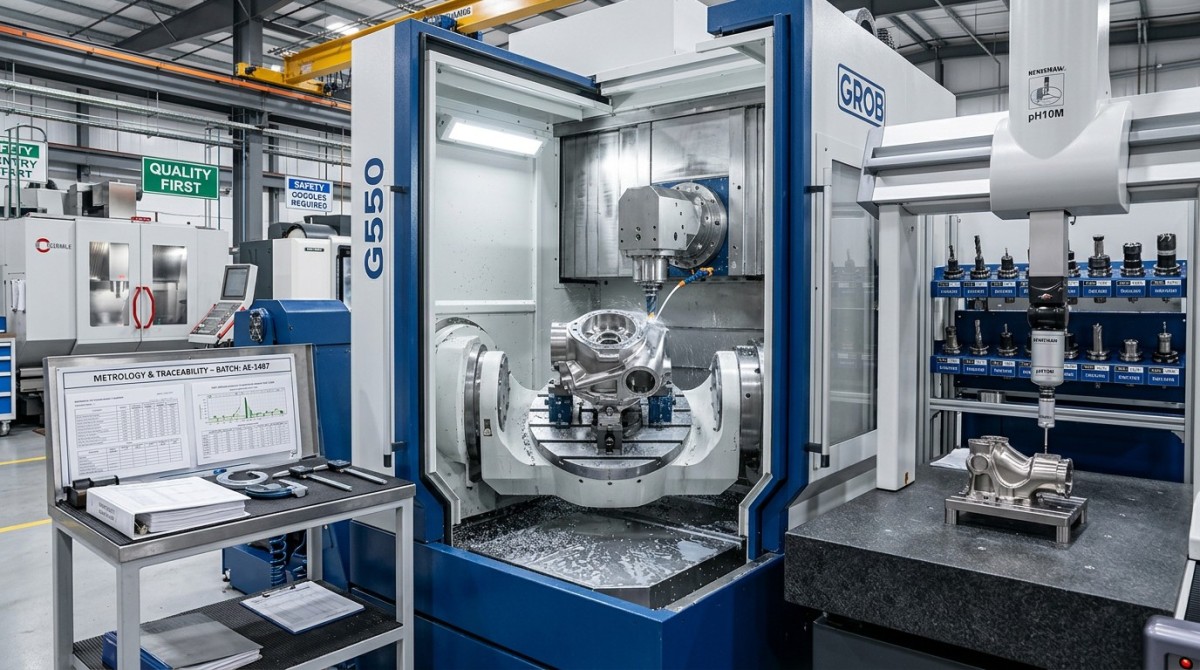
When buyers search for 5 axis CNC machining aerospace China, they are usually not looking for a general manufacturing overview. They want to know where supplier risk hides. In aerospace programs, the most common gaps typically appear in six areas.
1. Tolerance drift across the full machining sequence
A supplier may achieve tolerance on a single feature, yet fail to hold positional accuracy after multiple tool changes, re-clamping events, or long cycle times. This is especially relevant for complex structural brackets, housings, impellers, and thin-wall components. The problem is not nominal machine travel accuracy alone, but accumulated variation across the entire process route.
Warning signs include:
- Strong first-piece results but unstable batch consistency
- CMM reports that highlight only selected critical dimensions
- No clear strategy for thermal compensation or in-process verification
- Difficulty maintaining profile or true position after finishing passes
2. Toolpath and programming inconsistency
In aerospace machining, CAM strategy matters as much as spindle quality. Poorly optimized toolpaths can create chatter, burr formation, excess residual stress, surface tearing, or inconsistent edge condition—especially on titanium alloys, aluminum aerospace grades, and nickel-based superalloys. A capable shop should be able to explain how it controls engagement angle, cutting load, rest machining logic, and finishing consistency across similar part families.
If the supplier cannot describe its programming revision control, simulation workflow, and prove-out process, that is often a larger risk than machine brand alone.
3. Weak fixture strategy for thin-wall or high-value parts
Many aerospace parts are geometrically sensitive. Thin sections deform easily, and expensive alloys leave little room for trial-and-error. Quality gaps often show up when fixture design is treated as a workshop task rather than an engineering discipline. In practice, poor fixturing leads to distortion after unclamping, inconsistent datum transfer, and rework that is hidden until final inspection.
Buyers should pay attention to whether the supplier develops dedicated fixture plans for part families, validates clamping force effects, and understands how roughing-to-finishing transitions affect part stability.
4. Material-specific process weakness
Not every shop that machines aluminum well can reliably machine titanium or Inconel for aerospace applications. A titanium CNC machining supplier should demonstrate experience with heat buildup control, tool wear management, chip evacuation, and burr minimization. A custom Inconel parts manufacturer should show how it handles work hardening, low thermal conductivity, and cycle stability without sacrificing surface integrity.
The quality gap here usually appears in one of two ways: either excessive conservatism that causes long lead times and high cost, or aggressive machining that creates hidden metallurgical or dimensional problems.
5. Inspection depth that is weaker than machining complexity
Some suppliers machine difficult parts reasonably well but underinvest in measurement planning. That creates a dangerous mismatch. Aerospace buyers should verify not only whether a shop owns CMMs, but whether it uses inspection methods appropriate to part complexity, GD&T requirements, and lot traceability. If a part has deep internal geometry, compound angles, freeform surfaces, or tight positional controls, the inspection plan must be just as robust as the machining plan.
6. Documentation and traceability gaps
In aerospace, a part is not fully qualified by shape alone. Material certificates, lot traceability, process records, inspection records, and revision control are part of quality. This is often where commercial-looking suppliers fall behind true aerospace-ready suppliers. A shop may produce a visually good part, but if traceability breaks between raw material, process history, and final release documents, the supplier may still be unsuitable for serious programs.
What buyers, engineers, and procurement teams should check before approving a supplier
Different stakeholders look at quality from different angles, but their concerns overlap. Information researchers want to separate signal from marketing. Operators and engineers care about process realism. Procurement teams need supplier comparison criteria. Executives need to understand business risk, not only technical language.
The most useful evaluation framework is to ask for evidence in four layers.
Layer 1: Can they machine the material reliably?
Ask for examples by alloy, not just by industry. Aerospace machining capability should be material-specific. Request prior experience in titanium, Inconel, stainless aerospace grades, or high-strength aluminum depending on your application. A meaningful answer should include part type, tolerance class, wall thickness range, inspection method, and typical production volume.
Layer 2: Can they keep quality stable from prototype to batch?
A common sourcing mistake is approving a supplier based on one successful prototype run. The real test is repeatability. Ask how the supplier manages:
- First article inspection and process validation
- Tool life control and replacement criteria
- Machine calibration and thermal stability checks
- Fixture repeatability between lots
- Operator handoff and program version control
If answers depend heavily on one senior programmer or one key machinist, the process may not be scalable.
Layer 3: Can their quality system support aerospace expectations?
For aerospace buyers, this goes beyond generic ISO language. The relevant question is whether the supplier’s quality system actually supports nonconformance handling, inspection record retention, revision control, and full material traceability. Certifications matter, but operating discipline matters more. A supplier should be able to show how a problem is contained, investigated, documented, and prevented from recurring.
Layer 4: Can they communicate technical risk clearly?
Good suppliers do not simply say yes to every drawing. They identify risk early: unstable datums, overconstrained tolerances, inaccessible inspection features, likely distortion points, or problematic finishing sequences. In aerospace sourcing, one of the strongest quality indicators is technical honesty. If a shop never challenges a drawing or asks process-related questions, that can indicate weak engineering review rather than strong confidence.
How quality gaps affect cost, lead time, and program risk
For enterprise decision-makers, quality gaps are not isolated shop-floor issues. They directly shape total acquisition cost and project reliability.
When a supplier cannot hold tolerance consistently, the consequences usually include:
- Higher first-article iteration cost
- Longer qualification cycles
- More incoming inspection burden on the customer side
- Higher probability of schedule slip on production lots
- Increased field or assembly risk if hidden defects pass through
This is why the cheapest quote in 5 axis CNC machining aerospace China is often not the lowest-cost option in reality. If process capability is weak, the buyer pays elsewhere: engineering rework, expediting, supplier development time, excess safety stock, or internal inspection overhead.
For procurement teams, a useful mindset is to evaluate not only unit price, but cost of uncertainty. A supplier with slightly higher pricing but stronger material traceability, more stable process control, and better documentation may reduce total program cost significantly.
Questions that reveal real capability faster than generic sales claims
If your goal is to assess a titanium CNC machining supplier or custom Inconel parts manufacturer efficiently, the fastest route is to ask technically specific questions that expose process maturity.
- How do you control thermal effects during long-cycle 5-axis machining?
- What is your typical strategy for fixturing thin-wall aerospace parts?
- How do you verify positional accuracy after re-clamping or secondary operations?
- What inspection plan do you use for complex GD&T requirements?
- How do you manage tool wear in titanium or nickel-based alloys?
- What records link raw material heat number to final released part?
- How do you handle nonconformance, rework approval, and process correction?
- Can you show examples of repeat production, not just prototype success?
These questions are useful because they shift the conversation from advertised capability to demonstrated control. A mature supplier will answer with process logic, not slogans.
What strong aerospace machining suppliers in China usually do differently
Not all suppliers operate at the same level, and country-level assumptions are often less useful than factory-level evidence. The better aerospace machining suppliers in China tend to share several traits.
- They match part type and alloy to a proven machining window instead of overpromising broad capability.
- They treat fixturing, programming, and inspection as integrated engineering functions.
- They document process changes and maintain revision discipline.
- They can explain not just what tolerance they hit, but how they keep hitting it.
- They are comfortable discussing scrap risk, distortion risk, and process limitations early.
- They support buyer qualification with data, not marketing adjectives.
This aligns with how serious engineering organizations evaluate suppliers today. The decision is no longer based on machine count or brochure language. It is based on whether the supplier can reduce uncertainty in critical manufacturing outcomes.
Conclusion: quality gaps are usually process-control gaps, not brochure gaps
For anyone researching 5 axis CNC machining aerospace China, the most important takeaway is that visible capability and actual aerospace readiness are not the same thing. The quality gaps that matter most usually appear in process control: tolerance stability, material-specific machining discipline, fixture design, inspection depth, and traceability completeness.
If you are comparing a titanium CNC machining supplier or a custom Inconel parts manufacturer, focus less on broad claims and more on where performance typically breaks under real conditions. Ask for evidence of repeatability, not just examples of success. Ask how problems are prevented, not only how parts are produced. In aerospace sourcing, the best supplier is rarely the one that sounds most confident. It is the one that can prove, with process data and engineering clarity, where quality risk is controlled before it reaches your program.
Search News
Hot Articles
- Carbon Fiber StructuresHow to Specify Aerospace Carbon Fiber Assemblies for Lightweight, Load-Bearing PartsJul 11, 2026
- Machine VisionXiaomi, Alibaba DAMO Academy Drive Open-Source Robotics Model Ecosystem, Lowering Algorithm Development Barriers for Overseas SMEs Adopting Chinese Robotics SolutionsMar 30, 2026
- Cobots & ArmsShanxi 'AI+' Conference Showcases Embodied Intelligence with Multinational Buyer Engagement: Key Industry ImplicationsMar 30, 2026
Popular Tags
Recommended News
 Jul 11, 2026How to Specify Aerospace Carbon Fiber Assemblies for Lightweight, Load-Bearing PartsAerospace carbon fiber assemblies: learn how to specify laminate design, load data, joining methods, and inspection controls for lighter, reliable load-bearing aerospace parts.Elena Rostova (UAV Systems Researcher)
 Mar 30, 2026Xiaomi, Alibaba DAMO Academy Drive Open-Source Robotics Model Ecosystem, Lowering Algorithm Development Barriers for Overseas SMEs Adopting Chinese Robotics SolutionsXiaomi & Alibaba DAMO Academy's open-source robotics models lower algorithm barriers for global SMEs. Boost efficiency in manufacturing, logistics & smart retail with ROS 2 compatible solutions.TSV Data Lab
 Mar 30, 2026Shanxi 'AI+' Conference Showcases Embodied Intelligence with Multinational Buyer Engagement: Key Industry ImplicationsShanxi 'AI+' Conference highlights embodied intelligence with Tesla, Ubtech & Jiantao showcasing multimodal robotics. 40+ global buyers validated tech on-site, creating new B2B channels for industrial automation & AI solutions.Chen Wei (Automation Lead Engineer)
 Mar 30, 2026Zhongguancun Unveils 6G Integrated Sensing-Computing-Intelligence Platform to Empower Embodied Robots for Global Industrial ApplicationsZhongguancun's new 6G platform revolutionizes industrial robotics with <10ms latency, empowering global automotive, logistics & port automation. Discover how this tech boosts China's smart manufacturing exports.TSV Data Lab
 Mar 30, 2026Mech-Mind Tianjin Embodied Intelligence R&D and Production Base Goes Live, Cutting Delivery Time by 20%–30% for Global Customized AMR+Vision SolutionsMech-Mind's Tianjin AMR+Vision production base cuts delivery time by 20%-30% for欧美 & Latin American markets. Discover how this PLd-certified facility accelerates customized robotics solutions for smart manufacturing and logistics.Chen Wei (Automation Lead Engineer)
 Mar 30, 2026Boao Forum Reveals 'Co-evolution of Big and Small Brains' Trend in Humanoid Robots, China's Embodied Intelligence Accelerates Adaptation to Overseas Manufacturing Service ScenariosDiscover how China's humanoid robots, featuring 'Co-evolution of Big and Small Brains,' are revolutionizing global manufacturing. Learn about Embodied Tian Gong 3.0's ISO compliance and overseas deployment at Boao Forum 2026.Chen Wei (Automation Lead Engineer)
 Mar 30, 2026China Railway Industrial Secures Patent for Embodied Robotics in Material Handling, Boosting High-Precision Delivery Capabilities for Overseas Infrastructure and Manufacturing ProjectsChina Railway Industrial's new patent for embodied robotics in material handling boosts high-precision delivery for global infrastructure & manufacturing. Discover how this innovation enhances logistics accuracy in automotive, rail transit & EPC projects.Chen Wei (Automation Lead Engineer)
 Oct 27, 2026GXO and Agility Robotics Expand Partnership to Accelerate US Humanoid Robot DeploymentGXO and Agility Robotics plan to expand US humanoid robot deployment with Digit 4 in early 2027. Explore warehouse automation plans, service terms and future Digit 5 upgrades.Chen Wei (Automation Lead Engineer)
 Oct 27, 2026Robotic Automation Costs: Budgeting for Equipment, Integration, and MaintenancePlan your robotics automation cost with confidence. Explore equipment, integration, and maintenance expenses, compare quotes, and build a realistic budget for better ROI.Chen Wei (Automation Lead Engineer)
 Oct 26, 2026AMAXiMAL Releases Open-Source TopMod 3D v3 With Claude AIExplore AMAXiMAL’s free, open-source TopMod 3D v3 with Claude AI assistance, topology-based modeling and plywood fabrication tools that connect complex designs to physical builds.Dr. Marcus Vance
 Oct 26, 2026Choosing a SCADA System Integrator Company: PLC Compatibility and Long-Term SupportChoose a scada system integrator company with proven PLC compatibility and reliable long-term support. Discover what to test, compare, and require before investing.Victor Lin (Chief Software Architect)
 Oct 25, 2026Hesai Leads Global ADAS Main Lidar Shipments in Yole’s 2026 ReportHesai led global ADAS main lidar shipments with a 43% share in 2025, according to Yole’s 2026 report. Explore what this ranking reveals about its automotive market position.TSV Data Lab
 Oct 25, 2026Choosing an Aerospace Materials Manufacturer: Quality and Traceability ChecksChoosing an aerospace materials manufacturer? Learn how to verify certifications, test reports, and lot traceability to qualify suppliers confidently and reduce costly sourcing risks.Dr. Marcus Vance
 Oct 24, 2026Guotai Haitong: Global Entry-Level 3D Printer Shipments Rose 39% in Q1 2026Entry-level 3D printer shipments rose 39% in Q1 2026, Guotai Haitong reports. Explore how AI, multicolor printing and print farms are shaping market growth.Dr. Marcus Vance
 Oct 24, 2026Choosing an Industrial Vision Inspection Supplier: Acceptance Tests That MatterChoose an industrial vision inspection supplier with confidence. Discover acceptance tests for defect detection, false rejects, production speed, and reliable part rejection before you buy.TSV Data Lab
 Oct 23, 2026US Navy Raises Gecko Robotics Contract Ceiling to $300M for Robotic Fleet MaintenanceUS Navy raises Gecko Robotics’ contract ceiling to $300M for Pacific Fleet robotic inspections. Explore potential opportunities for maintenance suppliers and key procurement considerations.Chen Wei (Automation Lead Engineer)
 Oct 23, 2026Choosing Industrial Sensing Systems for Global Plants: Protocol CompatibilityCompare industrial sensing systems international buyers can trust. Explore protocol compatibility, reduce integration risks, and select proven configurations for reliable global plant deployments.TSV Data Lab
 Oct 22, 2026KUKA Showcases Physical AI and iiQKA.AI Vision at NVIDIA GTC BerlinExplore KUKA’s Physical AI showcase at NVIDIA GTC Berlin and discover how iiQKA.AI Vision aims to simplify robotic vision integration and improve 2D and 3D scene recognition.TSV Data Lab
 Oct 22, 2026Robotic Machining of Advanced Composites: What Tolerances Are Achievable?Explore advanced materials machining robotics: discover what drives achievable composite tolerances and how to validate accuracy before investing in your next machining system.Dr. Marcus Vance
 Oct 21, 2026China’s Industrial Robot Exports Near RMB 10 Billion in First Nine Months of 2026China’s industrial robot exports neared RMB 10 billion in January–September 2026, with value rising faster than volume. Explore the data and what it could mean for suppliers.Chen Wei (Automation Lead Engineer)
 Oct 21, 2026Low-Latency Industrial Data Processing: Pricing and Key Cost DriversExplore industrial data latency price drivers, from edge hardware to integration and support. Learn how to compare quotes, verify performance, and avoid unnecessary costs.TSV Data Lab
 Oct 20, 2026KUKA Launches iiQKA.AI Vision to Simplify Industrial Image ProcessingKUKA iiQKA.AI Vision simplifies industrial image processing with controller-based 2D and 3D vision. Explore drag-and-drop setup for vision-guided automation.TSV Data Lab
 Oct 20, 2026Smart Industrial Edge Devices: Key Criteria for Legacy PLC IntegrationChoose smart industrial edge devices for legacy PLC integration. Discover key criteria for compatibility, data quality, security, and reliable collection without disrupting control.TSV Data Lab
 Oct 19, 2026Choosing a Radar Sensor by Application: Range, Resolution, and Field of ViewSimplify radar sensor application based product selection. Compare range, resolution, and field of view to avoid blind spots and choose with confidence. Explore the guide.TSV Data Lab























