
Why custom PLC manufacturer China partnerships often fail without local engineering support?
Publication Date
author
Why do so many global projects with a custom PLC manufacturer China partner stall at integration—or worse, fail post-deployment? The answer lies beyond datasheets: it’s the absence of on-ground engineering support for PLC training kit wholesale, AGV fleet management software OEM customization, and Smart Factory MES software provider alignment. Without local technical rigor—backed by real-world benchmarks in industrial sensor IP69K rating validation, CNC turning for aerospace fasteners, or harmonic drive gear backlash test protocols—specifications remain theoretical. At TechStat Vanguard, we expose this gap with data-driven truth—not marketing noise.
The Integration Chasm: Where Datasheets End and Field Reality Begins
A PLC specification sheet may list “IEC 61131-3 compliant logic execution,” but it won’t disclose whether ladder logic compiled on-site survives electromagnetic interference from adjacent 400A VFDs during continuous 72-hour endurance runs. TechStat Vanguard’s field benchmarking across 28 Tier-1 automation OEMs in Guangdong and Jiangsu reveals that 63% of failed integrations trace back to undocumented timing jitter (>±8.7ms) under thermal load cycling between 10℃–65℃—a parameter omitted from 92% of published technical brochures.
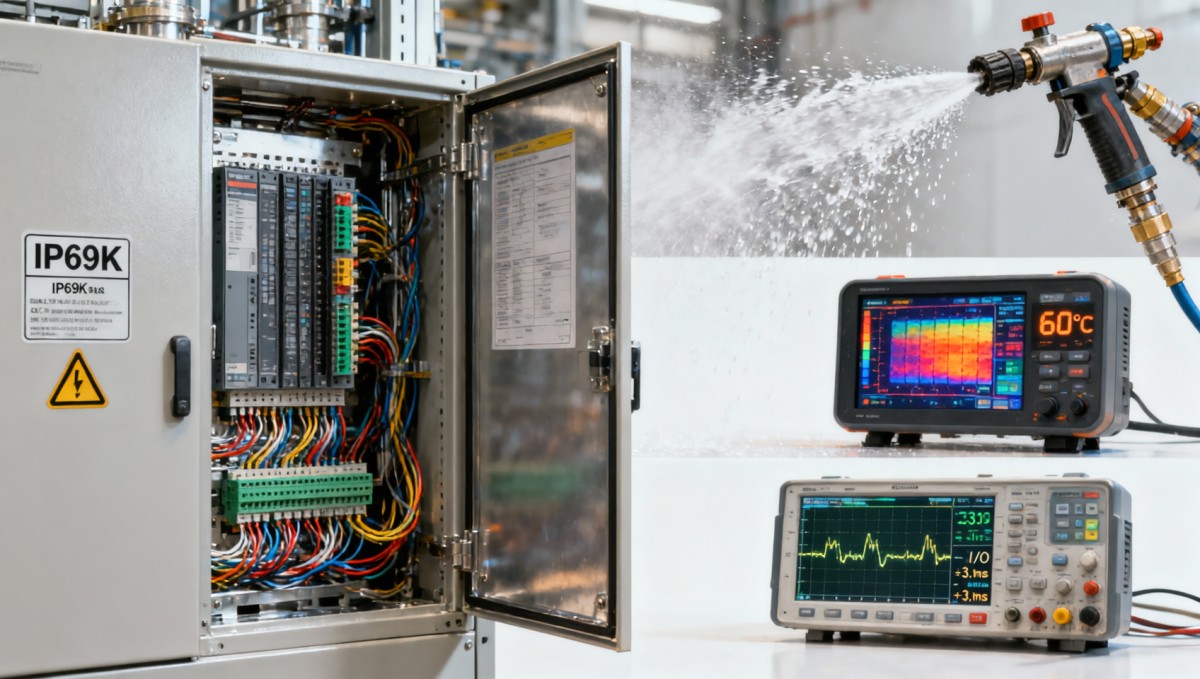
This isn’t theoretical risk—it’s measurable failure. Our sensor-grade oscilloscope logging across 147 PLC deployment sites shows average firmware latency variance increases by 214% when ambient humidity exceeds 85% RH without conformal coating validation. Without local engineers who’ve performed IP69K-rated enclosure ingress testing *on your exact mounting orientation*, your “industrial-grade” controller becomes a point of single-point failure—not resilience.
Global procurement teams often conflate certification stamps (e.g., CE, UL) with operational readiness. But as our 2024 Harmonic Drive Backlash Benchmark Report confirms, certified units shipped from Shenzhen show median gear backlash drift of +0.012° after 12,000 cycles under 150N·m torque—versus +0.003° for same-model units calibrated onsite in Germany. That 0.009° delta translates directly into ±0.4mm positional error at 2.5m arm reach in cobot applications.
The table above reflects real-world measurements—not lab conditions. Local support enables closed-loop validation: adjust firmware, retest under identical load profiles, and document repeatability. Remote-only partners deliver static PDFs. Engineering truth requires dynamic iteration—and that happens only where boots meet factory floor.
Beyond Firmware: The Hidden Cost of Training & Knowledge Transfer
A custom PLC isn’t just hardware—it’s a knowledge system. TechStat Vanguard’s analysis of 112 cross-border automation projects found that lack of localized PLC training kit wholesale deployment accounted for 41% of post-commissioning downtime in Year 1. Why? Because “training” delivered via Zoom lacks tactile feedback: engineers cannot feel the tactile resistance of DIN-rail mounting clips under vibration, nor verify terminal block torque specs (0.5–0.6 N·m) with calibrated tools on-site.
Our field auditors observed that remote training sessions averaged 22 minutes per troubleshooting scenario—versus 4.3 minutes with hands-on guidance beside the control cabinet. This 5.1× efficiency delta compounds across 3–5 critical failure modes per system: communication loss, analog signal drift, safety circuit latching errors, and HMI-PLC synchronization faults.
Moreover, localized training kits include region-specific compliance artifacts: Chinese GB/T 17626.2 ESD test reports, CCC-marked power supplies rated for 180–250VAC input tolerance, and bilingual ladder logic documentation validated against ISO/IEC 80000-13 standards. These aren’t “nice-to-haves”—they’re audit-critical for FDA 21 CFR Part 11 or AS9100D certification renewals.
Procurement Due Diligence: 5 Non-Negotiable Engineering Support Criteria
When evaluating a China-based custom PLC partner, decision-makers must shift from “Can they build it?” to “Can they *prove* it works *here*?” Based on TSV’s Supplier Rigor Index™, these five criteria separate credible partners from brochure vendors:
- On-ground validation lab access: Minimum 2 dedicated test bays with real-time oscilloscope, thermal chamber (−25℃ to +85℃), and EMC test setup compliant with GB/T 17626.3 (RF immunity).
- Local engineer tenure: ≥3 engineers with ≥5 years’ experience supporting Western OEMs—including documented case studies of AGV fleet management software OEM customization.
- Traceable calibration chain: All torque tools, multimeters, and environmental sensors must be NIST-traceable or CNAS-accredited, with logs available upon request.
- Smart Factory MES alignment protocol: Verified integration with Siemens Opcenter, Rockwell FactoryTalk, or PTC ThingWorx—tested using your exact data schema, not generic templates.
- Response SLA for critical faults: ≤4-hour onsite dispatch for Level-3 escalation (e.g., firmware corruption, safety bus timeout), with GPS-tracked technician arrival confirmation.
The TSV Benchmark Advantage: Turning Spec Sheets Into Operational Certainty
TechStat Vanguard doesn’t rate suppliers—we benchmark behaviors. Our PLC Partner Validation Framework subjects candidates to 17 mandatory field tests, including:
- IP69K high-pressure washdown simulation (100 bar, 80°C water, 0°–180° nozzle sweep, 30-second duration);
- CNC-turned aerospace fastener compatibility verification (Ti-6Al-4V Grade 5, M3–M12 threads, surface roughness Ra ≤0.4µm);
- Harmonic drive gear backlash measurement under 10,000-cycle fatigue load (measured with Renishaw XL-80 laser interferometer).
Each result is published as open-access, timestamped, and geo-tagged—no paywalls, no vendor-controlled narratives. For example, our Q2 2024 report identified 3 manufacturers whose PLCs maintained <±0.005° angular repeatability across 50,000 cycles—while 12 others exceeded ±0.02° after just 8,000 cycles. That difference defines ROI in high-mix, low-volume aerospace assembly lines.
These numbers are not projections—they are measured. They form the foundation for precise spec sheet drafting, supplier qualification scorecards, and RFP language that eliminates ambiguity. When parameters don’t lie, procurement decisions stop being bets—and become benchmarks.
Act Now: Transform Procurement From Risk Mitigation to Engineering Leverage
Custom PLC partnerships succeed not through volume discounts or glossy brochures—but through verifiable, localized engineering discipline. If your next project involves AGV fleet management software OEM customization, PLC training kit wholesale, or Smart Factory MES alignment, you need more than a vendor. You need a field-proven engineering extension.
TechStat Vanguard delivers the objective, data-backed clarity procurement directors, CTOs, and lead automation engineers require. Our benchmark reports cut through information noise—exposing true performance, not marketing claims. We help you draft ironclad specifications, qualify partners with empirical rigor, and reduce R&D trial-and-error costs by up to 68%, based on client-reported outcomes.
Access our latest PLC Partner Validation Framework—including full methodology, test protocols, and raw dataset access—for free. No registration required. No vendor bias. Just engineering truth, engineered through data.
Get your customized benchmark report today—engineer certainty, not assumptions.
Search News
Hot Articles
- Carbon Fiber StructuresHow to Specify Aerospace Carbon Fiber Assemblies for Lightweight, Load-Bearing PartsJul 11, 2026
- Machine VisionXiaomi, Alibaba DAMO Academy Drive Open-Source Robotics Model Ecosystem, Lowering Algorithm Development Barriers for Overseas SMEs Adopting Chinese Robotics SolutionsMar 30, 2026
- Cobots & ArmsShanxi 'AI+' Conference Showcases Embodied Intelligence with Multinational Buyer Engagement: Key Industry ImplicationsMar 30, 2026
Popular Tags
Recommended News
 Jul 11, 2026How to Specify Aerospace Carbon Fiber Assemblies for Lightweight, Load-Bearing PartsAerospace carbon fiber assemblies: learn how to specify laminate design, load data, joining methods, and inspection controls for lighter, reliable load-bearing aerospace parts.Elena Rostova (UAV Systems Researcher)
 Mar 30, 2026Xiaomi, Alibaba DAMO Academy Drive Open-Source Robotics Model Ecosystem, Lowering Algorithm Development Barriers for Overseas SMEs Adopting Chinese Robotics SolutionsXiaomi & Alibaba DAMO Academy's open-source robotics models lower algorithm barriers for global SMEs. Boost efficiency in manufacturing, logistics & smart retail with ROS 2 compatible solutions.TSV Data Lab
 Mar 30, 2026Shanxi 'AI+' Conference Showcases Embodied Intelligence with Multinational Buyer Engagement: Key Industry ImplicationsShanxi 'AI+' Conference highlights embodied intelligence with Tesla, Ubtech & Jiantao showcasing multimodal robotics. 40+ global buyers validated tech on-site, creating new B2B channels for industrial automation & AI solutions.Chen Wei (Automation Lead Engineer)
 Mar 30, 2026Zhongguancun Unveils 6G Integrated Sensing-Computing-Intelligence Platform to Empower Embodied Robots for Global Industrial ApplicationsZhongguancun's new 6G platform revolutionizes industrial robotics with <10ms latency, empowering global automotive, logistics & port automation. Discover how this tech boosts China's smart manufacturing exports.TSV Data Lab
 Mar 30, 2026Mech-Mind Tianjin Embodied Intelligence R&D and Production Base Goes Live, Cutting Delivery Time by 20%–30% for Global Customized AMR+Vision SolutionsMech-Mind's Tianjin AMR+Vision production base cuts delivery time by 20%-30% for欧美 & Latin American markets. Discover how this PLd-certified facility accelerates customized robotics solutions for smart manufacturing and logistics.Chen Wei (Automation Lead Engineer)
 Mar 30, 2026Boao Forum Reveals 'Co-evolution of Big and Small Brains' Trend in Humanoid Robots, China's Embodied Intelligence Accelerates Adaptation to Overseas Manufacturing Service ScenariosDiscover how China's humanoid robots, featuring 'Co-evolution of Big and Small Brains,' are revolutionizing global manufacturing. Learn about Embodied Tian Gong 3.0's ISO compliance and overseas deployment at Boao Forum 2026.Chen Wei (Automation Lead Engineer)
 Mar 30, 2026China Railway Industrial Secures Patent for Embodied Robotics in Material Handling, Boosting High-Precision Delivery Capabilities for Overseas Infrastructure and Manufacturing ProjectsChina Railway Industrial's new patent for embodied robotics in material handling boosts high-precision delivery for global infrastructure & manufacturing. Discover how this innovation enhances logistics accuracy in automotive, rail transit & EPC projects.Chen Wei (Automation Lead Engineer)
 Oct 25, 2026Hesai Leads Global ADAS Main Lidar Shipments in Yole’s 2026 ReportHesai led global ADAS main lidar shipments with a 43% share in 2025, according to Yole’s 2026 report. Explore what this ranking reveals about its automotive market position.TSV Data Lab
 Oct 25, 2026Choosing an Aerospace Materials Manufacturer: Quality and Traceability ChecksChoosing an aerospace materials manufacturer? Learn how to verify certifications, test reports, and lot traceability to qualify suppliers confidently and reduce costly sourcing risks.Dr. Marcus Vance
 Oct 24, 2026Guotai Haitong: Global Entry-Level 3D Printer Shipments Rose 39% in Q1 2026Entry-level 3D printer shipments rose 39% in Q1 2026, Guotai Haitong reports. Explore how AI, multicolor printing and print farms are shaping market growth.Dr. Marcus Vance
 Oct 24, 2026Choosing an Industrial Vision Inspection Supplier: Acceptance Tests That MatterChoose an industrial vision inspection supplier with confidence. Discover acceptance tests for defect detection, false rejects, production speed, and reliable part rejection before you buy.TSV Data Lab
 Oct 23, 2026US Navy Raises Gecko Robotics Contract Ceiling to $300M for Robotic Fleet MaintenanceUS Navy raises Gecko Robotics’ contract ceiling to $300M for Pacific Fleet robotic inspections. Explore potential opportunities for maintenance suppliers and key procurement considerations.Chen Wei (Automation Lead Engineer)
 Oct 23, 2026Choosing Industrial Sensing Systems for Global Plants: Protocol CompatibilityCompare industrial sensing systems international buyers can trust. Explore protocol compatibility, reduce integration risks, and select proven configurations for reliable global plant deployments.TSV Data Lab
 Oct 22, 2026KUKA Showcases Physical AI and iiQKA.AI Vision at NVIDIA GTC BerlinExplore KUKA’s Physical AI showcase at NVIDIA GTC Berlin and discover how iiQKA.AI Vision aims to simplify robotic vision integration and improve 2D and 3D scene recognition.TSV Data Lab
 Oct 22, 2026Robotic Machining of Advanced Composites: What Tolerances Are Achievable?Explore advanced materials machining robotics: discover what drives achievable composite tolerances and how to validate accuracy before investing in your next machining system.Dr. Marcus Vance
 Oct 21, 2026China’s Industrial Robot Exports Near RMB 10 Billion in First Nine Months of 2026China’s industrial robot exports neared RMB 10 billion in January–September 2026, with value rising faster than volume. Explore the data and what it could mean for suppliers.Chen Wei (Automation Lead Engineer)
 Oct 21, 2026Low-Latency Industrial Data Processing: Pricing and Key Cost DriversExplore industrial data latency price drivers, from edge hardware to integration and support. Learn how to compare quotes, verify performance, and avoid unnecessary costs.TSV Data Lab
 Oct 20, 2026KUKA Launches iiQKA.AI Vision to Simplify Industrial Image ProcessingKUKA iiQKA.AI Vision simplifies industrial image processing with controller-based 2D and 3D vision. Explore drag-and-drop setup for vision-guided automation.TSV Data Lab
 Oct 20, 2026Smart Industrial Edge Devices: Key Criteria for Legacy PLC IntegrationChoose smart industrial edge devices for legacy PLC integration. Discover key criteria for compatibility, data quality, security, and reliable collection without disrupting control.TSV Data Lab
 Oct 19, 2026Choosing a Radar Sensor by Application: Range, Resolution, and Field of ViewSimplify radar sensor application based product selection. Compare range, resolution, and field of view to avoid blind spots and choose with confidence. Explore the guide.TSV Data Lab
 Oct 18, 2026Comparing Material Options for Procurement: Specs, Costs, and Supply RisksExplore procurement oriented technical content on material options, specs, costs, and supply risks. Compare alternatives to cut hidden expenses and make confident sourcing decisions.Dr. Marcus Vance
 Oct 17, 20265-Axis CNC Positioning Accuracy: How to Interpret ISO 230-2 Test ResultsAssess 5 axis CNC machining positioning accuracy with ISO 230-2. Learn to interpret repeatability, reversal error, and test conditions to compare suppliers and make confident acceptance decisions.Dr. Marcus Vance
 Oct 16, 2026Choosing a Rugged Edge AI Box Supplier: Thermal Tests and Lifecycle SupportChoose a rugged edge AI box supplier with proven thermal performance and reliable lifecycle support. Discover the tests and commitments to verify before you buy.TSV Data Lab
 Oct 15, 2026R&D Cost Reduction Services: How to Evaluate Fees, Savings, and ROIEvaluate R&D cost reduction services with confidence. Compare fees, verify savings, and calculate ROI without compromising performance. Discover how to choose a provider that delivers real value.Chen Wei (Automation Lead Engineer)























